

- Home
- Industries
 Aerospace And Defence
 Agriculture
 Automotive And Transportation
 Banking And Finance
 Business
 Chemicals And Materials
 Consumer And Retail
 Electronics And Semiconductors
 Food And Beverages
 Machinery & Equipments
 Manufacturing And Construction
 Medical Devices
 Others
 Pharmaceuticals And Healthcare
 Power And Energy
 Sports
 Technology
- Services
- News Room
- About us
- Contact Us
-
Global Managed Detection and Response Service Market Size, Share | CAGR of 17.4%
Global Managed Detection and Response Service Market Size, Share & Analysis Report By Service Type (EDR, NDR, CDR, Managed SIEM, Incident Response), By Deployment (Cloud, On-Premises, Hybrid), By Organization Size (Large Enterprises, SMEs), By Vertical (BFSI, Healthcare, Government, IT & Telecom, Retail, Manufacturing): Regional Segment Overview, Market Dynamics, Competitive Strategies, Cybersecurity Trends & Forecast 2026–2034

Report Overview
| Market Size (2025) | Forecast Value (2034) | CAGR (2026-2034) | Largest Region (2025) |
| USD 4.90 Billion | USD 20.70 Billion | 17.4% | North America, 39.5% |
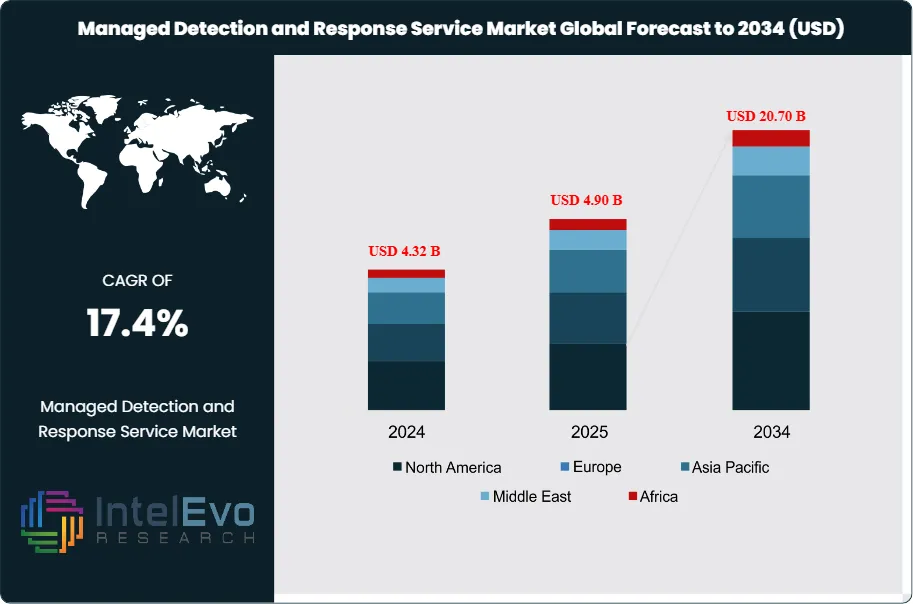
The Managed Detection and Response Service Market was valued at USD 4.32 Billion in 2024 and reached USD 4.90 Billion in 2025. The market is projected to reach USD 20.70 Billion by 2034, expanding at a CAGR of 17.4% during the forecast period from 2026 to 2034. This represents an absolute dollar opportunity of USD 15.80 Billion.
Get More Information about this report -
Request Free Sample ReportDemand for the managed detection and response service market is driven by faster attacker movement, understaffed SOC teams, and cloud identity exposure. Palo Alto Networks Unit 42 analyzed more than 750 high-severity incidents across more than 50 countries in 2025 and found that the fastest quartile reached data theft in 72 minutes, down from 285 minutes in 2024. Google Cloud Mandiant reported a 14-day global median dwell time in 2025, with espionage and DPRK IT worker incidents reaching 122 days. These windows push CISOs toward 24x7 triage and containment rather than alert-only tools.
Regulation is converting MDR from discretionary insurance into an operating requirement. The U.S. Securities and Exchange Commission requires listed companies to file material cyber incident disclosures on Form 8-K within four business days after materiality determination. The European Union NIS2 Directive applied from October 18, 2024, while DORA applied from January 17, 2025 to financial entities and critical ICT providers. These regimes compress reporting timelines, making managed detection, evidence collection, and response handoff central to audit readiness.
Technology mix is shifting the managed detection and response service market from endpoint-only monitoring toward managed XDR, identity threat detection, cloud workload telemetry, exposure context, and AI-assisted investigation. Microsoft Defender processes 100 trillion security signals daily, CrowdStrike reached USD 5.25 Billion in ending ARR on January 31, 2026, and Palo Alto Networks disclosed USD 5.6 Billion in NGS ARR for fiscal 2025. Zscaler closed its USD 675 Million Red Canary acquisition in August 2025, adding MDR to a Zero Trust Exchange data set of 500 billion daily transactions.
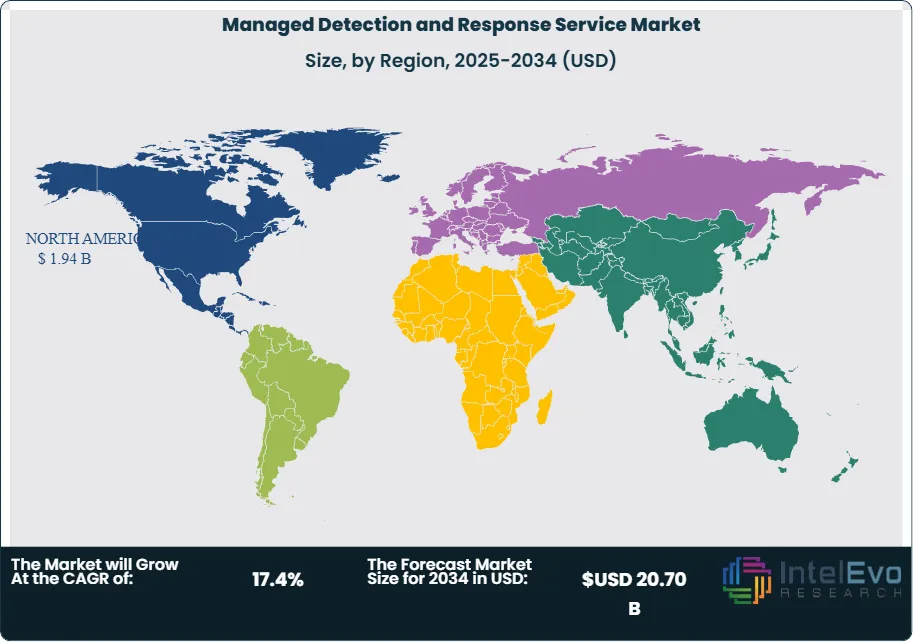
North America held 39.5% of the managed detection and response service market in 2025, supported by U.S. cloud adoption, SEC incident disclosure pressure, cyber insurance controls, and mature channels. Europe held 26.8% share as NIS2 and DORA lifted demand from banks, utilities, healthcare providers, and transport operators. Asia Pacific posted the fastest forecast CAGR at 18.9% through 2034 because India, Japan, Singapore, Australia, and South Korea are adding managed security services to digital infrastructure and financial-sector cyber rules.
Market Definition & Scope
The managed detection and response service market is defined as the global commercial revenue generated from outsourced threat monitoring, investigation, threat hunting, response guidance, and containment services delivered by provider-operated security analysts through endpoint, network, cloud, identity, and SaaS telemetry. The market covers managed EDR, managed XDR, cloud detection, threat intelligence enrichment, forensic triage, remote response playbooks, and security operations portals.
This analysis includes recurring MDR subscriptions, analyst retainers, managed threat hunting, bundled incident-response hours, and platform-enabled services from CrowdStrike Holdings, Sophos Group, Palo Alto Networks, Microsoft Corporation, Arctic Wolf, Zscaler, Google Cloud Mandiant, SentinelOne, Rapid7, Expel, and Huntress. It excludes standalone SIEM licenses, endpoint software without provider-led monitoring, penetration testing, cyber insurance premiums, and pure MSSP firewall management. The parent market is cybersecurity services, while MDR represents the high-growth detection and response layer within managed security operations.

Key Takeaways
- Market Growth: The managed detection and response service market expanded to USD 4.90 Billion in 2025 and is forecast to reach USD 20.70 Billion by 2034 at a 17.4% CAGR.
- Segment Dominance: Managed EDR and XDR services led by service type with 46.0% share in 2025, equal to USD 2.25 Billion in revenue.
- Segment Dominance: Large enterprises represented 61.5% of 2025 revenue, equal to USD 3.01 Billion, because global banks, hospitals, manufacturers, and public agencies require 24x7 response coverage.
- Driver: The fastest quartile of 2025 intrusions reached data theft in 72 minutes, making always-on investigation and containment a board-level control.
- Restraint: MDR programs face onboarding friction because legacy SIEM data, endpoint agents, identity logs, and cloud audit trails often need 30 to 90 days of normalization before service maturity.
- Opportunity: Managed cloud and identity detection represents a USD 4.02 Billion revenue opportunity by 2034 as attackers exploit Microsoft Entra ID, Okta, AWS IAM, OAuth tokens, and service accounts.
- Trend: Agentic SOC workflows moved from concept to production in 2025 as CrowdStrike, Microsoft, SentinelOne, Palo Alto Networks, and Zscaler added AI-guided triage and response automation.
- Regional: North America led with 39.5% share and USD 1.94 Billion in 2025 revenue, while Asia Pacific records the fastest regional CAGR at 18.9% through 2034.
Key Insights Summary
- The managed detection and response service market is being pulled by attack speed; Unit 42 measured 72-minute data theft in the fastest 25% of 2025 intrusions, down from 285 minutes in 2024.
- Mandiant recorded a 14-day global median dwell time across 2025 investigations, while espionage and DPRK IT worker cases produced a 122-day median dwell time.
- Sophos Group supported more than 28,000 MDR organizations after completing the Secureworks transaction in February 2025, creating the largest disclosed pure-play MDR customer base.
- CrowdStrike reached USD 5.25 Billion in ending ARR as of January 31, 2026, giving Falcon Complete MDR a broad endpoint, identity, cloud, and third-party telemetry base.
- Microsoft reported 100 trillion security signals processed daily in its 2025 Digital Defense disclosures, strengthening Defender Experts for XDR with Microsoft Defender, Sentinel, and Entra telemetry.
- Zscaler paid USD 675 Million in cash consideration for Red Canary in 2025, equivalent to about 4.8x Red Canary's disclosed USD 140 Million fiscal 2025 ARR before employee equity awards.
Competitive Landscape Overview
The managed detection and response service market is moderately consolidated because hundreds of regional MSSPs remain active, yet enterprise demand concentrates around platforms with global telemetry and analyst depth. Aggregated ARR, customer-count, and platform-coverage signals indicate the top four providers hold about 36.0% to 40.0% of 2025 revenue. Sophos Group leads pure-play MDR customer count, CrowdStrike anchors managed endpoint response, Palo Alto Networks Unit 42 competes through Cortex XDR and incident-response depth, and Microsoft scales through Defender Experts for XDR.
Competition has shifted from alert monitoring toward outcome-based response, where providers are judged on mean time to detect, mean time to respond, evidence quality, cloud identity context, and containment authority. Zscaler's Red Canary deal, Arctic Wolf's Sevco and Cylance additions, and CrowdStrike's SGNL and Pangea transactions show that MDR vendors are buying identity, exposure, endpoint, and AI-response assets to reduce customer tool sprawl.
Competitive Landscape Matrix
| Company Name | Headquarters | Market Position | Core Product/Solution | Geographic Strength | Recent Strategic Move |
| Sophos Group | United Kingdom | Leader | Sophos MDR, Secureworks Taegis XDR | North America, Europe, MSP channel | Closed Secureworks acquisition in February 2025; >28,000 MDR organizations |
| CrowdStrike Holdings, Inc. | United States | Leader | Falcon Complete MDR | North America, Europe, APAC | Introduced Fall 2025 Falcon agentic SOC features; agreed SGNL deal in January 2026 |
| Palo Alto Networks, Inc. | United States | Leader | Unit 42 MDR, Cortex XDR, Cortex XSIAM | North America, Europe, global enterprise | Unit 42 2026 report measured 72-minute data theft in fastest 25% of intrusions |
| Microsoft Corporation | United States | Leader | Defender Experts for XDR | Global enterprise, public sector | Updated Defender Experts for XDR managed-response guidance in March 2026 |
| Arctic Wolf Networks, Inc. | United States | Challenger | Aurora Managed Detection and Response | North America, UK, DACH | Acquired Sevco Security in February 2026; closed Cylance transaction in February 2025 |
| Zscaler, Inc. / Red Canary | United States | Challenger | Red Canary MDR, Zscaler SecOps | North America, global enterprise | Closed USD 675.0 Million Red Canary acquisition in August 2025 |
| Google Cloud Mandiant | United States | Challenger | Mandiant Managed Defense | Global enterprise, government | M-Trends 2026 reported 14-day global median dwell time from 2025 cases |
| SentinelOne, Inc. | United States | Challenger | Vigilance MDR, Singularity Platform | North America, Europe, APAC | Released Purple AI Athena agentic security features in May 2025 |
Segmentation Analysis
The managed detection and response service market segments by service type, deployment model, organization size, and vertical, with each segment shaped by telemetry depth, analyst staffing, compliance need, and response authority.
By Service Type
Managed EDR and XDR services dominated the managed detection and response service market with 46.0% share in 2025, equal to USD 2.25 Billion. Microsoft Defender, CrowdStrike Falcon, SentinelOne Singularity, Sophos Endpoint, and Palo Alto Networks Cortex supply endpoint telemetry for analyst-led triage and remote containment. Endpoints remain the richest detection surface and the fastest isolation path when ransomware or credential theft appears. The segment should reach about USD 9.32 Billion by 2034, although cloud and identity detection will take share.
Managed threat hunting and continuous monitoring held 21.0% share in 2025, equal to USD 1.03 Billion. Financial institutions, defense suppliers, healthcare groups, and manufacturers use provider analysts to search for adversary behavior beyond rules. Google Cloud Mandiant, Red Canary, Sophos X-Ops, and CrowdStrike OverWatch-style hunting shape buyer expectations for MITRE ATT&CK-mapped searches. Growth reflects attacker use of legitimate tools, service accounts, remote monitoring software, and unmanaged edge devices.
Incident response and containment retainers represented 18.0% share in 2025, equal to USD 0.88 Billion. MDR buyers now expect guided remediation, evidence packaging, root-cause analysis, and remote containment inside the subscription. Palo Alto Networks Unit 42 handled more than 750 high-severity incidents during 2025, showing why response capacity has become a differentiator. Forensic depth also supports breach counsel evidence, cyber insurance review, and executive communications.
Managed cloud and identity detection accounted for 15.0% share in 2025, equal to USD 0.74 Billion, and records the fastest service CAGR at 20.5% through 2034. Unit 42 found identity-related elements in nearly 90% of 2025 investigations, while Microsoft reported that more than 97% of April-June 2025 identity attacks were password spray or brute-force attempts. The segment covers Microsoft Entra ID, Okta, AWS IAM, Google Cloud IAM, SaaS audit trails, and OAuth token abuse because cloud identities now drive lateral movement.
By Deployment Model
Cloud-delivered MDR led the managed detection and response service market with 58.0% share in 2025, equal to USD 2.84 Billion. The model uses provider-hosted analytics, API ingestion, multi-tenant data lakes, and cloud-native case management across Microsoft Sentinel, CrowdStrike Falcon, Zscaler, AWS, Google Cloud, and Azure. Cloud delivery wins in distributed workforces because onboarding starts without a dedicated SOC room or customer-owned SIEM stack, while cross-customer attack patterns improve model retraining.
Hybrid MDR held 34.0% share in 2025, equal to USD 1.67 Billion, and remains preferred by banks, healthcare networks, manufacturers, utilities, and public agencies. Buyers keep selected logs on-premises or in sovereign clouds while provider analysts investigate through controlled access. DORA, NIS2, HIPAA, GLBA, and data-residency rules make hybrid delivery practical when full log export is restricted. Hybrid MDR grows at 17.8% CAGR because it balances cloud response speed with local governance.
Dedicated on-premises or customer-controlled SOC delivery accounted for 8.0% share in 2025, equal to USD 0.39 Billion. Defense, intelligence, nuclear energy, and critical infrastructure buyers use customer-owned SIEM, ticketing, identity, and endpoint systems while external experts deliver rule engineering and hunting. The segment grows below market average because cloud analytics and secure remote response meet most commercial control requirements at lower cost.
By Organization Size
Large enterprises generated 61.5% of managed detection and response service market revenue in 2025, equal to USD 3.01 Billion. Their contracts carry higher annual values because coverage spans thousands of endpoints, cloud workloads, SaaS applications, identity tenants, and network sensors across countries. Large banks, retailers, hospitals, manufacturers, and technology companies buy MDR to reduce hiring dependence, demonstrate incident readiness to auditors, and shorten board reporting cycles. These buyers require 24x7 analysts, response SLAs, threat briefings, and evidence quality for SEC, NIS2, DORA, GDPR, and insurance review.
Small and midsize enterprises held 38.5% share in 2025, equal to USD 1.89 Billion, and expand faster at an estimated 19.1% CAGR through 2034. Sophos, Huntress, Blackpoint Cyber, NinjaOne, Arctic Wolf, and regional MSSPs sell MDR through MSP channels because SMBs rarely staff night-shift analysts or forensic engineers. The segment benefits from per-endpoint or per-user pricing, bundled endpoint protection, and shared SOC economics. Procurement teams compare MDR pricing benchmarks against hiring two to four analysts, often above USD 400,000 per year in the United States.
By Vertical
BFSI led the managed detection and response service market with 24.0% share in 2025, equal to USD 1.18 Billion. Banks, payment processors, insurers, and capital-market firms operate under SEC, DORA, FFIEC, PCI DSS, and central-bank rules, making evidence retention and incident reporting central to vendor selection. Palo Alto Networks, Microsoft, CrowdStrike, Google Cloud Mandiant, and Sophos compete on identity, cloud, and transaction-system telemetry. The sector pays premium rates because account takeover, payment fraud, ransomware, and third-party outages can trigger regulatory risk.
Healthcare and life sciences captured 18.0% share in 2025, equal to USD 0.88 Billion, supported by HIPAA exposure, hospital downtime risk, pharmaceutical IP theft, and clinical-system availability. IBM reported a USD 7.42 Million average healthcare breach cost in 2025, keeping MDR budgets resilient. Healthcare MDR contracts emphasize ransomware containment, medical-device visibility, clinician identity monitoring, and patient-data investigation records. The segment grows faster than BFSI as regional hospitals move from antivirus-only coverage to managed detection.
IT, telecom, and technology companies held 17.0% share in 2025, equal to USD 0.83 Billion. Cloud providers, SaaS vendors, MSPs, software firms, and communications operators need MDR because their infrastructure is both internal system and customer delivery channel. Manufacturing held 14.0% share, equal to USD 0.69 Billion, as ransomware targets operational technology and supplier portals. Government, education, retail, and other sectors represented the remaining 27.0% because budget constraints favor outsourced SOC coverage.
Regional Analysis
The managed detection and response service market shows highest revenue concentration in North America and Europe, while Asia Pacific records the fastest forecast growth because financial institutions, digital governments, and manufacturers are moving to managed XDR and cloud detection.
North America
North America led the managed detection and response service market with 39.5% share and USD 1.94 Billion in 2025 revenue. The United States accounted for about USD 1.67 Billion, followed by Canada at USD 0.20 Billion and Mexico at USD 0.07 Billion. Demand is shaped by SEC incident disclosure rules, CISA critical-infrastructure reporting preparation, cyber insurance control reviews, and cloud migration across AWS, Microsoft Azure, and Google Cloud. CrowdStrike, Microsoft, Palo Alto Networks, Zscaler, Red Canary, Arctic Wolf, Rapid7, Expel, Huntress, and Google Cloud Mandiant maintain dense North American operations. Zscaler's August 2025 Red Canary close and Arctic Wolf's February 2026 Sevco purchase reinforced regional consolidation around managed SOC and exposure context.
Europe
Europe held 26.8% of the managed detection and response service market in 2025, equal to USD 1.31 Billion. The United Kingdom, Germany, France, the Netherlands, Italy, and Spain drive demand because NIS2 applied from October 18, 2024 and DORA applied from January 17, 2025. Financial entities, energy providers, hospitals, transport operators, and digital service providers use MDR to document incident triage, notification evidence, and third-party control performance. Sophos, Microsoft, Palo Alto Networks, CrowdStrike, Google Cloud Mandiant, Orange Cyberdefense, and regional MSSPs compete through local SOC capacity. MDR adoption trails North America in small business but advances faster among regulated financial and critical-infrastructure accounts.
Asia Pacific
Asia Pacific captured 23.0% of the managed detection and response service market in 2025, equal to USD 1.13 Billion, and posts the fastest regional CAGR at 18.9% through 2034. Japan, Australia, India, Singapore, South Korea, and China are the leading national markets. Growth is driven by cloud migration, state-backed digital identity systems, financial-sector cyber rules, and ransomware pressure on healthcare and manufacturing. Microsoft, Palo Alto Networks, CrowdStrike, Google Cloud Mandiant, Sophos, Tata Communications, NEC, NTT Security, and regional MSSPs supply MDR across the region. India and Southeast Asia lean toward MSP-delivered MDR for midmarket firms, while Japan and Australia emphasize incident readiness and critical-infrastructure continuity.
Latin America
Latin America accounted for 6.1% of the managed detection and response service market in 2025, equal to USD 0.30 Billion. Brazil, Mexico, Chile, Colombia, and Argentina generate most demand because banks, retailers, telecom groups, and digital government platforms face credential theft and ransomware. Buyers prioritize MDR bundles that include endpoint protection, email security, cloud monitoring, and incident retainer hours because internal Tier 2 and Tier 3 analyst supply remains thin. Microsoft, CrowdStrike, Sophos, Palo Alto Networks, and regional MSSPs reach the market through channel partners. Brazil's PIX payment scale and Mexico's manufacturing corridors create demand for identity and fraud-aware MDR services.
Middle East & Africa
Middle East and Africa held 4.6% of the managed detection and response service market in 2025, equal to USD 0.23 Billion. The United Arab Emirates, Saudi Arabia, South Africa, Israel, Qatar, and Kenya anchor regional spending. Gulf financial institutions and energy companies buy MDR to satisfy national cyber authorities and protect cloud and operational technology links, while South African and Kenyan enterprises adopt MDR through managed service providers. Microsoft, Palo Alto Networks, CrowdStrike, Google Cloud Mandiant, Help AG, and regional SOC operators compete on data residency and Arabic-language analyst support. Adoption remains price-sensitive outside energy, banking, and government.
Country Analysis
The managed detection and response service market is concentrated in the United States, United Kingdom, Germany, and India because these countries combine high cloud adoption, active cyber regulation, and deep enterprise outsourcing demand.
United States
The United States managed detection and response service market reached approximately USD 1.67 Billion in 2025 and is forecast to expand at a 16.8% CAGR through 2034. SEC Form 8-K incident disclosure rules, CISA CIRCIA implementation preparation, cyber insurance underwriting, and federal zero-trust programs push listed companies and critical-infrastructure operators toward provider-led detection. CrowdStrike, Microsoft, Palo Alto Networks, Arctic Wolf, Zscaler, Red Canary, Google Cloud Mandiant, Rapid7, Expel, and Huntress are domestically anchored. The country hosts Zscaler's USD 675 Million Red Canary deal and CrowdStrike's USD 740 Million SGNL agreement.
United Kingdom
The United Kingdom managed detection and response service market was valued at approximately USD 0.32 Billion in 2025 and is expected to grow at a 16.9% CAGR through 2034. Demand comes from financial services, healthcare trusts, legal firms, retail chains, and managed service providers serving small companies. The National Cyber Security Centre's guidance, UK GDPR, resilience programs, and insurance controls shape MDR procurement. Sophos is headquartered in Oxford and gives the country a direct MDR provider advantage after the Secureworks combination. Arctic Wolf reported 510 UK and Ireland customers and 119 regional partners in October 2025, showing channel momentum.
Germany
Germany's managed detection and response service market reached approximately USD 0.29 Billion in 2025 and is forecast to grow at a 16.4% CAGR through 2034. NIS2 transposition, DORA implementation, BaFin oversight, automotive supply-chain controls, and industrial ransomware risk drive spending. Buyers in Bavaria, North Rhine-Westphalia, Baden-Wurttemberg, and Hesse prioritize MDR providers with German-language support, EU data handling, and OT-aware escalation. Microsoft, Palo Alto Networks, Sophos, Google Cloud Mandiant, CrowdStrike, and European SOC operators compete for banks, manufacturers, hospitals, and software companies. The non-obvious demand driver is supplier assurance, because German manufacturers now require MDR proof from tier-two and tier-three suppliers.
India
India's managed detection and response service market reached approximately USD 0.18 Billion in 2025 and is projected to grow at a 21.0% CAGR through 2034. The Digital Personal Data Protection Act, CERT-In incident reporting directions, RBI cybersecurity expectations, UPI scale, and cloud adoption by IT services firms lift demand. Large technology exporters and banks buy MDR from Microsoft, CrowdStrike, Palo Alto Networks, Google Cloud Mandiant, Sophos, Tata Communications, and Indian MSSPs. Midmarket growth comes from hospitals, fintech firms, manufacturers, and SaaS companies that need 24x7 monitoring without building three-shift SOC teams. India is a talent hub, but retention and night-shift coverage still favor managed delivery.
Get More Information about this report -
Request Free Sample ReportKey Market Segment
By Service Type
- Endpoint Detection & Response (EDR)
- Network Detection & Response (NDR)
- Cloud Detection & Response (CDR)
- Managed SIEM
- Incident Response Services
- Others
By Deployment Model
- Cloud-Based
- On-Premises
- Hybrid
By Organization Size
- Large Enterprises
- Small & Medium-Sized Enterprises (SMEs)
By Vertical
- BFSI
- Healthcare
- Government & Defense
- IT & Telecommunications
- Retail & E-commerce
- Manufacturing
- Energy & Utilities
- Others
By Regional Coverage
- North America
- Latin America
- East Asia And Pacific
- Sea And South Asia
- Eastern Europe
- Western Europe
- Middle East & Africa
| Report Attribute | Details |
| Market size (2025) | USD 4.90 B |
| Forecast Revenue (2034) | USD 20.70 B |
| CAGR (2025-2034) | 17.4% |
| Historical data | 2021-2025 |
| Base Year For Estimation | 2025 |
| Forecast Period | 2026-2034 |
| Report coverage | Revenue Forecast, Competitive Landscape, Market Dynamics, Growth Factors, Trends and Recent Developments |
| Segments covered | By Service Type, (Endpoint Detection & Response (EDR), Network Detection & Response (NDR), Cloud Detection & Response (CDR), Managed SIEM, Incident Response Services, Others), By Deployment Model, (Cloud-Based, On-Premises, Hybrid), By Organization Size, (Large Enterprises, Small & Medium-Sized Enterprises (SMEs)), By Vertical, (BFSI, Healthcare, Government & Defense, IT & Telecommunications, Retail & E-commerce, Manufacturing, Energy & Utilities, Others), |
| Research Methodology |
|
| Regional scope |
|
| Competitive Landscape | SOPHOS GROUP, CROWDSTRIKE HOLDINGS, INC., PALO ALTO NETWORKS, INC., MICROSOFT CORPORATION, ARCTIC WOLF NETWORKS, INC., ZSCALER, INC. / RED CANARY, GOOGLE CLOUD MANDIANT, SENTINELONE, INC., RAPID7, INC., EXPEL, INC., HUNTRESS LABS INCORPORATED, BLACKPOINT CYBER, SECURITYHQ, CYBEREASON INC., ESENTIRE, INC., WITHSECURE CORPORATION, TRELLIX, BITDEFENDER, NTT SECURITY HOLDINGS, OTHERS |
| Customization Scope | Customization for segments, region/country-level will be provided. Moreover, additional customization can be done based on the requirements. |
| Pricing and Purchase Options | Avail customized purchase options to meet your exact research needs. We have three licenses to opt for: Single User License, Multi-User License (Up to 5 Users), Corporate Use License (Unlimited User and Printable PDF). |


Frequently Asked Questions
How big is the Managed Detection and Response Service Market?
The Global Managed Detection and Response Service Market was valued at USD 4.32 Billion in 2024 and is projected to reach USD 20.70 Billion by 2034, growing at a CAGR of 17.4% during the forecast period 2026–2034.
Who are the major players in the Managed Detection and Response Service Market?
SOPHOS GROUP, CROWDSTRIKE HOLDINGS, INC., PALO ALTO NETWORKS, INC., MICROSOFT CORPORATION, ARCTIC WOLF NETWORKS, INC., ZSCALER, INC. / RED CANARY, GOOGLE CLOUD MANDIANT, SENTINELONE, INC., RAPID7, INC., EXPEL, INC., HUNTRESS LABS INCORPORATED, BLACKPOINT CYBER, SECURITYHQ, CYBEREASON INC., ESENTIRE, INC., WITHSECURE CORPORATION, TRELLIX, BITDEFENDER, NTT SECURITY HOLDINGS, OTHERS
Which segments covered the Managed Detection and Response Service Market?
By Service Type, (Endpoint Detection & Response (EDR), Network Detection & Response (NDR), Cloud Detection & Response (CDR), Managed SIEM, Incident Response Services, Others), By Deployment Model, (Cloud-Based, On-Premises, Hybrid), By Organization Size, (Large Enterprises, Small & Medium-Sized Enterprises (SMEs)), By Vertical, (BFSI, Healthcare, Government & Defense, IT & Telecommunications, Retail & E-commerce, Manufacturing, Energy & Utilities, Others),
How can this market research report help my business make strategic decisions?
Our market research reports provide actionable intelligence, including verified market size data, CAGR projections, competitive benchmarking, and segment-level opportunity analysis. These insights support strategic planning, investment decisions, product development, and market entry strategies for enterprises and startups alike.
How frequently is the data updated?
We continuously monitor industry developments and update our reports to reflect regulatory changes, technological advancements, and macroeconomic shifts. Updated editions ensure you receive the latest market intelligence.

Select Licence Type
Connect with our sales team

Managed Detection and Response Service Market
Published Date : 23 Jul 2026 | Formats :Why IntelEvoResearch
100%
Customer
Satisfaction
24x7+
Availability - we are always
there when you need us
200+
Fortune 50 Companies trust
IntelEvoResearch
80%
of our reports are exclusive
and first in the industry
100%
more data
and analysis
1000+
reports published
till date