

- Home
- Industries
 Aerospace And Defence
 Agriculture
 Automotive And Transportation
 Banking And Finance
 Business
 Chemicals And Materials
 Consumer And Retail
 Electronics And Semiconductors
 Food And Beverages
 Machinery & Equipments
 Manufacturing And Construction
 Medical Devices
 Others
 Pharmaceuticals And Healthcare
 Power And Energy
 Sports
 Technology
- Services
- News Room
- About us
- Contact Us
-
Mexico Biostimulants Market Size & 12.8% CAGR Forecast 2034
Mexico Biostimulants Market Size, Share & Agricultural Outlook By Product Type (Humic Substances, Amino Acids, Seaweed Extracts, Microbials), By Crop Type, By Application Method, Regulatory Landscape, Competitive Scenario, Growth Drivers & Forecast 2025–2034

Report Overview
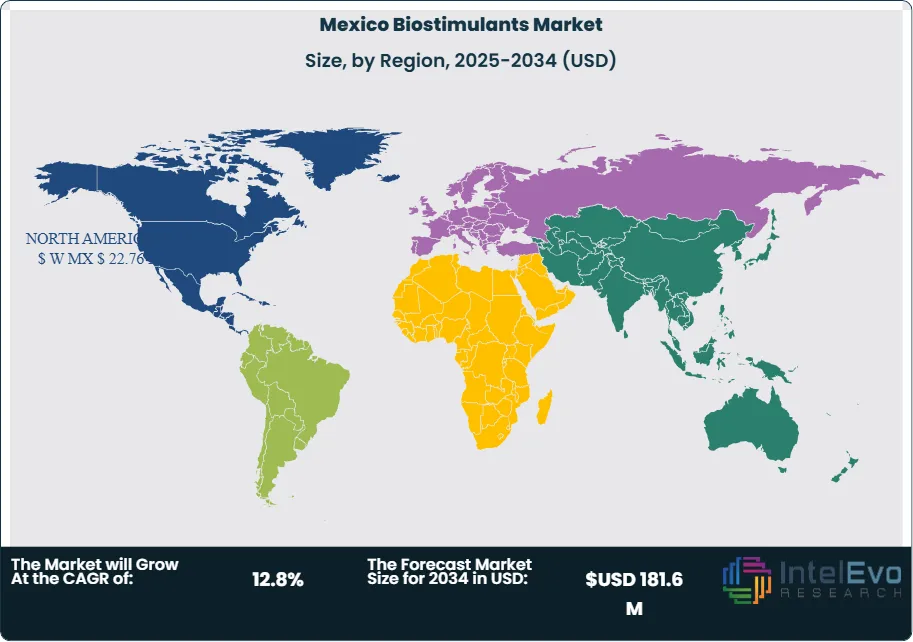
The Mexico Biostimulants Market is estimated at USD 54.2 million in 2024 and is projected to reach approximately USD 181.6 million by 2034, registering a CAGR of about 12.8% during 2025–2034. Growth is being driven by increasing adoption of sustainable agricultural practices, rising pressure to improve crop yield under water-stressed conditions, and stronger government support for eco-friendly inputs. Farmers are increasingly turning to biostimulants to enhance soil health, nutrient uptake, and stress tolerance, particularly in high-value crops such as fruits, vegetables, and cereals. In addition, expanding awareness of residue-free farming and export-oriented agriculture is positioning biostimulants as a critical input in Mexico’s evolving agri-input landscape.
-Size-by-Region.png.png)
The market has evolved from a niche input segment into a critical pillar of Mexico’s sustainable agriculture strategy. Rising concerns over soil degradation, high fertilizer prices, and growing demand for organic produce have pushed farmers and agribusinesses to adopt bio-based plant growth enhancers at a record pace.
Mexico’s agricultural sector, which contributes nearly 3.5% to national GDP, increasingly depends on biostimulants to sustain yields under erratic weather conditions. Products based on humic substances, seaweed extracts, amino acids, and microbial formulations are now widely used across major crop categories including maize, fruits, vegetables, and oilseeds. Between 2020 and 2025, adoption rates among medium-scale farmers doubled, driven by strong field performance data showing up to 20% higher yields and improved nutrient efficiency.
Regulation remains a defining challenge. Biostimulants are currently classified under fertilizer regulations monitored by COFEPRIS, with no dedicated framework for product certification. The absence of standardized criteria for efficacy and safety has allowed market fragmentation and the entry of low-quality imports. However, policy discussions in 2025 under the Ministry of Agriculture (SADER) aim to introduce registration norms similar to the European Union’s model, which could formalize market entry rules and attract larger foreign investment.
Investment momentum remains robust. Recent funding initiatives, such as BASF and Aqua-Spark’s joint investment exceeding USD 18 million in Sead Energy, underscore the growing confidence in biostimulant R&D. Major players like Yara and Bayer are expanding localized production and introducing formulations tailored for climate-stressed crops. Yara’s 2024 launch of YaraAmplix marks a shift toward strain-specific and precision-compatible biostimulants, aligning with Mexico’s push toward data-driven farming.
The outlook for 2025 and beyond points toward stronger alignment between biological inputs and precision agriculture platforms. Digital monitoring, AI-based nutrient modeling, and drone-assisted spraying are entering mainstream practice, improving cost efficiency and product traceability. Northern and central Mexico remain key consumption hubs due to intensive horticulture, while Baja California and Sinaloa show emerging investment potential. With rising public and private investment, Mexico’s biostimulants industry is positioned for long-term expansion built on sustainability, regulation, and agritech integration.

Key Takeaways
- Market Growth: The Mexico biostimulants market was valued at USD 54.2 million in 2024 and is projected to reach USD 181.6 million by 2034, growing at a CAGR of 12.8%. Growth is driven by increasing demand for sustainable inputs and higher yields in key crops such as maize, sugarcane, and avocados.
- Product Type: Humic and fulvic acids accounted for 32.6% of total market revenue in 2024 due to their strong role in soil fertility improvement and compatibility with organic farming systems. Seaweed extracts followed closely, supported by their wide application in high-value horticultural crops.
- Application Method: Foliar treatment represented 41% of total application volume, favored for its quick nutrient uptake and visible yield response. The seed treatment segment is gaining momentum with a projected CAGR of 9.2% through 2030, particularly in the maize and cereal supply chain.
- Crop Type: Row crops and cereals formed the largest consumption base at 38% share in 2024, driven by government-supported yield enhancement programs. Fruit and vegetable applications are expected to grow fastest, posting a 9.8% CAGR as export-oriented growers adopt biostimulants to meet international residue standards.
- Driver: Strong national policies promoting sustainable agriculture and organic certification are accelerating adoption. Mexico’s Secretariat of Agriculture (SADER) allocated MXN 540 million (USD 30 million) in 2023 for biological input subsidies, expanding biostimulant trials in 12 states.
- Restraint: Limited farmer awareness and fragmented distribution networks restrict scale. Only 38% of medium-scale growers actively use biostimulants, creating a market education gap that slows penetration in non-export crops.
- Opportunity: The organic farming segment is projected to reach USD 74 million by 2030, supported by rising exports of certified produce to the U.S. and EU. Local formulations using indigenous raw materials (e.g., agave-based extracts) present a cost-efficient, high-margin opportunity for domestic producers.
- Trend: Companies are integrating microbial consortia into biostimulant formulations. Firms like Grupo Agrotecnologías Naturales and UPL México have launched microbial-based blends achieving 15–20% yield gains in pilot maize trials, encouraging rapid technology transfer within local distribution chains.
- Regional Analysis: Western Mexico (Jalisco, Michoacán, and Nayarit) leads with 42% of national biostimulant sales, driven by fruit export clusters. Northern Mexico is emerging with a 9.5% CAGR, supported by irrigation infrastructure and adoption in high-value greenhouse operations in Chihuahua and Sonora.
Active Ingredients Analysis
As of 2025, humic substances maintain a leading position in the Mexico biostimulants market, accounting for over 33% of total revenue. Their dominance stems from their fundamental role in improving soil fertility and nutrient retention capacities, which directly supports higher crop yields under limited fertilizer usage. With Mexico’s focus on sustainable productivity, humic-based biostimulants have seen rising adoption among maize, wheat, and sugarcane growers aiming to improve root structure and cation exchange capacity.
Growing emphasis on organic certification standards and carbon sequestration in agricultural soils further reinforces the segment’s expansion. Local manufacturers are increasingly developing humic formulations sourced from leonardite and lignite deposits, which enhances cost efficiency for domestic supply chains. As a result, humic substances are expected to register a CAGR of roughly 8.1% through 2030, sustaining their role as a key input in regenerative agriculture initiatives.
Seaweed extracts represent one of the fastest-growing subsegments, with projected market growth exceeding 9% CAGR during 2025–2030. Their wide acceptance is due to their high content of natural hormones such as cytokinins and auxins, which promote cell division, stress resilience, and flowering efficiency. Mexico’s horticulture sector, particularly avocado and berry producers, has increased reliance on seaweed-based products to ensure uniform fruit size and extended post-harvest life.
The import of marine-derived raw materials from Chile and Norway, combined with expanding local extraction capabilities, is driving innovation in product formulation. Leading suppliers like Agroenzymas and UPL México are investing in liquid seaweed blends tailored for arid conditions, ensuring tolerance to drought and salinity common in northern growing regions.
Microbial biostimulants, comprising beneficial bacteria and fungi, are gaining a foothold in integrated soil health strategies. They currently account for between 14%–16% of total biostimulant demand, supported by their dual role in nutrient solubilization and pathogen suppression. Mexican agribusinesses are adopting these products as part of biological pest management programs under SADER’s sustainable farming policy incentives.
Local R&D is expanding strain libraries of Azospirillum, Bacillus, and Trichoderma species suited for regional soil conditions. Their field performance shows 15–20% improvements in nitrogen uptake and yield stabilization under water stress. This segment is set for accelerated growth, particularly in export-oriented fruit crops facing residue-free certification pressures.
Amino acid-based biostimulants retain a significant presence, with demand driven by their role in protein synthesis and stress mitigation. Farmers use these products to counter heat, drought, and salinity-induced yield losses. Their incorporation improves chlorophyll formation, nutrient assimilation, and overall plant vigor, delivering visible gains in productivity for fruit, vegetable, and cash crops.
Liquid amino acid blends are increasingly combined with micronutrients to enhance absorption efficiency. Industry data indicates these formulations contribute to 10–12% yield improvements in leafy vegetables and other perishable crops. The segment is projected to expand steadily, supported by higher adoption in greenhouse operations and intensive cultivation zones.
Crop Type Analysis
In 2025, cereals and grains represent the largest user segment in Mexico’s biostimulant market, contributing approximately 35% of total consumption. High dependency on maize and wheat production underpins this dominance, with growers seeking solutions that sustain yield quality despite erratic rainfall and soil degradation. Biostimulants enhance nutrient uptake efficiency, particularly nitrogen and phosphorus, which are critical in large-scale cereal cultivation.
Government initiatives promoting biological inputs under the “Producción para el Bienestar” program further strengthen adoption. With improvements in soil conditioning and stress resistance, biostimulants are expected to play a central role in narrowing Mexico’s yield gap relative to global standards.
Fruits and vegetables form the second-largest segment, experiencing rapid expansion at a projected CAGR above 9% by 2030. Export-oriented crops such as berries, citrus, and avocados drive uptake, as biostimulants support uniform maturation, extended shelf life, and enhanced nutritional quality. Producers supplying U.S. and EU markets integrate biostimulants to comply with residue-free mandates and sustainability certifications.
Investments in controlled-environment farming, including hydroponic and greenhouse systems, are also increasing product penetration. Formulations focusing on root development and fruit-setting efficiency continue to see rapid commercialization through regional distributors.
Turf and ornamental plants show moderate but consistent growth, supported by rising urban landscaping projects and green recreational developments. Municipal authorities and private contractors demand biostimulants to maintain turf health and color sustainability under intensive use and high temperatures.
This segment demonstrates potential for broader application in golf courses, residential complexes, and public gardens, particularly in urban centers such as Guadalajara and Monterrey. The rising adoption of sustainable landscaping materials further fuels continued demand.
Oilseeds and pulses, including soybeans and chickpeas, account for a smaller share but are gaining traction as farmers recognize the benefits of biostimulants in enhancing nitrogen fixation and pod set. These crops are often grown under semi-arid conditions, where biostimulants help maintain productivity under climatic stress.
Other specialized crops, such as agave and forage species, are increasingly adopting customized biostimulant blends to improve biomass production and drought resistance, strengthening resilience in Mexico’s dryland agriculture areas.
Form Analysis
The liquid segment remains the leading form of biostimulants, accounting for over 74% of the market share in 2025. Ease of application through fertigation and foliar spray systems, combined with faster plant absorption rates, makes liquid formulations highly attractive for both large farms and greenhouse operations.
Continuous product innovation focused on water-soluble and multi-nutrient complexes further supports this format’s dominance. The segment is projected to maintain strong growth, aligning with the expansion of precision agriculture tools that enable efficient liquid dosing across variable rate irrigation systems.
The dry formulation segment, though smaller, retains strategic importance in long-term soil applications. Solid biostimulants offer extended shelf life and lower freight costs, making them suitable for large acreage and export logistics. These products are widely adopted in seed coating and bulk soil treatments where gradual nutrient release is required.
Latin American suppliers are investing in granular blends combining microbes and humic substances for sustainable nutrient management. Demand is expected to rise moderately as cooperatives and agro-industrial enterprises seek stable, cost-effective soil amendments for cereals and forage production.
Application Analysis
Foliar applications continue to dominate with more than 43% share of overall use in 2025, as they enable rapid nutrient uptake directly through leaf tissues. The approach provides immediate responses to stress and deficiency symptoms, significantly improving short-term plant recovery and growth.
High-performance formulations containing amino acids, seaweed, and micronutrients have become common across maize, tomato, and lettuce crops, showing measurable yield gains of 12–18% under controlled trials. This method remains the preferred practice for addressing in-season nutritional imbalances efficiently.
Soil treatments are strengthening their position as an essential component of long-term fertility management. They improve soil texture, microbial balance, and root nutrient accessibility, directly influencing sustained yield growth over multiple cycles. Products combining humic acids and microbial amendments are particularly valued in regions with degraded or saline soils.
As Mexican policy trends favor biological soil regeneration, this segment is forecast to expand steadily. Adoption is increasing in both row crop and fruit sectors where soil enrichment programs form part of integrated nutrient management practices.
Seed treatment applications are growing steadily, reflecting rising awareness of early-stage plant protection benefits. Coating seeds with biostimulants enhances germination uniformity, boosts root vigor, and strengthens seedling resistance to pathogens.
With Mexico’s emphasis on sustainable input efficiency, seed treatment is increasingly recognized as a cost-effective way to secure early plant establishment. Its share, currently just under 10% of the application market, is projected to increase as more commercial seed distributors integrate biological additives into their product portfolios.
Get More Information about this report -
Request Free Sample ReportMarket Key Segments
By Active ingredients
- Humic Substances
- Seaweed Extracts
- Microbial Amendments
- Amino Acids
- Other Active Ingredients
By Crop Type
- Cereals & Grains
- Fruits & Vegetables
- Turf & Ornamentals
- Oilseeds & Pulses
- Other Crop Types
By Form
- Dry
- Liquid
By Application
- Foliar Treatment
- Soil Treatment
- Seed Treatment
By Region
- Mexico
| Report Attribute | Details |
| Market size (2024) | USD 54.2 M |
| Forecast Revenue (2034) | USD 181.6 M |
| CAGR (2024-2034) | 12.8% |
| Historical data | 2020-2023 |
| Base Year For Estimation | 2024 |
| Forecast Period | 2025-2034 |
| Report coverage | Revenue Forecast, Competitive Landscape, Market Dynamics, Growth Factors, Trends and Recent Developments |
| Segments covered | By Active ingredients, Humic Substances, Seaweed Extracts, Microbial Amendments, Amino Acids, Other Active Ingredients, By Crop Type, Cereals & Grains, Fruits & Vegetables, Turf & Ornamentals, Oilseeds & Pulses, Other Crop Types, By Form, Dry, Liquid, By Application, Foliar Treatment, Soil Treatment, Seed Treatment |
| Research Methodology |
|
| Regional scope |
|
| Competitive Landscape | FMC Corporation, LIVENTIA, Corteva Inc., Isagro SpA, The Dow Chemical Company, Arysta LifeScience Corporation, Grupo Agrotecnología S.L., Sumitomo Chemical Co. Ltd., BASF SE, Syngenta AG (Valagro S.A.), United Phosphorus Ltd., Eastman Chemical Company, Bayer AG, DAMA Agricultural Solutions Ltd., Kingenta Group, DuPont, Rotam Global AgroSciences Limited, Monsanto Company, Syngenta |
| Customization Scope | Customization for segments, region/country-level will be provided. Moreover, additional customization can be done based on the requirements. |
| Pricing and Purchase Options | Avail customized purchase options to meet your exact research needs. We have three licenses to opt for: Single User License, Multi-User License (Up to 5 Users), Corporate Use License (Unlimited User and Printable PDF). |


Frequently Asked Questions
How big is the Mexico Biostimulants Market?
The Mexico Biostimulants Market is projected to reach USD 181.6 million by 2034, growing at a 12.8% CAGR, driven by sustainable farming, soil health focus, and yield optimization.
Who are the major players in the Mexico Biostimulants Market?
FMC Corporation, LIVENTIA, Corteva Inc., Isagro SpA, The Dow Chemical Company, Arysta LifeScience Corporation, Grupo Agrotecnología S.L., Sumitomo Chemical Co. Ltd., BASF SE, Syngenta AG (Valagro S.A.), United Phosphorus Ltd., Eastman Chemical Company, Bayer AG, DAMA Agricultural Solutions Ltd., Kingenta Group, DuPont, Rotam Global AgroSciences Limited, Monsanto Company, Syngenta
Which segments covered the Mexico Biostimulants Market?
By Active ingredients, Humic Substances, Seaweed Extracts, Microbial Amendments, Amino Acids, Other Active Ingredients, By Crop Type, Cereals & Grains, Fruits & Vegetables, Turf & Ornamentals, Oilseeds & Pulses, Other Crop Types, By Form, Dry, Liquid, By Application, Foliar Treatment, Soil Treatment, Seed Treatment
How can this market research report help my business make strategic decisions?
Our market research reports provide actionable intelligence, including verified market size data, CAGR projections, competitive benchmarking, and segment-level opportunity analysis. These insights support strategic planning, investment decisions, product development, and market entry strategies for enterprises and startups alike.
How frequently is the data updated?
We continuously monitor industry developments and update our reports to reflect regulatory changes, technological advancements, and macroeconomic shifts. Updated editions ensure you receive the latest market intelligence.

Select Licence Type
Connect with our sales team

Why IntelEvoResearch
100%
Customer
Satisfaction
24x7+
Availability - we are always
there when you need us
200+
Fortune 50 Companies trust
IntelEvoResearch
80%
of our reports are exclusive
and first in the industry
100%
more data
and analysis
1000+
reports published
till date
