

- Home
- Industries
 Aerospace And Defence
 Agriculture
 Automotive And Transportation
 Banking And Finance
 Business
 Chemicals And Materials
 Consumer And Retail
 Electronics And Semiconductors
 Food And Beverages
 Machinery & Equipments
 Manufacturing And Construction
 Medical Devices
 Others
 Pharmaceuticals And Healthcare
 Power And Energy
 Sports
 Technology
- Services
- News Room
- About us
- Contact Us
-
Microfiltration Membranes Market Size, Growth & Forecast 2034 | 11.2% CAGR
Global Microfiltration Membranes Market Size, Share, Analysis Report By Filtration Mode (Cross Flow, Direct Flow), Type (Ceramic, Cellulosic, Fluorinated Polymers), Application (Water and WasteWater Treatment, Pharmaceutical, Food and Beverage, Chemical, Biotechnology), Region and Key Players - Industry Segment Overview, Market Dynamics, Competitive Strategies, Trends and Forecast 2025-2034

Report Overview:
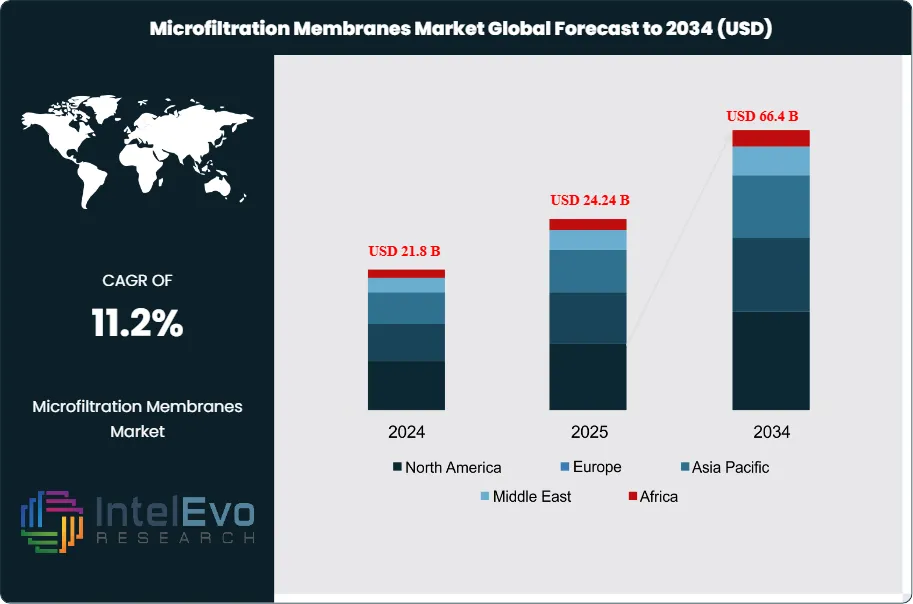
The Global Microfiltration Membranes Market size is expected to be worth around USD 66.4 billion by 2034, rising from USD 21.8 billion in 2024, growing at a CAGR of 11.2% during the forecast period from 2025 to 2034. The increasing demand for high-quality water purification, rapid growth in the biopharmaceutical industry, and stringent environmental regulations are major factors driving market expansion. Microfiltration membranes are gaining widespread adoption across healthcare, food & beverage, and wastewater treatment sectors. With continuous innovation in polymer and ceramic membrane technologies, the market is set to experience robust growth and attract significant investments globally.
Get More Information about this report -
Request Free Sample ReportThe microfiltration membranes market refers to the industry involved in the production, distribution, and application of microfiltration (MF) membranes, which are used to separate particles, microorganisms, and other contaminants from liquids and gases. Microfiltration is a type of membrane filtration with pore sizes typically in the range of 0.1 to 10 microns, making it suitable for removing larger particles like suspended solids, bacteria, and some viruses. These membranes are used in a variety of industries, including water treatment, food and beverage processing, pharmaceuticals, biotechnology, and chemicals. The market for microfiltration membranes has witnessed significant growth due to increased demand for clean water, advancements in membrane technology, and growing applications across different sectors.
The microfiltration membrane market is poised for substantial growth, driven by advancements in technology, increasing regulatory pressure for sustainable water treatment, and the rising demand for filtration solutions across various industries. As emerging markets continue to industrialize and urbanize, the market will see continued investment in water and wastewater treatment infrastructure, as well as other filtration applications. The growth of membrane separation technology is also anticipated to benefit from the growing use of this technology in the dairy processing and beverage industries throughout the projected period.
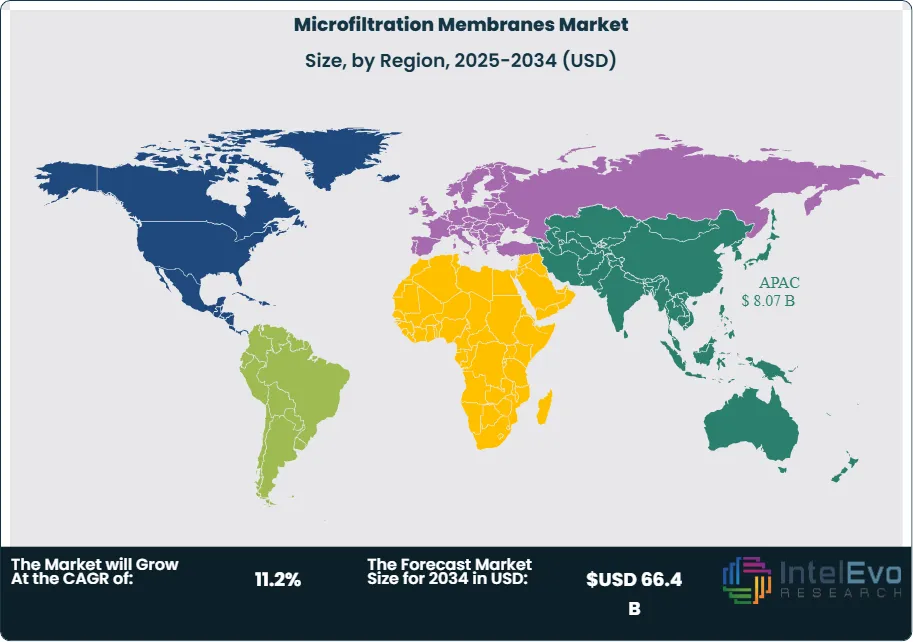
The Asia-Pacific region plays a leading role in the global microfiltration membranes market, driven by a combination of industrial growth, rising environmental concerns, and strong government initiatives. Rapid industrialization in countries such as China, India, and South Korea has increased the demand for efficient water treatment technologies to manage industrial effluents and ensure environmental compliance. At the same time, growing water scarcity in densely populated areas is prompting greater investment in filtration solutions that support water reuse and sustainability. Government-backed programs—like India’s Jal Jeevan Mission and China’s environmental protection strategies—are further accelerating the adoption of microfiltration systems. Additionally, the expansion of high-purity industries such as pharmaceuticals, food and beverage, and biotechnology across the region is boosting the need for reliable filtration technologies. Ongoing innovation and R&D efforts from both domestic and global players are helping to introduce more efficient, cost-effective membranes tailored to the region’s unique challenges, further strengthening Asia-Pacific’s position in this market.
The COVID-19 pandemic had a profound impact on global industries, including the microfiltration membranes market. The disruptions caused by the pandemic, along with the heightened focus on health and hygiene, led to both challenges and opportunities in the market. The pandemic heightened awareness of the importance of clean water, air, and surfaces in preventing the spread of diseases. This led to an increased demand for effective filtration systems, including microfiltration membranes, in both residential and commercial settings.

Key Takeaways:
- Market Growth: The microfiltration membranes market is expected to reach USD 66.4 billion by 2034, growing at a robust CAGR of 11.2%, indicating strong market expansion.
- Filtration mode Segment Dominance: The filtration segment is dominated by cross flow, accounting for over 40% of the market share. Cross-flow filtration operates by continuously moving liquid across the surface of the membrane, allowing particles to be carried away in the flow. This helps reduce membrane clogging and improves overall filtration efficiency.
- Type Segment Insights: Fluorinated polymers is anticipated to hold the largest market share, owing to their outstanding chemical resistance, making them an ideal choice for use in harsh and demanding industrial settings.
- Driver: Rising global population and urbanization are increasing demand for potable water. Microfiltration membranes are crucial in removing suspended solids and bacteria from water sources.
- Restraint: Even with significant progress in microfiltration technology, issues like limited membrane efficiency, susceptibility to fouling, and short lifespan still pose challenges. Manufacturers continue to face pressure to develop membranes that strike the right balance between performance and affordability.
- Opportunity: Rapid urbanization and industrial growth in countries like India, China, Brazil, and Southeast Asia are increasing demand for water treatment solutions. Government initiatives to improve water infrastructure present huge market potential.
- Trend: There's a major push for low-energy, chemical-free membrane operations. Integration of eco-friendly materials and longer-lasting membranes is aligning with sustainability goals, especially in water treatment and industrial applications.
- Regional Analysis: Market expansion is likely to gain momentum due to swift industrial development and growing environmental awareness across emerging economies in the Asia Pacific region. In particular, government efforts in countries like India and China to invest in water and wastewater treatment infrastructure are expected to play a key role in driving growth in the coming years.
Filtration Mode Analysis:
Microfiltration membranes market can be categorized by filtration mode. These include cross flow and direct flow. Cross-flow filtration works by maintaining a continuous flow of liquid along the surface of the membrane, which helps sweep away particles and minimizes clogging. This mechanism not only ensures effective filtration but also supports consistent performance over time. It's widely adopted across industries such as food and beverage, pharmaceuticals, and chemicals, where it's used for tasks like clarification, separation, and concentration. This method is particularly effective when processing dense or viscous liquids, as it can handle challenging materials without compromising filtration quality. Due to these strengths, cross-flow filtration is also a go-to solution in water and wastewater treatment, where it plays a key role in removing impurities, delivering clean water, and managing complex water sources efficiently.
Product type Analysis:
There are three categories for product type: Ceramic, cellulosic, fluorinated polymers, and others. Fluorinated polymers are widely recognized for their exceptional resistance to harsh chemicals, making them highly suitable for demanding industrial environments. In microfiltration membrane applications, this means they can endure aggressive substances without degrading. These materials also perform reliably under elevated temperatures, making them ideal for situations where conventional membranes might fail. Due to their resilience and versatility, fluorinated polymer membranes are seeing growing use in industries exposed to extreme chemical and thermal conditions. This increasing adoption is driving growth in the segment. Additionally, their robust nature makes them a preferred solution in water and wastewater treatment, where long-term durability and resistance to chemical exposure are essential.
Application Analysis:
Application segments of the microfiltration membranes include water and wastewater treatment, pharmaceutical, food and beverage, chemical, biotechnology, and others. The rising global demand for clean water across residential, commercial, and industrial sectors—combined with an increasing scarcity of freshwater resources—is a major factor driving interest in advanced water treatment solutions. In response to growing concerns about water availability, many governments are expected to tighten regulations around wastewater management. These developments are likely to boost the adoption of membrane-based microfiltration technologies, particularly for treating industrial effluents, in the coming years.
Region Analysis:
The Asia-Pacific region currently holds the largest share—approximately 37%—of the global microfiltration membranes market, underpinned by multiple driving forces that continue to fuel its expansion:
Industrial and Urban Expansion: Rapid industrial growth and urbanization in nations such as China and India have significantly increased the need for efficient water treatment systems. These developments are propelling the adoption of microfiltration membranes as industries seek to mitigate environmental impacts while supporting infrastructure growth.
Rising Environmental Awareness: The growing urgency to tackle water pollution and address water scarcity challenges has spurred investments in filtration technologies. Microfiltration membranes are central to these efforts, enabling the removal of fine particles, bacteria, and other impurities from water across residential, commercial, and industrial sectors.
Growth of High-Purity Sectors: Booming pharmaceutical, biotechnology, and food & beverage industries across the region are driving demand for advanced membrane technologies. Microfiltration membranes are essential in these sectors to ensure product sterility, process integrity, and compliance with strict quality standards.
Supportive Government Policies: Regional governments are introducing robust initiatives to improve water infrastructure and encourage sustainable water use. Notably, India’s Jal Jeevan Mission, which aims to provide every rural household with safe drinking water, is contributing to increased demand for microfiltration technologies.
Get More Information about this report -
Request Free Sample ReportKey Market Segment
By Material Type
- Polymeric Membranes
- Ceramic Membranes
- Metallic Membranes
- Others
By Filtration Type
- Crossflow Microfiltration
- Dead-End Microfiltration
By Application
- Water & Wastewater Treatment
- Food & Beverage Processing
- Biopharmaceutical & Biotechnology
- Chemical Processing
- Others (Mining, Electronics, etc.)
By End User
- Industrial
- Municipal
- Healthcare & Pharmaceutical
- Food & Beverage
- Others
By Region
- North America
- Latin America
- East Asia And Pacific
- Sea And South Asia
- Eastern Europe
- Western Europe
- Middle East & Africa
| Report Attribute | Details |
| Market size (2025) | USD 24.24 B |
| Forecast Revenue (2034) | USD 66.4 B |
| CAGR (2025-2034) | 11.2% |
| Historical data | 2018-2023 |
| Base Year For Estimation | 2024 |
| Forecast Period | 2025-2034 |
| Report coverage | Revenue Forecast, Competitive Landscape, Market Dynamics, Growth Factors, Trends and Recent Developments |
| Segments covered | By Material Type (Polymeric Membranes, Ceramic Membranes, Metallic Membranes, Others), By Filtration Type (Crossflow Microfiltration, Dead-End Microfiltration), By Application (Water & Wastewater Treatment, Food & Beverage Processing, Biopharmaceutical & Biotechnology, Chemical Processing, Others (Mining, Electronics, etc.)), By End User (Industrial, Municipal, Healthcare & Pharmaceutical, Food & Beverage, Others) |
| Research Methodology |
|
| Regional scope |
|
| Competitive Landscape | Asahi Kasei, Hydranautics, Kubota Corporation, Merck KGAA, Parker Hannifin Corporation, Sartorius Ag, The 3M Company, Applied Membranes, Inc.,, Graver Technologies, Koch Separation Solutions, Mann+Hummel Water & Fluid Solutions, Pall Corporation, Pentair, Suez, Toray Industries Inc. |
| Customization Scope | Customization for segments, region/country-level will be provided. Moreover, additional customization can be done based on the requirements. |
| Pricing and Purchase Options | Avail customized purchase options to meet your exact research needs. We have three licenses to opt for: Single User License, Multi-User License (Up to 5 Users), Corporate Use License (Unlimited User and Printable PDF). |


Select Licence Type
Connect with our sales team

Microfiltration Membranes Market
Published Date : 30 May 2025 | Formats :Why IntelEvoResearch
100%
Customer
Satisfaction
24x7+
Availability - we are always
there when you need us
200+
Fortune 50 Companies trust
IntelEvoResearch
80%
of our reports are exclusive
and first in the industry
100%
more data
and analysis
1000+
reports published
till date
