

- Home
- Industries
 Aerospace And Defence
 Agriculture
 Automotive And Transportation
 Banking And Finance
 Business
 Chemicals And Materials
 Consumer And Retail
 Electronics And Semiconductors
 Food And Beverages
 Machinery & Equipments
 Manufacturing And Construction
 Medical Devices
 Others
 Pharmaceuticals And Healthcare
 Power And Energy
 Sports
 Technology
- Services
- News Room
- About us
- Contact Us
-
Middle East Laboratory Furniture Market Size, Drivers | CAGR 6%
Middle East Laboratory Furniture Market Size, Share, Analysis Report By Product Type (Laboratory Benches & Tables, Storage Cabinets & Shelving, Fume Hoods & Safety Cabinets, Laboratory Stools & Chairs, Accessories), By Application (Medical Laboratories, R&D Centers, Educational Institutions, Industrial Laboratories), By Material (Wood, Stainless Steel, Laminate/Phenolic Resin, Plastic/Polypropylene) Region and Key Players - Industry Segment Overview, Market Dynamics, Competitive Strategies, Trends and Forecast 2025-2034

Report Overview
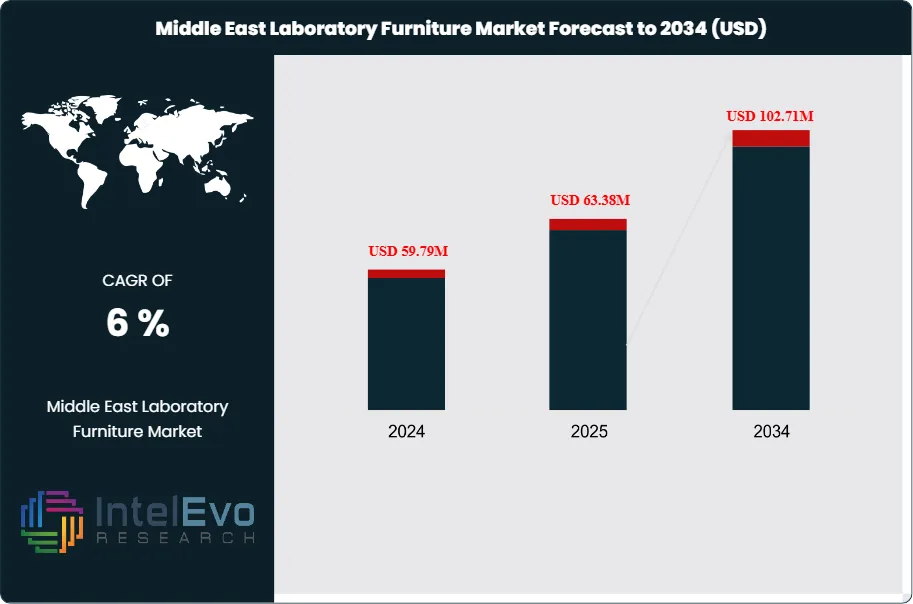
The Middle East Laboratory Furniture Market was valued at approximately USD 59.79 million in 2024 and is projected to reach nearly USD 102.71 million by 2034, supported by expanding healthcare infrastructure, growing pharmaceutical manufacturing capacity, and rising investments in academic and research laboratories across the region. Based on the expected growth trajectory, the market size for 2025 is estimated at approximately USD 63.38 million. From 2025 onward, the market is anticipated to expand at a compound annual growth rate (CAGR) of approximately 6.0% during 2025–2034, ultimately reaching around USD 102.71 million by 2034.
Get More Information about this report -
Request Free Sample ReportThe Middle East laboratory furniture industry is set for notable growth. This rise is driven by increasing investments in research and development (R&D) across different sectors, especially healthcare, biotechnology, and education. The market is vital for providing the necessary infrastructure for safe, functional, and modern laboratory environments. As regional economies diversify and focus on knowledge-based fields, the demand for high-quality, ergonomic, and customizable laboratory furniture continues to increase.
This report provides a detailed look at the market's dynamics, segmentation, and competitive landscape. It highlights key drivers, challenges, opportunities, and emerging trends. The market shows a rising adoption of new materials, smart lab solutions, and a stronger focus on sustainability and energy efficiency in laboratory design. This change is essential for supporting the complex research and technological advancements happening in the region.

Key Takeaways
- Market Growth: The Middle East Laboratory Furniture Market is projected for robust growth, fueled by rising R&D investments in healthcare, biotech, and educational institutions, alongside a strong push for economic diversification.
- Application Dominance: Medical laboratories and research and development centers are the dominant application segments, driven by increasing healthcare spending and the establishment of new research facilities.
- Material Trends: A shift towards durable, chemical-resistant, and sustainable materials like stainless steel and other eco-friendly options is a key trend.
- Driver: Increasing government and private sector investments in R&D infrastructure and the expansion of educational and healthcare facilities are major growth catalysts.
- Restraint: The relatively high cost of specialized laboratory furniture and potential challenges in supply chain and skilled labor availability could pose restraints.
- Opportunity: The rapid urbanization, growing population, and ambitious national visions (e.g., Saudi Vision 2030, UAE Vision 2030) are creating substantial opportunities for market expansion.
- Trend: The adoption of modular and adaptable lab furniture systems, integration of smart technologies for enhanced efficiency, and a focus on ergonomic and safety-compliant designs are shaping the market.
- Regional Analysis: Countries like Saudi Arabia, UAE, and Qatar are leading the market growth due to their significant investments in healthcare and research infrastructure.
Product Type Analysis:
Laboratory benches and tables are essential elements of any lab and make up a major part of the market. Their demand increases with the creation of new laboratories and the renovation of old ones. The trend toward modular and flexible systems is strong in this area as institutions look for options that can be adjusted to meet changing research needs. Fume hoods and safety cabinets also occupy a large share of the market. This demand comes from stricter safety regulations and the need to handle hazardous materials in research, medical, and industrial labs. The growth of this segment relies on the need to protect lab personnel and the environment, making it a crucial part of modern lab design.
Material Analysis:
The material segment is undergoing a major change, with stainless steel becoming a popular choice. Its popularity comes from its outstanding durability, non-porous nature that prevents bacterial growth, and resistance to corrosion and harsh chemicals. This makes stainless steel perfect for demanding environments like medical labs, pharmaceutical cleanrooms, and food and beverage quality control labs. While wood and laminate/phenolic resin are still used, especially in schools, the market is increasingly favoring sturdier and longer-lasting materials that can handle heavy use. There is also a growing demand for sustainable and eco-friendly materials, pushing manufacturers to look into new composites and recycling methods.
Application Analysis:
Medical laboratories are likely to keep their leading market position. This is mainly due to the ongoing growth of healthcare infrastructure, rising patient care demands, and substantial investments in pharmaceutical and biotechnology research in the Middle East. The increasing rates of chronic diseases and the focus on local drug manufacturing are also driving the need for well-equipped medical labs. These facilities need specialized furniture that ensures cleanliness, supports advanced diagnostic equipment, and meets strict safety standards.
Research and Development (R&D) Centers, which include both academic and industrial facilities, are another important application segment. The Middle East's goal to move toward knowledge-based economies requires significant funding for scientific research. This increases the need for innovative and customizable lab furniture that can serve various research fields, from material science to petrochemical analysis.
Educational Institutions are a growing segment, pushed by government plans to improve science and technology education at all levels. Modern school and university labs need sturdy and functional furniture to support hands-on learning and encourage scientific exploration among students.
Regional Analysis:
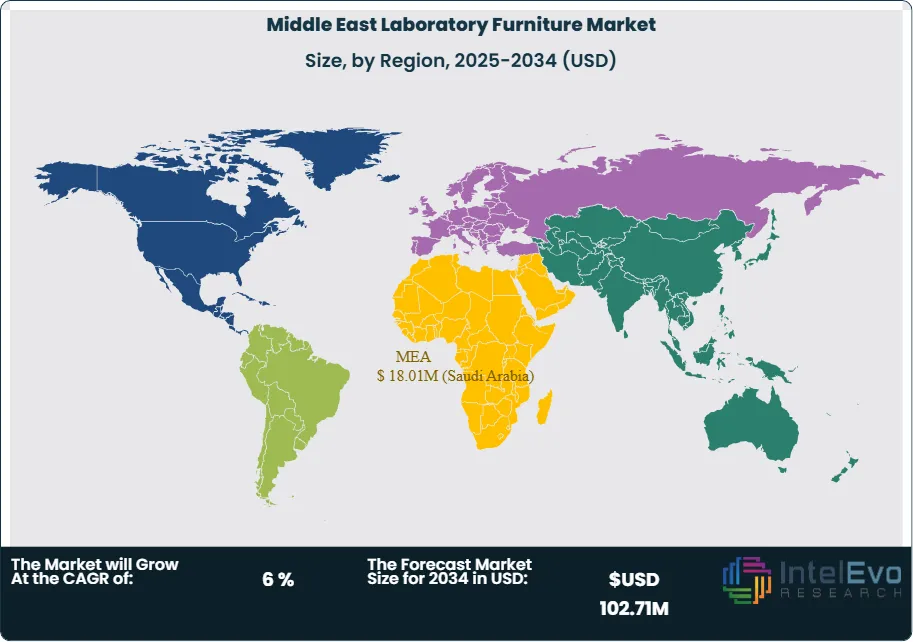
The Middle East laboratory furniture market is mainly in countries that have strong economic diversification goals and invest heavily in sectors outside of oil. Saudi Arabia and the UAE lead the market, driven by their ambitious national visions (Saudi Vision 2030 and UAE Vision 2030) which involve significant spending on healthcare, education, and technology. The creation of new medical cities, specialized universities, and research parks in these countries is driving remarkable demand. Other Gulf countries, like Qatar, are also seeing strong growth due to their specific investments. Beyond the GCC, emerging markets in the wider Middle East are showing promise as their healthcare and industrial sectors grow. However, factors like political stability, government policies, and economic growth rates will continue to significantly influence regional market dynamics.
Get More Information about this report -
Request Free Sample ReportKey Market Segment
By Product Type
- Laboratory Benches & Tables
- Storage Cabinets & Shelving
- Fume Hoods & Safety Cabinets
- Laboratory Stools & Chairs
- Accessories
By Application
- Medical Laboratories
- Research & Development (R&D) Centers
- Educational Institutions
- Industrial Laboratories
By Material
- Stainless Steel
- Wood
- Laminate/Phenolic Resin
- Plastic/Polypropylene
By Region
- Saudi Arabia
- United Arab Emirates (UAE)
- Qatar
- Kuwait
- Oman
- Bahrain
- Rest of Middle East
| Report Attribute | Details |
| Market size (2025) | USD 59.79M |
| Forecast Revenue (2034) | USD 102.71M |
| CAGR (2025-2034) | 6 % |
| Historical data | 2018-2023 |
| Base Year For Estimation | 2024 |
| Forecast Period | 2025-2034 |
| Report coverage | Revenue Forecast, Competitive Landscape, Market Dynamics, Growth Factors, Trends and Recent Developments |
| Segments covered | By Product Type (Laboratory Benches & Tables, Storage Cabinets & Shelving, Fume Hoods & Safety Cabinets, Laboratory Stools & Chairs, Accessories), By Application (Medical Laboratories, Research & Development (R&D) Centers, Educational Institutions, Industrial Laboratories), By Material (Wood, Stainless Steel, Laminate/Phenolic Resin, Plastic/Polypropylene) |
| Research Methodology |
|
| Regional scope |
|
| Competitive Landscape | Waldner, Kewaunee Scientific Corp., Thermo Fisher Scientific, Labconco, Asecos gmbh, Esco, Diversified Woodcrafts, NuAire, Lab Furniture Manufacturers Middle East LLC, PSA Laboratory Furniture, LabGuard India Pvt. Ltd., LOC Scientific, Modular Lab Systems FZE, Asec Solutions, Artech Lab Furniture, Lab Tech Middle East, Intech Laboratory Solutions, TMI Systems Design Corporation |
| Customization Scope | Customization for segments, region/country-level will be provided. Moreover, additional customization can be done based on the requirements. |
| Pricing and Purchase Options | Avail customized purchase options to meet your exact research needs. We have three licenses to opt for: Single User License, Multi-User License (Up to 5 Users), Corporate Use License (Unlimited User and Printable PDF). |


Frequently Asked Questions
How big is the Middle East Laboratory Furniture Market?
Middle East laboratory furniture market is projected to grow from USD 59.79M in 2024 to USD 102.71M by 2034, at a CAGR of 6 %. Explore trends, drivers, and growth outlook.
Who are the major players in the Middle East Laboratory Furniture Market?
Waldner, Kewaunee Scientific Corp., Thermo Fisher Scientific, Labconco, Asecos gmbh, Esco, Diversified Woodcrafts, NuAire, Lab Furniture Manufacturers Middle East LLC, PSA Laboratory Furniture, LabGuard India Pvt. Ltd., LOC Scientific, Modular Lab Systems FZE, Asec Solutions, Artech Lab Furniture, Lab Tech Middle East, Intech Laboratory Solutions, TMI Systems Design Corporation
Which segments covered the Middle East Laboratory Furniture Market?
By Product Type (Laboratory Benches & Tables, Storage Cabinets & Shelving, Fume Hoods & Safety Cabinets, Laboratory Stools & Chairs, Accessories), By Application (Medical Laboratories, Research & Development (R&D) Centers, Educational Institutions, Industrial Laboratories), By Material (Wood, Stainless Steel, Laminate/Phenolic Resin, Plastic/Polypropylene)
How can this market research report help my business make strategic decisions?
Our market research reports provide actionable intelligence, including verified market size data, CAGR projections, competitive benchmarking, and segment-level opportunity analysis. These insights support strategic planning, investment decisions, product development, and market entry strategies for enterprises and startups alike.
How frequently is the data updated?
We continuously monitor industry developments and update our reports to reflect regulatory changes, technological advancements, and macroeconomic shifts. Updated editions ensure you receive the latest market intelligence.

Select Licence Type
Connect with our sales team

Middle East Laboratory Furniture Market
Published Date : 15 Aug 2025 | Formats :Why IntelEvoResearch
100%
Customer
Satisfaction
24x7+
Availability - we are always
there when you need us
200+
Fortune 50 Companies trust
IntelEvoResearch
80%
of our reports are exclusive
and first in the industry
100%
more data
and analysis
1000+
reports published
till date