
Global Mobile CRM Market Size, Share & Analysis By Platform (IOS-based Mobile CRM App, Android-based CRM Platform App), By Application (Marketing Automation, Sales Automation, Contact Center Automation, Customer Service Management, Others), Industry Adoption Trends, Integration Capabilities & Forecast 2025–2034
The Mobile CRM Market is projected to grow from approximately USD 25.4 billion in 2024 to around USD 82.7 billion by 2034, expanding at a CAGR of about 12.3% during 2025–2034. This surge reflects the rising global shift toward hybrid work models, real-time customer engagement, and AI-powered sales automation. Enterprises are rapidly adopting mobile-first strategies to boost productivity, strengthen client communication, and streamline workflows across distributed teams. As digital transformation accelerates worldwide, mobile CRM solutions are becoming essential for sustaining competitive advantage and driving customer-centric innovation.
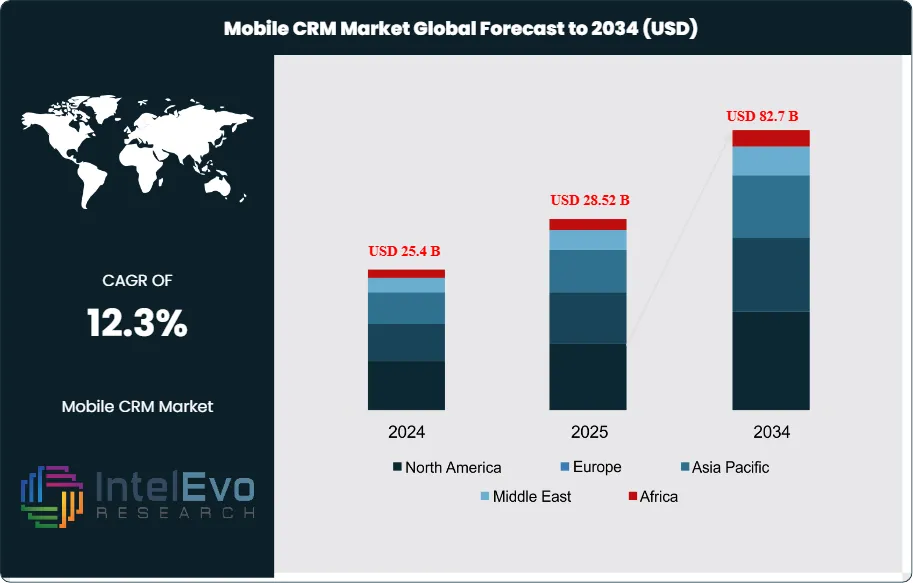
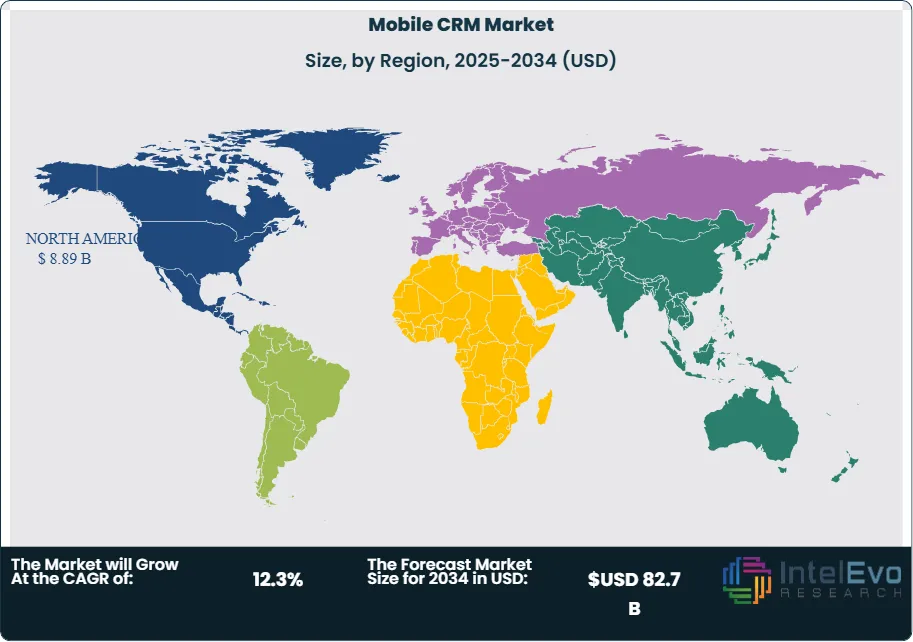
This growth reflects the accelerating shift toward mobile-first business operations, where organizations increasingly rely on real-time access to customer data to drive engagement, efficiency, and decision-making. In 2024, North America led the market with a 35.6% revenue share, equivalent to USD 8.2 billion, underscoring its role as an early adopter of mobile-driven enterprise solutions.
The market’s expansion is being fueled by the widespread use of smartphones and tablets, coupled with the growing prevalence of remote and hybrid work environments. Mobile CRM platforms enable sales, marketing, and customer service teams to seamlessly update and manage customer interactions in real time, resulting in improved collaboration, higher productivity, and enhanced customer experiences. According to industry estimates, businesses using mobile CRM report a 14.6% increase in sales productivity, with 65% of sales teams meeting their quotas compared to just 22% among firms without mobile CRM integration. This stark performance gap highlights the technology’s role as a critical enabler of revenue growth and operational agility.
Demand is also being driven by organizations seeking to strengthen customer relationships through greater accessibility and personalization. Mobile CRM applications allow employees to access key insights during field visits, tailor communications to individual customer needs, and make faster, data-driven decisions. At the same time, integration with artificial intelligence, big data analytics, and communication channels such as email, social media, and instant messaging is transforming mobile CRM into a hub for predictive customer insights and personalized marketing strategies. Enhanced security protocols and regulatory compliance features are further bolstering adoption among industries handling sensitive data, including banking, healthcare, and retail.
Regionally, adoption patterns highlight both saturation and opportunity. While North America and Asia-Pacific are advancing rapidly, Europe remains comparatively underpenetrated, with mobile CRM adoption estimated at just 34% in 2024. This lag presents substantial growth prospects for providers seeking to expand their footprint in the region. Meanwhile, businesses worldwide are aligning their digital strategies with mobile-first expectations, as 57% of consumers report they would not recommend a company with a poorly optimized mobile interface, and half would abandon a brand’s website altogether if it lacks mobile usability. As enterprises prioritize mobile accessibility and customer-centric engagement models, mobile CRM is expected to remain a cornerstone of digital transformation strategies well into the next decade.
Market Growth: The global mobile CRM market was valued at USD 25.4 billion in 2024 and is projected to reach USD 82.7 billion by 2034, expanding at a CAGR of 12.3% from 2025–2034. Growth is fueled by rising demand for real-time customer data access, mobile workforce enablement, and the integration of AI-driven insights into CRM platforms.
Operating System: Android-based CRM applications held over 68% of the market share in 2024, supported by Android’s vast global smartphone penetration and cost accessibility, particularly across emerging markets.
Application: Sales automation was the leading application area in 2024, accounting for more than 37% of revenue, as organizations increasingly prioritize mobile-enabled tools to streamline workflows, reduce administrative tasks, and boost salesforce productivity.
Driver: Businesses using mobile CRM report up to a 14.6% increase in sales productivity, with 65% of sales teams meeting their quotas compared to just 22% for non-users. This measurable performance gap is a primary driver of adoption.
Restraint: Data security and privacy concerns remain a key barrier, with compliance costs rising as companies adapt mobile CRM systems to meet stringent regulations such as GDPR in Europe and CCPA in the U.S.
Opportunity: Europe presents a significant growth opportunity, with mobile CRM penetration at only 34% in 2024. Providers offering tailored, compliance-ready solutions stand to capture substantial market share as adoption accelerates.
Trend: Integration of mobile CRM with AI and big data analytics is reshaping customer engagement, enabling predictive insights and hyper-personalized interactions. Vendors such as Salesforce and Microsoft are embedding advanced AI into mobile platforms to differentiate offerings.
Regional Analysis: North America led the market in 2024 with a 35.6% share, generating USD 8.2 billion in revenue, driven by early adoption and strong cloud infrastructure. Asia-Pacific is emerging as the fastest-growing region, fueled by rapid digital transformation in banking, retail, and telecom sectors.
Platform Analysis
As of 2025, Android-based CRM platforms continue to dominate the mobile CRM market, accounting for over two-thirds of total adoption. This strong position is driven by Android’s global reach, with the operating system powering the majority of smartphones across both developed and emerging markets. Its open-source framework offers developers significant flexibility, enabling businesses to customize applications to fit diverse workflows and customer engagement strategies. The affordability of Android devices, particularly in Asia-Pacific, Latin America, and Africa, makes these platforms attractive to small and medium-sized enterprises (SMEs) seeking scalable, cost-effective CRM solutions.
In addition to accessibility, Android-based CRM systems excel in interoperability, allowing seamless integration with third-party business tools, databases, and cloud platforms. This integration capability supports real-time analytics, predictive insights, and automated customer engagement, giving enterprises greater agility in decision-making. Enhanced developer community support further accelerates innovation, with features such as AI-powered lead scoring, customer segmentation, and personalized marketing now standard across leading Android CRM applications. This ecosystem strength ensures that Android-based solutions remain central to the market’s expansion, particularly in regions prioritizing affordability and flexibility.
Application Analysis
Sales automation remains the largest application segment in 2025, holding more than one-third of the global mobile CRM market. Organizations are investing heavily in automating lead management, pipeline tracking, and forecasting to improve sales efficiency and reduce cycle times. The shift toward mobile-first sales strategies is evident, with companies reporting productivity gains of up to 15% when deploying mobile-enabled sales automation tools. These platforms also improve data accuracy and provide management with a unified view of sales activities, driving more precise resource allocation and strategic planning.
The evolution of sales automation is increasingly tied to advanced technologies. AI and machine learning integration has enabled predictive sales analytics, helping teams anticipate customer needs and personalize interactions at scale. Businesses adopting these AI-powered sales automation tools are achieving higher conversion rates and stronger customer loyalty. As competition intensifies across industries such as retail, BFSI, and telecom, sales automation within mobile CRM platforms is set to remain a cornerstone of revenue growth strategies.
End-Use Analysis
Mobile CRM adoption is accelerating across all end-user categories, with commercial enterprises leading uptake in 2025. Large-scale organizations are leveraging mobile CRM to streamline complex sales and marketing functions across distributed teams while ensuring consistent customer experiences across geographies. Residential-focused service providers, including real estate and consumer services, are also adopting mobile CRM to enable field agents to access and update client data in real time, enhancing service responsiveness.
SMEs, however, represent the fastest-growing end-user segment, benefiting from the affordability and scalability of mobile CRM platforms. With cloud-based deployment reducing infrastructure costs, SMEs are using mobile CRM to compete more effectively with larger players, particularly in managing customer relationships and executing targeted campaigns. This democratization of access highlights mobile CRM’s role as a vital tool for business growth across enterprise sizes.
Regional Analysis
North America continues to lead the global mobile CRM market in 2025, generating over one-third of total revenues. The region’s dominance stems from a mature digital ecosystem, strong presence of leading vendors such as Salesforce, Microsoft, and Oracle, and early adoption of advanced features like AI and big data analytics. Enterprises in the U.S. and Canada are heavily investing in mobile CRM to deliver personalized, omnichannel customer experiences, positioning the region as both an innovation hub and a revenue leader.
Asia-Pacific, meanwhile, is emerging as the fastest-growing market, propelled by rapid digital transformation across banking, retail, and telecom sectors. Countries such as India, China, and Southeast Asian nations are witnessing strong SME adoption, supported by government digitalization programs and expanding smartphone penetration. Europe, with comparatively lower penetration (around 34% in 2024), presents untapped potential as businesses in the region accelerate mobile-first strategies to improve customer engagement. Latin America and the Middle East & Africa are also gaining momentum, with mobile CRM adoption rising in response to growing e-commerce activity and the need for affordable, scalable business solutions.
By Platform (IOS-based Mobile CRM App, Android-based CRM Platform App), By Application (Marketing Automation, Sales Automation, Contact Center Automation, Customer Service Management, Others)
Research Methodology
Primary Research- 100 Interviews of Stakeholders
Secondary Research
Desk Research
Regional scope
North America (United States, Canada, Mexico)
Latin America (Brazil, Argentina, Columbia)
East Asia And Pacific (China, Japan, South Korea, Australia, Cambodia, Fiji, Indonesia)
Sea And South Asia (India, Singapore, Thailand, Taiwan, Malaysia)
Eastern Europe (Poland, Russia, Czech Republic, Romania)
Western Europe (Germany, U.K., France, Spain, Itlay)
Middle East & Africa (GCC Countries, Egypt, Nigeria, South Africa, Israel)
Competitive Landscape
Salesforce, Inc., Microsoft Corporation, SAP SE, Oracle Corporation, Zoho Corporation Pvt. Ltd., HubSpot, Inc., SugarCRM Inc., Pipedrive OÜ, Freshworks Inc. (Freshsales), Zendesk, Inc., Infor Inc., Sage Group plc, Creatio, Keap (Infusionsoft), Nimble CRM, Insightly Inc., Apptivo Inc., Copper CRM, Bpm’online, ServiceNow, Inc., Monday.com Ltd. (CRM Module), ClickUp Inc. (CRM Extensions)
Customization Scope
Customization for segments, region/country-level will be provided. Moreover, additional customization can be done based on the requirements.
Pricing and Purchase Options
Avail customized purchase options to meet your exact research needs. We have three licenses to opt for: Single User License, Multi-User License (Up to 5 Users), Corporate Use License (Unlimited User and Printable PDF).
TABLE OF CONTENTS
1. EXECUTIVE SUMMARY
1.1. MARKET SNAPSHOT
1.2. KEY FINDINGS & INSIGHTS
1.3. ANALYST RECOMMENDATIONS
1.4. FUTURE OUTLOOK
2. RESEARCH METHODOLOGY
2.1. MARKET DEFINITION & SCOPE
2.2. RESEARCH OBJECTIVES: PRIMARY & SECONDARY DATA SOURCES
2.3. DATA COLLECTION SOURCES
2.3.1. COVERAGE OF 100+ PRIMARY RESEARCH/CONSULTATION CALLS WITH INDUSTRY STAKEHOLDERS
FIGURE 17 NORTH AMERICA MOBILE CRM CURRENT AND FUTURE TYPE ANALYSIS, 2025–2034, (USD MILLION)
FIGURE 18 NORTH AMERICA MOBILE CRM CURRENT AND FUTURE END USER ANALYSIS, 2025–2034, (USD MILLION)
FIGURE 19 MARKET SHARE BY COUNTRY
FIGURE 20 LATIN AMERICA MOBILE CRM CURRENT AND FUTURE TYPE ANALYSIS, 2025–2034, (USD MILLION)
FIGURE 21 LATIN AMERICA MOBILE CRM CURRENT AND FUTURE END USER ANALYSIS, 2025–2034, (USD MILLION)
FIGURE 22 MARKET SHARE BY COUNTRY
FIGURE 23 EASTERN EUROPE MOBILE CRM CURRENT AND FUTURE TYPE ANALYSIS, 2025–2034, (USD MILLION)
FIGURE 24 EASTERN EUROPE MOBILE CRM CURRENT AND FUTURE END USER ANALYSIS, 2025–2034, (USD MILLION)
FIGURE 25 MARKET SHARE BY COUNTRY
FIGURE 26 WESTERN EUROPE MOBILE CRM CURRENT AND FUTURE TYPE ANALYSIS, 2025–2034, (USD MILLION)
FIGURE 27 WESTERN EUROPE MOBILE CRM CURRENT AND FUTURE END USER ANALYSIS, 2025–2034, (USD MILLION)
FIGURE 28 MARKET SHARE BY COUNTRY
FIGURE 29 EAST ASIA AND PACIFIC MOBILE CRM CURRENT AND FUTURE TYPE ANALYSIS, 2025–2034, (USD MILLION)
FIGURE 30 EAST ASIA AND PACIFIC MOBILE CRM CURRENT AND FUTURE END USER ANALYSIS, 2025–2034, (USD MILLION)
FIGURE 31 MARKET SHARE BY COUNTRY
FIGURE 32 SEA AND SOUTH ASIA MOBILE CRM CURRENT AND FUTURE TYPE ANALYSIS, 2025–2034, (USD MILLION)
FIGURE 33 SEA AND SOUTH ASIA MOBILE CRM CURRENT AND FUTURE END USER ANALYSIS, 2025–2034, (USD MILLION)
FIGURE 34 MARKET SHARE BY COUNTRY
FIGURE 35 MIDDLE EAST AND AFRICA MOBILE CRM CURRENT AND FUTURE TYPE ANALYSIS, 2025–2034, (USD MILLION)
FIGURE 36 MIDDLE EAST AND AFRICA MOBILE CRM CURRENT AND FUTURE END USER ANALYSIS, 2025–2034, (USD MILLION)
FIGURE 37 NORTH AMERICA MOBILE CRM CURRENT AND FUTURE MARKET VOLUME SHARE REGIONAL ANALYSIS, 2025–2034, (USD MILLION)
FIGURE 38 U.S. MOBILE CRM CURRENT AND FUTURE TYPE ANALYSIS, 2025–2034, (USD MILLION)
FIGURE 39 U.S. MOBILE CRM CURRENT AND FUTURE END USER ANALYSIS, 2025–2034, (USD MILLION)
FIGURE 40 CANADA MOBILE CRM CURRENT AND FUTURE TYPE ANALYSIS, 2025–2034, (USD MILLION)
FIGURE 41 CANADA MOBILE CRM CURRENT AND FUTURE END USER ANALYSIS, 2025–2034, (USD MILLION)
FIGURE 42 LATIN AMERICA MOBILE CRM CURRENT AND FUTURE MARKET VOLUME SHARE REGIONAL ANALYSIS, 2025–2034, (USD MILLION)
FIGURE 43 MEXICO MOBILE CRM CURRENT AND FUTURE TYPE ANALYSIS, 2025–2034, (USD MILLION)
FIGURE 44 MEXICO MOBILE CRM CURRENT AND FUTURE END USER ANALYSIS, 2025–2034, (USD MILLION)
FIGURE 45 BRAZIL MOBILE CRM CURRENT AND FUTURE TYPE ANALYSIS, 2025–2034, (USD MILLION)
FIGURE 46 BRAZIL MOBILE CRM CURRENT AND FUTURE END USER ANALYSIS, 2025–2034, (USD MILLION)
FIGURE 47 ARGENTINA MOBILE CRM CURRENT AND FUTURE TYPE ANALYSIS, 2025–2034, (USD MILLION)
FIGURE 48 ARGENTINA MOBILE CRM CURRENT AND FUTURE END USER ANALYSIS, 2025–2034, (USD MILLION)
FIGURE 49 COLUMBIA MOBILE CRM CURRENT AND FUTURE TYPE ANALYSIS, 2025–2034, (USD MILLION)
FIGURE 50 COLUMBIA MOBILE CRM CURRENT AND FUTURE END USER ANALYSIS, 2025–2034, (USD MILLION)
FIGURE 51 REST OF LATIN AMERICA MOBILE CRM CURRENT AND FUTURE TYPE ANALYSIS, 2025–2034, (USD MILLION)
FIGURE 52 REST OF LATIN AMERICA MOBILE CRM CURRENT AND FUTURE END USER ANALYSIS, 2025–2034, (USD MILLION)
FIGURE 53 EASTERN EUROPE MOBILE CRM CURRENT AND FUTURE MARKET VOLUME SHARE REGIONAL ANALYSIS, 2025–2034, (USD MILLION)
FIGURE 54 POLAND MOBILE CRM CURRENT AND FUTURE TYPE ANALYSIS, 2025–2034, (USD MILLION)
FIGURE 55 POLAND MOBILE CRM CURRENT AND FUTURE END USER ANALYSIS, 2025–2034, (USD MILLION)
FIGURE 56 RUSSIA MOBILE CRM CURRENT AND FUTURE TYPE ANALYSIS, 2025–2034, (USD MILLION)
FIGURE 57 RUSSIA MOBILE CRM CURRENT AND FUTURE END USER ANALYSIS, 2025–2034, (USD MILLION)
FIGURE 58 CZECH REPUBLIC MOBILE CRM CURRENT AND FUTURE TYPE ANALYSIS, 2025–2034, (USD MILLION)
FIGURE 59 CZECH REPUBLIC MOBILE CRM CURRENT AND FUTURE END USER ANALYSIS, 2025–2034, (USD MILLION)
FIGURE 60 ROMANIA MOBILE CRM CURRENT AND FUTURE TYPE ANALYSIS, 2025–2034, (USD MILLION)
FIGURE 61 ROMANIA MOBILE CRM CURRENT AND FUTURE END USER ANALYSIS, 2025–2034, (USD MILLION)
FIGURE 62 REST OF EASTERN EUROPE MOBILE CRM CURRENT AND FUTURE TYPE ANALYSIS, 2025–2034, (USD MILLION)
FIGURE 63 REST OF EASTERN EUROPE MOBILE CRM CURRENT AND FUTURE END USER ANALYSIS, 2025–2034, (USD MILLION)
FIGURE 64 WESTERN EUROPE MOBILE CRM CURRENT AND FUTURE MARKET VOLUME SHARE REGIONAL ANALYSIS, 2025–2034, (USD MILLION)
FIGURE 65 GERMANY MOBILE CRM CURRENT AND FUTURE TYPE ANALYSIS, 2025–2034, (USD MILLION)
FIGURE 66 GERMANY MOBILE CRM CURRENT AND FUTURE END USER ANALYSIS, 2025–2034, (USD MILLION)
FIGURE 67 FRANCE MOBILE CRM CURRENT AND FUTURE TYPE ANALYSIS, 2025–2034, (USD MILLION)
FIGURE 68 FRANCE MOBILE CRM CURRENT AND FUTURE END USER ANALYSIS, 2025–2034, (USD MILLION)
FIGURE 69 UK MOBILE CRM CURRENT AND FUTURE TYPE ANALYSIS, 2025–2034, (USD MILLION)
FIGURE 70 UK MOBILE CRM CURRENT AND FUTURE END USER ANALYSIS, 2025–2034, (USD MILLION)
FIGURE 71 SPAIN MOBILE CRM CURRENT AND FUTURE TYPE ANALYSIS, 2025–2034, (USD MILLION)
FIGURE 72 SPAIN MOBILE CRM CURRENT AND FUTURE END USER ANALYSIS, 2025–2034, (USD MILLION)
FIGURE 73 ITALY MOBILE CRM CURRENT AND FUTURE TYPE ANALYSIS, 2025–2034, (USD MILLION)
FIGURE 74 ITALY MOBILE CRM CURRENT AND FUTURE END USER ANALYSIS, 2025–2034, (USD MILLION)
FIGURE 75 REST OF WESTERN EUROPE MOBILE CRM CURRENT AND FUTURE TYPE ANALYSIS, 2025–2034, (USD MILLION)
FIGURE 76 REST OF WESTERN EUROPE MOBILE CRM CURRENT AND FUTURE END USER ANALYSIS, 2025–2034, (USD MILLION)
FIGURE 77 EAST ASIA AND PACIFIC MOBILE CRM CURRENT AND FUTURE MARKET VOLUME SHARE REGIONAL ANALYSIS, 2025–2034, (USD MILLION)
FIGURE 78 CHINA MOBILE CRM CURRENT AND FUTURE TYPE ANALYSIS, 2025–2034, (USD MILLION)
FIGURE 79 CHINA MOBILE CRM CURRENT AND FUTURE END USER ANALYSIS, 2025–2034, (USD MILLION)
FIGURE 80 JAPAN MOBILE CRM CURRENT AND FUTURE TYPE ANALYSIS, 2025–2034, (USD MILLION)
FIGURE 81 JAPAN MOBILE CRM CURRENT AND FUTURE END USER ANALYSIS, 2025–2034, (USD MILLION)
FIGURE 82 AUSTRALIA MOBILE CRM CURRENT AND FUTURE TYPE ANALYSIS, 2025–2034, (USD MILLION)
FIGURE 83 AUSTRALIA MOBILE CRM CURRENT AND FUTURE END USER ANALYSIS, 2025–2034, (USD MILLION)
FIGURE 84 CAMBODIA MOBILE CRM CURRENT AND FUTURE TYPE ANALYSIS, 2025–2034, (USD MILLION)
FIGURE 85 CAMBODIA MOBILE CRM CURRENT AND FUTURE END USER ANALYSIS, 2025–2034, (USD MILLION)
FIGURE 86 FIJI MOBILE CRM CURRENT AND FUTURE TYPE ANALYSIS, 2025–2034, (USD MILLION)
FIGURE 87 FIJI MOBILE CRM CURRENT AND FUTURE END USER ANALYSIS, 2025–2034, (USD MILLION)
FIGURE 88 INDONESIA MOBILE CRM CURRENT AND FUTURE TYPE ANALYSIS, 2025–2034, (USD MILLION)
FIGURE 89 INDONESIA MOBILE CRM CURRENT AND FUTURE END USER ANALYSIS, 2025–2034, (USD MILLION)
FIGURE 90 SOUTH KOREA MOBILE CRM CURRENT AND FUTURE TYPE ANALYSIS, 2025–2034, (USD MILLION)
FIGURE 91 SOUTH KOREA MOBILE CRM CURRENT AND FUTURE END USER ANALYSIS, 2025–2034, (USD MILLION)
FIGURE 92 REST OF EAST ASIA AND PACIFIC MOBILE CRM CURRENT AND FUTURE TYPE ANALYSIS, 2025–2034, (USD MILLION)
FIGURE 93 REST OF EAST ASIA AND PACIFIC MOBILE CRM CURRENT AND FUTURE END USER ANALYSIS, 2025–2034, (USD MILLION)
FIGURE 94 SEA AND SOUTH ASIA MOBILE CRM CURRENT AND FUTURE MARKET VOLUME SHARE REGIONAL ANALYSIS, 2025–2034, (USD MILLION)
FIGURE 95 BANGLADESH MOBILE CRM CURRENT AND FUTURE TYPE ANALYSIS, 2025–2034, (USD MILLION)
FIGURE 96 BANGLADESH MOBILE CRM CURRENT AND FUTURE END USER ANALYSIS, 2025–2034, (USD MILLION)
FIGURE 97 NEW ZEALAND MOBILE CRM CURRENT AND FUTURE TYPE ANALYSIS, 2025–2034, (USD MILLION)
FIGURE 98 NEW ZEALAND MOBILE CRM CURRENT AND FUTURE END USER ANALYSIS, 2025–2034, (USD MILLION)
FIGURE 99 INDIA MOBILE CRM CURRENT AND FUTURE TYPE ANALYSIS, 2025–2034, (USD MILLION)
FIGURE 100 INDIA MOBILE CRM CURRENT AND FUTURE END USER ANALYSIS, 2025–2034, (USD MILLION)
FIGURE 101 SINGAPORE MOBILE CRM CURRENT AND FUTURE TYPE ANALYSIS, 2025–2034, (USD MILLION)
FIGURE 102 SINGAPORE MOBILE CRM CURRENT AND FUTURE END USER ANALYSIS, 2025–2034, (USD MILLION)
FIGURE 103 THAILAND MOBILE CRM CURRENT AND FUTURE TYPE ANALYSIS, 2025–2034, (USD MILLION)
FIGURE 104 THAILAND MOBILE CRM CURRENT AND FUTURE END USER ANALYSIS, 2025–2034, (USD MILLION)
FIGURE 105 TAIWAN MOBILE CRM CURRENT AND FUTURE TYPE ANALYSIS, 2025–2034, (USD MILLION)
FIGURE 106 TAIWAN MOBILE CRM CURRENT AND FUTURE END USER ANALYSIS, 2025–2034, (USD MILLION)
FIGURE 107 MALAYSIA MOBILE CRM CURRENT AND FUTURE TYPE ANALYSIS, 2025–2034, (USD MILLION)
FIGURE 108 MALAYSIA MOBILE CRM CURRENT AND FUTURE END USER ANALYSIS, 2025–2034, (USD MILLION)
FIGURE 109 REST OF SEA AND SOUTH ASIA MOBILE CRM CURRENT AND FUTURE TYPE ANALYSIS, 2025–2034, (USD MILLION)
FIGURE 110 REST OF SEA AND SOUTH ASIA MOBILE CRM CURRENT AND FUTURE END USER ANALYSIS, 2025–2034, (USD MILLION)
FIGURE 111 MIDDLE EAST AND AFRICA MOBILE CRM CURRENT AND FUTURE MARKET VOLUME SHARE REGIONAL ANALYSIS, 2025–2034, (USD MILLION)
FIGURE 112 GCC COUNTRIES MOBILE CRM CURRENT AND FUTURE TYPE ANALYSIS, 2025–2034, (USD MILLION)
FIGURE 113 GCC COUNTRIES MOBILE CRM CURRENT AND FUTURE END USER ANALYSIS, 2025–2034, (USD MILLION)
FIGURE 114 SAUDI ARABIA MOBILE CRM CURRENT AND FUTURE TYPE ANALYSIS, 2025–2034, (USD MILLION)
FIGURE 115 SAUDI ARABIA MOBILE CRM CURRENT AND FUTURE END USER ANALYSIS, 2025–2034, (USD MILLION)
FIGURE 116 UAE MOBILE CRM CURRENT AND FUTURE TYPE ANALYSIS, 2025–2034, (USD MILLION)
FIGURE 117 UAE MOBILE CRM CURRENT AND FUTURE END USER ANALYSIS, 2025–2034, (USD MILLION)
FIGURE 118 BAHRAIN MOBILE CRM CURRENT AND FUTURE TYPE ANALYSIS, 2025–2034, (USD MILLION)
FIGURE 119 BAHRAIN MOBILE CRM CURRENT AND FUTURE END USER ANALYSIS, 2025–2034, (USD MILLION)
FIGURE 120 KUWAIT MOBILE CRM CURRENT AND FUTURE TYPE ANALYSIS, 2025–2034, (USD MILLION)
FIGURE 121 KUWAIT MOBILE CRM CURRENT AND FUTURE END USER ANALYSIS, 2025–2034, (USD MILLION)
FIGURE 122 OMAN MOBILE CRM CURRENT AND FUTURE TYPE ANALYSIS, 2025–2034, (USD MILLION)
FIGURE 123 OMAN MOBILE CRM CURRENT AND FUTURE END USER ANALYSIS, 2025–2034, (USD MILLION)
FIGURE 124 QATAR MOBILE CRM CURRENT AND FUTURE TYPE ANALYSIS, 2025–2034, (USD MILLION)
FIGURE 125 QATAR MOBILE CRM CURRENT AND FUTURE END USER ANALYSIS, 2025–2034, (USD MILLION)
FIGURE 126 EGYPT MOBILE CRM CURRENT AND FUTURE TYPE ANALYSIS, 2025–2034, (USD MILLION)
FIGURE 127 EGYPT MOBILE CRM CURRENT AND FUTURE END USER ANALYSIS, 2025–2034, (USD MILLION)
FIGURE 128 NIGERIA MOBILE CRM CURRENT AND FUTURE TYPE ANALYSIS, 2025–2034, (USD MILLION)
FIGURE 129 NIGERIA MOBILE CRM CURRENT AND FUTURE END USER ANALYSIS, 2025–2034, (USD MILLION)
FIGURE 130 SOUTH AFRICA MOBILE CRM CURRENT AND FUTURE TYPE ANALYSIS, 2025–2034, (USD MILLION)
FIGURE 131 SOUTH AFRICA MOBILE CRM CURRENT AND FUTURE END USER ANALYSIS, 2025–2034, (USD MILLION)
FIGURE 132 ISRAEL MOBILE CRM CURRENT AND FUTURE TYPE ANALYSIS, 2025–2034, (USD MILLION)
FIGURE 133 ISRAEL MOBILE CRM CURRENT AND FUTURE END USER ANALYSIS, 2025–2034, (USD MILLION)
FIGURE 134 REST OF MEA MOBILE CRM CURRENT AND FUTURE TYPE ANALYSIS, 2025–2034, (USD MILLION)
FIGURE 135 REST OF MEA MOBILE CRM CURRENT AND FUTURE END USER ANALYSIS, 2025–2034, (USD MILLION)
FIGURE 136 U. S. MARKET SHARE ANALYSIS BY TYPE (2024)
FIGURE 137 U. S. MARKET SHARE ANALYSIS BY END USER (2024)
FIGURE 138 CANADA MARKET SHARE ANALYSIS BY TYPE (2024)
FIGURE 139 CANADA MARKET SHARE ANALYSIS BY END USER (2024)
FIGURE 140 MEXICO MARKET SHARE ANALYSIS BY TYPE (2024)
FIGURE 141 MEXICO MARKET SHARE ANALYSIS BY END USER (2024)
FIGURE 142 CHINA MARKET SHARE ANALYSIS BY TYPE (2024)
FIGURE 143 CHINA MARKET SHARE ANALYSIS BY END USER (2024)
FIGURE 144 JAPAN MARKET SHARE ANALYSIS BY TYPE (2024)
FIGURE 145 JAPAN MARKET SHARE ANALYSIS BY END USER (2024)
FIGURE 146 INDIA MARKET SHARE ANALYSIS BY TYPE (2024)
FIGURE 147 INDIA MARKET SHARE ANALYSIS BY END USER (2024)
FIGURE 148 SOUTH KOREA MARKET SHARE ANALYSIS BY TYPE (2024)
FIGURE 149 SOUTH KOREA MARKET SHARE ANALYSIS BY END USER (2024)
FIGURE 150 SAUDI ARABIA MARKET SHARE ANALYSIS BY TYPE (2024)
FIGURE 151 SAUDI ARABIA MARKET SHARE ANALYSIS BY END USER (2024)
FIGURE 152 UAE MARKET SHARE ANALYSIS BY TYPE (2024)
FIGURE 153 UAE MARKET SHARE ANALYSIS BY END USER (2024)
FIGURE 154 EGYPT MARKET SHARE ANALYSIS BY TYPE (2024)
FIGURE 155 EGYPT MARKET SHARE ANALYSIS BY END USER (2024)
FIGURE 156 NIGERIA MARKET SHARE ANALYSIS BY TYPE (2024)
FIGURE 157 NIGERIA MARKET SHARE ANALYSIS BY END USER (2024)
FIGURE 158 SOUTH AFRICA MARKET SHARE ANALYSIS BY TYPE (2024)
FIGURE 159 SOUTH AFRICA MARKET SHARE ANALYSIS BY END USER (2024)
FIGURE 160 GERMANY MARKET SHARE ANALYSIS BY TYPE (2024)
FIGURE 161 GERMANY MARKET SHARE ANALYSIS BY END USER (2024)
FIGURE 162 FRANCE MARKET SHARE ANALYSIS BY TYPE (2024)
FIGURE 163 FRANCE MARKET SHARE ANALYSIS BY END USER (2024)
FIGURE 164 UK MARKET SHARE ANALYSIS BY TYPE (2024)
FIGURE 165 UK MARKET SHARE ANALYSIS BY END USER (2024)
FIGURE 166 SPAIN MARKET SHARE ANALYSIS BY TYPE (2024)
FIGURE 167 SPAIN MARKET SHARE ANALYSIS BY END USER (2024)
FIGURE 168 ITALY MARKET SHARE ANALYSIS BY TYPE (2024)
FIGURE 169 ITALY MARKET SHARE ANALYSIS BY END USER (2024)
FIGURE 170 BRAZIL MARKET SHARE ANALYSIS BY TYPE (2024)
FIGURE 171 BRAZIL MARKET SHARE ANALYSIS BY END USER (2024)
FIGURE 172 ARGENTINA MARKET SHARE ANALYSIS BY TYPE (2024)
FIGURE 173 ARGENTINA MARKET SHARE ANALYSIS BY END USER (2024)
FIGURE 174 COLUMBIA MARKET SHARE ANALYSIS BY TYPE (2024)
FIGURE 175 COLUMBIA MARKET SHARE ANALYSIS BY END USER (2024)
FIGURE 176 GLOBAL MOBILE CRM CURRENT AND FUTURE MARKET KEY COUNTRY LEVEL ANALYSIS, 2024–2034, (USD MILLION)
FIGURE 177 FINANCIAL OVERVIEW:
Key Player Analysis
Microsoft Corporation: Microsoft remains a leader in the mobile CRM market in 2025, leveraging its Dynamics 365 platform as part of the broader Microsoft Cloud ecosystem. Dynamics 365 offers seamless integration with Microsoft Teams, Outlook, and Azure AI services, enabling real-time collaboration, predictive sales insights, and automated customer engagement. Microsoft has invested heavily in embedding generative AI into its mobile CRM solutions, enhancing user productivity through features such as natural language queries and intelligent sales forecasting. With a strong enterprise customer base across North America and Europe, Microsoft differentiates itself by offering scalable solutions for both SMEs and large enterprises, positioning it as a trusted provider for businesses pursuing digital transformation.
Oracle Corporation: Oracle positions itself as both a challenger and innovator in the mobile CRM landscape, driven by its Oracle CX Cloud suite. The company’s mobile-first CRM offerings emphasize data integration, advanced analytics, and AI-powered personalization. In 2025, Oracle has strengthened its market positioning through partnerships with telecom and BFSI firms to deliver mobile CRM platforms optimized for high-volume customer engagement. A key differentiator lies in Oracle’s robust database capabilities and its ability to unify customer data across diverse business functions, enhancing predictive insights. With growing traction in Asia-Pacific, Oracle is expanding its presence in fast-growing markets, capitalizing on demand from enterprises modernizing legacy CRM systems with mobile-native solutions.
SAP SE: SAP holds a strong position as an innovator in the mobile CRM market through its SAP Customer Experience suite, which integrates seamlessly with SAP S/4HANA. The company has prioritized mobility and AI-driven analytics, enabling businesses to deliver real-time customer insights and hyper-personalized interactions. In 2025, SAP continues to expand its mobile CRM footprint across Europe and Asia-Pacific, supported by investments in industry-specific solutions for retail, manufacturing, and financial services. Sustainability is also a differentiator, as SAP integrates ESG reporting features into its CRM ecosystem, aligning with the growing demand for transparent, responsible business practices. By combining ERP leadership with CRM mobility, SAP maintains a competitive edge in serving large enterprises with complex operational needs.
Salesforce.com Inc.: Salesforce remains the global leader in CRM, with its Salesforce Mobile App at the core of its mobile CRM strategy. The platform integrates with Salesforce’s broader Customer 360 ecosystem, offering AI-powered features via Einstein GPT to automate sales tasks, generate predictive insights, and personalize customer interactions. In 2025, Salesforce has reinforced its dominance through strategic acquisitions in AI and workflow automation, as well as partnerships with telecom providers to enhance mobile connectivity for CRM users. The company’s differentiator lies in its ecosystem of third-party applications and AppExchange marketplace, which provides unparalleled flexibility and scalability for enterprises of all sizes. With strong penetration in North America and growing adoption in Asia-Pacific, Salesforce continues to shape the mobile CRM market through innovation and ecosystem-driven growth.
Key Market Players
Salesforce, Inc.
Microsoft Corporation
SAP SE
Oracle Corporation
Zoho Corporation Pvt. Ltd.
HubSpot, Inc.
SugarCRM Inc.
Pipedrive OÜ
Freshworks Inc. (Freshsales)
Zendesk, Inc.
Infor Inc.
Sage Group plc
Creatio
Keap (Infusionsoft)
Nimble CRM
Insightly Inc.
Apptivo Inc.
Copper CRM
Bpm’online
ServiceNow, Inc.
Monday.com Ltd. (CRM Module)
ClickUp Inc. (CRM Extensions)
Driver:
Key Drivers Fueling Mobile CRM Adoption in 2025
As of 2025, the rapid expansion of mobile and hybrid workforces has become the most powerful catalyst for mobile CRM adoption. With more than 70% of global sales teams now operating in hybrid or fully remote environments, enterprises require tools that provide real-time access to customer data, communication history, and transaction records. Mobile CRM enables seamless connectivity, allowing employees to engage with clients, update sales pipelines, and deliver tailored service directly from their smartphones or tablets. Companies leveraging mobile CRM report productivity improvements of up to 15%, highlighting its role as a core enabler of responsiveness and customer-centricity in an increasingly digital business landscape.
Restraint:
Data Security Challenges Restricting Market Expansion
Data security remains a critical restraint limiting widespread mobile CRM adoption. As sensitive customer data is accessed and shared across mobile devices, the risks of breaches, theft, and unauthorized access have intensified. In 2025, more than 40% of enterprises cite mobile data vulnerabilities as a key concern, particularly with employees frequently connecting through unsecured public networks. A lost or compromised device can expose thousands of customer records, creating reputational damage and potential regulatory penalties under frameworks such as GDPR and CCPA. Unless vendors continue to embed advanced encryption, biometric authentication, and zero-trust security models, security concerns will remain a deterrent for conservative adopters in regulated industries.
Opportunity:
Real-Time Engagement as a Major Opportunity for Growth
Real-time engagement represents one of the largest growth opportunities for mobile CRM providers. With 80% of customers expecting same-day responses to inquiries and nearly half demanding real-time interaction, mobile CRM platforms are emerging as the backbone of omnichannel support strategies. By integrating chatbots, social media, email, and SMS into a single mobile interface, businesses can resolve queries instantly and provide hyper-personalized recommendations. This opportunity is particularly strong in customer-facing industries such as retail, BFSI, and telecom, where rapid response times directly correlate with higher conversion rates and loyalty. Market forecasts suggest that mobile CRM solutions enabling real-time engagement will grow at a CAGR of over 13% through 2030, offering high-return prospects for both vendors and adopters.
Trend:
Emerging Technology Trends Redefining the Mobile CRM Landscape
The mobile CRM market in 2025 is being reshaped by the integration of emerging technologies. Artificial intelligence and machine learning are now central to mobile CRM platforms, powering predictive analytics, lead scoring, and automated personalization. At the same time, conversational AI and voice-enabled interfaces are making CRM tools more intuitive, with adoption rising among enterprises seeking faster, hands-free interaction for field teams. Another defining trend is the “mobile-first” design philosophy, as vendors optimize interfaces for smartphones and tablets rather than desktop retrofits. This aligns with the shift toward always-on, customer-centric operations, positioning mobile CRM as not just an extension of traditional CRM but as the primary channel for engagement and growth in the digital era.
Recent Developments
Dec 2024 – Salesforce.com Inc.: Salesforce launched an upgraded version of its Mobile App, embedding Einstein GPT-powered predictive insights and generative AI-driven sales assistants. The rollout, expected to increase sales productivity by up to 18% for enterprise users, strengthens Salesforce’s leadership in AI-enabled mobile CRM.
Feb 2025 – Microsoft Corporation: Microsoft announced the integration of Copilot AI into Dynamics 365 Mobile CRM, offering natural language-driven analytics and task automation. Early trials with Fortune 500 firms reported a 25% reduction in manual data entry, positioning Microsoft as a key innovator in AI-first CRM solutions.
Apr 2025 – Oracle Corporation: Oracle expanded its Oracle CX Mobile platform into Southeast Asia, targeting SMEs with cloud-native, mobile-first CRM solutions valued at over USD 100 million in projected annual revenue. The expansion enhances Oracle’s regional footprint and addresses high-growth emerging markets.
Jul 2025 – SAP SE: SAP introduced sustainability-focused mobile CRM features within its Customer Experience suite, enabling enterprises to track ESG-related customer engagement metrics in real time. This innovation aligns SAP with rising regulatory demands in Europe and positions it as a leader in sustainable digital transformation.
Sep 2025 – Infosys Limited: Infosys partnered with three global telecom operators to integrate 5G-enabled mobile CRM services, designed to improve latency and enhance real-time customer interactions. The move expands Infosys’ value proposition for enterprise clients and accelerates its push into next-gen mobile CRM infrastructure.
