

- Home
- Industries
 Aerospace And Defence
 Agriculture
 Automotive And Transportation
 Banking And Finance
 Business
 Chemicals And Materials
 Consumer And Retail
 Electronics And Semiconductors
 Food And Beverages
 Machinery & Equipments
 Manufacturing And Construction
 Medical Devices
 Others
 Pharmaceuticals And Healthcare
 Power And Energy
 Sports
 Technology
- Services
- News Room
- About us
- Contact Us
-
Global Multimodal AI Systems Market Forecast 2034 | CAGR 36.9%
Global Multimodal AI Systems Market Size, Share, Growth & Industry Analysis By Offering (Software/Solutions, Services), By Data Modality (Text, Image, Audio/Speech, Video), By Technology (NLP, Computer Vision, Speech Recognition, Machine Learning & Deep Learning, Sensor Fusion), By Vertical (BFSI, Healthcare, Media & Entertainment, Automotive, Retail & E-Commerce, Manufacturing, Others) Industry Trends & Forecast 2026–2034

Report Overview
| Market Size (2025) | Forecast Value (2034) | CAGR (2026–2034) | Largest Region (2025) |
| USD 2.51 Billion | USD 42.38 Billion | 36.9% | North America, 47.0% |
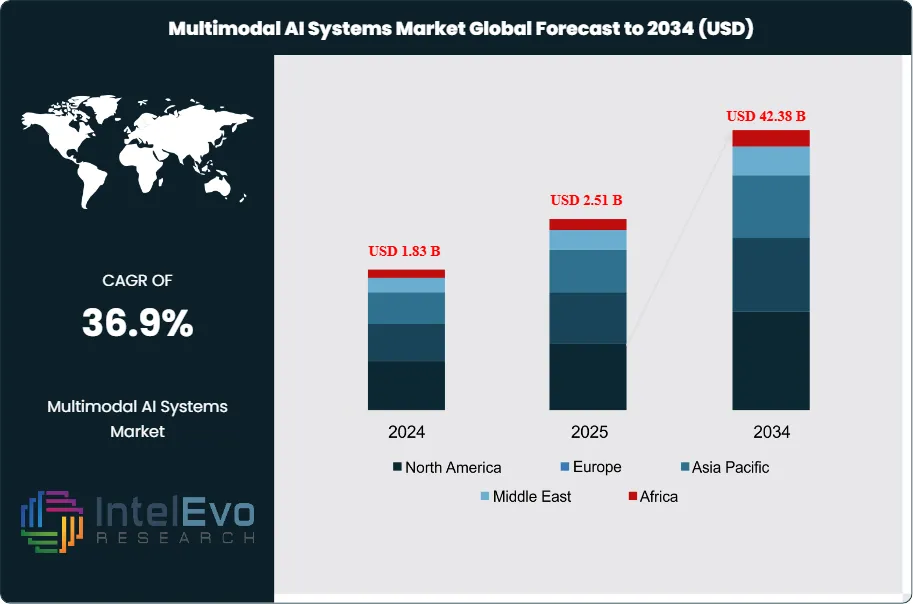
The Multimodal AI Systems Market was valued at approximately USD 1.83 Billion in 2024 and reached USD 2.51 Billion in 2025. The market is projected to grow to USD 42.38 Billion by 2034, expanding at a CAGR of 36.9% during the forecast period from 2026 to 2034. This represents an absolute dollar opportunity of USD 39.87 Billion over the analysis period. Industry analysis indicates that the market is entering a transformative phase where artificial intelligence graduates from text-only processing to a comprehensive sensory emulation of human perception. Unlike traditional unimodal models, multimodal AI systems integrate diverse data formats—including text, images, audio, video, and sensor data—into a unified latent space for processing. Current market assessment shows that this transition is primarily driven by the enterprise requirement for AI that can correlate complex, unstructured datasets to produce contextually accurate and actionable insights.
Get More Information about this report -
Request Free Sample ReportMarket patterns suggest that the demand for these systems is surging across industries such as healthcare, automotive, and retail, where real-time decision-making relies on the synthesis of multiple sensory inputs. Regulatory influences, such as the EU AI Act, are beginning to shape the deployment of these systems by requiring transparency in how different modalities are fused and processed. Technical data indicates that the adoption of transformer-based architectures with native multimodality is the primary enabler for this market expansion. Supply-chain evaluation highlights that the availability of high-performance silicon, specifically AI-optimized Neural Processing Units (NPUs), is facilitating the shift from cloud-dependent processing to edge multimodality.
Risk factors include the high computational costs associated with training and running models that process video and 3D data, which consume significantly more energy than text-only models. However, technology effects such as model distillation and quantized inference are making these systems more accessible for deployment on mobile devices and autonomous robotics. Regional highlights show that North America maintains its position as the primary investment hub for foundation models, while the Asia Pacific region is emerging as a critical adoption hotspot for industrial and consumer multimodal AI. Current evaluations suggest that the maturation of agentic multimodal AI will fundamentally alter the competitive environment in customer service and industrial automation over the forecast period.

Key Takeaways
- Market Growth: The Global Multimodal AI Systems Market is projected to expand from USD 2.51 Billion in 2025 to USD 42.38 Billion by 2034, representing a robust CAGR of 36.9%.
- Segment Dominance: The Software segment held a dominant 66.0% market share in 2025, valued at USD 1.66 Billion, as enterprises prioritize the acquisition of pre-trained multimodal foundation models.
- Segment Dominance: The BFSI vertical emerged as the leading end-user in 2025 with a 24.5% share, utilizing multimodal inputs for enhanced biometric verification and complex fraud analysis.
- Driver: The rise of autonomous systems in automotive and logistics is a primary driver, with 10-year forecasts suggesting that multimodal fusion will become standard in 85.0% of autonomous vehicle platforms by 2034.
- Restraint: High computational costs and GPU supply chain volatility represent a significant restraint, potentially increasing the total cost of ownership for multimodal systems by up to 45.0% over single-modality AI.
- Opportunity: Accessibility solutions for individuals with visual or hearing impairments represent a USD 8.20 Billion untapped opportunity, driven by real-time speech-to-vision and vision-to-speech translation tools.
- Trend: The transition toward Edge Multimodality is a dominant trend, with a 32.0% increase in models optimized for local inference on laptops and smartphones expected through 2027.
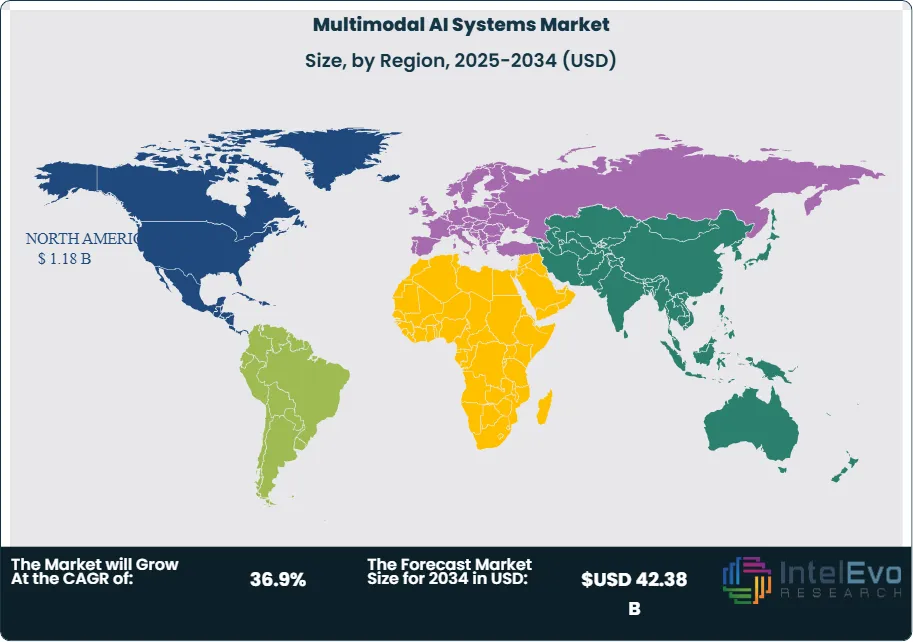
- Regional Analysis: North America remains the leading regional market with a 47.0% share in 2025, valued at USD 1.18 Billion, supported by massive R&D investments in Silicon Valley and Seattle.
Competitive Landscape Overview
The competitive environment of the Global Multimodal AI Systems Market is currently moderately consolidated, with the top four players commanding a combined market share of approximately 54.2% in 2025. Competition is increasingly platform-based, where major hyperscalers provide the underlying infrastructure and foundation models while pure-play AI firms focus on vertical-specific tuning. Nature of competition has shifted from pure parameter size to token throughput efficiency and 'context window' depth, with the ability to ingest hours of video data becoming a key competitive moat. Recent competitive intensity has been characterized by massive joint ventures and infrastructure investments, such as those involving OpenAI, Microsoft, and Google, to secure the compute power necessary for multimodal training.
| Company Name | Headquarters | Market Position | Key Product | Geographic Strength | Recent Strategic Move |
| OPENAI | USA | Leader | GPT-4o | Global | Launched real-time voice/vision API in May 2025 |
| USA | Leader | Gemini 1.5 Pro | Global | Integrated complex part-to-part search in March 2025 | |
| MICROSOFT | USA | Leader | Azure AI Multimodal | North America | Expanded Azure multimodal interactive assistants for 300M users |
| ANTHROPIC | USA | Challenger | Claude 3.7 | North America | Launched safety-centric multimodal model with vision-language reasoning |
| META | USA | Challenger | LLaMA-4 Scout | Global | Released open-source mobile-first multimodal models in late 2025 |
| NVIDIA | USA | Leader | NIM Multimodal | Global | Launched optimized multimodal NIMs for Blackwell chips in 2025 |
| AMAZON AWS | USA | Leader | Bedrock Multimodal | Global | Deployed "Package Decision Engine" for multimodal logistics in 2024 |
| BAIDU | China | Challenger | Ernie Bot Multimodal | Asia Pacific | Integrated multimodal AI into autonomous taxi fleets in 2025 |
| MISTRAL AI | France | Challenger | Mistral Mix | Europe | Released open-weight multimodal modular architectures in 2025 |
| IBM | USA | Challenger | Watsonx.ai | Global | Launched domain-specific multimodal tools for legal and finance in 2025 |
By Offering
Based on supply-chain and demand-side evaluation, the market is segmented into Solutions (Software/Platforms) and Services. The Solutions segment dominated the market in 2025 with a 66.0% share, worth USD 1.66 Billion. This dominance is attributed to the aggressive uptake of AI platforms like AWS, Google Vertex AI, and Microsoft Azure AI, which allow enterprises to integrate text, image, and audio data without building models from scratch. The Services segment, including professional and managed services, accounted for the remaining 34.0% in 2025 (USD 0.85 Billion) but is projected to grow at the highest CAGR through 2034. As companies face the 'Black Box' complexity of fusing varied data streams, the demand for integration and customization services will surge to ensure model reliability in specific production environments.
By Data Modality
The market is categorized by modality into Text, Image, Audio, and Video data. Text data accounted for the largest revenue share in 2025 at 41.2% (USD 1.03 Billion), serving as the foundational anchor for most multimodal systems. However, Image and Video data are accelerating rapidly. Image data multimodal AI reached USD 0.81 Billion in 2025, driven by healthcare diagnostics and retail automation. Video data is emerging as the highest-value modality, projected to grow by 38.0% annually, as surveillance systems and media companies require real-time analysis of high-volume streaming content. Audio and Speech data accounted for 14.8% of the market in 2025, primarily used for customer engagement and voice-activated enterprise interfaces.
By End User
Vertical analysis shows that BFSI led the market in 2025 with a 24.5% share (USD 0.61 Billion). The sector's requirement for intelligent customer service and multi-factor biometric authentication has made it an early adopter. Healthcare followed with a 19.2% share (USD 0.48 Billion), where multimodal AI fuses radiology scans with electronic health records to reduce diagnostic errors by up to 20.0%. Media and Entertainment accounted for 16.5% of revenue, utilizing multimodal systems for automated content indexing and personalized advertising. Other significant sectors include Automotive (15.8%), where sensor fusion is critical for autonomous vehicle safety, and Retail (12.0%), which uses vision-language models for visual search and customer sentiment analysis.
Regional Analysis
North America
North America dominated the market in 2025 with a 47.0% share, generating revenue of USD 1.18 Billion. The region's position is cemented by a sophisticated technological infrastructure and massive investments in AI startups. The United States market alone was valued at USD 1.08 Billion in 2025. Demand is fueled by the widespread adoption of smart devices and the presence of hyperscale cloud providers. Industry analysis shows that North American enterprises are allocating approximately 30.0% of their total AI budgets to multimodal systems as they move beyond simple text-based chatbots toward sensory-rich cognitive assistants.
Europe
Europe held a 22.4% market share in 2025, valued at USD 0.56 Billion. The regional market is characterized by a strong emphasis on sovereign AI and regulatory compliance. The EU AI Act is driving a market for 'Trustworthy Multimodal AI,' with German and French firms leading the development of industrial-grade vision and sensor fusion models. The UK remains a critical hub for AI research, contributing significantly to the region's overall growth. European healthcare and automotive sectors are the primary consumers, prioritizing data privacy and anonymization in multimodal medical imaging and autonomous navigation solutions.
Asia Pacific
The Asia Pacific region accounted for a 19.1% share in 2025 (USD 0.48 Billion) and is expected to exhibit the fastest growth through 2034. China, Japan, and India are the primary growth engines, supported by strategic government initiatives for digital transformation. In China, internet penetration reached 77.5% in 2023, providing a vast dataset for multimodal retail and e-commerce applications. The region is seeing a rapid proliferation of 5G networks, which enables real-time data processing for edge-based multimodal AI in manufacturing and smart cities. India's growing digital ecosystem and large population drive significant demand for multilingual and voice-based AI interfaces.
Latin America
Latin America represented 6.0% of the market in 2025, worth USD 0.15 Billion. Brazil and Mexico are the top regional markets, with adoption centered on retail and financial services. Industry evaluation shows that the region's growth is supported by increasing smartphone penetration and the expansion of digital banking services that utilize multimodal AI for fraud detection and customer support. While infrastructure challenges exist, the adoption of cloud-native AI platforms is lowering the barrier to entry for Latin American SMEs looking to leverage multimodal analytics.
Middle East & Africa
The Middle East & Africa held a 5.5% share in 2025 (USD 0.14 Billion), with Saudi Arabia and the UAE leading the investment. These nations are building national AI capabilities, such as Saudi Arabia's USD 2.14 Billion AI market target for 2025. Large-scale projects like NEOM are driving the demand for net-zero AI data centers capable of handling massive generative workloads. The region is focusing on sovereign AI infrastructure, with initiatives like Stargate UAE aiming to strengthen national security and government service efficiency through multi-sensory AI tools.
Get More Information about this report -
Request Free Sample ReportMarket Key Segments
By Offering
- Software/Solutions
- Services
By Data Modality
- Text Data
- Image Data
- Audio/Speech Data
- Video Data
By Technology
- Natural Language Processing (NLP)
- Computer Vision
- Speech Recognition
- Machine Learning & Deep Learning
- Sensor Fusion
By Vertical
- BFSI
- Healthcare
- Media & Entertainment
- Automotive & Transportation
- Retail & E-commerce
- Manufacturing
- Others
Regional Analysis and Coverage
- North America
- Latin America
- East Asia And Pacific
- Sea And South Asia
- Eastern Europe
- Western Europe
- Middle East & Africa
| Report Attribute | Details |
| Market size (2025) | USD 2.51 B |
| Forecast Revenue (2034) | USD 42.38 B |
| CAGR (2025-2034) | 36.9% |
| Historical data | 2021-2024 |
| Base Year For Estimation | 2025 |
| Forecast Period | 2026-2034 |
| Report coverage | Revenue Forecast, Competitive Landscape, Market Dynamics, Growth Factors, Trends and Recent Developments |
| Segments covered | By Offering, (Software/Solutions, Services), By Data Modality, (Text Data, Image Data, Audio/Speech Data, Video Data), By Technology, (Natural Language Processing (NLP), Computer Vision, Speech Recognition, Machine Learning & Deep Learning, Sensor Fusion), By Vertical, (BFSI, Healthcare, Media & Entertainment, Automotive & Transportation, Retail & E-commerce, Manufacturing, Others) |
| Research Methodology |
|
| Regional scope |
|
| Competitive Landscape | OPENAI, GOOGLE, MICROSOFT, ANTHROPIC, META, NVIDIA, AMAZON AWS, BAIDU, MISTRAL AI, IBM, ALIBABA, DEEPSEEK, CLARIFAI, INC., SENSETIME, TWELVE LABS INC., UNIPHORE TECHNOLOGIES INC., Others |
| Customization Scope | Customization for segments, region/country-level will be provided. Moreover, additional customization can be done based on the requirements. |
| Pricing and Purchase Options | Avail customized purchase options to meet your exact research needs. We have three licenses to opt for: Single User License, Multi-User License (Up to 5 Users), Corporate Use License (Unlimited User and Printable PDF). |


Frequently Asked Questions
How big is the Multimodal AI Systems Market?
Global Multimodal AI systems market valued at USD 1.83B in 2024, reaching USD 42.38B by 2034, growing at a CAGR of 36.9% from 2026–2034.
Who are the major players in the Multimodal AI Systems Market?
OPENAI, GOOGLE, MICROSOFT, ANTHROPIC, META, NVIDIA, AMAZON AWS, BAIDU, MISTRAL AI, IBM, ALIBABA, DEEPSEEK, CLARIFAI, INC., SENSETIME, TWELVE LABS INC., UNIPHORE TECHNOLOGIES INC., Others
Which segments covered the Multimodal AI Systems Market?
By Offering, (Software/Solutions, Services), By Data Modality, (Text Data, Image Data, Audio/Speech Data, Video Data), By Technology, (Natural Language Processing (NLP), Computer Vision, Speech Recognition, Machine Learning & Deep Learning, Sensor Fusion), By Vertical, (BFSI, Healthcare, Media & Entertainment, Automotive & Transportation, Retail & E-commerce, Manufacturing, Others)
How can this market research report help my business make strategic decisions?
Our market research reports provide actionable intelligence, including verified market size data, CAGR projections, competitive benchmarking, and segment-level opportunity analysis. These insights support strategic planning, investment decisions, product development, and market entry strategies for enterprises and startups alike.
How frequently is the data updated?
We continuously monitor industry developments and update our reports to reflect regulatory changes, technological advancements, and macroeconomic shifts. Updated editions ensure you receive the latest market intelligence.

Select Licence Type
Connect with our sales team

Multimodal AI Systems Market
Published Date : 09 Apr 2026 | Formats :Why IntelEvoResearch
100%
Customer
Satisfaction
24x7+
Availability - we are always
there when you need us
200+
Fortune 50 Companies trust
IntelEvoResearch
80%
of our reports are exclusive
and first in the industry
100%
more data
and analysis
1000+
reports published
till date
