

- Home
- Industries
 Aerospace And Defence
 Agriculture
 Automotive And Transportation
 Banking And Finance
 Business
 Chemicals And Materials
 Consumer And Retail
 Electronics And Semiconductors
 Food And Beverages
 Machinery & Equipments
 Manufacturing And Construction
 Medical Devices
 Others
 Pharmaceuticals And Healthcare
 Power And Energy
 Sports
 Technology
- Services
- News Room
- About us
- Contact Us
-
Global Nano-Enhanced Drilling Fluid Market Size, Share | CAGR of 15.5%
Global Nano-Enhanced Drilling Fluid Market Size, Share & Analysis Report By Nanoparticle Type (Silica, Metal Oxide, Carbon-Based, Polymer), By Base Fluid (Water-Based, Oil-Based, Synthetic-Based), By Application (Onshore, Offshore, HPHT Wells, Shale), By End User (Oil & Gas Companies, Drilling Contractors, Service Providers, R&D Institutes): Industry Segment Overview, Market Dynamics, Competitive Strategies, Emerging Technologies, Growth Trends & Forecast 2026–2034

Report Overview
| Market Size (2025) | Forecast Value (2034) | CAGR (2026-2034) | Largest Region (2025) |
|---|---|---|---|
| USD 0.85 Billion | USD 3.10 Billion | 15.5% | North America, 38.0% |
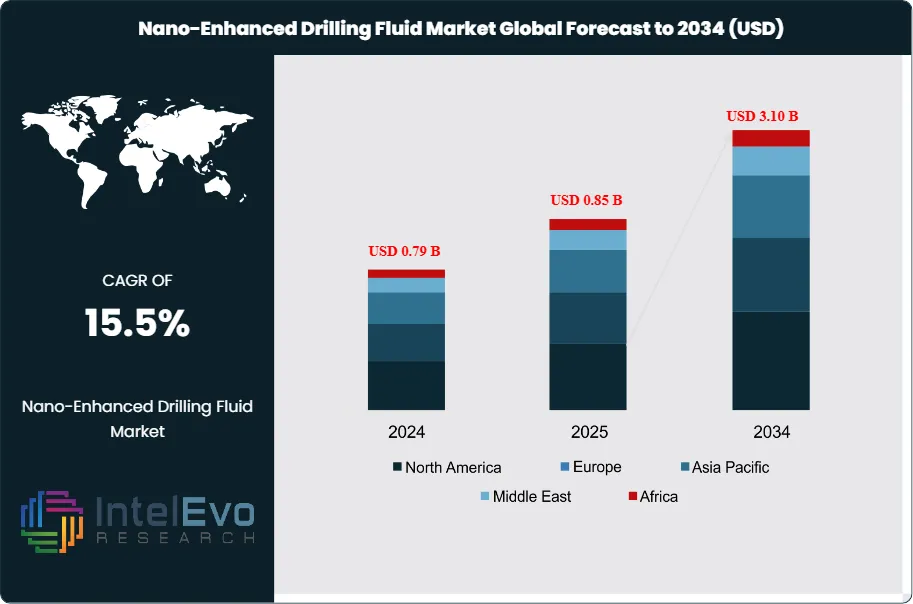
The Nano-Enhanced Drilling Fluid Market was valued at USD 0.79 Billion in 2024 and reached USD 0.85 Billion in 2025. The market is projected to reach USD 3.10 Billion by 2034, expanding at a CAGR of 15.5% during the forecast period from 2026 to 2034. This represents an absolute dollar opportunity of USD 2.25 Billion over the analysis period.
Get More Information about this report -
Request Free Sample ReportDemand for the nano-enhanced drilling fluid market sits inside the broader oilfield drilling fluids parent market, which the U.S. Energy Information Administration cross-correlated rig count and well completion data place at approximately USD 11.0 Billion in 2025. Nano-enhanced fluids represent the fastest-growing additive sub-category, accounting for roughly 7.7% of total drilling fluids spending in 2025 and forecast to climb past 16% by 2034 as operators absorb HPHT (high-pressure, high-temperature) field validation results. Field deployments concentrate in shale plays such as the Bakken Formation in North Dakota and Montana, the Permian Basin in West Texas, the Marcellus and Utica formations, alongside ultra-deepwater developments in the Gulf of Mexico, the UK North Sea, the Brazilian pre-salt, and offshore West Africa. Per EIA forecasts, U.S. crude oil output is set to expand from 13.2 million barrels per day in 2024 to 13.5 million barrels per day in 2025, supporting upstream drilling spend that anchors nano fluid procurement.
Regulatory and procurement pressure shapes commercial economics across the nano-enhanced drilling fluid market. The U.S. Environmental Protection Agency's National Pollutant Discharge Elimination System Outer Continental Shelf permit program governs offshore discharge, while OSPAR Convention rules apply across the Northeast Atlantic and Norwegian Continental Shelf. The North Sea zero-discharge mandate has compelled operators including Equinor and TotalEnergies to migrate toward low-toxicity systems, where nano-additives such as nano-silica and graphene oxide deliver oil-based fluid performance from water-based base systems. ADNOC Offshore awarded ADNOC Drilling Company PJSC a USD 1.63 Billion five-year integrated drilling services contract in April 2025 covering directional drilling, drilling fluids, cementing, and technical support, with nano-additive use embedded in the offshore-well fluid program.
Innovation across the nano-enhanced drilling fluid market runs along three vectors. First, nanoparticle chemistry diversification. Silica (SiO2), alumina (Al2O3), titania (TiO2), graphene oxide (GO), multiwall carbon nanotubes (MWCNT), and nano-laponite formulations dominate published HPHT performance studies, with peer-reviewed concentrations between 0.1 and 5 weight percent showing material rheological gains. Second, OEM-grade commercialization. Halliburton's BaraHib Nano high-performance water-based system delivered a documented USD 25,000 per well savings in operator field cases, while BaraFLC Nano-1 wellbore sealant lowered HPHT fluid loss by 25-30% versus offset wells. Third, partnership-enabled supply chain build-out. NanoXplore's September 18, 2025 multi-year Tribograf graphene supply agreement with Chevron Phillips Chemical anchors the NanoSlide lubricant launched on November 17, 2025, with field trials in the Bakken Formation recording sub-0.05 coefficient of friction. North America captured 38.0% of 2025 revenue, while Asia Pacific is forecast to register the fastest 18.5% CAGR through 2034.
Market Definition and Scope
The nano-enhanced drilling fluid market is defined as the global commercial supply of drilling and completion fluid systems incorporating nanoparticle additives at concentrations between 0.05 and 5 weight percent for the purpose of improving rheological performance, fluid loss control, thermal stability, lubricity, shale inhibition, or wellbore stability during oil and gas well construction. The market includes water-based, oil-based, and synthetic-based fluid systems augmented with nano-additives, alongside the standalone nano-additive products supplied to operators and oilfield service firms.
Included in this analysis are nano-silica (SiO2), nano-alumina (Al2O3), nano-titania (TiO2), graphene oxide (GO), graphene nanoplatelets (GNP), multiwall carbon nanotubes (MWCNT), nano-laponite, nano-zinc oxide (ZnO), iron oxide nanoparticles, calcium carbonate nanoparticles, and proprietary blended carbon products such as Tribograf, deployed in onshore conventional, shale, deepwater, and ultra-deepwater drilling operations. Excluded from scope are nano-enhanced fracturing fluids, nano-enhanced enhanced oil recovery (EOR) fluids, nano-coatings for downhole equipment, nano-sensor reservoir monitoring solutions, and nano-enhanced cementing slurries, each of which constitutes its own oilfield nanotechnology sub-market. The nano-enhanced drilling fluid market sits inside the parent oilfield drilling fluids market and accounted for approximately 7.7% of that USD 11.0 Billion total in 2025.

Key Takeaways
- Market Growth: The nano-enhanced drilling fluid market reached USD 0.85 Billion in 2025 and is projected to reach USD 3.10 Billion by 2034 at a 15.5% CAGR.
- Segment Dominance: By nanoparticle type, nano-silica captured 38.4% of 2025 revenue equivalent to USD 326 Million, supported by HPHT filtration and shale stabilization performance.
- Segment Dominance: By base fluid, water-based nano-enhanced fluids accounted for 52.6% of 2025 revenue, with oil-based and synthetic-based systems together making up the remainder.
- Driver: Bakken Formation field trials of CPChem's NanoSlide graphene lubricant, launched November 17, 2025, recorded coefficient of friction below 0.05, validating nano-lubricant deployment in tight-oil reservoirs and extended-reach laterals.
- Restraint: Nano-additive cost premium ranges from 4 to 12 times conventional bentonite or polymer additives, limiting deployment to wells where HPHT, deepwater, or shale stability complications justify the formulation expense.
- Opportunity: Offshore zero-discharge mandates in the North Sea and Norwegian Continental Shelf create a USD 320 Million addressable opportunity for water-based nano systems substituting for OBM and SBM through 2034.
- Trend: Commercial supply chain integration accelerated, with NanoXplore's September 18, 2025 Tribograf agreement with Chevron Phillips Chemical anchoring graphene supply for the NanoSlide product line at the company's Montreal facility.
- Regional: North America held the leading regional position at 38.0% revenue share, equivalent to USD 323 Million in 2025, anchored by Permian and Bakken shale activity.
Key Insights Summary
- On November 17, 2025, Drilling Specialties (a CPChem division) brought NanoSlide drilling fluid lubricant to commercial release, blending micronized graphene Tribograf and Synfluid PAO into a tribofilm-forming multiphase formulation that consistently registered coefficient of friction below 0.05 in Stribeck-curve tribometer testing at the Kingwood, Texas R&D facility.
- NanoXplore Inc. (TSX:GRA, OTCQX:NNXPF) closed a multi-year Tribograf supply agreement with Chevron Phillips Chemical on September 18, 2025, with shipments commencing October 2025 from the Montreal graphene production plant and addressable market scoped at approximately 70,000 wells annually with average loadings of 2 tonnes of graphene powder per well.
- Halliburton's BaraHib Nano high-performance water-based fluid delivered USD 25,000 per well in operator-documented savings while maintaining HPHT fluid loss between 8-12 ml/30 min at 500 psi and 120°C, registering 25-30% lower filtration than offset wells in vertical gas applications across Oman.
- A November 2025 SPE ADIPEC paper (SPE-229003-MS) aggregated 22 peer-reviewed studies across SiO2, Al2O3, TiO2, and graphene oxide nanoparticles, applying z-score standardization and coefficient-of-variation analysis across rheology, HPHT fluid loss, thermal stability, lubricity, and shale inhibition metrics.
- A January 2025 SLB multi-year contract with Shell for deepwater and ultra-deepwater assets across Trinidad and Tobago, the UK North Sea, and the Gulf of Mexico embedded advanced drilling and completion fluid technologies into the operator's wellbore stability and operational efficiency program.
- Per a February 2026 Springer Interactions peer-reviewed study, water-based drilling fluids dosed with 0.3 g/350 ml nano-SiO2 and graphene reduced HPHT fluid loss by approximately 24% and increased yield point by 36% versus the unmodified base fluid baseline.
Competitive Landscape Overview
The nano-enhanced drilling fluid market is moderately consolidated. The four largest oilfield service companies, Halliburton, SLB (formerly Schlumberger), Baker Hughes, and Newpark Resources, anchor commercial nano-fluid product lines and integrated drilling services contracts, collectively holding an estimated 58% of 2025 revenue. Specialty chemical providers including Chevron Phillips Chemical (Drilling Specialties), Tetra Technologies, and Weatherford International serve niche performance segments such as nano-lubricants and HPHT completion brines. Upstream nanomaterial suppliers including NanoXplore, NanoTech Corp., and university research consortia in Brazil, China, and the United States support OEM formulation development. Competitive levers run along three lines: HPHT performance qualification across PMA-graded laboratory tests, integrated drilling services contract scope including fluids, cementing, and directional services, and proprietary nanoparticle chemistry IP including patented surface-modification protocols. Strategic activity over the trailing 12 months centered on multi-year supply agreements and integrated services contract awards rather than outright M&A.
Competitive Landscape Matrix
| Company | Headquarters | Market Position | Key Product | Geographic Strength | Recent Strategic Move |
|---|---|---|---|---|---|
| Halliburton Company | Houston, TX, USA | Leader | BaraHib Nano, BaraFLC Nano-1 | Global | Q1-Q3 2025 reported revenues of USD 16.53 Billion at parent level, drilling and evaluation segment USD 7.01 Billion |
| SLB | Houston, TX, USA / Paris, France | Leader | High-performance drilling and completion fluids | Global | Concluded January 2025 multi-year deepwater drilling fluid contracts with Shell across Trinidad and Tobago, UK North Sea, and Gulf of Mexico |
| Baker Hughes | Houston, TX, USA | Leader | Drilling fluid systems with nano-additive integration | Global | Continued expansion of HPHT-qualified fluid systems for ultra-deepwater applications |
| Newpark Resources | The Woodlands, TX, USA | Leader | Kronos and Evolution drilling fluid systems | North America, Europe | Inked September 2025 strategic agreement with Intelligent Mud Solutions for autonomous real-time drilling fluid measurement |
| Chevron Phillips Chemical (Drilling Specialties) | The Woodlands, TX, USA | Challenger | NanoSlide drilling fluid lubricant, Tribex ERD | Global | Brought NanoSlide micronized graphene-PAO lubricant to commercial release on November 17, 2025 with successful Bakken field trials |
| NanoXplore Inc. | Montreal, Quebec, Canada | Challenger (supply) | Tribograf graphene powder | Global | Inked multi-year supply agreement with Chevron Phillips Chemical on September 18, 2025 with shipments commencing October 2025 |
| Tetra Technologies | The Woodlands, TX, USA | Challenger | TETRA CS Neptune completion fluids | North America | Continued offshore Gulf of Mexico completion brine deployment in 2025 deepwater development programs |
| Weatherford International | Houston, TX, USA | Niche Player | Drilling fluid systems and additives | Global | Maintained drilling fluid technology portfolio across Middle East and Asia Pacific deployments |
| ADNOC Drilling Company PJSC | Abu Dhabi, UAE | Niche Player (regional) | Integrated drilling services | Middle East | Earned USD 1.63 Billion five-year integrated drilling services contract from ADNOC Offshore in April 2025 |
| ChampionX (now SLB Champion) | The Woodlands, TX, USA | Challenger | Drilling and production chemicals | North America | Integrated into SLB during 2025 following the July 2025 acquisition close |
By Nanoparticle Type
Nano-silica (SiO2) dominated the nano-enhanced drilling fluid market with 38.4% of 2025 revenue equivalent to USD 326 Million. Silica nanoparticles plug nano-pores in shale formations and form thin, low-permeability mud cakes that reduce HPHT filtration by 16-26% versus base fluid in published peer-reviewed studies. Halliburton's BaraFLC Nano-1 wellbore sealant anchors the commercial silica sub-segment, with operator-documented filter cake permeability reductions and improved rheological profiles in vertical gas wells across Oman. Optimal silica concentrations in published studies cluster around 3 weight percent for shale inhibition and 0.3-0.5 weight percent for fluid loss control.
Graphene-based nanoparticles (graphene oxide, graphene nanoplatelets, micronized graphene) captured 26.7% of 2025 revenue and are forecast to grow at an 18.2% CAGR through 2034, the fastest among nanoparticle classes. CPChem's NanoSlide drilling fluid lubricant, brought to commercial release on November 17, 2025, anchors the graphene sub-segment alongside research-grade graphene oxide formulations validated for HPHT and shale applications. NanoXplore's high-aspect-ratio Tribograf product, supplied to CPChem under the September 18, 2025 multi-year agreement, addresses graphene flow restriction limitations that constrained earlier formulations.
Nano-alumina (Al2O3) and nano-titania (TiO2) collectively held 17.5% of 2025 revenue. Alumina nanoparticles serve thermal stability and rheology applications, while titania serves photocatalytic and surface-modification functions. Carbon nanotubes including multiwall (MWCNT) and single-wall variants accounted for 9.6% of revenue, anchored by HPHT oil-based mud applications where MWCNT-bentonite composites have doubled gel strength versus the unmodified baseline in published studies. Other nanoparticles including nano-zinc oxide, iron oxide, calcium carbonate, and nano-laponite represented the remaining 7.8%, with nano-laponite-polymer composites used as filtration reducers in water-based fluids.
By Base Fluid
Water-based nano-enhanced fluids captured 52.6% of the nano-enhanced drilling fluid market in 2025, equivalent to USD 447 Million. Halliburton's BaraHib Nano high-performance water-based system anchors the commercial water-based nano sub-segment for sensitive offshore zones where North Sea zero-discharge mandates rule out oil-based mud. Industry analysis pegged water-based fluids at approximately 47% of total 2025 drilling fluid market revenue, with nano-additives over-indexing the water-based share because of pressure to match OBM performance from a water base.
Oil-based nano-enhanced fluids accounted for 27.3% of 2025 revenue, anchored by ester-based and diesel-based systems supplemented with MWCNT and nano-silica for HPHT shale and tight oil applications. Synthetic-based nano-enhanced fluids captured 20.1% of revenue and are forecast to grow at a 16.8% CAGR through 2034, supported by deepwater and ultra-deepwater operator preference for low-toxicity synthetic systems that reduce environmental compliance costs in the Gulf of Mexico, the UK North Sea, and the Norwegian Continental Shelf.
By Application
Onshore drilling captured 56.4% of nano-enhanced drilling fluid market revenue in 2025, anchored by U.S. shale plays including the Permian Basin, Bakken Formation, and Marcellus Shale. Bakken Formation field trials of CPChem's NanoSlide lubricant validated commercial nano-lubricant deployment in tight-oil reservoirs and extended-reach laterals. The Saudi Aramco Vision 2030 rig count expansion has increased nano-additive procurement in onshore conventional and tight gas wells across the Empty Quarter and adjacent fields. Offshore drilling held 30.4% of revenue, anchored by Gulf of Mexico, North Sea, and West Africa deepwater developments where HPHT and zero-discharge mandates support nano-fluid premiums. Ultra-deepwater (water depths over 1,500 meters) accounted for 13.2% of revenue and is forecast to grow at a 17.5% CAGR through 2034, the fastest among application segments, supported by Brazilian pre-salt and Gulf of Mexico Lower Tertiary developments.
By End User
National oil companies including Saudi Aramco, ADNOC, Petrobras, CNPC, and Pemex captured 41.7% of 2025 nano-enhanced drilling fluid market revenue, reflecting the concentration of upstream activity in NOC-led portfolios. International oil companies including ExxonMobil, Shell, Chevron, BP, TotalEnergies, and Equinor accounted for 38.5% of revenue, anchored by deepwater and HPHT exploration spend. Independent and tight-oil operators represented 19.8% of revenue, anchored by U.S. shale-focused independents in the Permian, Bakken, and Eagle Ford basins.
Regional Analysis
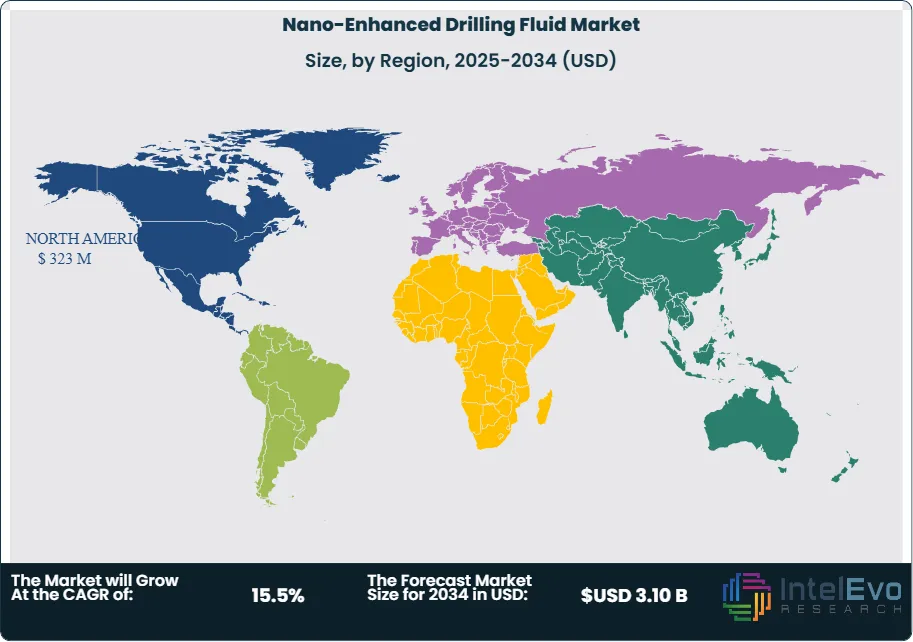
North America generated USD 323 Million in nano-enhanced drilling fluid market revenue in 2025, equivalent to 38.0% of global share. The United States anchors regional demand through Permian Basin, Bakken Formation, Marcellus Shale, Eagle Ford, and Haynesville activity, with U.S. crude oil production forecast at 13.5 million barrels per day in 2025 per the EIA. The Gulf of Mexico hosts the densest deepwater nano-fluid deployment, with Lower Tertiary developments and the Wilcox formation supporting HPHT nano-additive procurement. Bakken Formation field trials of CPChem's NanoSlide lubricant in November 2025 validated commercial graphene-PAO deployment in tight-oil reservoirs. Canadian Montney Shale operators have implemented closed-loop fluid recycling with nano-additive carryover protocols, reducing water usage and disposal costs while maintaining additive performance across multiple well runs.
The Middle East and Africa region contributed USD 187 Million or 22.0% of 2025 revenue. Saudi Arabia leads regional demand under Vision 2030 rig count expansion targeting 13 million barrels per day production capacity, while UAE upstream activity has accelerated under ADNOC Drilling's USD 1.63 Billion April 2025 integrated drilling services contract from ADNOC Offshore. Iraq, Kuwait, Qatar, Oman, and offshore West Africa anchor secondary regional demand. Halliburton documented USD 25,000 per well savings using BaraHib Nano in vertical gas wells in Oman, with the system delivering HPHT fluid loss between 8-12 ml/30 min at 500 psi and 120°C.
Asia Pacific produced USD 153 Million in 2025, holding 18.0% of revenue, and is forecast to register the fastest 18.5% CAGR through 2034. China leads regional growth on the back of CNPC and Sinopec shale-gas activity in the Sichuan Basin and Tarim Basin, while peer-reviewed research from Chinese universities has anchored published HPHT nanoparticle studies. India's Krishna-Godavari Basin, Mumbai High, and Rajasthan field development supports nano-additive procurement, while Indonesia, Malaysia, and Australia anchor offshore deepwater and ultra-deepwater nano-fluid demand. Japan's deepwater methane hydrate research programs have supported HPHT nano-fluid testing through JOGMEC.
Europe accounted for USD 119 Million or 14.0% of 2025 revenue. The UK North Sea, Norwegian Continental Shelf, and Dutch offshore anchor regional demand under OSPAR Convention zero-discharge rules and the EU Offshore Safety Directive. Equinor and TotalEnergies migration toward low-toxicity systems supports water-based nano-fluid procurement substituting for OBM and SBM. Germany, Romania, and the Black Sea support secondary regional activity. Latin America contributed USD 68 Million or 8.0% of 2025 revenue, anchored by Brazilian pre-salt deepwater and ultra-deepwater developments operated by Petrobras and IOC partners. Mexico, Argentina (Vaca Muerta shale), Colombia, and Guyana support secondary regional demand.
Country Analysis
The United States nano-enhanced drilling fluid market reached USD 285 Million in 2025 and is projected to expand at a 14.8% CAGR through 2034. Manufacturing concentration in The Woodlands, Texas (Drilling Specialties / CPChem, Halliburton operational HQ, Newpark Resources), Houston (SLB, Halliburton, Baker Hughes), and Lakewood, Colorado anchors domestic supply. EPA NPDES Outer Continental Shelf permit rules govern Gulf of Mexico discharge, while state regulations in Texas, Oklahoma, North Dakota, and Pennsylvania shape onshore wastewater and produced-water handling. Bakken Formation field deployment of CPChem's NanoSlide lubricant in November 2025 marked the first commercial-scale graphene-PAO nano-lubricant rollout in the U.S. shale corridor.
Saudi Arabia generated USD 95 Million in 2025 with a country CAGR of 15.2% projected through 2034. Saudi Aramco's Vision 2030 rig count expansion targets 13 million barrels per day production capacity by 2027, supporting onshore conventional and tight gas drilling activity in the Khurais, Ghawar, and Empty Quarter fields. Domestic R&D programs at KAUST and KFUPM have anchored published nano-fluid studies, while Aramco's Drilling Technology Team has piloted nano-silica and graphene oxide additives in operator-led trials. Domestic procurement preferences favor integrated drilling services bundled fluid procurement, with Halliburton, SLB, and Baker Hughes dominating commercial supply.
China generated USD 78 Million in 2025 nano-enhanced drilling fluid market revenue and is projected to grow at a 17.8% CAGR through 2034, the fastest among the four reported countries. CNPC and Sinopec shale gas activity in the Sichuan Basin, Junggar Basin, and Tarim Basin anchors domestic demand, while academic R&D at China University of Petroleum, Tsinghua, and Xi'an Jiaotong has driven peer-reviewed nano-fluid publications. China's National Energy Administration five-year shale gas development targets support nano-additive procurement, while domestic chemical producers including Sinopec Shengli Oilfield Service have scaled local supply.
The United Arab Emirates posted USD 62 Million in 2025 with a country CAGR of 16.4% projected through 2034. ADNOC Drilling Company PJSC's USD 1.63 Billion five-year integrated drilling services contract from ADNOC Offshore, awarded in April 2025, anchors offshore well drilling fluid procurement covering directional drilling, drilling fluids, cementing, and technical support. The contract supports ADNOC's expanded offshore production capacity targets through 2030, while embedded nano-additive use ranks among the highest in the Middle East. Domestic R&D at the Petroleum Institute (now part of Khalifa University) has supported nano-fluid laboratory validation programs.
Get More Information about this report -
Request Free Sample ReportKey Market Segment
By Nanoparticle Type
- Silica Nanoparticles
- Metal Oxide Nanoparticles
- Carbon-Based Nanoparticles
- Polymer Nanoparticles
- Others
By Base Fluid
- Water-Based Drilling Fluid (WBF)
- Oil-Based Drilling Fluid (OBF)
- Synthetic-Based Drilling Fluid (SBF)
By Application
- Onshore Drilling
- Offshore Drilling
- High-Pressure High-Temperature (HPHT) Wells
- Shale Drilling
By End User
- Oil & Gas Exploration Companies
- Drilling Contractors
- Oilfield Service Providers
- Research & Development Institutes
By Regional Coverage
- North America
- Latin America
- East Asia And Pacific
- Sea And South Asia
- Eastern Europe
- Western Europe
- Middle East & Africa
| Report Attribute | Details |
| Market size (2025) | USD 0.85 B |
| Forecast Revenue (2034) | USD 3.10 B |
| CAGR (2025-2034) | 15.5% |
| Historical data | 2021-2025 |
| Base Year For Estimation | 2025 |
| Forecast Period | 2026-2034 |
| Report coverage | Revenue Forecast, Competitive Landscape, Market Dynamics, Growth Factors, Trends and Recent Developments |
| Segments covered | By Nanoparticle Type, (Silica Nanoparticles, Metal Oxide Nanoparticles, Carbon-Based Nanoparticles, Polymer Nanoparticles, Others), By Base Fluid, (Water-Based Drilling Fluid (WBF), Oil-Based Drilling Fluid (OBF), Synthetic-Based Drilling Fluid (SBF)), By Application, (Onshore Drilling, Offshore Drilling, High-Pressure High-Temperature (HPHT) Wells, Shale Drilling), By End User, (Oil & Gas Exploration Companies, Drilling Contractors, Oilfield Service Providers, Research & Development Institutes), |
| Research Methodology |
|
| Regional scope |
|
| Competitive Landscape | HALLIBURTON COMPANY, SLB (SCHLUMBERGER LIMITED), BAKER HUGHES COMPANY, NEWPARK RESOURCES INC., CHEVRON PHILLIPS CHEMICAL COMPANY LLC (DRILLING SPECIALTIES), TETRA TECHNOLOGIES INC., WEATHERFORD INTERNATIONAL PLC, NANOXPLORE INC., ADNOC DRILLING COMPANY PJSC, SAUDI ARAMCO, INTELLIGENT MUD SOLUTIONS (IMS), SCOMI GROUP BHD, AKZONOBEL N.V., CLARIANT AG, SECURE ENERGY SERVICES INC., DI-CORP INC., CES ENERGY SOLUTIONS CORP., IMDEX LIMITED, FLOTEK INDUSTRIES INC., SINOPEC SHENGLI OILFIELD SERVICE CORPORATION, CNPC GREATWALL DRILLING, GUMPRO DRILLING FLUIDS PVT. LTD., ANCHOR DRILLING FLUIDS USA LLC, M-I SWACO (SLB), NANOTECH CORP., Others |
| Customization Scope | Customization for segments, region/country-level will be provided. Moreover, additional customization can be done based on the requirements. |
| Pricing and Purchase Options | Avail customized purchase options to meet your exact research needs. We have three licenses to opt for: Single User License, Multi-User License (Up to 5 Users), Corporate Use License (Unlimited User and Printable PDF). |


Frequently Asked Questions
How big is the Nano-Enhanced Drilling Fluid Market?
The Global Nano-Enhanced Drilling Fluid Market was valued at USD 0.79 Billion in 2024 and is projected to reach USD 3.10 Billion by 2034, growing at a CAGR of 15.5% during the forecast period 2026–2034.
Who are the major players in the Nano-Enhanced Drilling Fluid Market?
HALLIBURTON COMPANY, SLB (SCHLUMBERGER LIMITED), BAKER HUGHES COMPANY, NEWPARK RESOURCES INC., CHEVRON PHILLIPS CHEMICAL COMPANY LLC (DRILLING SPECIALTIES), TETRA TECHNOLOGIES INC., WEATHERFORD INTERNATIONAL PLC, NANOXPLORE INC., ADNOC DRILLING COMPANY PJSC, SAUDI ARAMCO, INTELLIGENT MUD SOLUTIONS (IMS), SCOMI GROUP BHD, AKZONOBEL N.V., CLARIANT AG, SECURE ENERGY SERVICES INC., DI-CORP INC., CES ENERGY SOLUTIONS CORP., IMDEX LIMITED, FLOTEK INDUSTRIES INC., SINOPEC SHENGLI OILFIELD SERVICE CORPORATION, CNPC GREATWALL DRILLING, GUMPRO DRILLING FLUIDS PVT. LTD., ANCHOR DRILLING FLUIDS USA LLC, M-I SWACO (SLB), NANOTECH CORP., Others
Which segments covered the Nano-Enhanced Drilling Fluid Market?
By Nanoparticle Type, (Silica Nanoparticles, Metal Oxide Nanoparticles, Carbon-Based Nanoparticles, Polymer Nanoparticles, Others), By Base Fluid, (Water-Based Drilling Fluid (WBF), Oil-Based Drilling Fluid (OBF), Synthetic-Based Drilling Fluid (SBF)), By Application, (Onshore Drilling, Offshore Drilling, High-Pressure High-Temperature (HPHT) Wells, Shale Drilling), By End User, (Oil & Gas Exploration Companies, Drilling Contractors, Oilfield Service Providers, Research & Development Institutes),
How can this market research report help my business make strategic decisions?
Our market research reports provide actionable intelligence, including verified market size data, CAGR projections, competitive benchmarking, and segment-level opportunity analysis. These insights support strategic planning, investment decisions, product development, and market entry strategies for enterprises and startups alike.
How frequently is the data updated?
We continuously monitor industry developments and update our reports to reflect regulatory changes, technological advancements, and macroeconomic shifts. Updated editions ensure you receive the latest market intelligence.

Select Licence Type
Connect with our sales team

Nano-Enhanced Drilling Fluid Market
Published Date : 22 Jul 2026 | Formats :Why IntelEvoResearch
100%
Customer
Satisfaction
24x7+
Availability - we are always
there when you need us
200+
Fortune 50 Companies trust
IntelEvoResearch
80%
of our reports are exclusive
and first in the industry
100%
more data
and analysis
1000+
reports published
till date