

- Home
- Industries
 Aerospace And Defence
 Agriculture
 Automotive And Transportation
 Banking And Finance
 Business
 Chemicals And Materials
 Consumer And Retail
 Electronics And Semiconductors
 Food And Beverages
 Machinery & Equipments
 Manufacturing And Construction
 Medical Devices
 Others
 Pharmaceuticals And Healthcare
 Power And Energy
 Sports
 Technology
- Services
- News Room
- About us
- Contact Us
-
Global Nano Silver Market Size, Growth & Forecast | CAGR of 13.7%
Global Nano Silver Market Size, Share & Analysis Report By Form (Powder, Colloidal Dispersion, Coated Nanoparticles), By Synthesis Method (Chemical, Physical, Green/Biological), By Application (Antimicrobial Coatings, Conductive Inks, Medical, Textiles), By End-Use Industry (Healthcare, Electronics, Textile, Food & Beverage): Regional Segment Overview, Market Dynamics, Competitive Strategies, Key Players, Trends & Forecast 2026–2034

Report Overview
| Market Size (2025) | Forecast Value (2034) | CAGR (2026-2034) | Largest Region (2025) |
| USD 3.67 Billion | USD 11.66 Billion | 13.7% | North America, 35.4% |
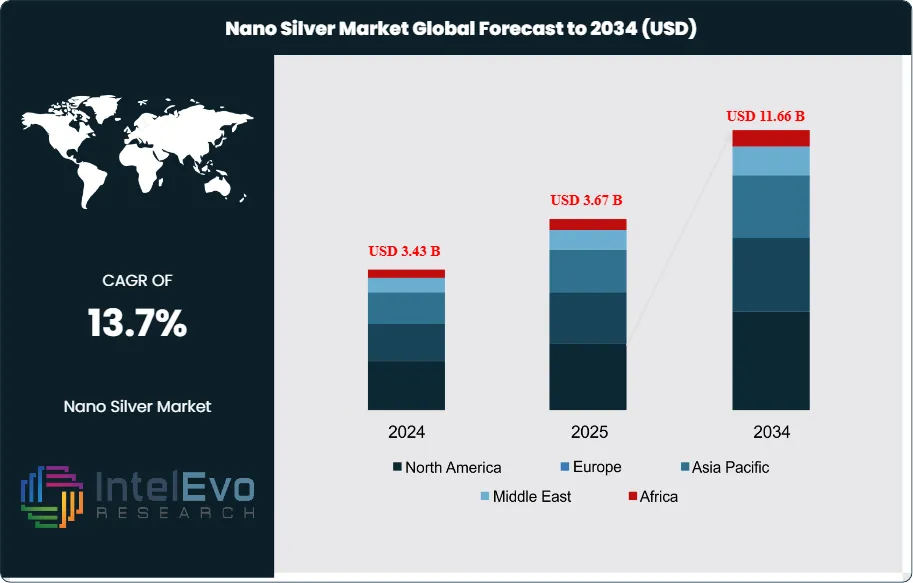
The Nano Silver Market was valued at USD 3.43 Billion in 2024 and reached USD 3.67 Billion in 2025. The market is projected to reach USD 11.66 Billion by 2034, expanding at a CAGR of 13.7% during the forecast period from 2026 to 2034. This represents an absolute dollar opportunity of USD 7.99 Billion over the analysis period. The estimate uses a narrow scope covering engineered silver nanoparticles, nano silver powders, colloids, dispersions, masterbatches, and nano silver conductive inks, while excluding conventional silver salts and finished consumer goods where silver content is not disclosed.
Get More Information about this report -
Request Free Sample ReportDemand for the nano silver market is anchored by two application clusters: antimicrobial performance and high-conductivity electronics. Healthcare, textile, coating, and water-treatment buyers use nano silver because controlled silver-ion release can reduce bacterial growth on wound dressings, catheters, filters, polymers, and coated surfaces. Electronics buyers use silver nanoparticle inks because low-temperature sintering supports flexible circuits, RFID antennas, sensors, and photovoltaic interconnects on polymer substrates that cannot tolerate high heat.
Regulation is becoming a market-shaping force because nano silver sits between materials chemistry, biocides, food contact, cosmetics, medical devices, and occupational safety. The U.S. EPA regulates pesticidal antimicrobial claims under FIFRA, the FDA evaluates nanotechnology-enabled products under product-specific statutes, and NIOSH recommends a 0.9 microgram per cubic meter 8-hour respirable exposure limit for silver nanomaterials with primary particle size at or below 100 nm. In Europe, REACH, CLP, the Biocidal Products Regulation, and EFSA food-additive assessments create a higher documentation burden for suppliers that sell into coatings, packaging, and consumer-health channels.
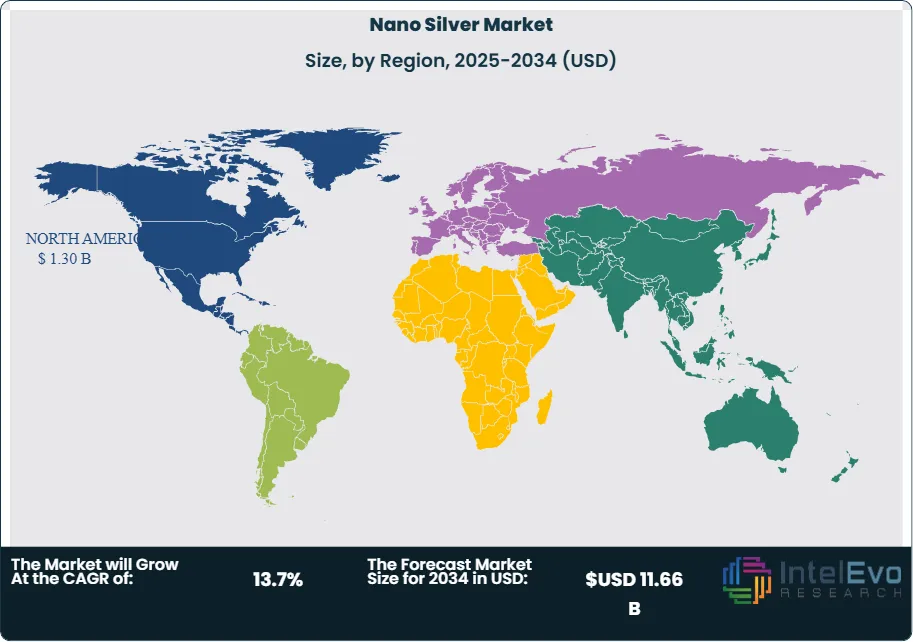
North America held 35.4% of the nano silver market in 2025, supported by U.S. medical-device development, antimicrobial textile demand, and flexible-electronics research in California, Massachusetts, Texas, and Ontario. Asia Pacific captured 31.5% because China, Japan, South Korea, and India combine electronics manufacturing with low-cost nanomaterial synthesis capacity. Europe accounted for 24.0% because Germany, France, the United Kingdom, Italy, and the Netherlands maintain strict materials compliance systems that reward suppliers with documented particle-size distribution, surface chemistry, and leaching data.
The nano silver market will not grow as a commodity powder business through 2034. The highest-margin revenue will come from validated dispersions, surface-modified particles, GMP-adjacent grades, and electronic inks where particle uniformity, endotoxin control, residue after sintering, and migration behavior determine customer acceptance. Silver price volatility, which intensified during the 2025 silver rally, will push users toward lower loading levels, hybrid antimicrobial systems, copper-silver ink blends, and supplier contracts that include indexed metal pass-through clauses.
Market Definition & Scope
The nano silver market is defined as the global commercial activity surrounding engineered silver particles with at least one external dimension generally between 1 nm and 100 nm, plus closely related nanoscale dispersions, powders, coatings, masterbatches, and inks sold for their antimicrobial, electrical, optical, catalytic, and sensing properties. The market encompasses spherical silver nanoparticles, nanoplates, nanowires, colloidal silver particles, PVP- or citrate-stabilized dispersions, polymer-compatible masterbatches, and nano silver conductive inks used by American Elements, nanoComposix, Nanoshel, Merck KGaA, and Thermo Fisher Scientific customers.
This analysis includes raw nano silver materials, surface-modified grades, research-grade particles, industrial dispersions, and engineered formulations sold to healthcare, electronics, textiles, coatings, water treatment, packaging, cosmetics, and agriculture users. It excludes bulk silver powder, micron-scale silver flake paste, silver nitrate, silver zeolites without nanoscale particle disclosure, conventional ionic silver antimicrobials, finished wound dressings, finished apparel, and consumer products that contain nano silver but are sold primarily under a downstream brand.

Key Takeaways
- Market Growth: The nano silver market increased to USD 3.67 Billion in 2025 and is forecast to reach USD 11.66 Billion by 2034 at a 13.7% CAGR, creating USD 7.99 Billion in added revenue.
- Segment Dominance: Colloidal dispersions and liquid formulations led by form with 43.5% share in 2025, equal to USD 1.60 Billion, because electronics, coatings, and biomedical users prefer ready-to-dose material systems.
- Segment Dominance: Electronics and conductive inks led applications with 34.8% share in 2025, equal to USD 1.28 Billion, ahead of healthcare and life sciences at 27.6%.
- Driver: Antimicrobial material demand is the primary driver, with NIOSH, EPA, FDA, and EU frameworks turning particle characterization into a purchasing criterion for healthcare, textiles, and coated polymers.
- Restraint: Toxicology and migration uncertainty restrain food-contact and consumer-goods adoption, reinforced by EFSA's 2025 inability to conclude on the safety of silver food additive E 174.
- Opportunity: Nano silver conductive inks represent a USD 1.28 Billion 2025 application base and will add approximately USD 2.90 Billion by 2034 as flexible electronics and photovoltaic metallization expand.
- Trend: Green synthesis moved from laboratory novelty to commercialization pathway, with 2025 and 2026 studies demonstrating 25-50 nm particles, plant-mediated reduction, and room-temperature fabrication routes.
- Regional: North America led with 35.4% share and USD 1.30 Billion in 2025 revenue, while Asia Pacific will post the fastest regional CAGR at approximately 14.9% through 2034.
Key Insights Summary
- NIOSH recommends a 0.9 microgram per cubic meter 8-hour respirable exposure limit for silver nanomaterials with primary particle size at or below 100 nm, compared with 10 micrograms per cubic meter for total silver.
- American Elements offers nanoscale silver particles across a 10-200 nm range with specific surface area of 30-60 square meters per gram, showing the breadth required for coatings, catalysis, and antimicrobial polymers.
- nanoComposix sells silver nanospheres and nanocubes across 2-199 nm ranges, with citrate, PVP, and silica-shell surface chemistries that support biosensors, antimicrobial coatings, and conductive composites.
- Nanoshel lists 99.9% silver nanoparticle grades with 30-50 nm average particle size and 50-80 nm nanopowder options, placing research and industrial buyers inside the same supply funnel.
- Silver's share of industrial demand used by photovoltaics reached 29% in 2024 versus 11% in 2014, reinforcing the raw-material price pressure facing nano silver conductive ink makers.
- A 2026 Scientific Reports study described room-temperature 25-50 nm silver nanoparticles that degraded more than 89% of two industrial dyes in 180 minutes and printed circuits powering 240 LEDs.
- EFSA's April 2025 follow-up assessment of silver E 174 found submitted physicochemical and toxicity data inadequate, raising the compliance threshold for nano silver uses connected to food and packaging.
Competitive Landscape Overview
The nano silver market is fragmented, with the top four suppliers accounting for approximately 28% of 2025 revenue because production is spread across specialty nanomaterial houses, catalog chemical suppliers, coating-technology firms, and conductive-ink formulators. Competition is based on particle-size control, surface chemistry, dispersion stability, endotoxin levels, lot documentation, and ability to meet EPA, FDA, REACH, CLP, and customer-specific quality files. American Elements and Nanoshel compete through broad industrial catalogs. nanoComposix and Merck KGaA compete through research-grade characterization and life-science channel access.
Competition is shifting away from basic silver nanopowder toward validated materials packages. Buyers comparing nano silver vendors now request transmission electron microscopy data, zeta potential, ionic silver release profiles, residual dispersant levels, and leach-test documentation. Price remains relevant, but material reproducibility determines repeat revenue in medical coatings, biosensors, printed electronics, and antimicrobial polymers.
Competitive Landscape Matrix
| Company Name | Headquarters | Market Position | Key Product/Solution | Geographic Strength | Recent Strategic Move |
| American Elements | United States | Leader | Silver nanoparticles, nanofluids, nanoprism grades | North America, Europe, Asia Pacific | Maintained 10-200 nm commercial nano silver portfolio with 30-60 m2/g grades for industrial users |
| nanoComposix, Fortis Life Sciences | United States | Leader | Silver nanospheres, nanocubes, silica-shelled silver | North America, Europe | Expanded catalog depth across 2-199 nm particles and multiple surface chemistries for research and device programs |
| Nanoshel LLC | United States / India | Leader | Silver nanoparticles, nanopowders, dispersions | Asia Pacific, North America, Europe | Listed 99.9% 30-50 nm and 50-80 nm grades for antimicrobial paints and medical-use research channels |
| Merck KGaA | Germany | Leader | Silver nanopowder and analytical nanomaterial products | Europe, North America, Asia Pacific | Reported EUR 21.1 Billion 2025 group sales and continued Life Science material-supply focus |
| Thermo Fisher Scientific Inc. | United States | Challenger | Research-grade silver nanoparticle reagents and analytical tools | Global | Reported USD 44.56 Billion 2025 revenue and sustained demand for laboratory products and services |
| Advanced Nano Products Co., Ltd. | South Korea | Challenger | Metal nanoparticles, electronic materials, conductive materials | Asia Pacific | Served electronics users tied to Korean display, battery, and printed-device supply chains |
| NovaCentrix | United States | Challenger | Metalon conductive inks and PulseForge processing systems | North America, Europe, Asia Pacific | Focused on silver-based conductive inks for flexible printed electronics and low-temperature substrates |
| Bio-Gate AG | Germany | Niche Player | HyProtect silver-containing antimicrobial coating | Europe, North America | Expanded North American animal-care products in April 2025 and advanced HyProtect implant validation |
| Cytodiagnostics Inc. | Canada | Niche Player | Functionalized silver nanoparticles for life science research | North America, Europe | Maintained custom nanoparticles and conjugation services for biosensor and diagnostic workflows |
| Hongwu International Group Ltd. | China | Niche Player | Silver nanopowders, nanowires, dispersions | Asia Pacific | Supplied cost-focused nano silver materials into coatings, textile, and electronics channels |
Segmentation Analysis
The nano silver market segments by form, synthesis method, application, and end-use industry, with economics shaped by particle morphology, dispersion stability, regulatory status, and customer validation costs.
By Form
The nano silver market by form is led by colloidal dispersions and liquid formulations at 43.5% share in 2025, equal to USD 1.60 Billion. Dispersions command the lead because coatings, inks, sensors, and biomedical users need particles already stabilized in water, ethanol, DMF, IPA, or polymer-compatible carriers. American Elements, nanoComposix, Nanoshel, and Cytodiagnostics support this model with citrate, PVP, silica-shell, and custom-ligand systems. Dispersions reduce customer processing risk compared with dry powders because agglomeration can destroy antimicrobial release profiles and electrical conductivity.
Nanopowders held 27.0% share in 2025, equal to USD 0.99 Billion, with demand concentrated in antimicrobial paints, polymer compounding, research synthesis, and catalytic use. Nanoshel's 99.9% powder grades and American Elements' high-purity offerings show how vendors serve both laboratory and industrial buyers. Nanowires, nanoplates, and nanocubes held 14.5% share because optical, sensing, and transparent-conductor uses demand anisotropic shapes. Masterbatches and coated additives captured 15.0%, driven by textile, plastic, and hygiene applications where nano silver must be locked into a host matrix.
By Synthesis Method
The nano silver market by synthesis method is led by wet chemical reduction at 48.2% share in 2025, equal to USD 1.77 Billion. Wet chemistry remains dominant because sodium borohydride, citrate, ascorbate, polyol, and PVP-assisted routes offer size control, batch repeatability, and accessible scale-up. nanoComposix, Merck KGaA, American Elements, and university spinout suppliers use wet routes for nanospheres, nanocubes, and dispersion products. The method's drawback is post-synthesis cleaning because residual reductants and stabilizers can affect cytotoxicity, conductivity, and food-contact migration.
Biological and green synthesis accounted for 22.4% share in 2025, equal to USD 0.82 Billion, and is the fastest-growing synthesis route at an estimated 15.6% CAGR. Plant extracts, microbial systems, algae, and agricultural waste streams can reduce silver ions while acting as capping agents, which attracts buyers under sustainability and solvent-reduction programs. Physical and vapor methods held 16.0%, ion implantation 7.5%, and other hybrid routes 5.9%. Physical methods cost more per kilogram, but they serve electronics and high-purity research markets where ionic contamination matters.
By Application
The nano silver market by application is led by electronics and conductive inks at 34.8% share in 2025, equal to USD 1.28 Billion. Silver nanoparticle inks serve flexible circuits, antennas, biosensor traces, wearable devices, photovoltaic metallization, display components, and printed circuit repair. NovaCentrix, DuPont Electronics, Heraeus, Advanced Nano Products, and conductive-ink specialists compete with metal loading, sintering temperature, viscosity, substrate adhesion, and line resistance. The strongest procurement case appears when low-temperature processing allows printing on PET, paper, or textile substrates that cannot survive conventional firing.
Healthcare and life sciences held 27.6% share in 2025, equal to USD 1.01 Billion, supported by wound-care research, antimicrobial coatings, biosensors, diagnostic reagents, and experimental drug-delivery studies. Bio-Gate, nanoComposix, Merck KGaA, Cytodiagnostics, and Thermo Fisher Scientific supply this channel through coated surfaces, functionalized particles, or characterization instruments. Textiles and industrial coatings captured 17.4%, water treatment 8.2%, and food packaging, cosmetics, and agriculture 12.0%. Food-contact use is more constrained than medical research because EFSA and FDA scrutiny centers on migration, particle transformation, and dietary exposure.
By End-Use Industry
Electronics manufacturers represented 32.5% of nano silver market demand in 2025, equal to USD 1.19 Billion, with China, South Korea, Japan, Taiwan, and the United States forming the core buyer base. The segment uses nano silver for conductivity, printable circuitry, thermal interface materials, and miniaturized sensor structures. Medical device and healthcare users represented 28.0%, with demand tied to antimicrobial surfaces, wound dressings, catheters, implant coatings, and diagnostic assays. This segment accepts higher prices when suppliers provide bioburden, endotoxin, and lot-to-lot characterization records.
Textile, coating, and polymer users captured 20.5% share in 2025 because nano silver enables odor-control, hygiene, and material-preservation claims when compliant with EPA, BPR, and country-level rules. Water treatment and environmental users held 8.5%, led by filters, membranes, photocatalytic materials, and pathogen-control trials. Cosmetics, packaging, and agriculture represented 10.5%, but this demand carries the highest regulatory friction because consumer exposure, nanoscale transformation, and environmental release remain active review topics in the United States, Canada, and the European Union.
Regional Analysis
The nano silver market shows regional concentration in North America, Asia Pacific, and Europe, while Latin America and Middle East & Africa remain application-specific growth corridors.
North America: North America led the nano silver market with 35.4% share and USD 1.30 Billion in 2025 revenue. The United States accounted for approximately USD 1.08 Billion, Canada USD 0.16 Billion, and Mexico USD 0.06 Billion. Demand is driven by medical coatings, antimicrobial textiles, printed electronics, water-treatment materials, and life-science research. EPA's FIFRA pathway governs antimicrobial claims for treated articles, FDA guidance shapes drug, device, food-contact, and cosmetic uses, and NIOSH's 0.9 microgram per cubic meter silver nanomaterial REL influences manufacturing controls. American Elements, nanoComposix, Thermo Fisher Scientific, NovaCentrix, and Sciessent form the regional supplier base.
Asia Pacific: Asia Pacific captured 31.5% of the nano silver market in 2025, equal to USD 1.16 Billion, and will grow at the fastest regional CAGR of approximately 14.9% through 2034. China, Japan, South Korea, India, and Taiwan anchor demand through electronics, antimicrobial textiles, flexible displays, sensors, and low-cost nanopowder production. China and India supply price-sensitive powders and dispersions, while Japan and South Korea focus on electronic materials and high-purity formulations. The region's manufacturing advantage is counterbalanced by tighter export documentation and customer audits from U.S. and EU buyers.
Europe: Europe held 24.0% of the nano silver market in 2025, equivalent to USD 0.88 Billion. Germany, France, the United Kingdom, Italy, and the Netherlands dominate because they combine medical-device clusters, specialty chemicals, textile finishing, and advanced coatings. REACH registration, CLP classification, the Biocidal Products Regulation, and EFSA food-additive review make Europe the strictest compliance region for nano silver suppliers. Merck KGaA and Bio-Gate AG are regional anchors, while ECHA's 2026 silver chloride consultation and 2025 silver nitrate classification work increase the need for toxicology files and downstream-use mapping.
Latin America: Latin America accounted for 5.0% of the nano silver market in 2025, equal to USD 0.18 Billion, with Brazil, Mexico, Chile, and Argentina leading regional demand. Adoption is concentrated in antimicrobial textiles, industrial coatings, water filtration, and university-led nanotechnology programs. Brazil's healthcare manufacturing base and Mexico's medical-device export sector create demand for suppliers that can document particle size, stability, and antimicrobial performance. Import reliance keeps prices sensitive to silver and currency volatility, so distributors favor multi-grade catalog suppliers such as American Elements, Nanoshel, and Asian nanopowder producers.
Middle East & Africa: Middle East and Africa held 4.1% of the nano silver market in 2025, equal to USD 0.15 Billion. Demand is concentrated in Saudi Arabia, the United Arab Emirates, Israel, South Africa, and Turkey through hospital-surface coatings, water-treatment materials, research nanomaterials, and antimicrobial polymers. The Gulf region links nano silver use to healthcare infrastructure and desalination-adjacent filtration research. South Africa and Turkey support coatings and textile applications, but limited domestic particle-characterization capacity slows qualification for medical and food-contact grades.
Country Analysis
Country-level nano silver market performance is led by the United States, China, Germany, and India because these countries combine materials supply, downstream manufacturing, and regulatory influence.
United States: The United States nano silver market reached USD 1.08 Billion in 2025 and is forecast to grow at a 13.1% CAGR through 2034. Demand is concentrated in California, Texas, Massachusetts, Minnesota, and North Carolina across medical devices, flexible electronics, antimicrobial textiles, and water-treatment research. EPA registration requirements apply when nano silver is used to make pesticidal antimicrobial claims, while FDA nanotechnology guidance applies product-by-product in drugs, devices, cosmetics, and food-contact materials. NIOSH's 0.9 microgram per cubic meter REL has become a practical benchmark for powder handling and dispersion manufacturing.
China: China's nano silver market reached approximately USD 0.54 Billion in 2025 and is projected to expand at a 15.5% CAGR through 2034. Demand is tied to electronics, conductive inks, textile finishing, packaging research, and low-cost nanomaterial supply. Chinese suppliers including Hongwu International compete with U.S., Korean, and Japanese vendors on price and custom particle forms. Domestic printed-electronics growth and solar supply-chain depth support nano silver use, but foreign customers increasingly request batch-level TEM, ICP-MS, and zeta-potential records before qualifying Chinese material.
Germany: Germany's nano silver market reached approximately USD 0.31 Billion in 2025, with a country-level CAGR of 12.4% through 2034. Merck KGaA, Bio-Gate AG, medical-device clusters in Bavaria and Baden-Wurttemberg, and coatings companies in North Rhine-Westphalia anchor domestic demand. Bio-Gate's HyProtect platform connects silver-containing antimicrobial coatings with implant and veterinary-care applications. German buyers treat REACH, CLP, BPR, ISO 10993 biocompatibility, and MDR documentation as procurement requirements rather than post-sale compliance tasks.
India: India's nano silver market reached approximately USD 0.22 Billion in 2025 and is forecast to grow at a 15.2% CAGR through 2034. Demand comes from textile finishing, antimicrobial paints, wound-care research, electronics, water purification, and green-synthesis research. Nanoshel's India-linked supply footprint and university laboratories in Hyderabad, Chennai, Pune, Bengaluru, and Delhi support domestic know-how. A 2026 Indian-led study on room-temperature silver nanoparticles for dye degradation and printed circuits reflects the country's shift from laboratory synthesis toward multi-application engineering.
Get More Information about this report -
Request Free Sample ReportKey Market Segment
By Form
- Powder
- Colloidal Dispersion
- Suspension
- Coated Nanoparticles
By Synthesis Method
- Chemical Reduction
- Physical Synthesis
- Biological (Green) Synthesis
- Others
By Application
- Antimicrobial Coatings
- Conductive Inks & Electronics
- Medical & Healthcare
- Textiles
- Catalysts
- Water Treatment
- Others
By End-Use Industry
- Healthcare & Pharmaceuticals
- Electronics & Electrical
- Textile
- Food & Beverage
- Water Treatment
- Consumer Goods
- Others
By Regional Coverage
- North America
- Latin America
- East Asia And Pacific
- Sea And South Asia
- Eastern Europe
- Western Europe
- Middle East & Africa
| Report Attribute | Details |
| Market size (2025) | USD 3.67 B |
| Forecast Revenue (2034) | USD 11.66 B |
| CAGR (2025-2034) | 13.7% |
| Historical data | 2021-2025 |
| Base Year For Estimation | 2025 |
| Forecast Period | 2026-2034 |
| Report coverage | Revenue Forecast, Competitive Landscape, Market Dynamics, Growth Factors, Trends and Recent Developments |
| Segments covered | By Form, Powder, (Colloidal Dispersion, Suspension, Coated Nanoparticles), By Synthesis Method, (Chemical Reduction, Physical Synthesis, Biological (Green) Synthesis, Others), By Application, (Antimicrobial Coatings, Conductive Inks & Electronics, Medical & Healthcare, Textiles, Catalysts, Water Treatment, Others), By End-Use Industry, (Healthcare & Pharmaceuticals, Electronics & Electrical, Textile, Food & Beverage, Water Treatment, Consumer Goods, Others), |
| Research Methodology |
|
| Regional scope |
|
| Competitive Landscape | AMERICAN ELEMENTS, NANOCOMPOSIX, FORTIS LIFE SCIENCES, NANOSHEL LLC, MERCK KGAA, THERMO FISHER SCIENTIFIC INC., ADVANCED NANO PRODUCTS CO., LTD., NOVACENTRIX, BIO-GATE AG, CYTODIAGNOSTICS INC., HONGWU INTERNATIONAL GROUP LTD., US RESEARCH NANOMATERIALS, INC., CREATIVE DIAGNOSTICS, MELIORUM TECHNOLOGIES INC., NANOCS INC., ASCENSUS SPECIALTIES LLC, SCIESSENT LLC, DUPONT ELECTRONICS, HERAEUS HOLDING GMBH, OTHERS |
| Customization Scope | Customization for segments, region/country-level will be provided. Moreover, additional customization can be done based on the requirements. |
| Pricing and Purchase Options | Avail customized purchase options to meet your exact research needs. We have three licenses to opt for: Single User License, Multi-User License (Up to 5 Users), Corporate Use License (Unlimited User and Printable PDF). |


Frequently Asked Questions
How big is the Nano Silver Market?
The Global Nano Silver Market was valued at USD 3.43 Billion in 2024 and is projected to reach USD 11.66 Billion by 2034, growing at a CAGR of 13.7% during the forecast period 2026–2034.
Who are the major players in the Nano Silver Market?
AMERICAN ELEMENTS, NANOCOMPOSIX, FORTIS LIFE SCIENCES, NANOSHEL LLC, MERCK KGAA, THERMO FISHER SCIENTIFIC INC., ADVANCED NANO PRODUCTS CO., LTD., NOVACENTRIX, BIO-GATE AG, CYTODIAGNOSTICS INC., HONGWU INTERNATIONAL GROUP LTD., US RESEARCH NANOMATERIALS, INC., CREATIVE DIAGNOSTICS, MELIORUM TECHNOLOGIES INC., NANOCS INC., ASCENSUS SPECIALTIES LLC, SCIESSENT LLC, DUPONT ELECTRONICS, HERAEUS HOLDING GMBH, OTHERS
Which segments covered the Nano Silver Market?
By Form, Powder, (Colloidal Dispersion, Suspension, Coated Nanoparticles), By Synthesis Method, (Chemical Reduction, Physical Synthesis, Biological (Green) Synthesis, Others), By Application, (Antimicrobial Coatings, Conductive Inks & Electronics, Medical & Healthcare, Textiles, Catalysts, Water Treatment, Others), By End-Use Industry, (Healthcare & Pharmaceuticals, Electronics & Electrical, Textile, Food & Beverage, Water Treatment, Consumer Goods, Others),
How can this market research report help my business make strategic decisions?
Our market research reports provide actionable intelligence, including verified market size data, CAGR projections, competitive benchmarking, and segment-level opportunity analysis. These insights support strategic planning, investment decisions, product development, and market entry strategies for enterprises and startups alike.
How frequently is the data updated?
We continuously monitor industry developments and update our reports to reflect regulatory changes, technological advancements, and macroeconomic shifts. Updated editions ensure you receive the latest market intelligence.

Select Licence Type
Connect with our sales team

Why IntelEvoResearch
100%
Customer
Satisfaction
24x7+
Availability - we are always
there when you need us
200+
Fortune 50 Companies trust
IntelEvoResearch
80%
of our reports are exclusive
and first in the industry
100%
more data
and analysis
1000+
reports published
till date