

- Home
- Industries
 Aerospace And Defence
 Agriculture
 Automotive And Transportation
 Banking And Finance
 Business
 Chemicals And Materials
 Consumer And Retail
 Electronics And Semiconductors
 Food And Beverages
 Machinery & Equipments
 Manufacturing And Construction
 Medical Devices
 Others
 Pharmaceuticals And Healthcare
 Power And Energy
 Sports
 Technology
- Services
- News Room
- About us
- Contact Us
-
Global Nano Titanium Dioxide Market Size, Share | CAGR of 6.9%
Global Nano Titanium Dioxide Market Size, Share & Analysis Report By Crystal Structure (Anatase, Rutile, Brookite), By Form (Powder, Dispersion, Coated Nanoparticles), By Application (Photocatalysts, UV Protection, Self-Cleaning, Energy Storage), By End-Use Industry (Paints & Coatings, Cosmetics, Electronics, Healthcare, Energy): Regional Segment Overview, Market Dynamics, Competitive Strategies, Key Players, Trends & Forecast 2026–2034

Report Overview
| Market Size (2025) | Forecast Value (2034) | CAGR (2026-2034) | Largest Region (2025) |
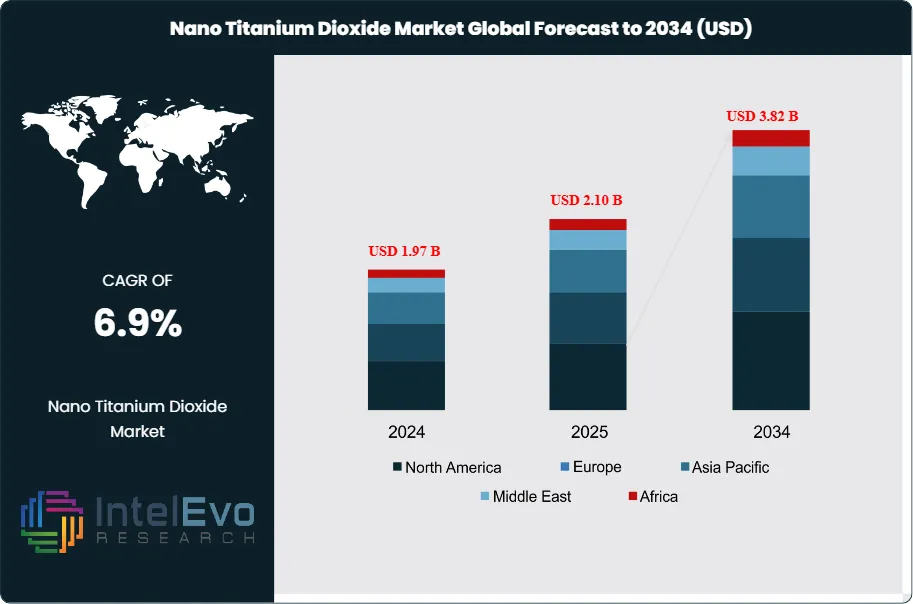
| USD 2.10 Billion | USD 3.82 Billion | 6.9% | Asia Pacific, 41.6% |
The Nano Titanium Dioxide Market was valued at USD 1.97 Billion in 2024 and reached USD 2.10 Billion in 2025. The market is projected to reach USD 3.82 Billion by 2034, expanding at a CAGR of 6.9% during the forecast period from 2026 to 2034. This represents an absolute dollar opportunity of USD 1.72 Billion over the analysis period. The nano titanium dioxide market is defined around engineered nanoscale and ultrafine titanium dioxide grades, not commodity white pigment, which keeps the scope tied to specialty UV filtration, transparent coatings, photocatalysis, energy materials, and high-purity additives.
Get More Information about this report -
Request Free Sample ReportDemand in the nano titanium dioxide market is anchored by three application clusters. Mineral sunscreen and beauty formulations use coated rutile nano TiO2 for transparent ultraviolet protection, with the European cosmetics framework allowing titanium dioxide nano as a UV filter up to 25% in ready-to-use products where inhalation exposure is excluded. Photocatalytic coatings, self-cleaning glass, water treatment membranes, and antimicrobial surfaces use anatase or mixed-phase nano TiO2 because nanoscale surface area raises light-driven reaction density. Battery, catalyst, and photovoltaic developers use fumed nano TiO2 grades such as AEROXIDE TiO2 P 25, which carries a 35-65 m2/g BET surface-area specification.
Regulation sets the commercial boundary for the nano titanium dioxide market because the same chemistry can be treated differently by application and exposure route. In the United States, titanium dioxide and zinc oxide remain the mineral UV filters positioned as generally recognized as safe and effective under the 2021 proposed sunscreen order, while the FDA proposed adding bemotrizinol at a 6% maximum level in December 2025. In Europe, the Scientific Committee on Consumer Safety accepted a September 2025 mandate to reassess nano and non-nano titanium dioxide in cosmetics, with oral cosmetic grades and particle-count thresholds under review. EPA TSCA nanoscale reporting under 40 CFR 704.20 and NIOSH workplace guidance at 0.3 mg/m3 for ultrafine TiO2 shape powder handling and procurement specifications.
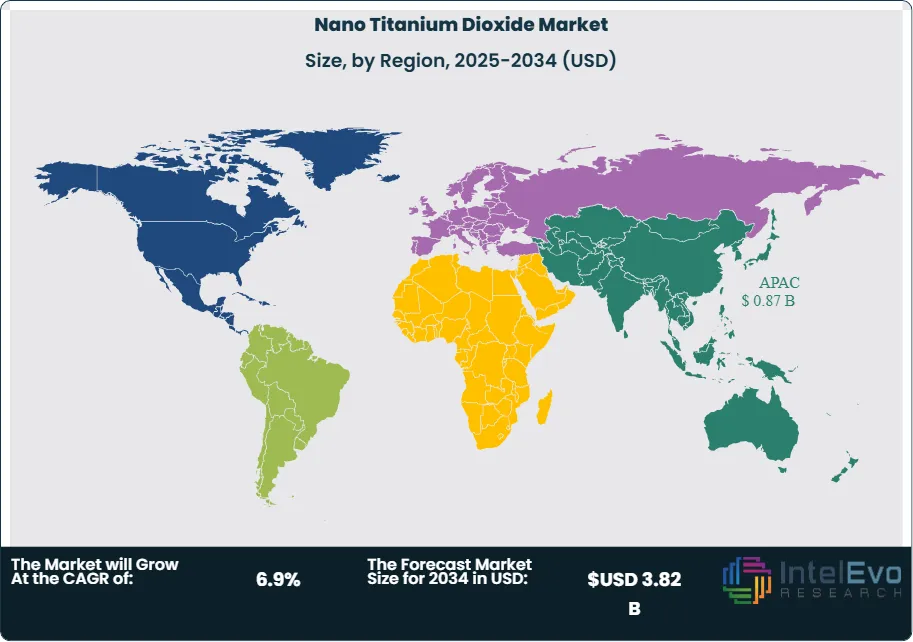
Asia Pacific led the nano titanium dioxide market with 41.6% share in 2025 because Japan, China, South Korea, and India combine specialty chemical production, cosmetic formulation, electronics ceramics, and coatings demand. North America held 24.7% share, supported by U.S. sunscreen reformulation, EPA nanoscale reporting, and U.S. TiO2 pigment production of 1.0 Million metric tons valued at USD 3.0 Billion in 2025. Europe held 21.8% share, with Evonik, KRONOS, Venator Materials, EU REACH, and SCCS scrutiny making the region the highest-compliance market. Through 2034, the market shifts toward surface-treated rutile dispersions, low-dust powders, doped photocatalysts, and application-specific grades priced above bulk pigment economics.
Market Definition & Scope
The nano titanium dioxide market is defined as global revenue from engineered titanium dioxide particles and dispersions where the primary particle size, aggregate design, or surface treatment is intentionally controlled at nanoscale or ultrafine dimensions. The market encompasses anatase nano TiO2, rutile nano TiO2, mixed anatase-rutile grades, fumed titanium dioxide, coated cosmetic UV filters, photocatalytic powders, aqueous dispersions, solvent dispersions, and high-purity nanostructured TiO2 used by Tayca Corporation, Ishihara Sangyo Kaisha, Evonik Operations, Venator Materials, and KRONOS Worldwide customers.
This analysis includes powders, dispersions, coated particles, doped particles, catalyst supports, transparent UV blockers, photocatalytic building materials, energy-device additives, cosmetics-grade TiO2, and nanostructured grades sold into specialty coating or electronics channels. It excludes commodity pigment-grade TiO2 sold only for opacity, titanium mineral concentrates, titanium metal, zinc oxide nanoparticles, complete sunscreen products, food-grade E171, and micronized non-nano pigments unless sold as nano-related low-particle-count alternatives. Under this narrow scope, nano TiO2 represented approximately 9.1% of the broader 2025 titanium dioxide value base.

Key Takeaways
- Market Growth: The nano titanium dioxide market advanced from USD 2.10 Billion in 2025 to a projected USD 3.82 Billion by 2034 at a 6.9% CAGR, adding USD 1.72 Billion in absolute dollar opportunity.
- Segment Dominance: Surface-treated rutile grades held 46.8% share in 2025, equal to USD 0.98 Billion, because sunscreen and transparent coating buyers require UV blocking without visible whitening.
- Segment Dominance: Cosmetics and personal care led applications with 35.4% share in 2025, equal to USD 0.74 Billion, due to mineral sunscreen demand in the United States, Europe, Japan, Australia, and China.
- Driver: Regulatory acceptance of mineral UV filters drives demand, with EU cosmetics rules allowing titanium dioxide nano at up to 25% and FDA sunscreen policy keeping TiO2 and zinc oxide in the mineral-filter core.
- Restraint: Worker-exposure limits constrain powder handling, with the NIOSH recommended exposure limit at 0.3 mg/m3 for ultrafine TiO2 versus 2.4 mg/m3 for fine TiO2.
- Opportunity: Photocatalytic coatings, water treatment, and air purification can add approximately USD 0.78 Billion in revenue by 2034 as anatase and mixed-phase grades move from pilot lines into commercial materials.
- Trend: Coated, doped, or dispersion-ready grades represented approximately 58.2% of 2025 sales because formulators prefer lower dust, tighter particle-size distribution, and validated surface-treatment packages.
- Regional: Asia Pacific led the nano titanium dioxide market with 41.6% share and USD 0.87 Billion in 2025 revenue, ahead of North America at 24.7% and Europe at 21.8%.
Key Insights Summary
- The nano titanium dioxide market sits on a broad TiO2 supply base, with U.S. pigment output at 1.0 Million metric tons and USD 3.0 Billion in estimated 2025 value, while nano grades capture higher value per kilogram through particle engineering.
- U.S. titanium mineral and synthetic concentrate imports reached USD 720.0 Million in 2025, and 88.0% net import reliance shows why ore security affects nano TiO2 cost even when specialty processing occurs downstream.
- The European cosmetics review launched in September 2025 covers nano and non-nano titanium dioxide, including oral cosmetic use, because some pigmentary grades can exceed 50% nanoscale particles by particle count.
- FDA sunscreen policy created a dual signal in December 2025: titanium dioxide remained in the mineral UV-filter base, while the proposed 6.0% bemotrizinol maximum opened a chemical-filter alternative for U.S. SPF formulas.
- Ishihara Sangyo Kaisha's TTO series defines ultrafine rutile TiO2 below 100 nm, while its disclosed 0.01-0.05 micrometer particle range supports transparent UV shielding in cosmetics and automotive coatings.
- Evonik's AEROXIDE TiO2 P 25 carries a 35-65 m2/g BET surface area and serves catalyst substrates, lithium-ion batteries, dye-sensitized solar cells, and photocatalytic coatings.
- Recent photocatalyst research in 2026 reported green-synthesized TiO2 nanoparticles with 17.4 nm crystallite size and 97.8% methylene-blue degradation under sunlight within 180 minutes, reinforcing water-treatment research pull.
Competitive Landscape Overview
The nano titanium dioxide market is fragmented to moderately consolidated because no audited vendor discloses nano TiO2 revenue separately from pigment, functional chemicals, or fumed oxides. Industry analysis indicates the top four specialty suppliers, Tayca Corporation, Ishihara Sangyo Kaisha, Evonik Operations, and Venator Materials, held approximately 37.0% of 2025 revenue across cosmetics-grade rutile, ultrafine TTO, fumed photocatalysts, and low-nano titanium dioxide alternatives. Competition is shaped by particle-size control, coating chemistry, toxicology dossiers, regulatory support, and distribution access to cosmetics, coatings, electronics, and catalyst customers.
Competitive movement is shifting from generic nanopowders toward application-qualified grades. Japanese suppliers differentiate through transparent rutile design, Evonik anchors catalyst and energy-material grades, Venator Materials competes in UV-filter and low-nano cosmetics, and LB Group's 2026 Greatham transaction strengthens China-Europe titanium dioxide asset control. Buyers comparing nano titanium dioxide vendor options should prioritize particle-size validation, inhalable-dust controls, surface-coating disclosure, REACH or TSCA documentation, and batch-to-batch optical performance.
Competitive Landscape Matrix
| Company Name | Headquarters | Market Position | Key Product/Solution | Geographic Strength | Recent Strategic Move |
|---|---|---|---|---|---|
| Tayca Corporation | Japan | Leader | MT Series micro titanium dioxide and cosmetic UV-filter grades | Japan, China, United States, Europe | During FY2025, micro titanium dioxide sales volume and value increased, and Tayca continued capacity work linked to the Kumayama production base. |
| Ishihara Sangyo Kaisha, Ltd. | Japan | Leader | TTO Series ultrafine rutile titanium dioxide | Japan, Asia Pacific, Europe | The 2025 integrated report placed TTO nanoscale TiO2, chloride-process production, cosmetics, and electronic materials at the center of functional-material expansion. |
| Evonik Operations GmbH | Germany | Leader | AEROXIDE TiO2 P 25 and P 90 fumed titanium dioxide | Europe, North America, Asia Pacific | In 2025, Evonik maintained fumed titanium dioxide grades for catalysts, lithium-ion batteries, dye-sensitized solar cells, and photocatalytic coatings. |
| Venator Materials PLC | United Kingdom | Leader | HOMBITAN and UV-TITAN titanium dioxide grades | Europe, North America | At in-cosmetics 2025, Venator presented low-nano cosmetic grades and UV-filter titanium dioxide options for sun-care formulators. |
| KRONOS Worldwide, Inc. | United States | Challenger | KRONOClean photocatalytic titanium dioxide | Europe, North America | In March 2026, KRONOS disclosed lower TiO2 selling prices for 2025 while keeping its KRONOClean photocatalyst offering in the portfolio. |
| LB Group Co., Ltd. | China | Challenger | Chloride TiO2 assets and specialty TiO2 supply | China, Europe | On 27 April 2026, LB Group completed the Venator Greatham TiO2 asset transaction and began operating the site through Tioxide. |
| Sakai Chemical Industry Co., Ltd. | Japan | Challenger | Nanostructured titanium dioxide and zinc oxide specialty materials | Japan, Asia Pacific | The company continued supplying ultrafine inorganic materials into cosmetics, electronics, and coating applications through 2025. |
| American Elements | United States | Niche Player | Titanium dioxide nanopowder and dispersions | North America, Europe | The supplier maintained catalog coverage for anatase, rutile, and mixed-phase nano TiO2 grades used by research and specialty manufacturing buyers. |
| US Research Nanomaterials, Inc. | United States | Niche Player | TiO2 nanopowder and nanodispersion products | North America | The company continued low-volume specialty supply for university, coatings, and environmental-remediation laboratories in 2025. |
| Nanoshel LLC | United States | Niche Player | Titanium dioxide nanoparticles and surface-treated grades | North America, Europe, Asia | Nanoshel kept catalog access to research-grade titanium dioxide nanoparticles for photochemistry, coatings, and polymer-compounding customers. |
Segmentation Analysis
The nano titanium dioxide market segments by crystal structure, form, application, and end-use industry, with each segmentation axis reflecting a different procurement risk. Crystal structure determines optical behavior and photocatalytic activity; form determines handling cost and dust exposure; application determines regulatory review; and end-use industry determines qualification timelines for Tayca Corporation, Ishihara Sangyo Kaisha, Evonik Operations, Venator Materials, and KRONOS Worldwide.
By Crystal Structure
The nano titanium dioxide market by crystal structure is led by surface-treated rutile grades, which held 46.8% share and USD 0.98 Billion in 2025 revenue. Rutile TiO2 offers lower photocatalytic activity than anatase after coating, which is why cosmetics and high-durability coating customers prefer it for transparent UV shielding. Tayca Corporation MT Series and Ishihara Sangyo Kaisha TTO Series compete in this segment through particle-size control, surface-treatment selection, and dispersion behavior. Anatase grades held 38.7% share and USD 0.81 Billion in 2025 because photocatalytic coatings, self-cleaning glass, antimicrobial surfaces, and wastewater treatment need higher photoactivity. Evonik AEROXIDE TiO2 P 25 and KRONOClean products sit closer to this technical demand. Mixed-phase and doped nano TiO2 held 14.5% share and USD 0.30 Billion in 2025, with copper, cerium, nitrogen, and carbon modification used to widen visible-light response.
By Form
The nano titanium dioxide market by form is led by powders, which captured 48.3% share and USD 1.01 Billion in 2025 revenue. Powders dominate research supply, catalyst support, ceramic electronics, polymer masterbatch, and coating additive channels because shipping cost per active kilogram is lower than dispersions. American Elements, US Research Nanomaterials, Nanoshel, and Evonik supply powder formats across anatase, rutile, mixed-phase, and fumed TiO2. Aqueous and solvent dispersions held 31.9% share and USD 0.67 Billion in 2025, gaining ground where formulators want safer handling, faster incorporation, and fewer agglomeration problems. Surface-treated granules and low-dust forms held 19.8% share and USD 0.42 Billion, but this category carries the fastest commercial pull because NIOSH ultrafine exposure limits and EU inhalation exclusions push buyers toward safer physical forms.
By Application
The nano titanium dioxide market by application is led by cosmetics and personal care, which held 35.4% share and USD 0.74 Billion in 2025 revenue. Mineral sunscreen, makeup with SPF claims, and skin-care products use coated nano rutile TiO2 because it blocks UVB and short UVA while reducing visible whitening. Tayca Corporation, Ishihara Sangyo Kaisha, Venator Materials, and Sakai Chemical compete through skin-feel, transparency, coating chemistry, and toxicology files. Paints, coatings, and plastics held 31.6% share and USD 0.66 Billion in 2025, with demand tied to automotive finishes, wood coatings, transparent UV protection, and weathering resistance. Photocatalysis and environmental treatment held 20.2% share and USD 0.42 Billion, while energy and electronics held 12.8% share and USD 0.27 Billion. Energy use is smaller in 2025 but carries higher specification value for batteries, MLCC additives, and dye-sensitized solar-cell materials.
By End-Use Industry
The nano titanium dioxide market by end-use industry is led by beauty and sun care at 34.2% share, followed by construction and automotive coatings at 30.4%, environmental treatment at 18.2%, electronics and energy at 11.5%, and research or other uses at 5.7% in 2025. Beauty and sun care purchases are regulated by FDA sunscreen monograph activity, EU Cosmetics Regulation entries, SCCS opinions, and formulation claims tested by dermatology brands. Construction and automotive buyers prioritize weatherability, transparency, and photocatalytic function because coating failures generate replacement cost and warranty exposure. Environmental treatment buyers use anatase or mixed-phase TiO2 in pilot and commercial systems for dye removal, odor control, nitrogen oxide reduction, and microbial load reduction. Electronics and energy buyers are smaller in volume, but tighter purity requirements make the segment attractive for Ishihara Sangyo Kaisha, Evonik, and high-purity TiO2 suppliers.
Regional Analysis
The nano titanium dioxide market is led by Asia Pacific, followed by North America, Europe, Latin America, and Middle East and Africa, with regional shares totaling 100.0% in 2025. Regional demand tracks cosmetics regulation, TiO2 processing capacity, electronics ceramics, coatings manufacturing, and government control of nanoscale substance reporting.
Asia Pacific held 41.6% share and USD 0.87 Billion in 2025 revenue, led by China, Japan, South Korea, and India. China is both the largest TiO2 producer-consumer and a titanium mineral concentrates importer, with 2025 ilmenite output near one-third of global production and 3.8 Million gross tons of concentrate imports through September 2025. Japan supplies the region's most specialized cosmetic and electronic-grade nano TiO2 through Tayca Corporation, Ishihara Sangyo Kaisha, Sakai Chemical, and Titan Kogyo. South Korea and India add sunscreen, plastics, and coating formulation demand. The region grows faster than Europe because electronics ceramics, automotive coatings, and sun-care consumption are scaling together.
North America held 24.7% share and USD 0.52 Billion in 2025 revenue, with the United States representing most regional purchases. U.S. TiO2 pigment production reached 1.0 Million metric tons and USD 3.0 Billion in 2025, creating a broad feedstock and formulation base even though nano grades remain specialty products. FDA sunscreen policy, EPA TSCA nanoscale reporting, and NIOSH ultrafine TiO2 exposure guidance shape supplier qualification. Canada contributes coating and clean-technology demand, while Mexico anchors automotive coating demand through export manufacturing. Chemours, KRONOS, American Elements, US Research Nanomaterials, and Nanoshel support domestic access across pigment, specialty, and research channels.
Europe held 21.8% share and USD 0.46 Billion in 2025 revenue, led by Germany, the United Kingdom, France, Italy, and Spain. EU Cosmetics Regulation rules allow titanium dioxide nano as a UV filter up to 25% when inhalation exposure is excluded, but the September 2025 SCCS review adds dossier pressure for oral cosmetic and particle-count questions. Germany contributes Evonik fumed TiO2, KRONOS photocatalysts, coatings R&D, and chemical compliance capacity. The United Kingdom gained added strategic weight in April 2026 when LB Group completed the Greatham transaction and the Tioxide operating structure began integration. Europe grows below Asia Pacific because compliance cost is higher, but margins are supported by application-qualified grades.
Latin America held 6.4% share and USD 0.13 Billion in 2025 revenue, led by Brazil, Mexico, Chile, and Argentina. Brazil drives sun-care and architectural coatings demand because high UV exposure, urban construction, and personal-care manufacturing support mineral-filter and weathering-resistant applications. Mexico contributes automotive coatings and plastics demand tied to North American supply chains. Regional buyers are price-sensitive, so distributors often prefer dispersions and pre-qualified grades that lower formulation failure risk. Growth through 2034 depends on sunscreen compliance alignment, construction coating demand, and local technical service from suppliers such as Venator Materials, Evonik, and LB Group-linked channels.
Middle East and Africa held 5.5% share and USD 0.12 Billion in 2025 revenue, with the Gulf Cooperation Council, South Africa, Egypt, and Turkey forming the core demand pool. Gulf construction coatings, solar infrastructure, and water-treatment pilots create demand for UV-stable and photocatalytic TiO2 grades. South Africa matters upstream because titanium slag accounted for 65% of U.S. titanium slag imports as of July 2025, linking mineral supply to downstream nano TiO2 pricing. Africa's adoption remains constrained by powder-handling cost, dispersed formulation capacity, and limited local toxicology support. Turkey bridges Europe and Middle East demand through coatings, plastics, and personal-care supply chains.
Country Analysis
The nano titanium dioxide market is concentrated in the United States, China, Japan, and Germany because these countries combine regulatory influence, TiO2 processing capacity, specialty chemical suppliers, and high-value formulation industries.
The United States nano titanium dioxide market reached USD 0.43 Billion in 2025 and is forecast to grow at a 6.5% country CAGR through 2034. FDA sunscreen policy anchors mineral UV-filter demand, while EPA TSCA nanoscale reporting and NIOSH guidance shape powder-handling specifications for manufacturers and formulators. U.S. TiO2 pigment production reached 1.0 Million metric tons in 2025, and apparent pigment consumption reached 900,000 metric tons. Domestic suppliers and distributors, including KRONOS, Chemours, American Elements, US Research Nanomaterials, and Nanoshel, serve coating, research, and specialty additive customers. The December 2025 FDA bemotrizinol proposal may shift some SPF formulations toward hybrid mineral-chemical systems rather than displacing nano TiO2.
China's nano titanium dioxide market reached USD 0.46 Billion in 2025 and is forecast to grow at a 7.8% country CAGR through 2034. China leads titanium mineral concentrate production and consumption, and 2025 imports through September reached 3.8 Million gross tons, up 5.0% versus the same 2024 period. LB Group, China National Titanium Dioxide channels, and export-oriented formulators support lower-cost TiO2 availability across coatings and plastics. The April 2026 completion of LB Group's Greatham acquisition adds European asset access and technical credibility. China also benefits from battery materials, ceramics, photocatalytic coatings, and UV-filter demand in domestic beauty brands.
Japan's nano titanium dioxide market reached USD 0.20 Billion in 2025 and is forecast to grow at a 5.8% country CAGR through 2034. Tayca Corporation and Ishihara Sangyo Kaisha give Japan a premium position in surface-treated rutile, ultrafine TTO, and high-purity TiO2 for cosmetics, automotive coatings, and electronic components. Tayca reported higher micro titanium dioxide sales volume and value in FY2025, while Ishihara Sangyo Kaisha's 2025 integrated report placed nanoscale TTO, chloride-process TiO2, and electronic-component materials into its functional-material plan. Japan's demand base is smaller than China's, but qualification depth and brand trust create higher grade stickiness.
Germany's nano titanium dioxide market reached USD 0.15 Billion in 2025 and is forecast to grow at a 5.9% country CAGR through 2034. Evonik Operations supplies fumed TiO2 grades such as AEROXIDE TiO2 P 25, while KRONOS Worldwide supports photocatalytic and pigment-adjacent customers. German buyers operate under REACH, EU Cosmetics Regulation, SCCS opinions, and occupational exposure expectations, which raises documentation cost but favors suppliers with toxicology and regulatory teams. Coatings, catalyst supports, lithium-ion batteries, and dye-sensitized solar cells create demand for higher-surface-area TiO2. Germany's value share is supported more by specialty grade complexity than by volume.
Get More Information about this report -
Request Free Sample ReportKey Market Segment
By Crystal Structure
- Anatase
- Rutile
- Brookite
By Form
- Powder
- Dispersion (Liquid Suspension)
- Coated Nanoparticles
By Application
- Photocatalysts
- UV Protection
- Self-Cleaning Coatings
- Energy Storage
- Environmental Remediation
- Others
By End-Use Industry
- Paints & Coatings
- Cosmetics & Personal Care
- Electronics
- Healthcare & Pharmaceuticals
- Energy
- Construction
- Others
By Regional Coverage
- North America
- Latin America
- East Asia And Pacific
- Sea And South Asia
- Eastern Europe
- Western Europe
- Middle East & Africa
| Report Attribute | Details |
| Market size (2025) | USD 2.10 B |
| Forecast Revenue (2034) | USD 3.82 B |
| CAGR (2025-2034) | 6.9% |
| Historical data | 2021-2025 |
| Base Year For Estimation | 2025 |
| Forecast Period | 2026-2034 |
| Report coverage | Revenue Forecast, Competitive Landscape, Market Dynamics, Growth Factors, Trends and Recent Developments |
| Segments covered | By Crystal Structure, (Anatase, Rutile, Brookite), By Form, (Powder, Dispersion (Liquid Suspension), Coated Nanoparticles), By Application, (Photocatalysts, UV Protection, Self-Cleaning Coatings, Energy Storage, Environmental Remediation, Others), By End-Use Industry, (Paints & Coatings, Cosmetics & Personal Care, Electronics, Healthcare & Pharmaceuticals, Energy, Construction, Others) |
| Research Methodology |
|
| Regional scope |
|
| Competitive Landscape | TAYCA CORPORATION, ISHIHARA SANGYO KAISHA, LTD., EVONIK OPERATIONS GMBH, VENATOR MATERIALS PLC, KRONOS WORLDWIDE, INC., LB GROUP CO., LTD., SAKAI CHEMICAL INDUSTRY CO., LTD., TITAN KOGYO, LTD., AMERICAN ELEMENTS, US RESEARCH NANOMATERIALS, INC., NANOSHEL LLC, SKYSPRING NANOMATERIALS, INC., RESONAC HOLDINGS CORPORATION, CINKARNA CELJE D.D., MERCK KGAA, TRONOX HOLDINGS PLC, THE CHEMOURS COMPANY, OTHERS |
| Customization Scope | Customization for segments, region/country-level will be provided. Moreover, additional customization can be done based on the requirements. |
| Pricing and Purchase Options | Avail customized purchase options to meet your exact research needs. We have three licenses to opt for: Single User License, Multi-User License (Up to 5 Users), Corporate Use License (Unlimited User and Printable PDF). |


Frequently Asked Questions
How big is the Nano Titanium Dioxide Market?
The Global Nano Titanium Dioxide Market was valued at USD 1.97 Billion in 2024 and is projected to reach USD 3.82 Billion by 2034, growing at a CAGR of 6.9% during the forecast period 2026–2034.
Who are the major players in the Nano Titanium Dioxide Market?
TAYCA CORPORATION, ISHIHARA SANGYO KAISHA, LTD., EVONIK OPERATIONS GMBH, VENATOR MATERIALS PLC, KRONOS WORLDWIDE, INC., LB GROUP CO., LTD., SAKAI CHEMICAL INDUSTRY CO., LTD., TITAN KOGYO, LTD., AMERICAN ELEMENTS, US RESEARCH NANOMATERIALS, INC., NANOSHEL LLC, SKYSPRING NANOMATERIALS, INC., RESONAC HOLDINGS CORPORATION, CINKARNA CELJE D.D., MERCK KGAA, TRONOX HOLDINGS PLC, THE CHEMOURS COMPANY, OTHERS
Which segments covered the Nano Titanium Dioxide Market?
By Crystal Structure, (Anatase, Rutile, Brookite), By Form, (Powder, Dispersion (Liquid Suspension), Coated Nanoparticles), By Application, (Photocatalysts, UV Protection, Self-Cleaning Coatings, Energy Storage, Environmental Remediation, Others), By End-Use Industry, (Paints & Coatings, Cosmetics & Personal Care, Electronics, Healthcare & Pharmaceuticals, Energy, Construction, Others)
How can this market research report help my business make strategic decisions?
Our market research reports provide actionable intelligence, including verified market size data, CAGR projections, competitive benchmarking, and segment-level opportunity analysis. These insights support strategic planning, investment decisions, product development, and market entry strategies for enterprises and startups alike.
How frequently is the data updated?
We continuously monitor industry developments and update our reports to reflect regulatory changes, technological advancements, and macroeconomic shifts. Updated editions ensure you receive the latest market intelligence.

Select Licence Type
Connect with our sales team

Nano Titanium Dioxide Market
Published Date : 24 Jul 2026 | Formats :Why IntelEvoResearch
100%
Customer
Satisfaction
24x7+
Availability - we are always
there when you need us
200+
Fortune 50 Companies trust
IntelEvoResearch
80%
of our reports are exclusive
and first in the industry
100%
more data
and analysis
1000+
reports published
till date