

- Home
- Industries
 Aerospace And Defence
 Agriculture
 Automotive And Transportation
 Banking And Finance
 Business
 Chemicals And Materials
 Consumer And Retail
 Electronics And Semiconductors
 Food And Beverages
 Machinery & Equipments
 Manufacturing And Construction
 Medical Devices
 Others
 Pharmaceuticals And Healthcare
 Power And Energy
 Sports
 Technology
- Services
- News Room
- About us
- Contact Us
-
Global Nanocoating Market Size, Share & Forecast 2034 | CAGR of 16.7%
Global Nanocoating Market Size, Share & Analysis Report By Type (Anti-Microbial, Anti-Fingerprint, Self-Cleaning, Anti-Corrosion), By Substrate (Metal, Glass, Plastic, Ceramics), By Coating Method (CVD, PVD, Sol-Gel, Spray Coating), By End-Use Industry (Healthcare, Automotive, Electronics, Construction, Energy, Aerospace & Defense, Marine): Industry Segment Overview, Market Dynamics, Competitive Strategies, Emerging Technologies, Growth Trends & Forecast 2026–2034

Report Overview
| Market Size (2025) | Forecast Value (2034) | CAGR (2026-2034) | Largest Region (2025) |
|---|---|---|---|
| USD 17.90 Billion | USD 71.60 Billion | 16.7% | North America, 38.4% |
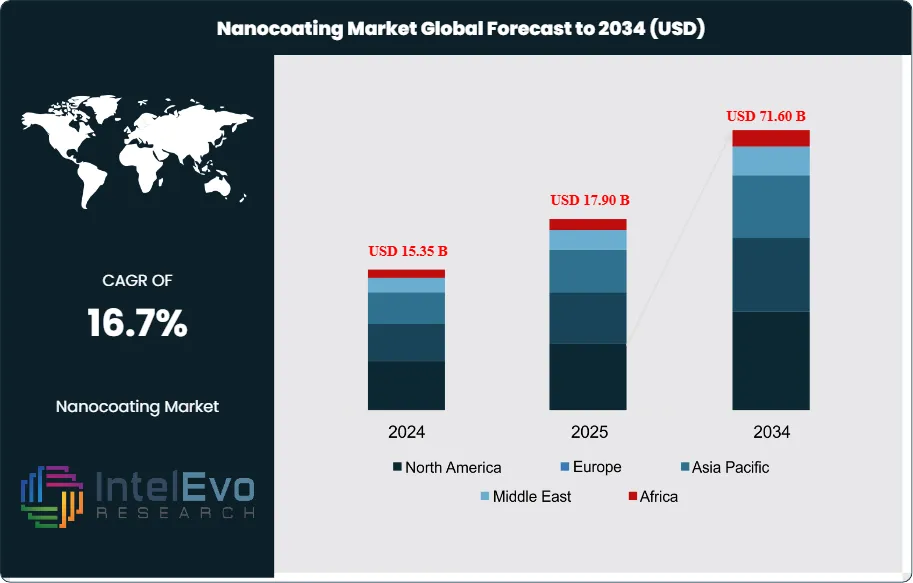
The Nanocoating Market was valued at USD 15.35 Billion in 2024 and reached USD 17.90 Billion in 2025. The market is projected to reach USD 71.60 Billion by 2034, expanding at a CAGR of 16.7% during the forecast period from 2026 to 2034. This represents an absolute dollar opportunity of USD 53.70 Billion over the analysis period.
Get More Information about this report -
Request Free Sample ReportDemand for the nanocoating market is anchored in three converging requirements that conventional polymer and ceramic coatings cannot satisfy simultaneously: nanoscale corrosion resistance, antimicrobial protection certified for healthcare contact surfaces, and self-cleaning behavior tied to building energy performance. Asia Pacific consumes the largest production volume because electronics fabrication concentrates in China, Taiwan, and South Korea, but North America accounts for the highest revenue per ton because aerospace, defense, and medical device buyers pay premium pricing for qualified formulations. The market also benefits from a substitution effect against solvent-based coatings, since nanocoatings reduce volatile organic compound emissions to levels compatible with EPA NESHAP and EU REACH limits.
Regulation cuts both ways for the nanocoating market. The European Chemicals Agency requires explicit nanoform registration dossiers for any nanomaterial manufactured or imported above one tonne per year under Commission Regulation 2018/1881, and France, Belgium, Denmark, and Norway maintain separate national nanomaterial registers that add cost. Counterbalancing these obligations, the EU Horizon Europe program and the US TSCA pre-manufacture notice pathway allow vetted formulations to enter commerce within 90 to 180 days. India's Production Linked Incentive scheme has triggered domestic capacity additions, with Pellucere Technologies opening an 8,500 metric ton per year nanocoating plant in Chakan, Maharashtra in March 2025.
Technology direction in the nanocoating market is consolidating around four deposition routes: chemical vapor deposition (CVD), atomic layer deposition (ALD), sol-gel chemistry, and roll-to-roll plasma. Forge Nano's TEPHRA single-wafer ALD tool, launched in mid-2024, enables semiconductor coatings that the company asserts can deliver 40% faster processing speeds and 50% reduced power consumption versus uncoated reference devices. Multifunctional formulations that combine antimicrobial silver, copper, or zinc oxide chemistries with hydrophobic silica or photocatalytic titanium dioxide are displacing single-property coatings in healthcare and consumer electronics tenders.
Forward outlook through 2034 hinges on three calibrated assumptions. First, AI chip and edge compute fabrication will lift ALD nanocoating demand at 22% to 25% CAGR, outpacing the headline market rate. Second, the AkzoNobel and Axalta merger announced in November 2025 will compress competitive pricing in marine and protective segments, transferring share to specialist formulators. Third, anti-microbial nanocoatings will retain their position as the largest type segment through the forecast period, supported by hospital-acquired infection budgets and food contact regulation. Combined, these forces support sustained 16.7% CAGR through 2034.
Market Definition & Scope
The nanocoating market is defined as the production and sale of engineered surface films with at least one external dimension between 1 and 100 nanometers, formulated to confer functional properties such as corrosion resistance, antimicrobial activity, self-cleaning behavior, anti-fingerprint characteristics, conductive thin-film performance, or ultraviolet protection. The market encompasses nanoparticle-enhanced liquid coatings, vapor-deposited atomic-scale films, sol-gel chemistries, plasma-applied conformal layers, and roll-to-roll deposited functional barriers across metallic, glass, plastic, ceramic, and textile substrates.
Scope coverage includes formulations applied through chemical vapor deposition, physical vapor deposition, atomic layer deposition, sol-gel routes, and plasma-enhanced chemical vapor deposition, sold to construction, electronics, healthcare, automotive, energy, aerospace, and marine end users. The analysis excludes conventional micrometer-scale paint and coating systems, bulk anti-corrosion primers without nanoparticle dispersion, and stand-alone nanoparticle synthesis used as raw material for non-coating applications. Nanocoatings represent approximately 11% of the broader USD 162 Billion industrial coatings parent market and capture the high-functional-value tier of that market.

Key Takeaways
- Market Growth: The global nanocoating market grows from USD 17.90 Billion in 2025 to USD 71.60 Billion in 2034, a CAGR of 16.7%.
- Segment Dominance (Type): Anti-microbial nanocoatings hold the leading type position at 32.5% revenue share in 2025, anchored by hospital and food contact applications.
- Segment Dominance (Application): Building and construction applications account for 26.4% of nanocoating revenue in 2025, with electronics following at 21.2%.
- Driver: Healthcare-associated infection control demand, valued at USD 28.7 Billion in annual hospital spending across OECD nations, is lifting antimicrobial nanocoating adoption at a 19.2% CAGR through 2030.
- Restraint: Production cost premiums of 3 to 7 times conventional coatings restrict adoption in price-sensitive construction segments below USD 12 million project value.
- Opportunity: ALD nanocoatings for AI semiconductor manufacturing represent a USD 6.3 Billion incremental opportunity by 2034, anchored by Forge Nano's disclosed USD 2 Billion-plus pipeline.
- Trend: Multifunctional coatings that combine antimicrobial, hydrophobic, and self-cleaning properties in a single nanolayer reached an estimated 17% of new product launches in 2025, up from 8% in 2022.
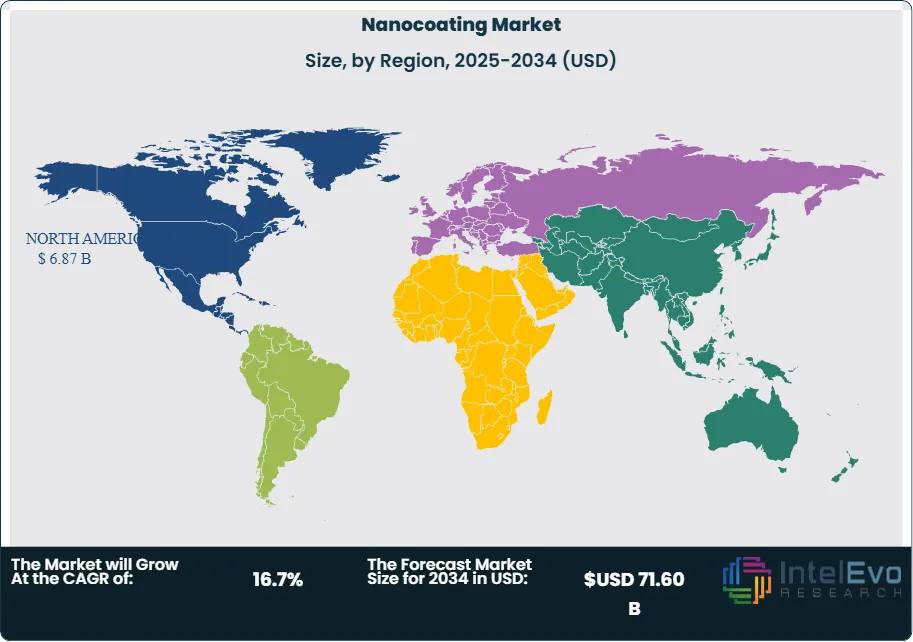
- Regional: North America leads the nanocoating market with 38.4% share and USD 6.87 Billion in revenue in 2025, propelled by aerospace, defense, and medical device qualification cycles.
Key Insights Summary
- The Forge Nano and Archimedes Tech SPAC Partners II business combination, announced on April 21, 2026, valued the ALD nanocoating specialist around its disclosed Series D commitment of USD 82.2 million and assigned a USD 359 Billion-plus expected addressable market by 2034.
- Forge Battery, the lithium-ion subsidiary of Forge Nano, was awarded USD 100 million by the U.S. Department of Energy in January 2025 to expand domestic cell manufacturing in North Carolina, with Atomic Armor ALD coatings as the differentiating technology layer.
- On November 18, 2025, AkzoNobel and Axalta Coating Systems entered a definitive all-stock combination valued at USD 25 Billion enterprise value, with combined 2024 revenue of USD 17 Billion and approximately USD 600 million in identified annual cost synergies.
- BASF agreed on October 10, 2025 to transfer majority control of its Coatings division to Carlyle and Qatar Investment Authority at a EUR 7.7 Billion enterprise value, with BASF retaining a 40% equity stake and the deal expected to close in Q2 2026.
- According to data from the European Chemicals Agency, nanoform registration dossiers under Commission Regulation 2018/1881 apply to any company manufacturing or importing nanomaterials above one tonne per year, a threshold that captures the bulk of commercial nanocoating chemistries entering the EU.
- 3M India introduced a Graphene Shield automotive coating on November 12, 2025 priced from INR 33,000 per vehicle, signaling the entry of graphene-based nanocoatings into mass-market consumer channels.
- Sparc Technologies and AkzoNobel formalized commercial release of ecosparc graphene-enhanced Interzone 954 in Australia for May 2026 on a made-to-order basis through AkzoNobel's local manufacturing facility, following more than six years of ecosparc development and 21 months of field trials.
Competitive Landscape Overview
The nanocoating market is moderately consolidated at the top, with PPG Industries, AkzoNobel, BASF Coatings, and 3M holding an estimated combined 31% to 34% revenue share in 2025, with the long tail dispersed across more than 510 specialist startups tracked in the segment as of January 2025. Competition is shifting from price-based selling toward technology-platform selling, where atomic layer deposition platforms, AI-assisted formulation, and graphene-enhanced chemistries determine deal economics. The AkzoNobel and Axalta combination announced in November 2025 will create a USD 17 Billion revenue coatings entity that places renewed competitive pressure on PPG in aerospace, mobility, and refinish, while BASF Coatings transitions to standalone operation under Carlyle and Qatar Investment Authority ownership in Q2 2026. Specialist new entrants such as Forge Nano, P2i, and Pellucere Technologies are scaling deposition platforms that the diversified incumbents cannot match without acquisition, reordering the M&A pipeline through 2027.
Competitive Landscape Matrix
| Company | Headquarters | Market Position | Key Product / Solution | Geographic Strength | Recent Strategic Move |
|---|---|---|---|---|---|
| PPG Industries | United States | Leader | HI-GARD ophthalmic hard coating; protective and marine portfolio | North America, Europe, Asia Pacific | Introduced HI-GARD Non-Methanol hard coating for 1.5-index ophthalmic lenses on September 16, 2025 |
| AkzoNobel N.V. | Netherlands | Leader | Interzone protective coatings; ecosparc graphene-enhanced range | Europe, Asia Pacific, Australia | Entered USD 25 Billion all-stock combination with Axalta on November 18, 2025 |
| BASF Coatings | Germany | Leader | Glasurit, R-M refinish; Chemetall surface treatment | Europe, Asia Pacific, North America | Concluded EUR 7.7 Billion sale of majority stake to Carlyle and QIA on October 10, 2025 |
| 3M | United States | Leader | Scotchgard PPF; Ceramic Coating; Graphene Shield | North America, Asia Pacific | Brought Graphene Shield Coating to Indian retail channel on November 12, 2025 |
| Sherwin-Williams | United States | Challenger | Coil coatings; protective industrial portfolio | North America | Disclosed Bowling Green coil coatings plant capacity expansion in March 2026 |
| Nippon Paint Holdings | Japan | Challenger | Industrial and automotive nanocoating chemistries | Asia Pacific | Expanded automotive OEM coating capacity across Greater China in 2025 |
| Hempel | Denmark | Challenger | Marine and protective fouling-release coatings | Europe, Asia Pacific | Scaled fouling-release product family for shipping decarbonization in 2025 |
| Forge Nano | United States | Niche Player | Atomic Armor ALD platform; TEPHRA single-wafer tool | North America | Inked SPAC business combination with Archimedes II on April 21, 2026 |
| P2i Limited | United Kingdom | Niche Player | Pulse plasma hydrophobic and antimicrobial coatings | Europe, North America, Asia Pacific | Scaled vapor deposition platform onto smartphone and public-display surfaces in 2025 |
| Nanophase Technologies | United States | Niche Player | Engineered metal oxide nanomaterials; Solésence skin actives | North America | Posted USD 52.3 million in FY2024 revenue, a 40% year-over-year gain |
Segmentation Analysis
The nanocoating market segments along four primary axes that procurement teams use to evaluate vendors: by type, by substrate, by coating method, and by end-use industry. Each axis maps to a different commercial decision and therefore a different competitive set, which is why incumbents serving multiple axes (PPG, AkzoNobel, 3M) outperform single-axis specialists in cross-sell economics.
By Type
The anti-microbial type segment leads the nanocoating market at 32.5% revenue share and approximately USD 5.82 Billion in 2025, supported by silver, copper, and zinc oxide chemistries qualified for hospital and food contact surfaces. Demand is driven by hospital-acquired infection control budgets and by EU Biocidal Products Regulation compliance for high-touch architectural surfaces. P2i, Bio-Gate, and Nanophase Technologies hold defensible niche positions, while PPG and AkzoNobel route antimicrobial chemistries through their broader protective portfolios. Anti-microbial coatings outpaced the headline market by approximately 250 basis points in 2024 to 2025.
Self-cleaning nanocoatings hold 23.8% share at USD 4.26 Billion in 2025, comprising photocatalytic titanium dioxide and superhydrophobic silica formulations applied to building facades, solar panels, and vehicle exteriors. A representative product, the TriNANO Technologies solar module coating commercialized in June 2024, lifts panel power output by up to 4% through anti-reflection and self-cleaning combined. Self-cleaning growth is fastest in solar PV applications, where soiling losses cost utility operators approximately USD 5 to 7 per panel per year in cleaning labor.
Anti-corrosion nanocoatings represent 18.6% of the market at USD 3.33 Billion in 2025, anchored by epoxy-graphene composites and ceramic-reinforced barrier coatings. Sparc Technologies' ecosparc graphene additive, scheduled for AkzoNobel's commercial release in Australia from May 2026 through Interzone 954, illustrates how niche additive specialists are partnering with majors to access industrial offtake. Asyad Drydock's October 2024 application of nano-epoxy coating to the Ultramax bulk carrier Jabal Al Kawr demonstrates marine-grade adoption.
Anti-fingerprint nanocoatings hold 12.4% share at USD 2.22 Billion in 2025 and will grow at the fastest rate among types at approximately 16.9% CAGR, propelled by foldable smartphone displays, kitchen appliance touch panels, and medical device interfaces. Conductive nanocoatings (7.8% share, USD 1.40 Billion) and the residual category covering anti-fouling, UV-resistant, and abrasion-resistant chemistries (4.6% share, USD 0.82 Billion) round out the type taxonomy.
By Substrate
Metal substrates dominate at 55.4% revenue share and USD 9.92 Billion in 2025, since corrosion economics on steel, aluminum, and titanium provide the strongest payback for nanocoating spend. Aerospace-grade aluminum, oil and gas pipeline carbon steel, and battery enclosure stainless steel are the three highest-value sub-segments. Glass substrates account for 18.7% at USD 3.35 Billion, lifted by smart glazing in commercial buildings, automotive windshields, and solar PV cover glass. HeatCure's Indian launch of nanotechnology-based glass coatings illustrates regional adoption.
Plastic substrates capture 14.2% of the nanocoating market at USD 2.54 Billion in 2025 and are the fastest-growing substrate at approximately 17.8% CAGR, supported by consumer electronics housings, automotive interior panels, and medical device plastics. Ceramics (6.3%, USD 1.13 Billion) and the residual substrate category covering wood, textile, and composite (4.8%, USD 0.86 Billion) complete the segmentation.
By Coating Method
Chemical vapor deposition holds the leading method position at 49.2% share and approximately USD 8.81 Billion in 2025, since CVD reactors are mature, high-throughput, and qualified for semiconductor and aerospace use. Sol-gel routes, atomic layer deposition, plasma-enhanced CVD, and physical vapor deposition divide the remaining 50.8% in declining order. Atomic layer deposition is the fastest-growing method at approximately 21% CAGR, propelled by demand for atomically conformal coatings on AI chip transistors and lithium-ion battery cathodes. Forge Nano's TEPHRA platform, asserting 4 times the throughput of conventional ALD, is positioning the company to capture share from incumbent semiconductor equipment vendors.
By End-Use Industry
Building and construction leads the nanocoating market by end-use at 26.4% revenue share and USD 4.73 Billion in 2025, anchored by self-cleaning facades, anti-graffiti finishes, and thermal-insulating glazing. Electronics follows at 21.2% (USD 3.79 Billion), driven by anti-fingerprint touchscreens and conductive thin films. Healthcare and medical devices account for 16.5% (USD 2.95 Billion), where antimicrobial chemistries on implants, instruments, and high-touch surfaces address infection control. Automotive (13.7%, USD 2.45 Billion), energy (8.9%, USD 1.59 Billion), aerospace and defense (6.4%, USD 1.15 Billion), marine (4.1%, USD 0.73 Billion), and food, packaging, and other (2.8%, USD 0.50 Billion) complete the end-use distribution. Energy applications, especially solar PV and lithium-ion battery components, will deliver the fastest end-use CAGR at approximately 18.1% through 2034.
Regional Analysis
North America commands 38.4% of the nanocoating market at USD 6.87 Billion in 2025. The United States contributes the bulk through aerospace coating qualification at PPG's Shelby, North Carolina facility, medical device antimicrobial spending across the FDA-regulated supply chain, and Department of Energy battery coating grants. Canada hosts research-grade nanocoating partnerships including the December 2025 Focus Graphite and Forge Nano joint product development for ALD-coated Lac Knife graphite. Mexico's automotive OEM clusters in Bajio and Nuevo Leon pull industrial coating demand, lifted by USMCA content requirements. Trump-era tariffs in 2025 accelerated reshoring of nanocoating raw materials, with Forge Nano disclosing more than 200 patents anchoring a U.S.-dominant supply chain.
Asia Pacific holds 29.1% share at USD 5.21 Billion in 2025 and will grow at the highest regional CAGR of approximately 18.4%, supported by electronics fabrication concentration, automotive volume, and renewable energy installation. China dominates the regional total through TSMC-adjacent semiconductor coating demand, BYD-led EV battery coating spend, and the largest construction pipeline by floor area globally. Japan contributes through Toyota and Honda automotive OEM coating qualification at Nippon Paint and Kansai Paint. South Korea anchors antimicrobial nanocoating innovation, with government export-friendly quality standards driving Samsung and LG supply-chain spend. India's nanocoating market grew to approximately USD 580 million in 2025 from USD 511 million in 2024 (a 13.5% increase), with Pellucere Technologies' March 2025 Maharashtra plant adding 8,500 metric tons of annual capacity.
Europe accounts for 22.6% at USD 4.04 Billion in 2025, with Germany, France, the United Kingdom, the Netherlands, and Switzerland providing the bulk. Germany's automotive OEM density supports BASF Coatings, Henkel, and Evonik nanoparticle dispersion business. The Netherlands hosts AkzoNobel headquarters and the planned dual-headquarter base for the merged AkzoNobel-Axalta entity. The United Kingdom benefits from P2i's pulse plasma platform and Sparc Technologies' graphene additive R&D. EU Horizon Europe funding sustains research momentum, while Commission Regulation 2018/1881 nanoform registration adds compliance overhead. Sweden, Denmark, and France maintain national nano registers that increase administrative burden.
Latin America holds 5.7% share at USD 1.02 Billion in 2025, anchored by Brazil's automotive and oil and gas demand and Mexico's USMCA-aligned manufacturing. Argentina and Colombia contribute incremental volume through construction and food packaging applications. Regional growth tracks broader industrial recovery and ranges between 11% and 14% CAGR through 2030. Local players partner with U.S. and European technology owners rather than developing proprietary chemistries.
Middle East and Africa account for 4.2% of the nanocoating market at USD 0.75 Billion in 2025. The United Arab Emirates and Saudi Arabia drive demand through Vision 2030 megaprojects, oil and gas pipeline corrosion programs, and Asyad Drydock-style marine nanocoating applications. South Africa anchors sub-Saharan demand through automotive assembly and mining equipment. Regional CAGR runs at approximately 15.6%, supported by infrastructure spending and tightening hygiene standards in Gulf healthcare procurement.
Country Analysis
The United States is the single largest country market for nanocoatings at USD 5.42 Billion in 2025, growing at 16.1% CAGR. Federal program support includes the Department of Energy's USD 100 million Forge Battery grant (January 2025), NSF SBIR nanotechnology track funding, and Department of Defense procurement language requiring U.S.-origin battery cells from 2028. EPA Toxic Substances Control Act pre-manufacture notice rules govern new nanomaterial entry, while FDA 21 CFR Part 1271 oversees medical-device biocompatibility. Domestic R&D concentrates around Boulder, Boston, and Research Triangle. PPG's USD 380 million Shelby aerospace coatings facility investment and Forge Nano's North Carolina battery gigafactory anchor regional manufacturing.
China holds the second-largest country position at USD 2.84 Billion in 2025, growing at 19.2% CAGR. Demand is propelled by the world's largest automotive output, the densest electronics fabrication base, and the most aggressive solar PV deployment globally. State-backed nanotechnology R&D under the National Key R&D Program funds graphene, carbon nanotube, and titanium dioxide research at Tsinghua, Fudan, and Zhejiang universities. BASF's Caojing Innovation Campus, with cumulative investment of approximately EUR 280 million, illustrates foreign-direct-investment commitment. Domestic players ZKJN, Kltnano, and Sketch are scaling alongside multinational producers.
Germany is the largest European country market at USD 1.21 Billion in 2025, growing at 14.8% CAGR. Strength concentrates in automotive OEM coatings, where Mercedes-Benz, BMW, and Volkswagen procurement teams qualify nanocoating chemistries through multi-year supplier programs. BASF's Ludwigshafen R&D base, the AkzoNobel and Arkema and BASF September 2025 collaboration on lower-carbon-footprint architectural powder coatings, and Henkel's adhesive-adjacent nanoparticle dispersions anchor the local supplier base. Chemicals industry employment exceeding 480,000 jobs sustains the labor base.
India ranks as the fastest-growing major country market at USD 580 Million in 2025, growing at 17.95% CAGR. Make in India and the Production Linked Incentive scheme have triggered domestic capacity expansion, with Pellucere Technologies' March 2025 Chakan plant adding 8,500 metric tons annually for solar, automotive, and architecture customers. Trinano Technologies' solar module coating, lifting panel output by up to 4% and lowering temperature by 3 degrees Celsius, illustrates indigenous innovation. The November 2025 launch of 3M India's Graphene Shield Coating in retail channels priced from INR 33,000 signals consumer-tier adoption.
Get More Information about this report -
Request Free Sample ReportKey Market Segment
By Type
- Anti-Microbial Coatings
- Anti-Fingerprint Coatings
- Self-Cleaning Coatings
- Anti-Corrosion Coatings
- Others
By Substrate
- Metal
- Glass
- Plastic
- Ceramics
- Others
By Coating Method
- Chemical Vapor Deposition (CVD)
- Physical Vapor Deposition (PVD)
- Sol-Gel Process
- Spray Coating
- Others
By End-Use Industry
- Healthcare
- Automotive
- Electronics & Semiconductors
- Construction
- Energy
- Aerospace & Defense
- Marine
- Others
By Regional Coverage
- North America
- Latin America
- East Asia And Pacific
- Sea And South Asia
- Eastern Europe
- Western Europe
- Middle East & Africa
| Report Attribute | Details |
| Market size (2025) | USD 17.90 B |
| Forecast Revenue (2034) | USD 71.60 B |
| CAGR (2025-2034) | 16.7% |
| Historical data | 2021-2025 |
| Base Year For Estimation | 2025 |
| Forecast Period | 2026-2034 |
| Report coverage | Revenue Forecast, Competitive Landscape, Market Dynamics, Growth Factors, Trends and Recent Developments |
| Segments covered | By Type, (Anti-Microbial Coatings, Anti-Fingerprint Coatings, Self-Cleaning Coatings, Anti-Corrosion Coatings, Others), By Substrate, (Metal, Glass, Plastic, Ceramics, Others), By Coating Method, (Chemical Vapor Deposition (CVD), Physical Vapor Deposition (PVD), Sol-Gel Process, Spray Coating, Others), By End-Use Industry, (Healthcare, Automotive, Electronics & Semiconductors, Construction, Energy, Aerospace & Defense, Marine, Others), |
| Research Methodology |
|
| Regional scope |
|
| Competitive Landscape | PPG INDUSTRIES, INC., AKZONOBEL N.V., BASF COATINGS, 3M COMPANY, SHERWIN-WILLIAMS COMPANY, NIPPON PAINT HOLDINGS, HEMPEL A/S, JOTUN A/S, KANSAI PAINT CO., LTD., AXALTA COATING SYSTEMS, FORGE NANO, INC., P2I LIMITED, NANOPHASE TECHNOLOGIES CORPORATION, TESLA NANOCOATINGS, INC., NANOVERE TECHNOLOGIES, LLC, NANOFILM LTD., BIO-GATE AG, INFRAMAT CORPORATION, DIAMON-FUSION INTERNATIONAL, PELLUCERE TECHNOLOGIES, Others |
| Customization Scope | Customization for segments, region/country-level will be provided. Moreover, additional customization can be done based on the requirements. |
| Pricing and Purchase Options | Avail customized purchase options to meet your exact research needs. We have three licenses to opt for: Single User License, Multi-User License (Up to 5 Users), Corporate Use License (Unlimited User and Printable PDF). |


Frequently Asked Questions
How big is the Nanocoating Market?
The Global Nanocoating Market was valued at USD 15.35 Billion in 2024 and is projected to reach USD 71.60 Billion by 2034, growing at a CAGR of 16.7% during the forecast period 2026–2034.
Who are the major players in the Nanocoating Market?
PPG INDUSTRIES, INC., AKZONOBEL N.V., BASF COATINGS, 3M COMPANY, SHERWIN-WILLIAMS COMPANY, NIPPON PAINT HOLDINGS, HEMPEL A/S, JOTUN A/S, KANSAI PAINT CO., LTD., AXALTA COATING SYSTEMS, FORGE NANO, INC., P2I LIMITED, NANOPHASE TECHNOLOGIES CORPORATION, TESLA NANOCOATINGS, INC., NANOVERE TECHNOLOGIES, LLC, NANOFILM LTD., BIO-GATE AG, INFRAMAT CORPORATION, DIAMON-FUSION INTERNATIONAL, PELLUCERE TECHNOLOGIES, Others
Which segments covered the Nanocoating Market?
By Type, (Anti-Microbial Coatings, Anti-Fingerprint Coatings, Self-Cleaning Coatings, Anti-Corrosion Coatings, Others), By Substrate, (Metal, Glass, Plastic, Ceramics, Others), By Coating Method, (Chemical Vapor Deposition (CVD), Physical Vapor Deposition (PVD), Sol-Gel Process, Spray Coating, Others), By End-Use Industry, (Healthcare, Automotive, Electronics & Semiconductors, Construction, Energy, Aerospace & Defense, Marine, Others),
How can this market research report help my business make strategic decisions?
Our market research reports provide actionable intelligence, including verified market size data, CAGR projections, competitive benchmarking, and segment-level opportunity analysis. These insights support strategic planning, investment decisions, product development, and market entry strategies for enterprises and startups alike.
How frequently is the data updated?
We continuously monitor industry developments and update our reports to reflect regulatory changes, technological advancements, and macroeconomic shifts. Updated editions ensure you receive the latest market intelligence.

Select Licence Type
Connect with our sales team

Why IntelEvoResearch
100%
Customer
Satisfaction
24x7+
Availability - we are always
there when you need us
200+
Fortune 50 Companies trust
IntelEvoResearch
80%
of our reports are exclusive
and first in the industry
100%
more data
and analysis
1000+
reports published
till date