Online Alternative Finance Market Size 2025–2034 | CAGR 20.1%
Global Online Alternative Finance Market Size, Share, Growth & Analysis By Type (Peer-to-Peer Lending, Crowdfunding, Invoice Trading, Supply Chain Finance, Others), By End-Use (Individuals, SMEs, Large Enterprises), By Platform Model (Marketplace Lending, Direct Lending, Hybrid Models), By Region & Key Players – Industry Overview, Market Dynamics, Regulatory Landscape, Competitive Strategies, Emerging Trends & Forecast 2025–2034
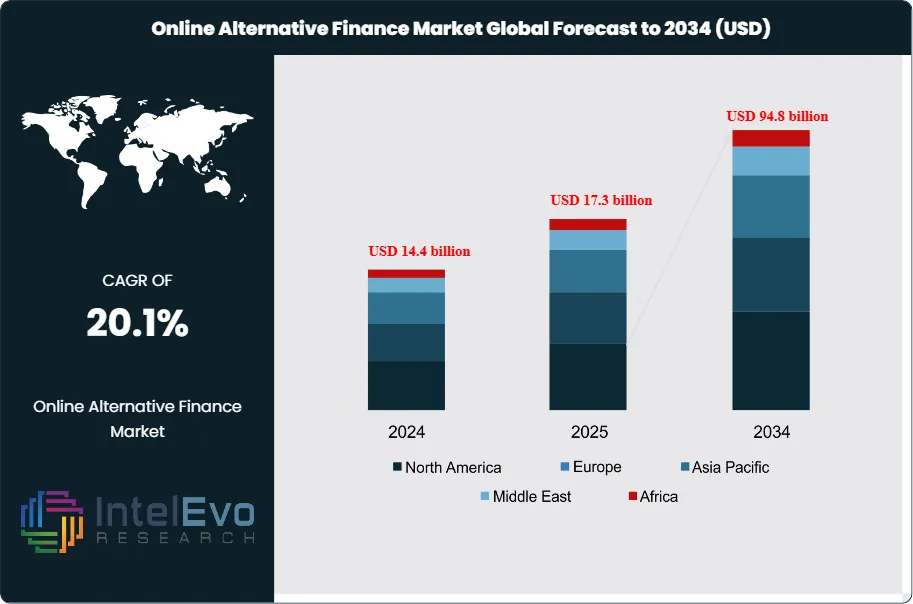
The Online Alternative Finance Market will likely reach about USD 17.3 billion by 2025. It is expected to grow to around USD 94.8 billion by 2034, with a strong CAGR of about 20.1% from 2026 to 2034. This growth is fuelled by the increasing use of digital lending platforms. More retail and institutional investors are getting involved. Traditional banks are tightening credit, which also influences this market. The rising use of AI for credit assessment, quicker loan approval processes, and better access in underbanked areas enhance platform growth. As regulations become clearer and data-based risk management improves, online alternative finance should become more integrated within global financial systems.
Online alternative finance comprises digital platforms that provide lending, crowdfunding, invoice trading, and crypto-enabled services outside traditional banking channels. These models connect funders directly with borrowers and enterprises, compress intermediation layers, and lower transaction costs, which supports rapid scale-up across both mature and emerging economies.
Growth momentum reflects strong demand from small businesses, start-ups, and individual borrowers that face tighter underwriting standards in conventional credit markets. Platforms use streamlined onboarding, automated credit decisioning, and flexible repayment structures to expand access to capital for users with thin or uneven credit files. On the supply side, retail and institutional investors seek yield premia versus traditional deposits and fixed income, which sustains liquidity and product innovation across peer-to-peer lending, revenue-based finance, and specialized working-capital solutions.
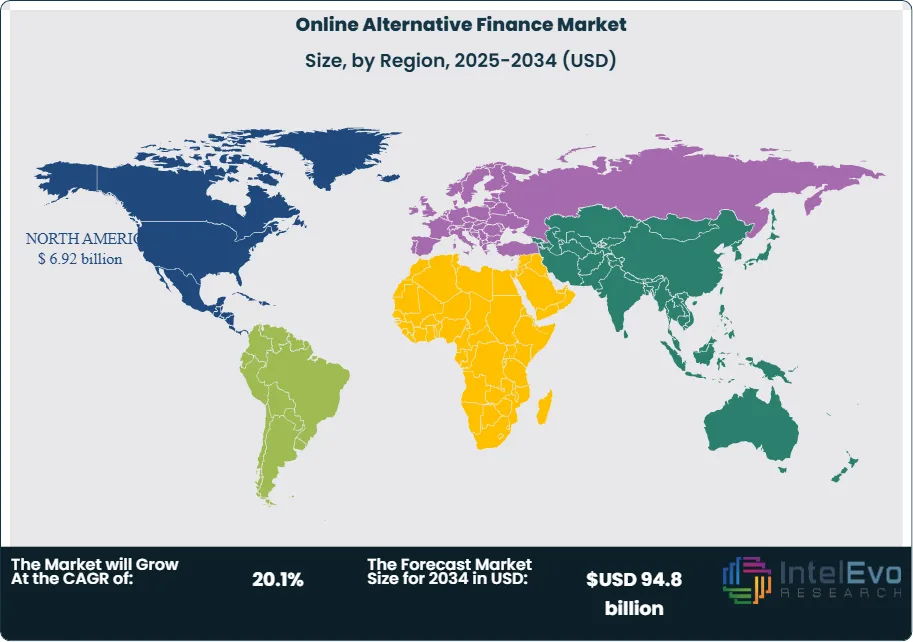
North America accounted for over 45% of global revenues in 2023, or around USD 5.5 Billion, anchored by a deep fintech ecosystem and supportive capital markets. Europe continues to expand under open-banking and data-sharing regimes, while Asia Pacific is emerging as the fastest-growing region, supported by high smartphone penetration, large underbanked populations, and increasingly pro-fintech regulatory sandboxes. Developing markets in Latin America, the Middle East, and Africa offer new growth runways where traditional banking infrastructure remains fragmented.
Technology acts as a primary differentiator. Platforms deploy artificial intelligence, machine learning, and advanced analytics to refine risk models, detect fraud in real time, and personalize pricing. Automation and digital identity tools compress processing times from weeks to minutes, improve user experience, and reduce operating cost per loan. At the same time, rising cyber threats, data-privacy obligations, and evolving licensing rules introduce regulatory and compliance risk.
Sustained expansion of the market will depend on regulators balancing innovation with consumer protection and financial stability. Clear prudential standards, consistent disclosure requirements, and harmonized cross-border frameworks can reduce uncertainty for operators and investors. Participants that combine robust risk governance with scalable technology and diversified funding bases are positioned to capture disproportionate value as online alternative finance becomes embedded in mainstream financial systems.
Market Growth: The Global Online Alternative Finance Market grows from USD 17.3 billion by 2025 to USD 94.8 billion by 2034, implying a CAGR of 20.1% from 2026 to 2034.
Segment Dominance: Peer-to-peer lending holds over 55.0% of total market share, 2023, as borrowers and lenders increasingly transact directly without conventional intermediaries.
Segment Dominance: The business customer segment contributes 62.0% of overall online alternative finance volume, 2023, underscoring strong corporate demand for non-bank financing channels.
Driver: Digital platforms that bypass traditional financial intermediaries and accelerate approval processes support rapid adoption, with estimated: 20.0% annual transaction growth, 2024.
Restraint: Regulatory uncertainty, credit-risk concerns, and evolving compliance requirements limit scale in some jurisdictions, with estimated: 15.0% of potential borrowers constrained by policy or risk controls, 2024.
Opportunity: Expanding access in underpenetrated small-business and emerging-market segments creates headroom for new platforms and products, with estimated: 10.0 billion USD incremental addressable volume, 2030.
Trend: Platforms increasingly apply automation, data analytics, and AI-driven scoring to streamline onboarding and risk assessment, with estimated: 70.0% of leading providers using algorithmic underwriting, 2024.
Regional Analysis: North America leads the market with more than 45.0% share and about 5.5 billion USD in revenue, 2023, while high-growth regions in Asia Pacific and other developing markets collectively contribute estimated: 30.0% of global volumes, 2024.
Type Analysis
Peer-to-peer lending continues to hold the largest share of the online alternative finance market in 2025. It accounts for more than half of global transactions, supported by strong demand from individuals and businesses seeking direct funding channels that do not use traditional intermediaries. Users value faster decision cycles and transparent pricing. Platforms that focus on small personal loans and SME credit have gained steady traction as borrowing needs rise across major economies.
The segment grows as platforms apply AI-driven scoring models that improve borrower assessment and reduce default risk. Providers use real-time data, behavioral indicators, and automated verification to create more accurate profiles, which increases lender confidence. Market analysts estimate that default rates on leading P2P platforms have dropped by 6 to 10 percent since 2022, improving platform credibility and widening participation among new lenders.
Crowdfunding, invoice trading, and other categories also expand in 2025. Crowdfunding supports early-stage businesses and creative projects, achieving double-digit annual growth as more users adopt digital fundraising. Invoice trading appeals to SMEs that require working capital and faster liquidity cycles. Several providers report transaction volume increases of more than 20 percent per year, driven by tighter bank lending conditions and steady digital adoption among small firms.
Application Analysis
Pavers, retaining walls, and related applications see growing use of online funding channels as project owners shift towards platforms that provide faster access to capital. Demand rises in regions where construction cycles accelerate and traditional lenders apply stricter approval filters. Project developers use online platforms to secure short-term funding for material procurement and contractor payments, which improves workflow continuity.
Retaining wall projects, often tied to infrastructure and land development, show increased interest in P2P and invoice-based financing as these projects require staged disbursements. Platforms that specialize in construction-related financing report higher application activity from small contractors who prefer predictable approval times and flexible repayment structures. Other applications, including landscaping and urban development projects, also integrate online finance for equipment purchases and service contracts.
Growth in this category reflects broader sector needs rather than large-ticket lending. Most transactions fall within small to mid-sized project budgets, making online finance suitable for rapid approval and moderate risk levels. Industry data from 2024 and 2025 indicates steady adoption as project owners favor digital models over conventional loans.
End-Use Analysis
Businesses remain the primary users of online alternative finance in 2025, accounting for close to two-thirds of total market activity. SMEs rely on these platforms to address cash flow gaps and project-based financing as banks continue to apply conservative credit policies. These firms value short processing cycles, minimal documentation, and a wider mix of funding models including P2P, crowdfunding, and invoice trading.
Early-stage businesses use online channels to support asset purchases, payroll coverage, and expansion projects. Many of them face high rejection rates from conventional lenders, which increases reliance on digital platforms. Large enterprises also participate, although at a smaller scale, mainly using invoice trading to improve working capital positions or support supplier financing.
Individual borrowers form the second major segment. They use P2P platforms for personal loans, medical expenses, education-related financing, and debt consolidation. Adoption climbs in markets with widening credit card debt, stricter bank lending, or limited access to traditional credit products. Average ticket sizes remain low compared with business loans, but overall transaction volume continues to rise.
Regional Analysis
North America maintains the largest regional share of the online alternative finance market in 2025. The region accounts for more than 40 percent of global revenue, supported by high digital adoption, a mature fintech environment, and users who are comfortable with non-bank financial tools. The United States leads regional activity, driven by strong participation from SMEs and a well-established technology base. Canada sees steady growth as regulatory bodies refine guidelines for online lending and crowdfunding.
Europe follows with stable expansion across major markets, including the United Kingdom, Germany, and the Nordic countries. Open banking frameworks and standardized digital identity systems support market activity. European SMEs use invoice trading and P2P lending to manage cross-border operations and diversified supply chains. Southern Europe records faster growth rates as smaller businesses transition to online funding options.
Asia Pacific is the fastest-growing region. Rapid digitization, rising smartphone penetration, and large unbanked populations support strong platform adoption in China, India, Indonesia, and the Philippines. Local providers scale quickly due to high loan demand and supportive regulatory sandboxes. Latin America and the Middle East & Africa show steady momentum, driven by financial inclusion programs and increasing interest from global fintech investors.
Customization for segments, region/country-level will be provided. Moreover, additional customization can be done based on the requirements.
Pricing and Purchase Options
Avail customized purchase options to meet your exact research needs. We have three licenses to opt for: Single User License, Multi-User License (Up to 5 Users), Corporate Use License (Unlimited User and Printable PDF).
TABLE OF CONTENTS
1. EXECUTIVE SUMMARY
1.1. MARKET SNAPSHOT
1.2. KEY FINDINGS & INSIGHTS
1.3. ANALYST RECOMMENDATIONS
1.4. FUTURE OUTLOOK
2. RESEARCH METHODOLOGY
2.1. MARKET DEFINITION & SCOPE
2.2. RESEARCH OBJECTIVES: PRIMARY & SECONDARY DATA SOURCES
2.3. DATA COLLECTION SOURCES
2.3.1. COVERAGE OF 100+ PRIMARY RESEARCH/CONSULTATION CALLS WITH INDUSTRY STAKEHOLDERS
FIGURE 17 NORTH AMERICA ONLINE ALTERNATIVE FINANCE CURRENT AND FUTURE TYPE ANALYSIS, 2025–2034, (USD MILLION)
FIGURE 18 NORTH AMERICA ONLINE ALTERNATIVE FINANCE CURRENT AND FUTURE END USER ANALYSIS, 2025–2034, (USD MILLION)
FIGURE 19 MARKET SHARE BY COUNTRY
FIGURE 20 LATIN AMERICA ONLINE ALTERNATIVE FINANCE CURRENT AND FUTURE TYPE ANALYSIS, 2025–2034, (USD MILLION)
FIGURE 21 LATIN AMERICA ONLINE ALTERNATIVE FINANCE CURRENT AND FUTURE END USER ANALYSIS, 2025–2034, (USD MILLION)
FIGURE 22 MARKET SHARE BY COUNTRY
FIGURE 23 EASTERN EUROPE ONLINE ALTERNATIVE FINANCE CURRENT AND FUTURE TYPE ANALYSIS, 2025–2034, (USD MILLION)
FIGURE 24 EASTERN EUROPE ONLINE ALTERNATIVE FINANCE CURRENT AND FUTURE END USER ANALYSIS, 2025–2034, (USD MILLION)
FIGURE 25 MARKET SHARE BY COUNTRY
FIGURE 26 WESTERN EUROPE ONLINE ALTERNATIVE FINANCE CURRENT AND FUTURE TYPE ANALYSIS, 2025–2034, (USD MILLION)
FIGURE 27 WESTERN EUROPE ONLINE ALTERNATIVE FINANCE CURRENT AND FUTURE END USER ANALYSIS, 2025–2034, (USD MILLION)
FIGURE 28 MARKET SHARE BY COUNTRY
FIGURE 29 EAST ASIA AND PACIFIC ONLINE ALTERNATIVE FINANCE CURRENT AND FUTURE TYPE ANALYSIS, 2025–2034, (USD MILLION)
FIGURE 30 EAST ASIA AND PACIFIC ONLINE ALTERNATIVE FINANCE CURRENT AND FUTURE END USER ANALYSIS, 2025–2034, (USD MILLION)
FIGURE 31 MARKET SHARE BY COUNTRY
FIGURE 32 SEA AND SOUTH ASIA ONLINE ALTERNATIVE FINANCE CURRENT AND FUTURE TYPE ANALYSIS, 2025–2034, (USD MILLION)
FIGURE 33 SEA AND SOUTH ASIA ONLINE ALTERNATIVE FINANCE CURRENT AND FUTURE END USER ANALYSIS, 2025–2034, (USD MILLION)
FIGURE 34 MARKET SHARE BY COUNTRY
FIGURE 35 MIDDLE EAST AND AFRICA ONLINE ALTERNATIVE FINANCE CURRENT AND FUTURE TYPE ANALYSIS, 2025–2034, (USD MILLION)
FIGURE 36 MIDDLE EAST AND AFRICA ONLINE ALTERNATIVE FINANCE CURRENT AND FUTURE END USER ANALYSIS, 2025–2034, (USD MILLION)
FIGURE 37 NORTH AMERICA ONLINE ALTERNATIVE FINANCE CURRENT AND FUTURE MARKET VOLUME SHARE REGIONAL ANALYSIS, 2025–2034, (USD MILLION)
FIGURE 38 U.S. ONLINE ALTERNATIVE FINANCE CURRENT AND FUTURE TYPE ANALYSIS, 2025–2034, (USD MILLION)
FIGURE 39 U.S. ONLINE ALTERNATIVE FINANCE CURRENT AND FUTURE END USER ANALYSIS, 2025–2034, (USD MILLION)
FIGURE 40 CANADA ONLINE ALTERNATIVE FINANCE CURRENT AND FUTURE TYPE ANALYSIS, 2025–2034, (USD MILLION)
FIGURE 41 CANADA ONLINE ALTERNATIVE FINANCE CURRENT AND FUTURE END USER ANALYSIS, 2025–2034, (USD MILLION)
FIGURE 42 LATIN AMERICA ONLINE ALTERNATIVE FINANCE CURRENT AND FUTURE MARKET VOLUME SHARE REGIONAL ANALYSIS, 2025–2034, (USD MILLION)
FIGURE 43 MEXICO ONLINE ALTERNATIVE FINANCE CURRENT AND FUTURE TYPE ANALYSIS, 2025–2034, (USD MILLION)
FIGURE 44 MEXICO ONLINE ALTERNATIVE FINANCE CURRENT AND FUTURE END USER ANALYSIS, 2025–2034, (USD MILLION)
FIGURE 45 BRAZIL ONLINE ALTERNATIVE FINANCE CURRENT AND FUTURE TYPE ANALYSIS, 2025–2034, (USD MILLION)
FIGURE 46 BRAZIL ONLINE ALTERNATIVE FINANCE CURRENT AND FUTURE END USER ANALYSIS, 2025–2034, (USD MILLION)
FIGURE 47 ARGENTINA ONLINE ALTERNATIVE FINANCE CURRENT AND FUTURE TYPE ANALYSIS, 2025–2034, (USD MILLION)
FIGURE 48 ARGENTINA ONLINE ALTERNATIVE FINANCE CURRENT AND FUTURE END USER ANALYSIS, 2025–2034, (USD MILLION)
FIGURE 49 COLUMBIA ONLINE ALTERNATIVE FINANCE CURRENT AND FUTURE TYPE ANALYSIS, 2025–2034, (USD MILLION)
FIGURE 50 COLUMBIA ONLINE ALTERNATIVE FINANCE CURRENT AND FUTURE END USER ANALYSIS, 2025–2034, (USD MILLION)
FIGURE 51 REST OF LATIN AMERICA ONLINE ALTERNATIVE FINANCE CURRENT AND FUTURE TYPE ANALYSIS, 2025–2034, (USD MILLION)
FIGURE 52 REST OF LATIN AMERICA ONLINE ALTERNATIVE FINANCE CURRENT AND FUTURE END USER ANALYSIS, 2025–2034, (USD MILLION)
FIGURE 53 EASTERN EUROPE ONLINE ALTERNATIVE FINANCE CURRENT AND FUTURE MARKET VOLUME SHARE REGIONAL ANALYSIS, 2025–2034, (USD MILLION)
FIGURE 54 POLAND ONLINE ALTERNATIVE FINANCE CURRENT AND FUTURE TYPE ANALYSIS, 2025–2034, (USD MILLION)
FIGURE 55 POLAND ONLINE ALTERNATIVE FINANCE CURRENT AND FUTURE END USER ANALYSIS, 2025–2034, (USD MILLION)
FIGURE 56 RUSSIA ONLINE ALTERNATIVE FINANCE CURRENT AND FUTURE TYPE ANALYSIS, 2025–2034, (USD MILLION)
FIGURE 57 RUSSIA ONLINE ALTERNATIVE FINANCE CURRENT AND FUTURE END USER ANALYSIS, 2025–2034, (USD MILLION)
FIGURE 58 CZECH REPUBLIC ONLINE ALTERNATIVE FINANCE CURRENT AND FUTURE TYPE ANALYSIS, 2025–2034, (USD MILLION)
FIGURE 59 CZECH REPUBLIC ONLINE ALTERNATIVE FINANCE CURRENT AND FUTURE END USER ANALYSIS, 2025–2034, (USD MILLION)
FIGURE 60 ROMANIA ONLINE ALTERNATIVE FINANCE CURRENT AND FUTURE TYPE ANALYSIS, 2025–2034, (USD MILLION)
FIGURE 61 ROMANIA ONLINE ALTERNATIVE FINANCE CURRENT AND FUTURE END USER ANALYSIS, 2025–2034, (USD MILLION)
FIGURE 62 REST OF EASTERN EUROPE ONLINE ALTERNATIVE FINANCE CURRENT AND FUTURE TYPE ANALYSIS, 2025–2034, (USD MILLION)
FIGURE 63 REST OF EASTERN EUROPE ONLINE ALTERNATIVE FINANCE CURRENT AND FUTURE END USER ANALYSIS, 2025–2034, (USD MILLION)
FIGURE 64 WESTERN EUROPE ONLINE ALTERNATIVE FINANCE CURRENT AND FUTURE MARKET VOLUME SHARE REGIONAL ANALYSIS, 2025–2034, (USD MILLION)
FIGURE 65 GERMANY ONLINE ALTERNATIVE FINANCE CURRENT AND FUTURE TYPE ANALYSIS, 2025–2034, (USD MILLION)
FIGURE 66 GERMANY ONLINE ALTERNATIVE FINANCE CURRENT AND FUTURE END USER ANALYSIS, 2025–2034, (USD MILLION)
FIGURE 67 FRANCE ONLINE ALTERNATIVE FINANCE CURRENT AND FUTURE TYPE ANALYSIS, 2025–2034, (USD MILLION)
FIGURE 68 FRANCE ONLINE ALTERNATIVE FINANCE CURRENT AND FUTURE END USER ANALYSIS, 2025–2034, (USD MILLION)
FIGURE 69 UK ONLINE ALTERNATIVE FINANCE CURRENT AND FUTURE TYPE ANALYSIS, 2025–2034, (USD MILLION)
FIGURE 70 UK ONLINE ALTERNATIVE FINANCE CURRENT AND FUTURE END USER ANALYSIS, 2025–2034, (USD MILLION)
FIGURE 71 SPAIN ONLINE ALTERNATIVE FINANCE CURRENT AND FUTURE TYPE ANALYSIS, 2025–2034, (USD MILLION)
FIGURE 72 SPAIN ONLINE ALTERNATIVE FINANCE CURRENT AND FUTURE END USER ANALYSIS, 2025–2034, (USD MILLION)
FIGURE 73 ITALY ONLINE ALTERNATIVE FINANCE CURRENT AND FUTURE TYPE ANALYSIS, 2025–2034, (USD MILLION)
FIGURE 74 ITALY ONLINE ALTERNATIVE FINANCE CURRENT AND FUTURE END USER ANALYSIS, 2025–2034, (USD MILLION)
FIGURE 75 REST OF WESTERN EUROPE ONLINE ALTERNATIVE FINANCE CURRENT AND FUTURE TYPE ANALYSIS, 2025–2034, (USD MILLION)
FIGURE 76 REST OF WESTERN EUROPE ONLINE ALTERNATIVE FINANCE CURRENT AND FUTURE END USER ANALYSIS, 2025–2034, (USD MILLION)
FIGURE 77 EAST ASIA AND PACIFIC ONLINE ALTERNATIVE FINANCE CURRENT AND FUTURE MARKET VOLUME SHARE REGIONAL ANALYSIS, 2025–2034, (USD MILLION)
FIGURE 78 CHINA ONLINE ALTERNATIVE FINANCE CURRENT AND FUTURE TYPE ANALYSIS, 2025–2034, (USD MILLION)
FIGURE 79 CHINA ONLINE ALTERNATIVE FINANCE CURRENT AND FUTURE END USER ANALYSIS, 2025–2034, (USD MILLION)
FIGURE 80 JAPAN ONLINE ALTERNATIVE FINANCE CURRENT AND FUTURE TYPE ANALYSIS, 2025–2034, (USD MILLION)
FIGURE 81 JAPAN ONLINE ALTERNATIVE FINANCE CURRENT AND FUTURE END USER ANALYSIS, 2025–2034, (USD MILLION)
FIGURE 82 AUSTRALIA ONLINE ALTERNATIVE FINANCE CURRENT AND FUTURE TYPE ANALYSIS, 2025–2034, (USD MILLION)
FIGURE 83 AUSTRALIA ONLINE ALTERNATIVE FINANCE CURRENT AND FUTURE END USER ANALYSIS, 2025–2034, (USD MILLION)
FIGURE 84 CAMBODIA ONLINE ALTERNATIVE FINANCE CURRENT AND FUTURE TYPE ANALYSIS, 2025–2034, (USD MILLION)
FIGURE 85 CAMBODIA ONLINE ALTERNATIVE FINANCE CURRENT AND FUTURE END USER ANALYSIS, 2025–2034, (USD MILLION)
FIGURE 86 FIJI ONLINE ALTERNATIVE FINANCE CURRENT AND FUTURE TYPE ANALYSIS, 2025–2034, (USD MILLION)
FIGURE 87 FIJI ONLINE ALTERNATIVE FINANCE CURRENT AND FUTURE END USER ANALYSIS, 2025–2034, (USD MILLION)
FIGURE 88 INDONESIA ONLINE ALTERNATIVE FINANCE CURRENT AND FUTURE TYPE ANALYSIS, 2025–2034, (USD MILLION)
FIGURE 89 INDONESIA ONLINE ALTERNATIVE FINANCE CURRENT AND FUTURE END USER ANALYSIS, 2025–2034, (USD MILLION)
FIGURE 90 SOUTH KOREA ONLINE ALTERNATIVE FINANCE CURRENT AND FUTURE TYPE ANALYSIS, 2025–2034, (USD MILLION)
FIGURE 91 SOUTH KOREA ONLINE ALTERNATIVE FINANCE CURRENT AND FUTURE END USER ANALYSIS, 2025–2034, (USD MILLION)
FIGURE 92 REST OF EAST ASIA AND PACIFIC ONLINE ALTERNATIVE FINANCE CURRENT AND FUTURE TYPE ANALYSIS, 2025–2034, (USD MILLION)
FIGURE 93 REST OF EAST ASIA AND PACIFIC ONLINE ALTERNATIVE FINANCE CURRENT AND FUTURE END USER ANALYSIS, 2025–2034, (USD MILLION)
FIGURE 94 SEA AND SOUTH ASIA ONLINE ALTERNATIVE FINANCE CURRENT AND FUTURE MARKET VOLUME SHARE REGIONAL ANALYSIS, 2025–2034, (USD MILLION)
FIGURE 95 BANGLADESH ONLINE ALTERNATIVE FINANCE CURRENT AND FUTURE TYPE ANALYSIS, 2025–2034, (USD MILLION)
FIGURE 96 BANGLADESH ONLINE ALTERNATIVE FINANCE CURRENT AND FUTURE END USER ANALYSIS, 2025–2034, (USD MILLION)
FIGURE 97 NEW ZEALAND ONLINE ALTERNATIVE FINANCE CURRENT AND FUTURE TYPE ANALYSIS, 2025–2034, (USD MILLION)
FIGURE 98 NEW ZEALAND ONLINE ALTERNATIVE FINANCE CURRENT AND FUTURE END USER ANALYSIS, 2025–2034, (USD MILLION)
FIGURE 99 INDIA ONLINE ALTERNATIVE FINANCE CURRENT AND FUTURE TYPE ANALYSIS, 2025–2034, (USD MILLION)
FIGURE 100 INDIA ONLINE ALTERNATIVE FINANCE CURRENT AND FUTURE END USER ANALYSIS, 2025–2034, (USD MILLION)
FIGURE 101 SINGAPORE ONLINE ALTERNATIVE FINANCE CURRENT AND FUTURE TYPE ANALYSIS, 2025–2034, (USD MILLION)
FIGURE 102 SINGAPORE ONLINE ALTERNATIVE FINANCE CURRENT AND FUTURE END USER ANALYSIS, 2025–2034, (USD MILLION)
FIGURE 103 THAILAND ONLINE ALTERNATIVE FINANCE CURRENT AND FUTURE TYPE ANALYSIS, 2025–2034, (USD MILLION)
FIGURE 104 THAILAND ONLINE ALTERNATIVE FINANCE CURRENT AND FUTURE END USER ANALYSIS, 2025–2034, (USD MILLION)
FIGURE 105 TAIWAN ONLINE ALTERNATIVE FINANCE CURRENT AND FUTURE TYPE ANALYSIS, 2025–2034, (USD MILLION)
FIGURE 106 TAIWAN ONLINE ALTERNATIVE FINANCE CURRENT AND FUTURE END USER ANALYSIS, 2025–2034, (USD MILLION)
FIGURE 107 MALAYSIA ONLINE ALTERNATIVE FINANCE CURRENT AND FUTURE TYPE ANALYSIS, 2025–2034, (USD MILLION)
FIGURE 108 MALAYSIA ONLINE ALTERNATIVE FINANCE CURRENT AND FUTURE END USER ANALYSIS, 2025–2034, (USD MILLION)
FIGURE 109 REST OF SEA AND SOUTH ASIA ONLINE ALTERNATIVE FINANCE CURRENT AND FUTURE TYPE ANALYSIS, 2025–2034, (USD MILLION)
FIGURE 110 REST OF SEA AND SOUTH ASIA ONLINE ALTERNATIVE FINANCE CURRENT AND FUTURE END USER ANALYSIS, 2025–2034, (USD MILLION)
FIGURE 111 MIDDLE EAST AND AFRICA ONLINE ALTERNATIVE FINANCE CURRENT AND FUTURE MARKET VOLUME SHARE REGIONAL ANALYSIS, 2025–2034, (USD MILLION)
FIGURE 112 GCC COUNTRIES ONLINE ALTERNATIVE FINANCE CURRENT AND FUTURE TYPE ANALYSIS, 2025–2034, (USD MILLION)
FIGURE 113 GCC COUNTRIES ONLINE ALTERNATIVE FINANCE CURRENT AND FUTURE END USER ANALYSIS, 2025–2034, (USD MILLION)
FIGURE 114 SAUDI ARABIA ONLINE ALTERNATIVE FINANCE CURRENT AND FUTURE TYPE ANALYSIS, 2025–2034, (USD MILLION)
FIGURE 115 SAUDI ARABIA ONLINE ALTERNATIVE FINANCE CURRENT AND FUTURE END USER ANALYSIS, 2025–2034, (USD MILLION)
FIGURE 116 UAE ONLINE ALTERNATIVE FINANCE CURRENT AND FUTURE TYPE ANALYSIS, 2025–2034, (USD MILLION)
FIGURE 117 UAE ONLINE ALTERNATIVE FINANCE CURRENT AND FUTURE END USER ANALYSIS, 2025–2034, (USD MILLION)
FIGURE 118 BAHRAIN ONLINE ALTERNATIVE FINANCE CURRENT AND FUTURE TYPE ANALYSIS, 2025–2034, (USD MILLION)
FIGURE 119 BAHRAIN ONLINE ALTERNATIVE FINANCE CURRENT AND FUTURE END USER ANALYSIS, 2025–2034, (USD MILLION)
FIGURE 120 KUWAIT ONLINE ALTERNATIVE FINANCE CURRENT AND FUTURE TYPE ANALYSIS, 2025–2034, (USD MILLION)
FIGURE 121 KUWAIT ONLINE ALTERNATIVE FINANCE CURRENT AND FUTURE END USER ANALYSIS, 2025–2034, (USD MILLION)
FIGURE 122 OMAN ONLINE ALTERNATIVE FINANCE CURRENT AND FUTURE TYPE ANALYSIS, 2025–2034, (USD MILLION)
FIGURE 123 OMAN ONLINE ALTERNATIVE FINANCE CURRENT AND FUTURE END USER ANALYSIS, 2025–2034, (USD MILLION)
FIGURE 124 QATAR ONLINE ALTERNATIVE FINANCE CURRENT AND FUTURE TYPE ANALYSIS, 2025–2034, (USD MILLION)
FIGURE 125 QATAR ONLINE ALTERNATIVE FINANCE CURRENT AND FUTURE END USER ANALYSIS, 2025–2034, (USD MILLION)
FIGURE 126 EGYPT ONLINE ALTERNATIVE FINANCE CURRENT AND FUTURE TYPE ANALYSIS, 2025–2034, (USD MILLION)
FIGURE 127 EGYPT ONLINE ALTERNATIVE FINANCE CURRENT AND FUTURE END USER ANALYSIS, 2025–2034, (USD MILLION)
FIGURE 128 NIGERIA ONLINE ALTERNATIVE FINANCE CURRENT AND FUTURE TYPE ANALYSIS, 2025–2034, (USD MILLION)
FIGURE 129 NIGERIA ONLINE ALTERNATIVE FINANCE CURRENT AND FUTURE END USER ANALYSIS, 2025–2034, (USD MILLION)
FIGURE 130 SOUTH AFRICA ONLINE ALTERNATIVE FINANCE CURRENT AND FUTURE TYPE ANALYSIS, 2025–2034, (USD MILLION)
FIGURE 131 SOUTH AFRICA ONLINE ALTERNATIVE FINANCE CURRENT AND FUTURE END USER ANALYSIS, 2025–2034, (USD MILLION)
FIGURE 132 ISRAEL ONLINE ALTERNATIVE FINANCE CURRENT AND FUTURE TYPE ANALYSIS, 2025–2034, (USD MILLION)
FIGURE 133 ISRAEL ONLINE ALTERNATIVE FINANCE CURRENT AND FUTURE END USER ANALYSIS, 2025–2034, (USD MILLION)
FIGURE 134 REST OF MEA ONLINE ALTERNATIVE FINANCE CURRENT AND FUTURE TYPE ANALYSIS, 2025–2034, (USD MILLION)
FIGURE 135 REST OF MEA ONLINE ALTERNATIVE FINANCE CURRENT AND FUTURE END USER ANALYSIS, 2025–2034, (USD MILLION)
FIGURE 136 U. S. MARKET SHARE ANALYSIS BY TYPE (2024)
FIGURE 137 U. S. MARKET SHARE ANALYSIS BY END USER (2024)
FIGURE 138 CANADA MARKET SHARE ANALYSIS BY TYPE (2024)
FIGURE 139 CANADA MARKET SHARE ANALYSIS BY END USER (2024)
FIGURE 140 MEXICO MARKET SHARE ANALYSIS BY TYPE (2024)
FIGURE 141 MEXICO MARKET SHARE ANALYSIS BY END USER (2024)
FIGURE 142 CHINA MARKET SHARE ANALYSIS BY TYPE (2024)
FIGURE 143 CHINA MARKET SHARE ANALYSIS BY END USER (2024)
FIGURE 144 JAPAN MARKET SHARE ANALYSIS BY TYPE (2024)
FIGURE 145 JAPAN MARKET SHARE ANALYSIS BY END USER (2024)
FIGURE 146 INDIA MARKET SHARE ANALYSIS BY TYPE (2024)
FIGURE 147 INDIA MARKET SHARE ANALYSIS BY END USER (2024)
FIGURE 148 SOUTH KOREA MARKET SHARE ANALYSIS BY TYPE (2024)
FIGURE 149 SOUTH KOREA MARKET SHARE ANALYSIS BY END USER (2024)
FIGURE 150 SAUDI ARABIA MARKET SHARE ANALYSIS BY TYPE (2024)
FIGURE 151 SAUDI ARABIA MARKET SHARE ANALYSIS BY END USER (2024)
FIGURE 152 UAE MARKET SHARE ANALYSIS BY TYPE (2024)
FIGURE 153 UAE MARKET SHARE ANALYSIS BY END USER (2024)
FIGURE 154 EGYPT MARKET SHARE ANALYSIS BY TYPE (2024)
FIGURE 155 EGYPT MARKET SHARE ANALYSIS BY END USER (2024)
FIGURE 156 NIGERIA MARKET SHARE ANALYSIS BY TYPE (2024)
FIGURE 157 NIGERIA MARKET SHARE ANALYSIS BY END USER (2024)
FIGURE 158 SOUTH AFRICA MARKET SHARE ANALYSIS BY TYPE (2024)
FIGURE 159 SOUTH AFRICA MARKET SHARE ANALYSIS BY END USER (2024)
FIGURE 160 GERMANY MARKET SHARE ANALYSIS BY TYPE (2024)
FIGURE 161 GERMANY MARKET SHARE ANALYSIS BY END USER (2024)
FIGURE 162 FRANCE MARKET SHARE ANALYSIS BY TYPE (2024)
FIGURE 163 FRANCE MARKET SHARE ANALYSIS BY END USER (2024)
FIGURE 164 UK MARKET SHARE ANALYSIS BY TYPE (2024)
FIGURE 165 UK MARKET SHARE ANALYSIS BY END USER (2024)
FIGURE 166 SPAIN MARKET SHARE ANALYSIS BY TYPE (2024)
FIGURE 167 SPAIN MARKET SHARE ANALYSIS BY END USER (2024)
FIGURE 168 ITALY MARKET SHARE ANALYSIS BY TYPE (2024)
FIGURE 169 ITALY MARKET SHARE ANALYSIS BY END USER (2024)
FIGURE 170 BRAZIL MARKET SHARE ANALYSIS BY TYPE (2024)
FIGURE 171 BRAZIL MARKET SHARE ANALYSIS BY END USER (2024)
FIGURE 172 ARGENTINA MARKET SHARE ANALYSIS BY TYPE (2024)
FIGURE 173 ARGENTINA MARKET SHARE ANALYSIS BY END USER (2024)
FIGURE 174 COLUMBIA MARKET SHARE ANALYSIS BY TYPE (2024)
FIGURE 175 COLUMBIA MARKET SHARE ANALYSIS BY END USER (2024)
FIGURE 176 GLOBAL ONLINE ALTERNATIVE FINANCE CURRENT AND FUTURE MARKET KEY COUNTRY LEVEL ANALYSIS, 2024–2034, (USD MILLION)
FIGURE 177 FINANCIAL OVERVIEW:
Key Player Analysis
SoFi: SoFi positions itself as a leading multi-service player in the online alternative finance market in 2025. The company operates a broad portfolio that includes personal loans, student loan refinancing, credit products, and digital banking services. SoFi uses its large member base, which surpasses 7 million users globally, to cross-sell financial products and drive recurring revenue. Its lending unit maintains steady growth as personal loan originations rise at double-digit rates, supported by automated underwriting and real-time income verification. You see SoFi strengthening its data models to reduce default exposure and improve the risk profile across consumer lending.
Strategically, the company invests in AI-driven credit analytics and identity verification tools to increase accuracy in borrower assessment. It also expands its partner ecosystem through credit card programs and embedded finance initiatives. The acquisition of smaller fintech firms in 2024 and 2025 has broadened SoFi’s product capabilities while improving access to younger digital borrowers. Its differentiators include strong brand visibility, an integrated financial app, and a diversified product structure that allows the firm to capture long-term customer value.
Zopa: Zopa operates as a challenger in the online lending and digital banking space with a strong presence in the United Kingdom. The company transitioned from a pure peer-to-peer lending platform to a regulated digital bank. This shift allowed Zopa to strengthen its funding base through deposits and reduce volatility in loan supply. By 2025, the company reports steady portfolio growth, with personal lending and credit products expanding at an estimated CAGR of 12 to 15 percent. You see Zopa aligning its credit models with real-time behavioral data to maintain portfolio stability in a tightening credit environment.
Zopa’s strategy centers on expanding digital banking services and building long-term customer relationships. The firm invests in automated repayment tools and savings products that target mid-income consumers seeking flexible credit. It continues to explore partnerships with retailers and payment providers to integrate Zopa’s credit products into everyday spending channels. The company differentiates itself through transparent pricing, a strong trust profile in the UK market, and a technology stack that supports quick onboarding and high approval accuracy.
StreetShares: StreetShares positions itself as a niche provider focused on small business financing in the United States. The company concentrates on lending products for veteran-owned and early-stage enterprises, which face more barriers in securing bank credit. Its core offerings include term loans, lines of credit, and government contract financing. By 2025, StreetShares gains traction as federal procurement activity increases and more SMEs seek short-term liquidity. You see the firm maintaining stable growth through a credit portfolio tailored to lower-ticket business loans with predictable repayment cycles.
StreetShares builds its strategy around data-driven underwriting that incorporates government contract performance and supplier payment patterns. This approach reduces risk in a segment that often lacks formal credit records. The company expands its partner network with small business agencies, procurement groups, and commercial service providers to widen access to qualified borrowers. Its differentiators include a focused customer base, expertise in government-related financing structures, and product designs aligned with the cash-flow needs of smaller firms.
Market Key Players
Prosper Marketplace
Upstart
Funding Circle
Kiva
SoFi
StreetShares
Peerform
ZOPA
Lending Club
Kickstarter
Other Key Players
Driver:
Credit Tightening Accelerates Shift to Alternative Finance
As of 2025, demand for online alternative finance continues to rise as individuals and businesses face tighter credit conditions across traditional banks. Many institutions maintain conservative lending policies due to higher capital requirements and risk-weight adjustments. This environment pushes borrowers toward platforms that offer faster approvals and simpler documentation. Global transaction values across peer-to-peer lending, crowdfunding, and invoice trading are growing at an estimated CAGR of 17 to 19 percent through 2030.
Data-Driven Direct Lending Expands Borrower and Investor Participation
You see direct lending models strengthening because platforms now use structured data and automated scoring to lower assessment time. This shift improves access for small firms that struggle with bank underwriting. For investors, the broader user base increases market liquidity and creates more predictable return profiles. The driver supports stronger participation from retail and institutional lenders, expanding the competitive landscape.
Regulatory uncertainty remains a core limitation in 2025. Several markets operate under evolving digital lending guidelines, and differences in disclosure standards, borrower protection rules, and cross-border funding policies create inconsistencies. Platforms operating in multiple regions face higher compliance costs, which can reduce margins by 8 to 12 percent depending on jurisdiction.
Credit Risk and Delinquency Concerns Limit Platform Growth
You must also consider credit-risk concerns tied to unverified borrowers and fragmented data. Some platforms report higher delinquency spikes during macroeconomic stress periods, which prompts investors to reduce exposure. These constraints slow platform expansion, delay product rollouts, and limit access for higher-risk segments. The restraint shapes investment decisions and influences platform strategies for risk control.
Market expansion in high-growth regions presents a strong opportunity from 2025 onward. Asia Pacific, Latin America, and parts of Africa report rapid adoption of digital lending due to underbanked populations and rising smartphone use. Analysts project that underserved SME financing gaps in these regions could exceed 800 billion USD by 2030, giving online platforms room to capture sizable market share. Platforms that build localized verification tools and partnerships with regional payment systems stand to gain early advantage.
Invoice Trading and Supply-Chain Finance Drive Scalable Growth
You can also see clear opportunities in invoice trading and supply-chain finance. Businesses facing liquidity gaps use these channels to manage working capital with greater predictability. Forecasts suggest these products could grow at more than 20 percent annually as firms shift toward digital financial operations. The opportunity supports long-term platform scalability and attracts new institutional funding pools.
Trend:
Automation and AI Transform Lending Decision Processes
In 2025, the industry moves toward automated, data-driven decision models that improve accuracy and reduce processing time. Providers are integrating machine learning, behavioral analytics, and alternative data sources such as transaction history and digital identity records. These tools shorten approval windows from days to minutes for many loan categories. Major platforms report that automated scoring now supports more than 70 percent of loan decisions.
Blockchain and Tokenization Enhance Transparency and Trust
Blockchain-based verification also gains relevance in transaction tracking and identity management. You see increasing use of tokenized assets in crowdfunding and invoice finance, improving audit trails and reducing reconciliation costs. The trend strengthens transparency for lenders and borrowers and positions online alternative finance as a reliable component of the wider financial system.
Recent Developments
Dec 2024 – SoFi: SoFi announced it had reached 10 million members, with customers borrowing a cumulative 117 billion USD, earning 1 billion USD in savings interest, and paying down 33 billion USD in credit card debt as of September 2024. This milestone reinforces SoFi’s scale in online consumer lending and gives you a wider installed base for cross-selling lending and banking products.
Dec 2024 – Zopa Bank: Zopa raised just over 80 million EUR (about 68 million GBP) in new equity funding led by A.P. Moller Holding and existing investors to support its growth plans and the rollout of a flagship current account and GenAI-led money management tools in 2025. The capital raise strengthens Zopa’s balance sheet and supports its push to deepen engagement with UK retail customers through an expanded digital banking and credit portfolio.
Mar 2025 – SoFi: SoFi finalized an agreement of up to 5 billion USD with funds managed by Blue Owl Capital to fund personal loans on its finance app. The facility increases SoFi’s lending firepower and helps the company grow originations without relying solely on its own balance sheet.
Apr 2025 – SoFi: SoFi secured a further 2 billion USD extension of its Loan Platform Business agreement with Fortress Investment Group, lifting Fortress commitments for this program to more than 5 billion USD and adding an extra 1.2 billion USD via a joint-venture structure with Edge Focus. The expanded warehouse and forward-flow capacity improves SoFi’s ability to scale unsecured lending while managing funding costs and risk transfer to institutional investors.
Jun 2025 – Circle: Circle, issuer of the USDC stablecoin, completed an IPO on the NYSE, raising about 624 million USD at a valuation of 6.9 billion USD, as US lawmakers advanced two stablecoin bills that introduce licensing, reserve, and audit requirements. The listing under a tighter regulatory framework enhances Circle’s credibility and pushes the broader online alternative finance and digital asset ecosystem toward more transparent, bank-like standards.
Nov 2025 – Zopa Bank: Zopa Bank launched “Zopa Investments” in partnership with Upvest, using Upvest’s investment API to offer General Investment Accounts and Stocks & Shares ISAs with a 1 GBP minimum, initially to its 1.6 million customers and targeting an estimated 15 million UK adults who hold more than six months of income in cash. The launch moves Zopa beyond lending into wealth products, positioning it as a broader alternative finance platform that links savings, credit, and entry-level investing under one digital interface.