

- Home
- Industries
 Aerospace And Defence
 Agriculture
 Automotive And Transportation
 Banking And Finance
 Business
 Chemicals And Materials
 Consumer And Retail
 Electronics And Semiconductors
 Food And Beverages
 Machinery & Equipments
 Manufacturing And Construction
 Medical Devices
 Others
 Pharmaceuticals And Healthcare
 Power And Energy
 Sports
 Technology
- Services
- News Room
- About us
- Contact Us
-
Global Parametric Insurance Platform Market Size, Share | CAGR 21.6%
Global Parametric Insurance Platform Market Size, Share, Growth Analysis By Insurance Type (Natural Catastrophe, Agriculture Index Insurance, Aviation & Travel, Energy, Marine & Trade Credit), By Trigger Type (Weather Data, Seismic, Satellite Sensing, IoT Sensors, Multi-Peril Index), By End-User, By Deployment Mode, Industry Trends & Forecast 2026-2034

Report Overview
| Market Size (2025) | Forecast Value (2034) | CAGR (2026–2034) | Largest Region (2025) |
| USD 4.27 Billion | USD 24.89 Billion | 21.6% | North America, 38.4% |
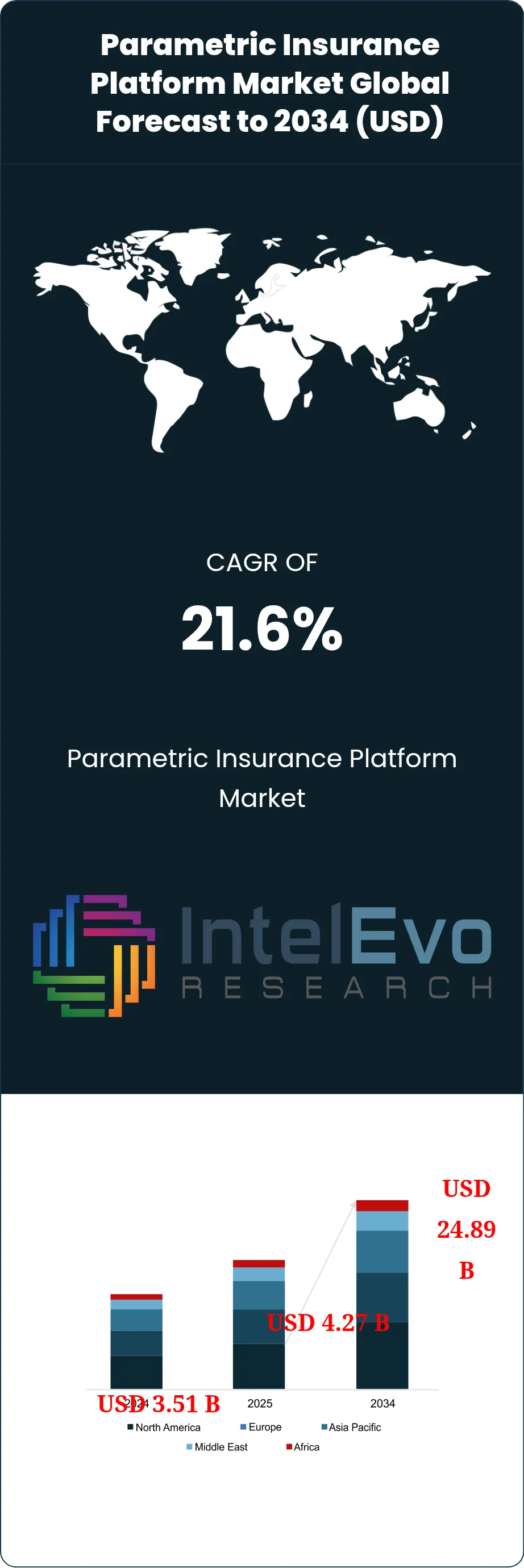
The Parametric Insurance Platform Market was valued at approximately USD 3.51 Billion in 2024 and reached USD 4.27 Billion in 2025. The market is projected to grow to USD 24.89 Billion by 2034, expanding at a CAGR of 21.6% during the forecast period from 2026 to 2034. This represents an absolute dollar opportunity of USD 20.62 Billion over the analysis period, establishing Parametric Insurance Platforms as one of the fastest-expanding categories within InsurTech and the broader financial technology sector.
Get More Information about this report -
Request Free Sample ReportParametric insurance, also referred to as index-based insurance, pays predetermined claim amounts automatically when a measurable trigger event crosses a defined threshold, entirely bypassing traditional loss assessment and claims adjustment processes. A parametric weather policy, for example, pays USD 500,000 automatically when a named weather station records wind speeds above 120 km/h for a minimum duration, regardless of whether the policyholder can document specific physical damage. This structure eliminates the basis risk of disputed claims, reduces loss adjustment expense by 60–80% relative to indemnity insurance, and delivers payouts within days rather than months. Parametric Insurance Platforms are the technology layer enabling this model at scale, providing trigger data ingestion from weather stations, satellite imagery, seismic sensors, and IoT devices; automated policy administration and pricing engines; smart contract execution and claims payment processing; and reinsurance placement APIs that connect cedents with capacity providers in real time.
Four structural forces are accelerating market growth through the forecast period. First, the global natural catastrophe protection gap, estimated at USD 280 Billion annually by the World Bank, reflects the vast underinsurance of populations and assets in climate-exposed markets where traditional indemnity insurance is unavailable or unaffordable. Parametric platforms address this gap by eliminating the underwriting and loss assessment infrastructure costs that make conventional insurance economically unviable in low-income and emerging markets. Second, climate change is increasing the frequency and severity of weather-related loss events, driving demand for faster post-disaster liquidity among governments, corporates, and farmers. Third, advances in satellite remote sensing, IoT sensor networks, and real-time weather data APIs have dramatically reduced the cost and improved the accuracy of parametric trigger measurement, expanding the range of insurable perils beyond the original wind and earthquake covers. Fourth, blockchain-based smart contracts have reduced the settlement latency for parametric triggers from days to minutes, creating new use cases in supply chain finance, trade credit, and real-time agriculture microinsurance.
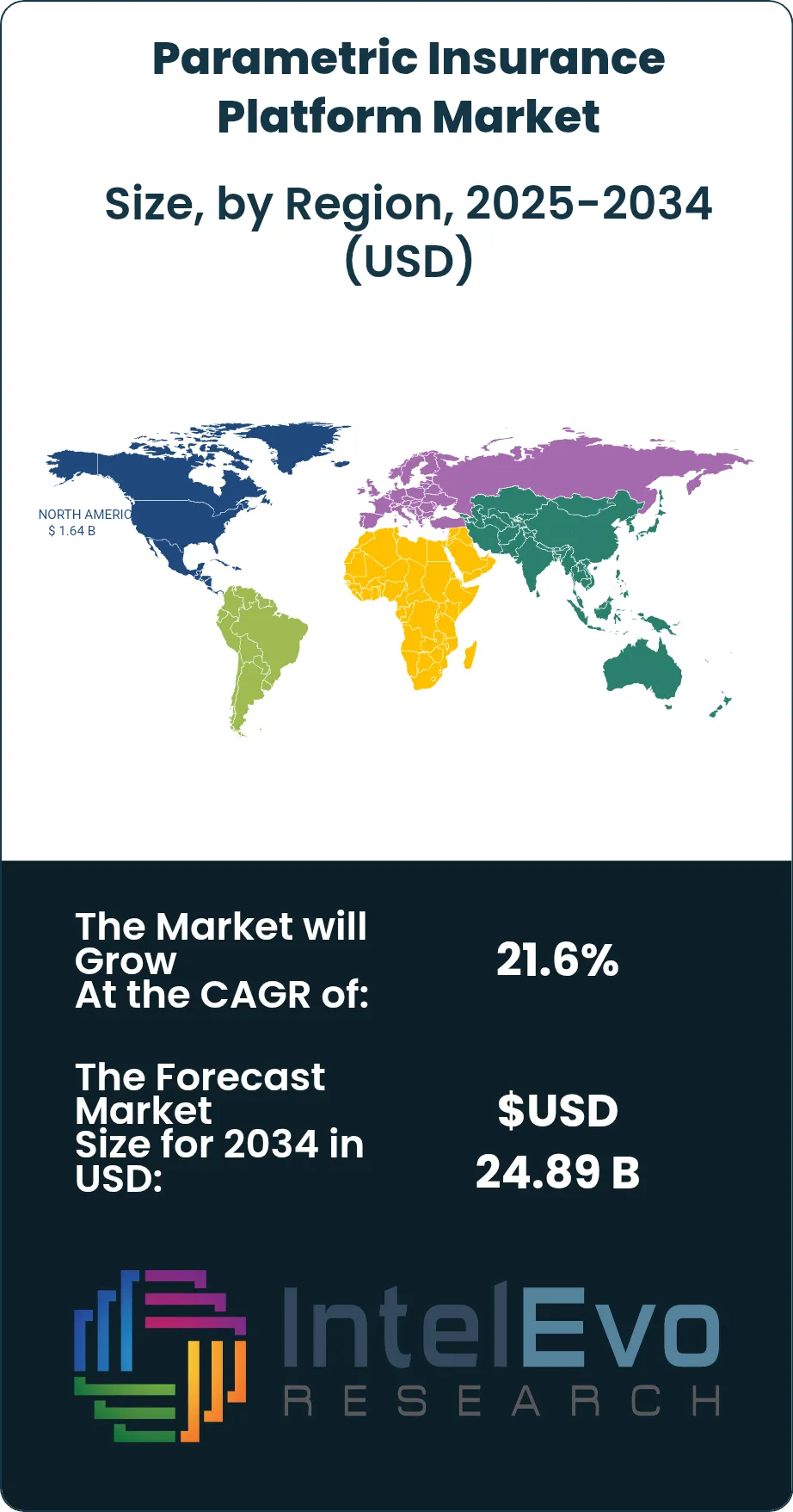
North America leads global market revenue at 38.4% in 2025, approximately USD 1.64 Billion, driven by a mature reinsurance capacity market, active catastrophe bond issuance, and growing climate risk purchasing by corporate treasury departments and state disaster risk financing agencies. Europe holds a 27.3% share, supported by the European Commission's InsuResilience initiative and established parametric catastrophe bond markets in Germany, France, and the United Kingdom. Asia Pacific accounted for 21.6% of global Parametric Insurance Platform revenue in 2025, with Japan's earthquake parametric products, India's Pradhan Mantri Fasal Bima Yojana agriculture index insurance, and the Philippines' sovereign parametric disaster facility as leading regional programs. The competitive environment is evolving rapidly, with specialist InsurTech platforms, reinsurance carriers, and data and analytics providers each competing for control of the platform layer that sits between parametric risk buyers and reinsurance capacity providers.
The Parametric Insurance Platform market is at an inflection point where the technology infrastructure for automated parametric settlement, including high-resolution satellite data, real-time IoT trigger networks, and smart contract execution environments, has matured sufficiently to support commercial scaling beyond the catastrophe bond and sovereign disaster risk financing niches of the 2010s. Corporate buyers across agriculture, energy, logistics, tourism, and construction are beginning to integrate parametric covers into enterprise risk management frameworks, while development finance institutions including the World Bank, IFC, and Asian Development Bank are funding parametric platform deployments in climate-vulnerable developing nations as a financial resilience investment.

Key Takeaways
- Market Growth: The global Parametric Insurance Platform market reached USD 4.27 Billion in 2025 and is forecast to reach USD 24.89 Billion by 2034, expanding at a CAGR of 21.6% over the 2026–2034 forecast period.
- Segment Dominance: By insurance type, natural catastrophe parametric covers held the largest segment share at 42.7% of global platform revenue in 2025, reflecting the established use of parametric triggers for earthquake, hurricane, and flood risk where rapid post-event liquidity and absence of loss adjustment are the primary buyer requirements.
- Segment Dominance: By end-user, commercial and corporate buyers represented the largest demand segment at 38.6% of global market revenue in 2025, as multinational corporations, energy producers, and agribusinesses integrate parametric covers into enterprise risk management and balance sheet protection programs.
- Driver: The widening natural catastrophe protection gap, estimated at USD 280 Billion annually by the World Bank, is the primary structural driver, as parametric platforms reduce insurance delivery costs by 60–80% versus indemnity models, enabling economically viable coverage in markets and risk segments where traditional insurance infrastructure cannot penetrate.
- Restraint: Basis risk, the potential divergence between the parametric trigger measurement and the policyholder's actual financial loss, remains the most significant adoption barrier, with industry surveys indicating that 34% of prospective corporate buyers cite basis risk uncertainty as their primary reason for not purchasing parametric covers in 2025.
- Opportunity: The integration of satellite-derived vegetation index and soil moisture data into agricultural parametric triggers is expanding the addressable agriculture index insurance market to an estimated USD 8.3 Billion by 2034, covering smallholder farmer populations in Sub-Saharan Africa, South Asia, and Southeast Asia where fewer than 5% of farming households currently hold any form of crop insurance.
- Trend: Real-time IoT sensor networks and AI-driven trigger calibration are the dominant 2025 trend, with parametric platforms integrating data from over 40,000 ground-based weather stations, 500-plus satellite constellations, and distributed IoT sensor arrays to achieve trigger measurement accuracy within 2–5% of physical loss outcomes, directly addressing buyer basis risk concerns.
- Regional Analysis: North America leads the global Parametric Insurance Platform market with a 38.4% share in 2025, representing approximately USD 1.64 Billion, driven by an active catastrophe bond market, state-level parametric disaster risk financing programs, and growing corporate parametric purchasing by energy sector and agribusiness risk managers.
Competitive Landscape Overview
The Global Parametric Insurance Platform Market is highly fragmented, with the top four platform providers, Descartes Underwriting, FloodFlash, Jumpstart Insurance, and Arbol, collectively accounting for approximately 22.8% of global platform revenue in 2025. Competition operates across three distinct layers: data and trigger infrastructure providers, parametric policy administration and pricing platforms, and distribution and capacity placement networks. No single vendor currently dominates all three layers, creating a competitive dynamic where specialists at each layer compete for platform integration partnerships with players in adjacent layers. Reinsurance carriers including Swiss Re, Munich Re, and Aon have developed proprietary parametric platforms as both internal tools and client-facing services, leveraging their reinsurance capacity relationships to offer integrated cover-and-technology packages that pure-play InsurTechs struggle to match. M&A activity in 2024–2025 has focused on data layer acquisitions, with platform vendors purchasing weather data and satellite imagery companies to internalize trigger measurement capabilities.
Competitive Landscape Matrix
| Company | HQ Country | Market Position | Key Product / Platform | Geographic Strength | Recent Strategic Move (2024–2026) |
| Descartes Underwriting | France | Leader | Descartes Climate Risk Platform | Europe / North America | Raised USD 120M Series C; launched real-time wildfire parametric product using satellite thermal imaging triggers for U.S. commercial properties (Feb 2025). |
| FloodFlash | UK | Leader | FloodFlash Smart Sensor Platform | Europe / North America | Deployed 18,000 IoT flood sensors across UK commercial properties; expanded to U.S. market with Lloyd's of London capacity backing (Jan 2025). |
| Arbol | USA | Leader | Arbol Climate Risk Marketplace | North America / Asia Pacific | Processed USD 1.2B in parametric weather risk contracts on-platform in 2024; launched agriculture parametric API for embedding in agri-lending platforms (Sep 2025). |
| Jumpstart Insurance | USA | Leader | Jumpstart Earthquake Platform | North America | Extended earthquake parametric product to Oregon and Washington state markets; partnered with State Farm for co-distribution to residential policyholders (Mar 2025). |
| Swiss Re (iptiQ / parametric) | Switzerland | Challenger | Swiss Re Parametric Solutions | Europe / Global | Launched Swiss Re FLOW parametric flood product for SME commercial buyers; signed sovereign parametric facility with 3 Caribbean governments (Jun 2025). |
| Munich Re (MRICS) | Germany | Challenger | Munich Re NatCat Parametric Suite | Europe / Asia Pacific | Expanded NatCat parametric capacity to cover typhoon risk in Philippines and Vietnam; deployed AI trigger calibration reducing basis risk by 18% (Oct 2025). |
| Aon (Aon Climate) | UK | Challenger | Aon Parametric Analytics Platform | Global | Aon Climate launched corporate parametric heat stress product for outdoor workforce risk; placed USD 800M in parametric reinsurance capacity for U.S. utilities (Apr 2025). |
| Metaweather (Speedwell) | UK | Niche Player | Speedwell Weather Derivative Platform | Europe / North America | Integrated ECMWF high-resolution weather model API into Speedwell pricing engine; expanded energy sector parametric product suite (Jan 2026). |
| Global Parametrics | UK | Niche Player | Natural Disaster Fund Platform | Asia Pacific / Africa | Deployed sovereign parametric facility in Bangladesh covering 2.1M smallholder farmers; backed by World Bank IDA guarantee (Feb 2026). |
By Insurance Type:
Natural catastrophe parametric covers dominate the global Parametric Insurance Platform with a 42.7% revenue share in 2025, approximately USD 1.82 Billion, reflecting the long-established use of index triggers for earthquake, hurricane, typhoon, and flood risk. The catastrophe bond market, which reached USD 46.8 Billion in outstanding issuance in 2024 according to data compiled from SEC filings and insurance-linked securities deal databases, relies entirely on parametric or modeled loss triggers, providing the core capital market infrastructure on which commercial parametric platforms are built. Earthquake parametric products, where the trigger is typically USGS ShakeMap peak ground acceleration at a defined grid point, have the longest commercial history, with the Mexican government's FONDEN catastrophe bond program operational since 2006. Hurricane and typhoon wind speed triggers, measured at official meteorological agency monitoring stations, are the second-largest natural catastrophe parametric sub-category, used by Caribbean sovereign risk pooling facilities including CCRIF SPC and Pacific island government disaster facilities. Flood parametric products are the fastest-growing natural catastrophe sub-segment, enabled by the proliferation of IoT flood sensor networks and high-resolution hydrological modeling that allows trigger thresholds to be calibrated at individual property or street-level resolution, reducing basis risk to commercially acceptable levels for corporate and SME buyers.
Agricultural index insurance represented 24.3% of global Parametric Insurance Platform revenue in 2025, approximately USD 1.04 Billion, encompassing rainfall index, normalized difference vegetation index (NDVI), temperature sum, and soil moisture triggers used to compensate smallholder farmers and agribusiness operations for weather-driven crop production losses. India's Pradhan Mantri Fasal Bima Yojana, the world's largest agriculture insurance program with approximately 55 million farmer enrollments in 2024, operates primarily on area yield index and weather index trigger structures administered through parametric platforms. Aviation and travel parametric covers, including flight delay compensation and weather cancellation products, accounted for 12.8% of market revenue, driven by airline and travel operator demand for fast-settling weather disruption covers. Energy sector parametric products, covering wind power revenue shortfall, solar irradiance shortfall, and heating degree day deviations, represented 11.4% of market revenue. Marine and trade credit parametric products, including port closure covers and supply chain disruption triggers, accounted for the remaining 8.8%.
By Trigger Type:
Weather and climate data triggers constitute the largest trigger category in the Parametric Insurance Platform at 48.3% of platform revenue in 2025, approximately USD 2.06 Billion. Weather triggers draw from networks of ground-based meteorological stations operated by national agencies including the U.S. National Oceanic and Atmospheric Administration, the UK Met Office, and Meteo France, as well as commercial weather data providers including The Weather Company (IBM), DTN, and Tomorrow.io, which operate dense supplementary sensor networks. Trigger data quality and spatial density are critical determinants of basis risk, and platform vendors that aggregate data from multiple meteorological sources achieve trigger accuracy superior to single-source implementations. Seismic triggers, using USGS, Japan Meteorological Agency, and European seismological network data, held a 18.7% share in 2025. Satellite and remote sensing triggers, using optical, synthetic aperture radar, and multispectral satellite imagery to measure flood extent, wildfire perimeter, drought severity, and vegetation stress, accounted for 17.4% of platform revenue and are the fastest-growing trigger category at approximately 31% annual growth, reflecting declining satellite data costs and improving image resolution from commercial constellations including Planet Labs, Maxar, and Airbus Defence and Space. IoT sensor triggers, from FloodFlash-style property-level flood sensors and agricultural soil moisture networks, represented 10.2% and multi-peril index triggers 5.4%.
By End-User:
Commercial and corporate buyers represented the largest end-user segment in the Parametric Insurance Platform at 38.6% of global revenue in 2025, approximately USD 1.65 Billion. Corporate parametric purchasing is concentrated among risk managers in industries with significant weather exposure, including energy generation and transmission, agriculture and food production, construction, hospitality and tourism, and retail. A wind farm operator purchasing a parametric wind speed shortfall policy, for example, receives a predetermined payout when average wind speeds fall below a contractual threshold during a policy period, compensating for lost power generation revenue without requiring metered production loss documentation. Corporate parametric adoption is accelerating as CFOs and treasury teams seek to reduce earnings volatility from weather events and qualify parametric premiums as hedging instruments under IFRS 9 and ASC 815 accounting standards. Government and sovereign end-users accounted for 27.4% of market revenue in 2025, covering national disaster risk financing facilities, multilateral development bank-backed sovereign parametric programs, and state-level catastrophe funds. Agricultural end-users held a 22.3% share, and reinsurance and insurance-linked securities buyers represented 11.7%.
By Deployment Mode:
Cloud-native SaaS deployment dominates new Parametric Insurance Platform platform implementations at 61.4% of market revenue in 2025, approximately USD 2.62 Billion. SaaS parametric platforms enable insurers, managing general agents, and corporate risk managers to access trigger data, run parametric pricing models, and administer policies without building proprietary technology infrastructure. API-embedded deployment, where parametric trigger and settlement functions are embedded into third-party financial platforms including agricultural lending apps, supply chain finance platforms, and weather-linked derivative trading systems, accounted for 24.8% of market revenue and is the fastest-growing deployment mode, reflecting the growing practice of embedding parametric protection into the point of commercial risk origination rather than selling it as a standalone insurance product. On-premise deployment retained a 13.8% share in 2025, concentrated among large reinsurance carriers and government disaster risk agencies with data sovereignty requirements.
Regional Analysis
North America
North America leads the global Parametric Insurance Platform market with a 38.4% share in 2025, representing approximately USD 1.64 Billion, driven by the world's most active catastrophe bond and insurance-linked securities market, growing corporate parametric purchasing, and state-level sovereign disaster risk financing programs. The United States accounts for approximately 85% of North American market revenue, supported by the USGS ShakeMap earthquake trigger network, NOAA's hurricane track and intensity monitoring infrastructure, and the NFIP's ongoing reform discussions that have increased corporate interest in parametric alternatives to the National Flood Insurance Program. The California Department of Insurance's increasing scrutiny of traditional homeowners insurance availability in wildfire-exposed zones has created significant demand for parametric wildfire products among commercial property owners, HOA associations, and municipal governments unable to secure traditional indemnity coverage. Catastrophe bond issuance in the United States reached USD 18.4 Billion in 2024, with parametric and modeled loss triggers representing approximately 68% of total issuance, providing the reinsurance capital market infrastructure that supports commercial parametric platform development. FEMA's Building Resilient Infrastructure and Communities program and state emergency management agency parametric disaster reserve funds are expanding the sovereign parametric market within the U.S. Canada's parametric market is centered on agriculture index insurance through Agriculture and Agri-Food Canada programs and growing corporate parametric purchasing in the energy and mining sectors in Alberta and British Columbia.
Europe
Europe accounted for 27.3% of the global Parametric Insurance Platform market in 2025, approximately USD 1.17 Billion, supported by sophisticated reinsurance capacity markets in London and Zurich, active insurance-linked securities issuance, and growing corporate parametric purchasing driven by climate risk disclosure requirements. The United Kingdom is Europe's largest parametric market, with Lloyd's of London syndicates providing the reinsurance capacity backing for the majority of European commercial parametric products. Lloyd's Market Association's parametric working group has published standardized trigger documentation and basis risk disclosure frameworks that have improved buyer confidence and reduced transaction costs for corporate parametric procurement. France is the second-largest European market, with Caisse Centrale de Reassurance operating parametric covers for French overseas territories exposed to Caribbean hurricane and Indian Ocean cyclone risk, and French agricultural cooperatives using rainfall and temperature index covers. Germany's parametric market is developing around corporate weather risk purchasing in the energy, agriculture, and construction sectors, supported by Munich Re and Allianz's parametric product development capabilities. The European Commission's InsuResilience initiative and the EU's Adaptation Strategy have allocated EUR 400 Million toward climate risk finance programs that include parametric insurance components for climate-vulnerable EU regions and partner countries. Switzerland's reinsurance hub, hosting Swiss Re's global parametric center of excellence, positions the country as a leading parametric structuring and capacity market.
Asia Pacific
Asia Pacific represented 21.6% of the global Parametric Insurance Platform market in 2025, approximately USD 923 Million, with the region hosting the world's largest agriculture index insurance programs, the most active sovereign parametric disaster risk facilities, and rapidly growing corporate parametric purchasing. Japan is the most sophisticated Asia Pacific parametric market, with earthquake parametric products backed by government-sponsored Japan Earthquake Reinsurance Company capacity and commercial parametric weather products for the energy and agriculture sectors from Tokio Marine, Sompo, and MS&AD. Japan's earthquake parametric market is unique in its depth of trigger station coverage, with approximately 4,400 K-NET and KiK-net strong motion observation stations providing sub-10 km resolution ShakeMap data for parametric trigger calibration. India's agriculture parametric market, operating through the PMFBY national scheme, enrolled 55 million farmers in 2024 and processed approximately USD 3.2 Billion in seasonal premiums, making it the world's largest single agriculture parametric program by enrollment. The program's administration through parametric platforms supplied by vendors including HDFC ERGO, Bajaj Allianz, and AIC has driven significant technology investment in satellite trigger validation, mobile enrollment, and digital claims processing. The Philippines' PCIC sovereign parametric facility and Thailand's government-backed agriculture index scheme represent additional significant Asia Pacific market programs. China's agricultural index insurance market, operating through People's Insurance Company of China and China Life Property Insurance, is expanding rapidly with provincial government co-financing.
Latin America
Latin America held a 7.4% share of the global Parametric Insurance Platform market in 2025, approximately USD 316 Million, with a regional market shaped by sovereign disaster risk financing programs, agriculture index insurance, and growing corporate parametric purchasing. The Caribbean Catastrophe Risk Insurance Facility Segregated Portfolio Company (CCRIF SPC) is the most established parametric institution in Latin America and the Caribbean, providing earthquake and hurricane parametric covers to 23 Caribbean and Central American governments since 2007 and processing over USD 260 Million in parametric payouts by 2025. Mexico operates the FONDEN catastrophe bond program, which has triggered parametric payouts following multiple earthquake events, and the agricultural index insurance program Agrosemex covers approximately 4 million hectares of crop area annually. Brazil's agricultural sector, the world's largest producer of soybeans and a major coffee, sugarcane, and corn producer, represents a substantial but underpenetrated parametric agriculture opportunity, with rainfall and NDVI-triggered index products beginning to reach larger commercial agribusiness buyers through platforms including Solutia and Bboxx Brazil. Colombia's national disaster risk management agency UNGRD has implemented parametric components in its disaster reserve financing framework. Chile's mining sector parametric purchasing, covering rainfall-driven operational disruption at open-cut mines in the Atacama region, represents a growing corporate parametric sub-market.
Middle East & Africa
The Middle East and Africa region accounted for 5.3% of the global Parametric Insurance Platform market in 2025, approximately USD 226 Million, with Africa representing the more active parametric development environment driven by agriculture index insurance programs and sovereign disaster risk financing. The African Risk Capacity Agency, an African Union specialized agency, operates the world's most sophisticated sovereign parametric drought insurance facility, providing payout triggers based on African Rainfall Climatology version 2 satellite rainfall estimation data for 35 member state governments. ARC has paid out over USD 80 Million in drought parametric claims since its 2014 inception, demonstrating the operational viability of satellite-triggered sovereign parametric insurance at continental scale. Sub-Saharan Africa's smallholder farmer population of approximately 400 million represents the world's largest underserved agricultural parametric market opportunity, with programs including the Ethiopia IBLI livestock index insurance, Kenya's Kilimo Salama (now Pula), and Nigeria's agricultural index programs expanding digital enrollment through mobile money platforms. The Middle East's parametric market is concentrated in the GCC states, where sovereign wealth fund risk managers and corporate energy sector buyers are beginning to use parametric weather covers for oil and gas production disruption from dust storms and temperature extremes. UAE's DIFC has established a regulatory framework for parametric insurance products that positions Dubai as a regional parametric structuring hub.
Get More Information about this report -
Request Free Sample ReportMarket Key Segments
By Insurance Type
- Natural Catastrophe (Earthquake, Hurricane, Flood, Wildfire)
- Agriculture Index Insurance (Rainfall, NDVI, Temperature, Soil Moisture)
- Aviation and Travel (Flight Delay, Weather Cancellation)
- Energy (Wind Shortfall, Solar Irradiance, Heating/Cooling Degree Days)
- Marine and Trade Credit (Port Closure, Supply Chain Disruption)
By Trigger Type
- Weather and Climate Data (Ground Station, NWP Model)
- Seismic (USGS ShakeMap, JMA, ESM)
- Satellite and Remote Sensing (Optical, SAR, Multispectral)
- IoT Sensor Network (Flood Gauge, Soil Moisture, Air Quality)
- Multi-Peril Composite Index
By End-User
- Commercial and Corporate
- Government and Sovereign
- Agricultural (Smallholder and Agribusiness)
- Reinsurance and Insurance-Linked Securities
By Deployment Mode
- Cloud-Native SaaS
- API-Embedded
- On-Premise
Regional Analysis and Coverage
- North America
- Latin America
- East Asia And Pacific
- Sea And South Asia
- Eastern Europe
- Western Europe
- Middle East & Africa
| Report Attribute | Details |
| Market size (2025) | USD 4.27 B |
| Forecast Revenue (2034) | USD 24.89 B |
| CAGR (2025-2034) | 21.6% |
| Historical data | 2021-2024 |
| Base Year For Estimation | 2025 |
| Forecast Period | 2026-2034 |
| Report coverage | Revenue Forecast, Competitive Landscape, Market Dynamics, Growth Factors, Trends and Recent Developments |
| Segments covered | By Insurance Type, (Natural Catastrophe (Earthquake, Hurricane, Flood, Wildfire), Agriculture Index Insurance (Rainfall, NDVI, Temperature, Soil Moisture), Aviation and Travel (Flight Delay, Weather Cancellation), Energy (Wind Shortfall, Solar Irradiance, Heating/Cooling Degree Days), Marine and Trade Credit (Port Closure, Supply Chain Disruption)), By Trigger Type, (Weather and Climate Data (Ground Station, NWP Model), Seismic (USGS ShakeMap, JMA, ESM), Satellite and Remote Sensing (Optical, SAR, Multispectral), IoT Sensor Network (Flood Gauge, Soil Moisture, Air Quality), Multi-Peril Composite Index), By End-User, (Commercial and Corporate, Government and Sovereign, Agricultural (Smallholder and Agribusiness), Reinsurance and Insurance-Linked Securities), By Deployment (Mode, Cloud-Native SaaS, API-Embedded, On-Premise) |
| Research Methodology |
|
| Regional scope |
|
| Competitive Landscape | DESCARTES UNDERWRITING, FLOODFLASH, ARBOL, JUMPSTART INSURANCE, SWISS RE (PARAMETRIC SOLUTIONS), MUNICH RE (MRICS PARAMETRIC), AON (AON CLIMATE), METAWEATHER / SPEEDWELL, GLOBAL PARAMETRICS, ETHERISC, PULA ADVISORS, IBISA (CROP PARAMETRIC), WELLINGTON UNDERWRITING (CLIMATE), AGROTOKEN, SKYLO TECHNOLOGIES (IOT TRIGGER), CCRIF SPC (SOVEREIGN), AFRICAN RISK CAPACITY AGENCY, GUY CARPENTER (PARAMETRIC STRUCTURING), Others |
| Customization Scope | Customization for segments, region/country-level will be provided. Moreover, additional customization can be done based on the requirements. |
| Pricing and Purchase Options | Avail customized purchase options to meet your exact research needs. We have three licenses to opt for: Single User License, Multi-User License (Up to 5 Users), Corporate Use License (Unlimited User and Printable PDF). |


Frequently Asked Questions
How big is the Parametric Insurance Platform Market?
The Global Parametric Insurance Platform Market was valued at USD 3.51 Billion in 2024 and is projected to reach USD 24.89 Billion by 2034, growing at a CAGR of 21.6% from 2026 to 2034, driven by rising demand for automated insurance claim settlements, increasing climate-related risks, growing adoption of AI, IoT, blockchain, and satellite-based risk analytics, and expanding investments in digital insurtech platforms worldwide.
Who are the major players in the Parametric Insurance Platform Market?
DESCARTES UNDERWRITING, FLOODFLASH, ARBOL, JUMPSTART INSURANCE, SWISS RE (PARAMETRIC SOLUTIONS), MUNICH RE (MRICS PARAMETRIC), AON (AON CLIMATE), METAWEATHER / SPEEDWELL, GLOBAL PARAMETRICS, ETHERISC, PULA ADVISORS, IBISA (CROP PARAMETRIC), WELLINGTON UNDERWRITING (CLIMATE), AGROTOKEN, SKYLO TECHNOLOGIES (IOT TRIGGER), CCRIF SPC (SOVEREIGN), AFRICAN RISK CAPACITY AGENCY, GUY CARPENTER (PARAMETRIC STRUCTURING), Others
Which segments covered the Parametric Insurance Platform Market?
By Insurance Type, (Natural Catastrophe (Earthquake, Hurricane, Flood, Wildfire), Agriculture Index Insurance (Rainfall, NDVI, Temperature, Soil Moisture), Aviation and Travel (Flight Delay, Weather Cancellation), Energy (Wind Shortfall, Solar Irradiance, Heating/Cooling Degree Days), Marine and Trade Credit (Port Closure, Supply Chain Disruption)), By Trigger Type, (Weather and Climate Data (Ground Station, NWP Model), Seismic (USGS ShakeMap, JMA, ESM), Satellite and Remote Sensing (Optical, SAR, Multispectral), IoT Sensor Network (Flood Gauge, Soil Moisture, Air Quality), Multi-Peril Composite Index), By End-User, (Commercial and Corporate, Government and Sovereign, Agricultural (Smallholder and Agribusiness), Reinsurance and Insurance-Linked Securities), By Deployment (Mode, Cloud-Native SaaS, API-Embedded, On-Premise)
How can this market research report help my business make strategic decisions?
Our market research reports provide actionable intelligence, including verified market size data, CAGR projections, competitive benchmarking, and segment-level opportunity analysis. These insights support strategic planning, investment decisions, product development, and market entry strategies for enterprises and startups alike.
How frequently is the data updated?
We continuously monitor industry developments and update our reports to reflect regulatory changes, technological advancements, and macroeconomic shifts. Updated editions ensure you receive the latest market intelligence.

Select Licence Type
Connect with our sales team

Parametric Insurance Platform Market
Published Date : 23 May 2026 | Formats :Why IntelEvoResearch
100%
Customer
Satisfaction
24x7+
Availability - we are always
there when you need us
200+
Fortune 50 Companies trust
IntelEvoResearch
80%
of our reports are exclusive
and first in the industry
100%
more data
and analysis
1000+
reports published
till date