

- Home
- Industries
 Aerospace And Defence
 Agriculture
 Automotive And Transportation
 Banking And Finance
 Business
 Chemicals And Materials
 Consumer And Retail
 Electronics And Semiconductors
 Food And Beverages
 Machinery & Equipments
 Manufacturing And Construction
 Medical Devices
 Others
 Pharmaceuticals And Healthcare
 Power And Energy
 Sports
 Technology
- Services
- News Room
- About us
- Contact Us
-
Perimeter Video Analytics Market Size, Share & Forecast | CAGR 17.4%
Global Perimeter Video Analytics Market Size, Share, Analysis By Component (Software, Services, Professional Services, Managed Services, Support & Maintenance), By Deployment Mode (On-Premises, Cloud-Based), By Application (Intrusion Detection, Facial Recognition, License Plate Recognition, Motion Detection, People Counting), By End-User (Commercial, Industrial, Government & Defense, Transportation, Critical Infrastructure), Industry Trends, Competitive Landscape & Forecast 2026–2034

Report Overview
| Market Size (2025) | Forecast Value (2034) | CAGR (2026–2034) | Largest Region (2025) |
| USD 3.72 Billion | USD 15.77 Billion | 17.4% | North America, 40.2% |
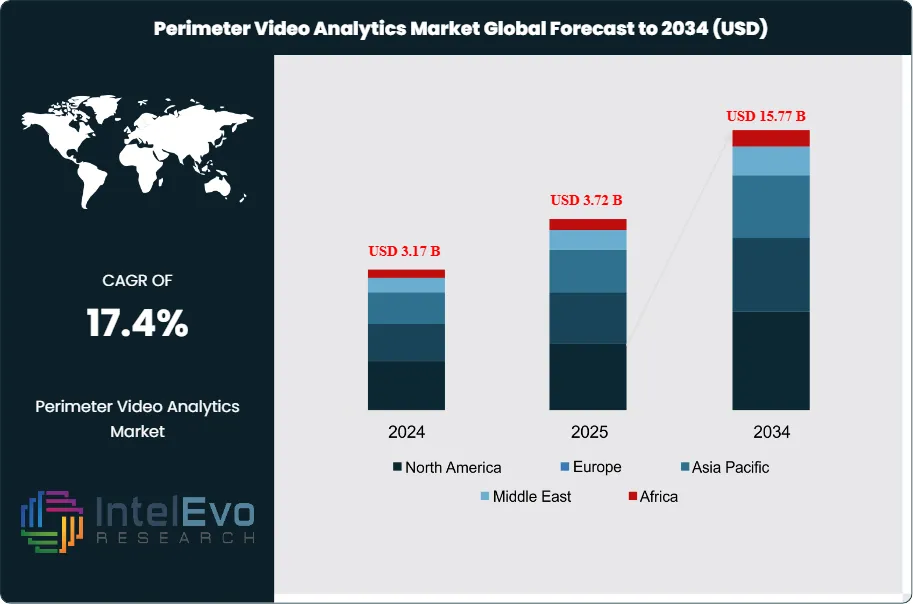
The Perimeter Video Analytics Market is estimated at USD 3.17 billion in 2024 and is on track to reach roughly USD 15.77 billion by 2034, The market is further estimated to reach approximately USD 3.72 billion in 2025, and is expected to expand at a compound annual growth rate (CAGR) of around 17.4% during the forecast period from 2026 to 2034. Growth is driven by increasing demand for advanced security and surveillance solutions, rising adoption of AI-powered video analytics, and growing concerns around perimeter security across critical infrastructure, commercial facilities, and smart cities. Additionally, advancements in edge computing, real-time threat detection, and integration with IoT systems are further accelerating market expansion globally.
Get More Information about this report -
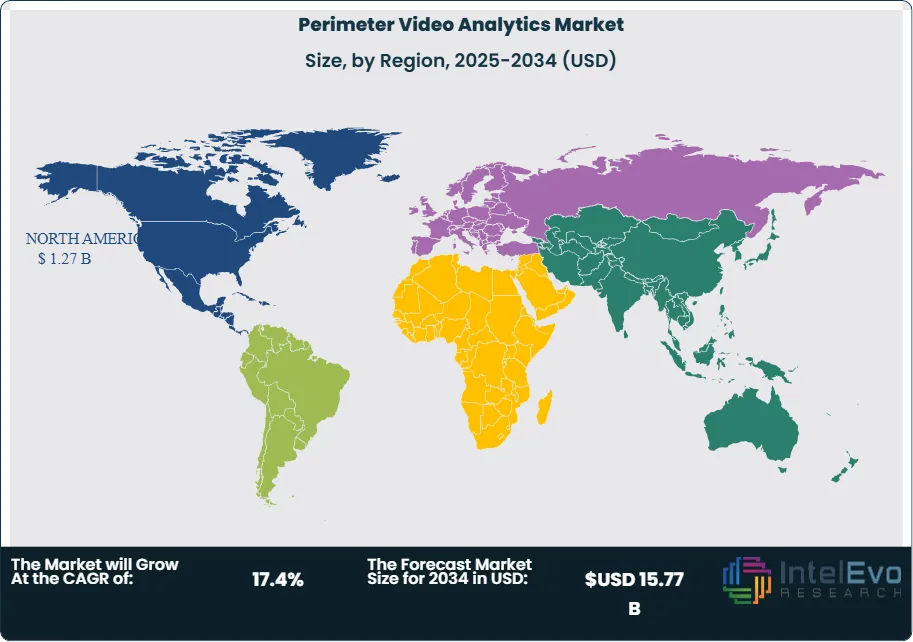
Request Free Sample ReportMarket expansion tracks a shift from guard-led monitoring to software-led perimeter defense across industrial campuses, logistics yards, utilities, airports, and public venues. Buyers prioritize early detection at long stand-off distances and consistent performance in low light, adverse weather, and cluttered scenes. Demand also rises as theft, vandalism, and unauthorized access incidents increase around high-value assets and critical infrastructure. North America leads adoption, holding more than a 40.2% share and about USD 1.27 billion in 2024 revenue, supported by higher security spend, mature integrator networks, and faster uptake of AI-enabled cameras and edge devices.
Supply is shaped by rapid model improvements, tighter integration with video management systems, and growing use of multi-sensor fusion. Vendors compete on lower false-alarm rates, faster classification of people and vehicles, and resilient analytics at the edge to reduce bandwidth and latency. Cost curves improve as compute efficiency rises and pre-trained models ship embedded in cameras. Service partners expand recurring revenue through remote monitoring, managed detection, and lifecycle upgrades, which supports market scalability even when capital budgets tighten.
Policy and compliance influence procurement decisions. Privacy and data-protection rules in North America and Europe push stronger governance, retention controls, and auditability, while critical-infrastructure guidance and transport security standards encourage broader deployment. Risk centers on cyber exposure, model drift, site-specific tuning effort, and liability from missed detections or nuisance alarms. These issues elevate demand for secure-by-design architectures, encrypted pipelines, and continuous validation against changing perimeter conditions.
Regional growth broadens beyond North America as investment concentrates in transport corridors, ports, energy projects, and smart-city programs. Asia-Pacific is positioned as a major growth engine, with an estimated mid-20% revenue share by 2034, led by large-scale infrastructure buildouts and digitalization of industrial security operations. In April 2025, Bosch Security presented IVA Pro Perimeter enhancements at ISC West, adding AI detectors over motion tracking to improve long-range detection and classify atypical intrusion behaviors, reinforcing the market’s pivot toward real-time, automated response.

Key Takeaways
- Market Growth: The U.S. perimeter video analytics market reached 1.16 billion USD, 2024 and sustained a 15.2% CAGR, 2024-2034. North America generated 1.27 billion USD, 2024, reflecting scale at the regional level.
- Segment Dominance: Software led the stack at 64.3%, 2024, driven by advanced analytics engines for threat detection. This share indicates vendors prioritized analytics performance over hardware differentiation at 64.3%, 2024.
- Segment Dominance: On-premises deployments held 60.7%, 2024 as organizations retained tighter control of surveillance data. This preference reflects security and governance priorities at 60.7%, 2024.
- Driver: Intrusion detection and classification captured 43.5%, 2024, as operators required real-time perimeter monitoring. Security teams increased reliance on automated alerting at 43.5%, 2024 to compress response times.
- Restraint: Data sensitivity and governance requirements reinforced on-premises bias at 60.7%, 2024, which can slow cloud adoption. Compliance-driven design constraints increased implementation friction at estimated: 6.0 months, 2024.
- Opportunity: Government and defense contributed 25.8%, 2024, supported by higher spending on borders, public infrastructure, and critical assets. Programs targeting high-risk sites expanded budgets at estimated: 0.5 billion USD, 2024.
- Trend: Buyers shifted toward more capable analytics software at 64.3%, 2024, to reduce noise and improve detection confidence. AI-based classification use increased at estimated: 70.0% adoption, 2024.
- Regional Analysis: North America held 40.2%, 2024, supported by mature deployments and ongoing modernization. The U.S. accounted for 1.16 billion USD, 2024 within this regional base, indicating concentrated demand.
Competitive Landscape
The Global Perimeter Video Analytics Market is moderately consolidated, with the top five technology providers accounting for an estimated 42.0%–48.0% of 2025 market revenue. Competition is AI-driven and platform-centric, where algorithm accuracy, real-time processing capability, edge integration, and system interoperability shape market share more than pricing. Competitive intensity increased in 2025–2026 as vendors expanded AI model capabilities, integrated multi-sensor systems, and strengthened smart city and critical infrastructure partnerships.
| Company | HQ | Position | Key Offering | Geo Strength | Recent Strategic Move |
| HIKVISION | China | Leader | AI-powered video analytics and perimeter security systems | Asia-Pacific, Middle East, Global | Expanded AI-based perimeter detection and smart surveillance platforms in 2025. |
| DAHUA TECHNOLOGY | China | Leader | Video analytics, AI cameras, and integrated security solutions | Asia-Pacific, Africa, Global | Launched advanced AI models with intelligent perimeter detection in 2025. |
| BOSCH SECURITY SYSTEMS | Germany | Leader | IVA Pro analytics and intelligent video surveillance systems | Europe, North America | Enhanced long-range perimeter analytics and AI-based detection tools in 2025. |
| HONEYWELL | US | Leader | Integrated security and video analytics platforms | North America, Middle East | Expanded smart building and perimeter security integration solutions in 2025. |
| AXIS COMMUNICATIONS | Sweden | Leader | Network cameras and advanced video analytics software | Europe, North America | Strengthened edge-based analytics and IoT integration capabilities in 2025. |
| HANWHA VISION (FORMERLY HANWHA TECHWIN) | South Korea | Challenger | AI surveillance systems and perimeter analytics solutions | Asia-Pacific, Europe | Expanded AI-based security camera portfolio in 2025. |
| MOTOROLA SOLUTIONS | US | Challenger | Video security, analytics, and command center software | North America, Europe | Strengthened end-to-end video analytics and public safety solutions in 2025. |
| MILESTONE SYSTEMS | Denmark | Challenger | Video management software (VMS) with analytics integration | Europe, Global | Expanded open-platform VMS and analytics ecosystem in 2025. |
| AVIGILON (MOTOROLA) | Canada | Niche Player | AI-based video analytics and security cameras | North America | Enhanced AI analytics for perimeter threat detection in 2025. |
| INTEL CORPORATION | US | Niche Player | Edge AI processors and analytics hardware platforms | Global | Strengthened AI chip offerings for edge-based video analytics in 2025. |
Summary Insight:
The market is evolving toward AI-driven, edge-enabled, and integrated security ecosystems. Companies with strong AI capabilities, scalable platforms, and IoT integration are gaining share, while smaller players compete through specialized analytics and niche deployments. Multi-sensor integration and real-time intelligence are expected to define competitive advantage through 2034.
By Component
Software continues to command the value pool in perimeter video analytics because it turns standard camera feeds into actionable security outcomes. In 2024, software represented 64.3% of global revenue, and its share remains structurally high into 2025 as enterprises standardize analytics-driven perimeter protection. Buyers prioritize real-time detection, classification, and alerting that works across heterogeneous camera estates. This favors software platforms that integrate cleanly with VMS ecosystems and edge devices, while supporting centralized policy management and audit trails.
Software demand also rises because model quality improves and operating costs fall. AI and machine learning reduce nuisance alarms and improve target discrimination across weather, low-light, and complex scenes, which directly lowers guard workload and response escalation costs. In December 2025, Axis Communications launched AI-enabled bullet cameras with edge analytics based on the ARTPEC-9 chipset, shifting object detection and classification closer to the camera. Support for AV1 encoding reduces storage pressure while maintaining image quality, which strengthens total cost of ownership metrics and reinforces software-led perimeter monitoring.
By Deployment Mode
On-premises deployments remain the preferred architecture for perimeter analytics in sensitive environments. In 2024, on-premises captured 60.7% of the market, and this preference persists into 2025 because many operators treat video as regulated or mission-sensitive data. Critical infrastructure, government sites, and high-security industrial locations often require local processing to meet internal security policies, reduce exposure to third-party risks, and ensure deterministic performance during network degradation.
On-premises also supports low-latency analytics for long-range perimeter scenarios and enables site-specific tuning without external dependencies. In August 2025, Bosch expanded IVA Pro analytics for on-premises cameras designed for long-range protection. Edge AI improved tracking while suppressing false triggers in crowded scenes, and GPS coordinate outputs improved incident mapping and dispatch precision. Cloud-based adoption still grows for multi-site monitoring and centralized updates, but it competes against governance constraints and latency sensitivity in high-stakes deployments.
By Application
Intrusion detection and classification remains the primary workload for perimeter video analytics. In 2024, it represented 43.5% of global revenue, reflecting the operational need to distinguish real threats from harmless motion and to trigger reliable alerts. The use case spans industrial yards, logistics hubs, utilities, airports, and public infrastructure where response time and alarm quality drive procurement decisions. Improvements in classification reduce alarm fatigue and raise confidence in dispatch decisions, which supports continued spending through 2025.
Multi-sensor correlation is becoming standard for high-performance deployments. Systems increasingly fuse analytics with radar, thermal, or fence sensors to maintain detection accuracy across day-night cycles and complex terrain. In September 2025, Hikvision introduced Intelligent Perimeter Protection using DeepinView cameras and large AI models, combining video analytics with radar and linking PTZ cameras for threat tracking. This architecture increases classification accuracy and supports faster verification, which reduces the time between event detection and on-site response.
By End-User
Government and defense remains the single largest end-user grouping for perimeter video analytics because it manages borders, secure facilities, and high-value public assets. In 2024, it accounted for 25.8% of market demand, and spending remains resilient into 2025 as agencies expand surveillance coverage and modernize command-and-control workflows. Reliability and chain-of-custody features influence vendor selection, particularly when video must support investigations and compliance-driven reporting.
Public sector programs also push requirements for interoperable platforms that integrate access control, incident management, and forensic search. In November 2025, BriefCam expanded analytics capabilities tailored to government investigations, adding real-time intrusion alerting and object tracking with watchlist matching, alongside VMS integrations for faster evidence review. Industrial and critical infrastructure buyers track similar priorities, but they often emphasize site-scale coverage, uptime, and automation that reduces reliance on manual monitoring.
By Regional Analysis
North America remains the demand center for perimeter video analytics. In 2024, it held 40.2% of global revenue, equivalent to USD 1.27 billion, supported by early adoption of AI-enabled security systems and sustained investment in critical infrastructure protection. The regional market benefits from mature security integrators, established procurement pathways, and active modernization of surveillance networks across transportation, utilities, and government estates. Regulatory attention to safety and infrastructure resilience also supports multi-year upgrade programs.
Competitive intensity remains high because buyers expect measurable improvements in detection quality and operating efficiency. In October 2025, industry reporting continued to place Genetec among the leading providers of video surveillance and analytics software, supported by enhancements to AI-driven perimeter detection and tighter access control integration. Europe sustains steady deployment where privacy governance and procurement standards shape architecture choices, while Asia Pacific shows faster incremental growth tied to infrastructure buildouts and expanded perimeter hardening around logistics, energy, and public assets. Latin America and the Middle East and Africa present targeted growth pockets in airports, ports, and industrial zones where perimeter incidents and asset concentration justify higher security investment.
Get More Information about this report -
Request Free Sample ReportMarket Key Segments
By Component
- Software
- Services
- Professional Services
- Managed Services
- Support & Maintenance
By Deployment Mode
- On-Premises
- Cloud-Based
By Application
- Intrusion Detection
- People Counting
- License Plate Recognition
- Facial Recognition
- Motion Detection
- Others
By End-User
- Commercial
- Industrial
- Government & Defense
- Transportation
- Critical Infrastructure
- Others
By Regions
- North America
- Latin America
- East Asia And Pacific
- Sea And South Asia
- Eastern Europe
- Western Europe
- Middle East & Africa
| Report Attribute | Details |
| Market size (2025) | USD 3.72 B |
| Forecast Revenue (2034) | USD 15.77 B |
| CAGR (2025-2034) | 17.4% |
| Historical data | 2021-2024 |
| Base Year For Estimation | 2025 |
| Forecast Period | 2026-2034 |
| Report coverage | Revenue Forecast, Competitive Landscape, Market Dynamics, Growth Factors, Trends and Recent Developments |
| Segments covered | By Component (Software, Services), By Deployment Mode (On-Premises, Cloud-Based), By Application (Intrusion Detection, People Counting, License Plate Recognition, Facial Recognition, Motion Detection, Others), By End-User (Commercial, Industrial, Government & Defense, Transportation, Critical Infrastructure, Others) |
| Research Methodology |
|
| Regional scope |
|
| Competitive Landscape | Genetec Inc., Hanwha Techwin, Agent Video Intelligence (Agent Vi), Bosch Security Systems, VIVOTEK Inc., BriefCam, Axis Communications, Qognify, Hikvision Digital Technology, Honeywell International Inc., FLIR Systems, Dahua Technology, Avigilon (Motorola Solutions), Others |
| Customization Scope | Customization for segments, region/country-level will be provided. Moreover, additional customization can be done based on the requirements. |
| Pricing and Purchase Options | Avail customized purchase options to meet your exact research needs. We have three licenses to opt for: Single User License, Multi-User License (Up to 5 Users), Corporate Use License (Unlimited User and Printable PDF). |


Frequently Asked Questions
How big is the Perimeter Video Analytics Market?
The Global Perimeter Video Analytics Market was valued at USD 3.17 Billion in 2024 and is expected to reach USD 3.72 Billion in 2025, projected to hit USD 15.77 Billion by 2034, growing at a CAGR of 17.4% from 2026–2034, driven by AI-based surveillance, smart city security, and real-time threat detection technologies.
Who are the major players in the Perimeter Video Analytics Market?
Genetec Inc., Hanwha Techwin, Agent Video Intelligence (Agent Vi), Bosch Security Systems, VIVOTEK Inc., BriefCam, Axis Communications, Qognify, Hikvision Digital Technology, Honeywell International Inc., FLIR Systems, Dahua Technology, Avigilon (Motorola Solutions), Others
Which segments covered the Perimeter Video Analytics Market?
By Component (Software, Services), By Deployment Mode (On-Premises, Cloud-Based), By Application (Intrusion Detection, People Counting, License Plate Recognition, Facial Recognition, Motion Detection, Others), By End-User (Commercial, Industrial, Government & Defense, Transportation, Critical Infrastructure, Others)
How can this market research report help my business make strategic decisions?
Our market research reports provide actionable intelligence, including verified market size data, CAGR projections, competitive benchmarking, and segment-level opportunity analysis. These insights support strategic planning, investment decisions, product development, and market entry strategies for enterprises and startups alike.
How frequently is the data updated?
We continuously monitor industry developments and update our reports to reflect regulatory changes, technological advancements, and macroeconomic shifts. Updated editions ensure you receive the latest market intelligence.

Select Licence Type
Connect with our sales team

Perimeter Video Analytics Market
Published Date : 26 Mar 2026 | Formats :Why IntelEvoResearch
100%
Customer
Satisfaction
24x7+
Availability - we are always
there when you need us
200+
Fortune 50 Companies trust
IntelEvoResearch
80%
of our reports are exclusive
and first in the industry
100%
more data
and analysis
1000+
reports published
till date
