
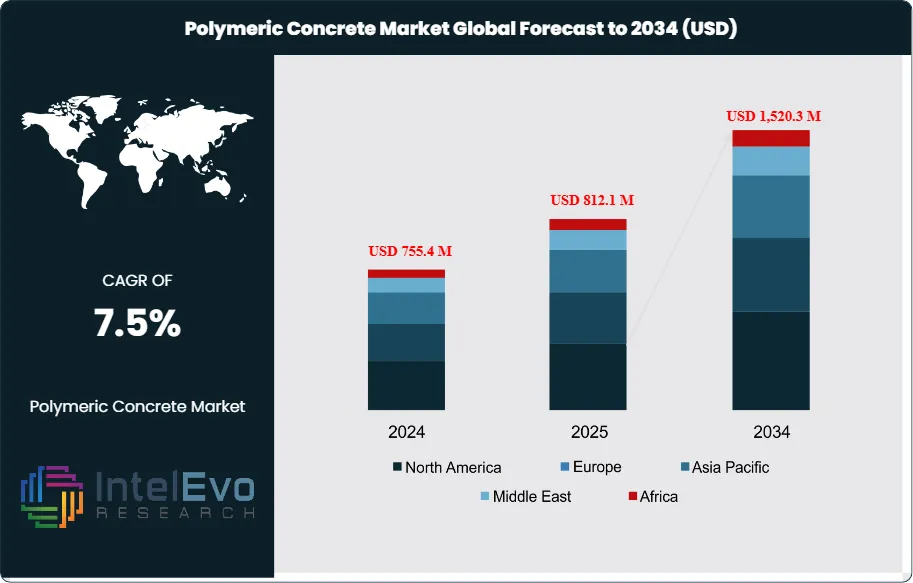
The Polymeric Concrete Market size is expected to reach USD 1,520.3 million by 2034, up from USD 755.4 million in 2024, growing at a CAGR of 7.5% during the forecast period from 2025 to 2034. The market growth is driven by the increasing demand for high-performance, durable, and chemical-resistant construction materials across infrastructure, industrial, and commercial projects. Rising adoption in bridge construction, industrial flooring, and repair applications is further fueling expansion. Additionally, innovations in eco-friendly polymeric binders and rapid-curing concrete solutions are enhancing sustainability and efficiency in the construction sector, making polymeric concrete a key material in modern infrastructure development.
Polymer concrete is a composite material comprising a polymer binder mixed with aggregates such as gravel, sand, or crushed stone. Unlike traditional cement-based concrete, polymer concrete utilizes polymer resins as the binding agent, offering enhanced properties like superior chemical resistance, high strength, and reduced permeability. These attributes make it an ideal choice for applications requiring durability and resistance to harsh environmental conditions.
The polymer concrete market is poised for significant growth, driven by the demand for sustainable and durable construction materials. While challenges like higher initial costs and limited awareness exist, the opportunities presented by emerging economies and technological advancements are substantial. With its superior properties and alignment with modern construction needs, polymer concrete is set to play a pivotal role in the future of the construction industry.
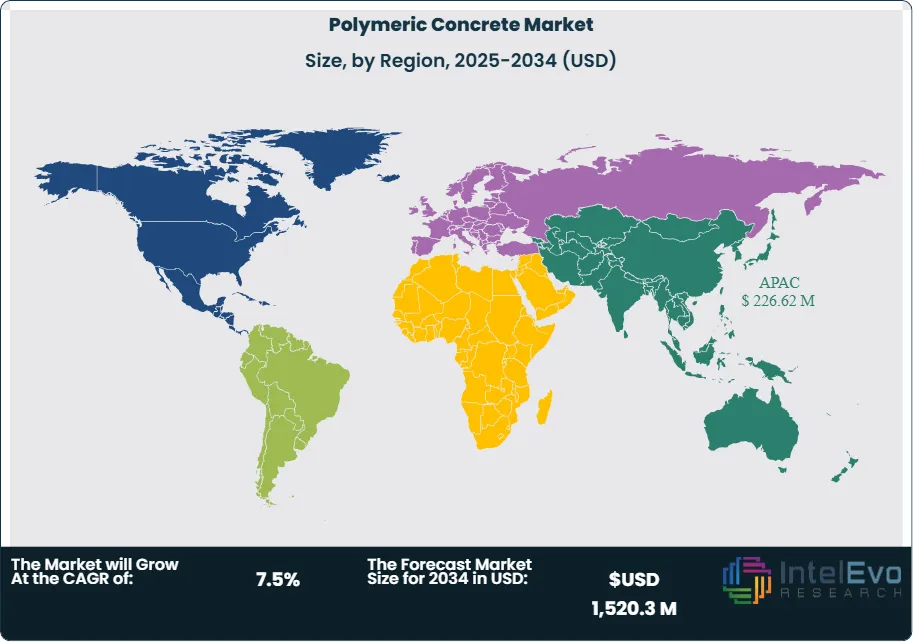
Asia Pacific dominated the polymer concrete market in 2024, accounting for a significant revenue share. This dominance is attributed to rapid industrialization, urbanization, and substantial infrastructure investments in countries like China and India. The region's focus on sustainable construction practices and pollution control further propels the demand for polymer concrete.
The COVID-19 pandemic adversely affected the polymer concrete market due to halted construction activities, disrupted supply chains, and labor shortages. However, as economies recover and infrastructure projects resume, the market is expected to regain momentum. The pandemic also highlighted the importance of resilient and low-maintenance construction materials, potentially accelerating the adoption of polymer concrete in future projects.
Key Takeaways:
Market Growth: The Polymeric Concrete Market is expected to reach USD 1,520.3 million by 2034, growing at a robust CAGR of 7.5% from 2024, growth is driven by increasing demand for sustainable and durable construction materials, rapid urbanization, and significant investments in infrastructure development across emerging economies.
Type Dominance: The Polymer Impregnated Concrete (PIC) segment leads the polymeric concrete market due to its superior strength, reduced permeability, and enhanced durability compared to conventional concrete. PIC is widely used in structural repairs and high-performance applications where longevity and resistance to environmental stressors are critical. Its dominance is also attributed to growing infrastructure refurbishment projects globally.
Polymer Type Dominance: Epoxy leads the polymeric concrete market due to its excellent adhesion, high mechanical strength, and superior chemical resistance. It is widely used in industrial and infrastructure applications that demand durability and resistance to harsh environmental and chemical exposures. Epoxy-based polymer concrete is also favored for flooring, pump bases, and containment structures due to its long service life and minimal maintenance requirements.
Application Dominance: Flooring Blocks lead the polymeric concrete market owing to their extensive use in industrial, commercial, and infrastructure projects. These blocks offer superior strength, durability, and resistance to chemicals, making them ideal for heavy-duty flooring in warehouses, factories, and public facilities. Their ability to withstand mechanical loads and corrosive environments ensures long-lasting performance with minimal maintenance.
End-use Dominance: Industrial applications leads due to the material's excellent resistance to corrosion, high strength, and durability in harsh environments. Industries such as chemical processing, manufacturing, and power generation prefer polymeric concrete for flooring, drainage systems, and containment areas because it outperforms traditional concrete under extreme conditions.
Driver: Rising demand for durable, corrosion-resistant materials in infrastructure and industrial projects is propelling market growth. The need for low-maintenance and long-lasting construction solutions also fuels the adoption of polymeric concrete.
Restraint: High initial costs and limited availability of specialized raw materials restrict widespread adoption. Lack of standardized codes and skilled workforce affects installation and design practices.
Opportunity: Increasing investment in sustainable construction materials creates new market avenues. Growth in renovation and rehabilitation of aging infrastructure boosts future demand.
Trend: Rising adoption of precast polymeric components is revolutionizing the construction process. Technological advancements in resin formulations are expanding application scope.
Regional Analysis: North America is currently the leading region in the polymeric concrete market. The dominance can be attributed to a combination of factors such as a well-established construction industry, a growing focus on infrastructure maintenance and repair, and the adoption of advanced construction materials.
Type Analysis:
Polymer Impregnated Concrete (PIC) is currently the leading type in the polymeric concrete market due to its structural advantages over traditional concrete. The process of impregnating hardened concrete with a monomer and subsequently polymerizing it greatly improves its mechanical strength, reduces permeability, and enhances its resistance to chemical attacks and wear. These properties make PIC ideal for high-performance environments such as bridges, tunnels, marine structures, and industrial repair work. The increasing need for rehabilitation of aging infrastructure globally further fuels the demand for PIC. Given its extended service life and lower lifecycle maintenance, its dominance in the market is expected to persist. However, with rising innovation in construction composites, Polymer Resin Concrete (PMC) is anticipated to see growth in the future due to its moldability and quick curing time.
Product Class Analysis:
Epoxy Leads With more than 30% Market Share In Polymeric Concrete Market: Epoxy-based polymer concrete leads the market owing to its unparalleled chemical resistance, strong adhesive properties, and mechanical robustness. Epoxy is extensively used in environments where structural integrity and chemical durability are non-negotiable—such as in manufacturing plants, chemical facilities, and wastewater treatment stations. Its versatility in structural components like pump bases, flooring, and containment systems makes it a top choice among contractors. While epoxy continues to dominate due to its premium performance, Vinylester is expected to witness notable growth in the future due to its cost-effectiveness and balanced performance in moderate corrosive environments.
Application Analysis:
Among applications, flooring blocks dominate the polymeric concrete market, primarily because of their widespread adoption in heavy-use facilities like factories, warehouses, and commercial spaces. These blocks are valued for their ability to withstand constant mechanical stress, resist chemical spills, and maintain structural integrity over time. Their minimal maintenance and extended durability make them a cost-effective solution for long-term infrastructure investments. Moving forward, chemical containment structures are expected to gain traction due to increasing safety regulations and demand for efficient hazardous waste handling.
End-use Analysis:
The industrial sector is the largest end-use segment in the polymeric concrete market. This dominance is driven by the material’s resilience in corrosive and high-stress environments found in sectors like chemical processing, mining, oil & gas, and power generation. Polymeric concrete’s resistance to extreme pH conditions, chemicals, and thermal cycling makes it ideal for harsh industrial operations. Moreover, its role in reducing downtime through less frequent repairs gives it an edge over conventional concrete. As sustainability and resilience become key considerations, the infrastructure segment is poised for future growth due to increased investments in public works, smart cities, and resilient urban infrastructure.
Region Analysis:
Asia-Pacific holds over 30% Market Share In Polymeric Concrete Market: North America is a key player in the polymeric concrete market, with the U.S. leading the demand due to a strong construction sector and a focus on infrastructure upgrades. The region benefits from technological advancements and the adoption of high-performance concrete in industrial and commercial applications. The growing demand for infrastructure repairs, particularly in the U.S., has increased the adoption of polymeric concrete in highway, bridge, and sewage systems.
Europe is driven by the increasing demand for sustainable construction materials. Countries like Germany, France, and the U.K. are leading the way in adopting polymeric concrete, particularly in industrial and infrastructure applications.
Asia-Pacific is expected to experience the highest growth in the polymeric concrete market due to rapid urbanization, industrial growth, and infrastructure development in countries such as China, India, and Japan.
Latin America is gaining traction, driven by the construction boom and the need for infrastructure upgrades in countries like Brazil and Mexico. The Middle East & Africa (MEA) region is witnessing steady growth in the driven by infrastructure expansion, particularly in the UAE, Saudi Arabia, and South Africa.
By Product Class (Polymer Cement Concrete (PCC), Polymer Resin Concrete (PMC), Polymer Impregnated Concrete (PIC)), By Polymer Type (Epoxy, Vinylester, Polyester, Furan, Acrylate, Latex, Others), By Application (Flooring Blocks, Trench Drains, Pump Bases, Waste Containers, Chemical Containments, Others), By End-use (Commercial, Industrial, Residential, Municipal, Infrastructure)
Research Methodology
Primary Research- 100 Interviews of Stakeholders
Secondary Research
Desk Research
Regional scope
North America (United States, Canada, Mexico)
Latin America (Brazil, Argentina, Columbia)
East Asia And Pacific (China, Japan, South Korea, Australia, Cambodia, Fiji, Indonesia)
Sea And South Asia (India, Singapore, Thailand, Taiwan, Malaysia)
Eastern Europe (Poland, Russia, Czech Republic, Romania)
Western Europe (Germany, U.K., France, Spain, Itlay)
Middle East & Africa (GCC Countries, Egypt, Nigeria, South Africa, Israel)
Competitive Landscape
Interplastic Corporation, Wacker Chemie AG, Lidco Building Technologies, ULMA Architectural Solutions, BASF SE, TPP Manufacturing Sdn. Bhd, Carborundum Universal Limited, ACO FUNKI A/S, Forte Composites Inc,, Polycare Namibia, Sika AG, Dudick Inc., Kwik Bond Polymers, ErgonArmor
Customization Scope
Customization for segments, region/country-level will be provided. Moreover, additional customization can be done based on the requirements.
Pricing and Purchase Options
Avail customized purchase options to meet your exact research needs. We have three licenses to opt for: Single User License, Multi-User License (Up to 5 Users), Corporate Use License (Unlimited User and Printable PDF).
TABLE OF CONTENTS
1. EXECUTIVE SUMMARY
1.1. MARKET SNAPSHOT
1.2. KEY FINDINGS & INSIGHTS
1.3. ANALYST RECOMMENDATIONS
1.4. FUTURE OUTLOOK
2. RESEARCH METHODOLOGY
2.1. MARKET DEFINITION & SCOPE
2.2. RESEARCH OBJECTIVES: PRIMARY & SECONDARY DATA SOURCES
2.3. DATA COLLECTION SOURCES
2.3.1. COVERAGE OF 100+ PRIMARY RESEARCH/CONSULTATION CALLS WITH INDUSTRY STAKEHOLDERS
FIGURE 17 NORTH AMERICA POLYMERIC CONCRETE CURRENT AND FUTURE TYPE ANALYSIS, 2025–2034, (USD MILLION)
FIGURE 18 NORTH AMERICA POLYMERIC CONCRETE CURRENT AND FUTURE END USER ANALYSIS, 2025–2034, (USD MILLION)
FIGURE 19 MARKET SHARE BY COUNTRY
FIGURE 20 LATIN AMERICA POLYMERIC CONCRETE CURRENT AND FUTURE TYPE ANALYSIS, 2025–2034, (USD MILLION)
FIGURE 21 LATIN AMERICA POLYMERIC CONCRETE CURRENT AND FUTURE END USER ANALYSIS, 2025–2034, (USD MILLION)
FIGURE 22 MARKET SHARE BY COUNTRY
FIGURE 23 EASTERN EUROPE POLYMERIC CONCRETE CURRENT AND FUTURE TYPE ANALYSIS, 2025–2034, (USD MILLION)
FIGURE 24 EASTERN EUROPE POLYMERIC CONCRETE CURRENT AND FUTURE END USER ANALYSIS, 2025–2034, (USD MILLION)
FIGURE 25 MARKET SHARE BY COUNTRY
FIGURE 26 WESTERN EUROPE POLYMERIC CONCRETE CURRENT AND FUTURE TYPE ANALYSIS, 2025–2034, (USD MILLION)
FIGURE 27 WESTERN EUROPE POLYMERIC CONCRETE CURRENT AND FUTURE END USER ANALYSIS, 2025–2034, (USD MILLION)
FIGURE 28 MARKET SHARE BY COUNTRY
FIGURE 29 EAST ASIA AND PACIFIC POLYMERIC CONCRETE CURRENT AND FUTURE TYPE ANALYSIS, 2025–2034, (USD MILLION)
FIGURE 30 EAST ASIA AND PACIFIC POLYMERIC CONCRETE CURRENT AND FUTURE END USER ANALYSIS, 2025–2034, (USD MILLION)
FIGURE 31 MARKET SHARE BY COUNTRY
FIGURE 32 SEA AND SOUTH ASIA POLYMERIC CONCRETE CURRENT AND FUTURE TYPE ANALYSIS, 2025–2034, (USD MILLION)
FIGURE 33 SEA AND SOUTH ASIA POLYMERIC CONCRETE CURRENT AND FUTURE END USER ANALYSIS, 2025–2034, (USD MILLION)
FIGURE 34 MARKET SHARE BY COUNTRY
FIGURE 35 MIDDLE EAST AND AFRICA POLYMERIC CONCRETE CURRENT AND FUTURE TYPE ANALYSIS, 2025–2034, (USD MILLION)
FIGURE 36 MIDDLE EAST AND AFRICA POLYMERIC CONCRETE CURRENT AND FUTURE END USER ANALYSIS, 2025–2034, (USD MILLION)
FIGURE 37 NORTH AMERICA POLYMERIC CONCRETE CURRENT AND FUTURE MARKET VOLUME SHARE REGIONAL ANALYSIS, 2025–2034, (USD MILLION)
FIGURE 38 U.S. POLYMERIC CONCRETE CURRENT AND FUTURE TYPE ANALYSIS, 2025–2034, (USD MILLION)
FIGURE 39 U.S. POLYMERIC CONCRETE CURRENT AND FUTURE END USER ANALYSIS, 2025–2034, (USD MILLION)
FIGURE 40 CANADA POLYMERIC CONCRETE CURRENT AND FUTURE TYPE ANALYSIS, 2025–2034, (USD MILLION)
FIGURE 41 CANADA POLYMERIC CONCRETE CURRENT AND FUTURE END USER ANALYSIS, 2025–2034, (USD MILLION)
FIGURE 42 LATIN AMERICA POLYMERIC CONCRETE CURRENT AND FUTURE MARKET VOLUME SHARE REGIONAL ANALYSIS, 2025–2034, (USD MILLION)
FIGURE 43 MEXICO POLYMERIC CONCRETE CURRENT AND FUTURE TYPE ANALYSIS, 2025–2034, (USD MILLION)
FIGURE 44 MEXICO POLYMERIC CONCRETE CURRENT AND FUTURE END USER ANALYSIS, 2025–2034, (USD MILLION)
FIGURE 45 BRAZIL POLYMERIC CONCRETE CURRENT AND FUTURE TYPE ANALYSIS, 2025–2034, (USD MILLION)
FIGURE 46 BRAZIL POLYMERIC CONCRETE CURRENT AND FUTURE END USER ANALYSIS, 2025–2034, (USD MILLION)
FIGURE 47 ARGENTINA POLYMERIC CONCRETE CURRENT AND FUTURE TYPE ANALYSIS, 2025–2034, (USD MILLION)
FIGURE 48 ARGENTINA POLYMERIC CONCRETE CURRENT AND FUTURE END USER ANALYSIS, 2025–2034, (USD MILLION)
FIGURE 49 COLUMBIA POLYMERIC CONCRETE CURRENT AND FUTURE TYPE ANALYSIS, 2025–2034, (USD MILLION)
FIGURE 50 COLUMBIA POLYMERIC CONCRETE CURRENT AND FUTURE END USER ANALYSIS, 2025–2034, (USD MILLION)
FIGURE 51 REST OF LATIN AMERICA POLYMERIC CONCRETE CURRENT AND FUTURE TYPE ANALYSIS, 2025–2034, (USD MILLION)
FIGURE 52 REST OF LATIN AMERICA POLYMERIC CONCRETE CURRENT AND FUTURE END USER ANALYSIS, 2025–2034, (USD MILLION)
FIGURE 53 EASTERN EUROPE POLYMERIC CONCRETE CURRENT AND FUTURE MARKET VOLUME SHARE REGIONAL ANALYSIS, 2025–2034, (USD MILLION)
FIGURE 54 POLAND POLYMERIC CONCRETE CURRENT AND FUTURE TYPE ANALYSIS, 2025–2034, (USD MILLION)
FIGURE 55 POLAND POLYMERIC CONCRETE CURRENT AND FUTURE END USER ANALYSIS, 2025–2034, (USD MILLION)
FIGURE 56 RUSSIA POLYMERIC CONCRETE CURRENT AND FUTURE TYPE ANALYSIS, 2025–2034, (USD MILLION)
FIGURE 57 RUSSIA POLYMERIC CONCRETE CURRENT AND FUTURE END USER ANALYSIS, 2025–2034, (USD MILLION)
FIGURE 58 CZECH REPUBLIC POLYMERIC CONCRETE CURRENT AND FUTURE TYPE ANALYSIS, 2025–2034, (USD MILLION)
FIGURE 59 CZECH REPUBLIC POLYMERIC CONCRETE CURRENT AND FUTURE END USER ANALYSIS, 2025–2034, (USD MILLION)
FIGURE 60 ROMANIA POLYMERIC CONCRETE CURRENT AND FUTURE TYPE ANALYSIS, 2025–2034, (USD MILLION)
FIGURE 61 ROMANIA POLYMERIC CONCRETE CURRENT AND FUTURE END USER ANALYSIS, 2025–2034, (USD MILLION)
FIGURE 62 REST OF EASTERN EUROPE POLYMERIC CONCRETE CURRENT AND FUTURE TYPE ANALYSIS, 2025–2034, (USD MILLION)
FIGURE 63 REST OF EASTERN EUROPE POLYMERIC CONCRETE CURRENT AND FUTURE END USER ANALYSIS, 2025–2034, (USD MILLION)
FIGURE 64 WESTERN EUROPE POLYMERIC CONCRETE CURRENT AND FUTURE MARKET VOLUME SHARE REGIONAL ANALYSIS, 2025–2034, (USD MILLION)
FIGURE 65 GERMANY POLYMERIC CONCRETE CURRENT AND FUTURE TYPE ANALYSIS, 2025–2034, (USD MILLION)
FIGURE 66 GERMANY POLYMERIC CONCRETE CURRENT AND FUTURE END USER ANALYSIS, 2025–2034, (USD MILLION)
FIGURE 67 FRANCE POLYMERIC CONCRETE CURRENT AND FUTURE TYPE ANALYSIS, 2025–2034, (USD MILLION)
FIGURE 68 FRANCE POLYMERIC CONCRETE CURRENT AND FUTURE END USER ANALYSIS, 2025–2034, (USD MILLION)
FIGURE 69 UK POLYMERIC CONCRETE CURRENT AND FUTURE TYPE ANALYSIS, 2025–2034, (USD MILLION)
FIGURE 70 UK POLYMERIC CONCRETE CURRENT AND FUTURE END USER ANALYSIS, 2025–2034, (USD MILLION)
FIGURE 71 SPAIN POLYMERIC CONCRETE CURRENT AND FUTURE TYPE ANALYSIS, 2025–2034, (USD MILLION)
FIGURE 72 SPAIN POLYMERIC CONCRETE CURRENT AND FUTURE END USER ANALYSIS, 2025–2034, (USD MILLION)
FIGURE 73 ITALY POLYMERIC CONCRETE CURRENT AND FUTURE TYPE ANALYSIS, 2025–2034, (USD MILLION)
FIGURE 74 ITALY POLYMERIC CONCRETE CURRENT AND FUTURE END USER ANALYSIS, 2025–2034, (USD MILLION)
FIGURE 75 REST OF WESTERN EUROPE POLYMERIC CONCRETE CURRENT AND FUTURE TYPE ANALYSIS, 2025–2034, (USD MILLION)
FIGURE 76 REST OF WESTERN EUROPE POLYMERIC CONCRETE CURRENT AND FUTURE END USER ANALYSIS, 2025–2034, (USD MILLION)
FIGURE 77 EAST ASIA AND PACIFIC POLYMERIC CONCRETE CURRENT AND FUTURE MARKET VOLUME SHARE REGIONAL ANALYSIS, 2025–2034, (USD MILLION)
FIGURE 78 CHINA POLYMERIC CONCRETE CURRENT AND FUTURE TYPE ANALYSIS, 2025–2034, (USD MILLION)
FIGURE 79 CHINA POLYMERIC CONCRETE CURRENT AND FUTURE END USER ANALYSIS, 2025–2034, (USD MILLION)
FIGURE 80 JAPAN POLYMERIC CONCRETE CURRENT AND FUTURE TYPE ANALYSIS, 2025–2034, (USD MILLION)
FIGURE 81 JAPAN POLYMERIC CONCRETE CURRENT AND FUTURE END USER ANALYSIS, 2025–2034, (USD MILLION)
FIGURE 82 AUSTRALIA POLYMERIC CONCRETE CURRENT AND FUTURE TYPE ANALYSIS, 2025–2034, (USD MILLION)
FIGURE 83 AUSTRALIA POLYMERIC CONCRETE CURRENT AND FUTURE END USER ANALYSIS, 2025–2034, (USD MILLION)
FIGURE 84 CAMBODIA POLYMERIC CONCRETE CURRENT AND FUTURE TYPE ANALYSIS, 2025–2034, (USD MILLION)
FIGURE 85 CAMBODIA POLYMERIC CONCRETE CURRENT AND FUTURE END USER ANALYSIS, 2025–2034, (USD MILLION)
FIGURE 86 FIJI POLYMERIC CONCRETE CURRENT AND FUTURE TYPE ANALYSIS, 2025–2034, (USD MILLION)
FIGURE 87 FIJI POLYMERIC CONCRETE CURRENT AND FUTURE END USER ANALYSIS, 2025–2034, (USD MILLION)
FIGURE 88 INDONESIA POLYMERIC CONCRETE CURRENT AND FUTURE TYPE ANALYSIS, 2025–2034, (USD MILLION)
FIGURE 89 INDONESIA POLYMERIC CONCRETE CURRENT AND FUTURE END USER ANALYSIS, 2025–2034, (USD MILLION)
FIGURE 90 SOUTH KOREA POLYMERIC CONCRETE CURRENT AND FUTURE TYPE ANALYSIS, 2025–2034, (USD MILLION)
FIGURE 91 SOUTH KOREA POLYMERIC CONCRETE CURRENT AND FUTURE END USER ANALYSIS, 2025–2034, (USD MILLION)
FIGURE 92 REST OF EAST ASIA AND PACIFIC POLYMERIC CONCRETE CURRENT AND FUTURE TYPE ANALYSIS, 2025–2034, (USD MILLION)
FIGURE 93 REST OF EAST ASIA AND PACIFIC POLYMERIC CONCRETE CURRENT AND FUTURE END USER ANALYSIS, 2025–2034, (USD MILLION)
FIGURE 94 SEA AND SOUTH ASIA POLYMERIC CONCRETE CURRENT AND FUTURE MARKET VOLUME SHARE REGIONAL ANALYSIS, 2025–2034, (USD MILLION)
FIGURE 95 BANGLADESH POLYMERIC CONCRETE CURRENT AND FUTURE TYPE ANALYSIS, 2025–2034, (USD MILLION)
FIGURE 96 BANGLADESH POLYMERIC CONCRETE CURRENT AND FUTURE END USER ANALYSIS, 2025–2034, (USD MILLION)
FIGURE 97 NEW ZEALAND POLYMERIC CONCRETE CURRENT AND FUTURE TYPE ANALYSIS, 2025–2034, (USD MILLION)
FIGURE 98 NEW ZEALAND POLYMERIC CONCRETE CURRENT AND FUTURE END USER ANALYSIS, 2025–2034, (USD MILLION)
FIGURE 99 INDIA POLYMERIC CONCRETE CURRENT AND FUTURE TYPE ANALYSIS, 2025–2034, (USD MILLION)
FIGURE 100 INDIA POLYMERIC CONCRETE CURRENT AND FUTURE END USER ANALYSIS, 2025–2034, (USD MILLION)
FIGURE 101 SINGAPORE POLYMERIC CONCRETE CURRENT AND FUTURE TYPE ANALYSIS, 2025–2034, (USD MILLION)
FIGURE 102 SINGAPORE POLYMERIC CONCRETE CURRENT AND FUTURE END USER ANALYSIS, 2025–2034, (USD MILLION)
FIGURE 103 THAILAND POLYMERIC CONCRETE CURRENT AND FUTURE TYPE ANALYSIS, 2025–2034, (USD MILLION)
FIGURE 104 THAILAND POLYMERIC CONCRETE CURRENT AND FUTURE END USER ANALYSIS, 2025–2034, (USD MILLION)
FIGURE 105 TAIWAN POLYMERIC CONCRETE CURRENT AND FUTURE TYPE ANALYSIS, 2025–2034, (USD MILLION)
FIGURE 106 TAIWAN POLYMERIC CONCRETE CURRENT AND FUTURE END USER ANALYSIS, 2025–2034, (USD MILLION)
FIGURE 107 MALAYSIA POLYMERIC CONCRETE CURRENT AND FUTURE TYPE ANALYSIS, 2025–2034, (USD MILLION)
FIGURE 108 MALAYSIA POLYMERIC CONCRETE CURRENT AND FUTURE END USER ANALYSIS, 2025–2034, (USD MILLION)
FIGURE 109 REST OF SEA AND SOUTH ASIA POLYMERIC CONCRETE CURRENT AND FUTURE TYPE ANALYSIS, 2025–2034, (USD MILLION)
FIGURE 110 REST OF SEA AND SOUTH ASIA POLYMERIC CONCRETE CURRENT AND FUTURE END USER ANALYSIS, 2025–2034, (USD MILLION)
FIGURE 111 MIDDLE EAST AND AFRICA POLYMERIC CONCRETE CURRENT AND FUTURE MARKET VOLUME SHARE REGIONAL ANALYSIS, 2025–2034, (USD MILLION)
FIGURE 112 GCC COUNTRIES POLYMERIC CONCRETE CURRENT AND FUTURE TYPE ANALYSIS, 2025–2034, (USD MILLION)
FIGURE 113 GCC COUNTRIES POLYMERIC CONCRETE CURRENT AND FUTURE END USER ANALYSIS, 2025–2034, (USD MILLION)
FIGURE 114 SAUDI ARABIA POLYMERIC CONCRETE CURRENT AND FUTURE TYPE ANALYSIS, 2025–2034, (USD MILLION)
FIGURE 115 SAUDI ARABIA POLYMERIC CONCRETE CURRENT AND FUTURE END USER ANALYSIS, 2025–2034, (USD MILLION)
FIGURE 116 UAE POLYMERIC CONCRETE CURRENT AND FUTURE TYPE ANALYSIS, 2025–2034, (USD MILLION)
FIGURE 117 UAE POLYMERIC CONCRETE CURRENT AND FUTURE END USER ANALYSIS, 2025–2034, (USD MILLION)
FIGURE 118 BAHRAIN POLYMERIC CONCRETE CURRENT AND FUTURE TYPE ANALYSIS, 2025–2034, (USD MILLION)
FIGURE 119 BAHRAIN POLYMERIC CONCRETE CURRENT AND FUTURE END USER ANALYSIS, 2025–2034, (USD MILLION)
FIGURE 120 KUWAIT POLYMERIC CONCRETE CURRENT AND FUTURE TYPE ANALYSIS, 2025–2034, (USD MILLION)
FIGURE 121 KUWAIT POLYMERIC CONCRETE CURRENT AND FUTURE END USER ANALYSIS, 2025–2034, (USD MILLION)
FIGURE 122 OMAN POLYMERIC CONCRETE CURRENT AND FUTURE TYPE ANALYSIS, 2025–2034, (USD MILLION)
FIGURE 123 OMAN POLYMERIC CONCRETE CURRENT AND FUTURE END USER ANALYSIS, 2025–2034, (USD MILLION)
FIGURE 124 QATAR POLYMERIC CONCRETE CURRENT AND FUTURE TYPE ANALYSIS, 2025–2034, (USD MILLION)
FIGURE 125 QATAR POLYMERIC CONCRETE CURRENT AND FUTURE END USER ANALYSIS, 2025–2034, (USD MILLION)
FIGURE 126 EGYPT POLYMERIC CONCRETE CURRENT AND FUTURE TYPE ANALYSIS, 2025–2034, (USD MILLION)
FIGURE 127 EGYPT POLYMERIC CONCRETE CURRENT AND FUTURE END USER ANALYSIS, 2025–2034, (USD MILLION)
FIGURE 128 NIGERIA POLYMERIC CONCRETE CURRENT AND FUTURE TYPE ANALYSIS, 2025–2034, (USD MILLION)
FIGURE 129 NIGERIA POLYMERIC CONCRETE CURRENT AND FUTURE END USER ANALYSIS, 2025–2034, (USD MILLION)
FIGURE 130 SOUTH AFRICA POLYMERIC CONCRETE CURRENT AND FUTURE TYPE ANALYSIS, 2025–2034, (USD MILLION)
FIGURE 131 SOUTH AFRICA POLYMERIC CONCRETE CURRENT AND FUTURE END USER ANALYSIS, 2025–2034, (USD MILLION)
FIGURE 132 ISRAEL POLYMERIC CONCRETE CURRENT AND FUTURE TYPE ANALYSIS, 2025–2034, (USD MILLION)
FIGURE 133 ISRAEL POLYMERIC CONCRETE CURRENT AND FUTURE END USER ANALYSIS, 2025–2034, (USD MILLION)
FIGURE 134 REST OF MEA POLYMERIC CONCRETE CURRENT AND FUTURE TYPE ANALYSIS, 2025–2034, (USD MILLION)
FIGURE 135 REST OF MEA POLYMERIC CONCRETE CURRENT AND FUTURE END USER ANALYSIS, 2025–2034, (USD MILLION)
FIGURE 136 U. S. MARKET SHARE ANALYSIS BY TYPE (2024)
FIGURE 137 U. S. MARKET SHARE ANALYSIS BY END USER (2024)
FIGURE 138 CANADA MARKET SHARE ANALYSIS BY TYPE (2024)
FIGURE 139 CANADA MARKET SHARE ANALYSIS BY END USER (2024)
FIGURE 140 MEXICO MARKET SHARE ANALYSIS BY TYPE (2024)
FIGURE 141 MEXICO MARKET SHARE ANALYSIS BY END USER (2024)
FIGURE 142 CHINA MARKET SHARE ANALYSIS BY TYPE (2024)
FIGURE 143 CHINA MARKET SHARE ANALYSIS BY END USER (2024)
FIGURE 144 JAPAN MARKET SHARE ANALYSIS BY TYPE (2024)
FIGURE 145 JAPAN MARKET SHARE ANALYSIS BY END USER (2024)
FIGURE 146 INDIA MARKET SHARE ANALYSIS BY TYPE (2024)
FIGURE 147 INDIA MARKET SHARE ANALYSIS BY END USER (2024)
FIGURE 148 SOUTH KOREA MARKET SHARE ANALYSIS BY TYPE (2024)
FIGURE 149 SOUTH KOREA MARKET SHARE ANALYSIS BY END USER (2024)
FIGURE 150 SAUDI ARABIA MARKET SHARE ANALYSIS BY TYPE (2024)
FIGURE 151 SAUDI ARABIA MARKET SHARE ANALYSIS BY END USER (2024)
FIGURE 152 UAE MARKET SHARE ANALYSIS BY TYPE (2024)
FIGURE 153 UAE MARKET SHARE ANALYSIS BY END USER (2024)
FIGURE 154 EGYPT MARKET SHARE ANALYSIS BY TYPE (2024)
FIGURE 155 EGYPT MARKET SHARE ANALYSIS BY END USER (2024)
FIGURE 156 NIGERIA MARKET SHARE ANALYSIS BY TYPE (2024)
FIGURE 157 NIGERIA MARKET SHARE ANALYSIS BY END USER (2024)
FIGURE 158 SOUTH AFRICA MARKET SHARE ANALYSIS BY TYPE (2024)
FIGURE 159 SOUTH AFRICA MARKET SHARE ANALYSIS BY END USER (2024)
FIGURE 160 GERMANY MARKET SHARE ANALYSIS BY TYPE (2024)
FIGURE 161 GERMANY MARKET SHARE ANALYSIS BY END USER (2024)
FIGURE 162 FRANCE MARKET SHARE ANALYSIS BY TYPE (2024)
FIGURE 163 FRANCE MARKET SHARE ANALYSIS BY END USER (2024)
FIGURE 164 UK MARKET SHARE ANALYSIS BY TYPE (2024)
FIGURE 165 UK MARKET SHARE ANALYSIS BY END USER (2024)
FIGURE 166 SPAIN MARKET SHARE ANALYSIS BY TYPE (2024)
FIGURE 167 SPAIN MARKET SHARE ANALYSIS BY END USER (2024)
FIGURE 168 ITALY MARKET SHARE ANALYSIS BY TYPE (2024)
FIGURE 169 ITALY MARKET SHARE ANALYSIS BY END USER (2024)
FIGURE 170 BRAZIL MARKET SHARE ANALYSIS BY TYPE (2024)
FIGURE 171 BRAZIL MARKET SHARE ANALYSIS BY END USER (2024)
FIGURE 172 ARGENTINA MARKET SHARE ANALYSIS BY TYPE (2024)
FIGURE 173 ARGENTINA MARKET SHARE ANALYSIS BY END USER (2024)
FIGURE 174 COLUMBIA MARKET SHARE ANALYSIS BY TYPE (2024)
FIGURE 175 COLUMBIA MARKET SHARE ANALYSIS BY END USER (2024)
FIGURE 176 GLOBAL POLYMERIC CONCRETE CURRENT AND FUTURE MARKET KEY COUNTRY LEVEL ANALYSIS, 2024–2034, (USD MILLION)
FIGURE 177 FINANCIAL OVERVIEW:
Key Players Analysis:
Interplastic Corporation: Interplastic Corporation is a leader in the polymeric concrete market, specializing in advanced resin formulations, particularly for industrial and commercial applications. With a strong focus on high-performance polymer composites, they provide products that offer superior durability and chemical resistance, making them ideal for harsh environments. Their continuous innovation and broad product portfolio contribute to the growing adoption of polymeric concrete in diverse sectors like flooring, chemical containment, and structural repairs.
Wacker Chemie AG: Wacker Chemie AG is a global giant in the specialty chemicals industry, providing a range of high-performance materials, including polymers used in polymeric concrete. Their silane-based products enhance the durability and strength of concrete, especially in harsh environmental conditions. Wacker's extensive research and development capabilities and its ability to supply innovative solutions for infrastructure and industrial applications strengthen its position in the polymeric concrete market.
BASF SE: BASF SE is one of the world’s largest chemical companies, offering a wide array of construction solutions, including polymeric concrete. Their high-performance resins and additives improve the adhesion, durability, and chemical resistance of concrete, making BASF a key player in the sector. The company’s extensive global reach, combined with its robust R&D investments, helps drive the adoption of polymeric concrete for a range of applications from flooring to wastewater containment.
Sika AG: Sika AG is a renowned multinational company specializing in construction chemicals, including polymer-based products for concrete applications. Their advanced bonding agents, waterproofing solutions, and repair mortars are commonly used in polymeric concrete. Sika’s focus on sustainability, innovation, and its ability to provide tailored solutions for construction and infrastructure projects have cemented its leadership in the polymeric concrete market.
Market Key Players
Interplastic Corporation
Wacker Chemie AG
Lidco Building Technologies
ULMA Architectural Solutions
BASF SE
TPP Manufacturing Sdn. Bhd
Carborundum Universal Limited
ACO FUNKI A/S
Forte Composites Inc,
Polycare Namibia
Sika AG
Dudick Inc.
Kwik Bond Polymers
ErgonArmor
Driver:
Durability & Corrosion Resistance in Harsh Environments:
Polymeric concrete is gaining widespread acceptance in sectors such as wastewater treatment, chemical processing, and marine construction due to its exceptional resistance to corrosion, abrasion, and chemical attack. Unlike conventional concrete, polymer-based variants offer extended service life even in aggressive conditions. Governments and industries are increasingly investing in materials that reduce lifecycle costs, which makes polymeric concrete a strategic choice in infrastructure upgrades, especially in regions with extreme climates or heavy industrial activity.
Low Maintenance & Lifecycle Cost Advantage:
Another major growth driver is the low maintenance requirement and extended performance life of polymeric concrete. This material minimizes repair and replacement needs, making it ideal for applications like trench drains, flooring blocks, and containment structures. As urbanization and industrialization accelerate globally, stakeholders are focusing on long-term cost savings, further boosting demand for polymeric alternatives in construction.
Restrain:
High Initial Investment & Raw Material Cost:
One of the key challenges facing the polymeric concrete market is its relatively higher initial cost compared to conventional concrete. The polymers used—especially epoxy and vinylester—are more expensive, and the complex manufacturing process also adds to the cost. This acts as a deterrent, especially in cost-sensitive public projects or developing nations where budget constraints limit the use of advanced materials despite their long-term benefits.
Technical Know-How & Regulatory Barriers:
The polymeric concrete market also faces hurdles due to the lack of universal standards and a limited pool of skilled technicians. Proper formulation, handling, and curing of polymeric concrete require trained personnel, which is currently not widely available in many regions. Moreover, the absence of standardized building codes or design guidelines can discourage architects and contractors from adopting the material, especially in large-scale or critical infrastructure projects.
Opportunities:
Push for Sustainable & Resilient Infrastructure:
With a global shift towards green building practices and sustainable construction, polymeric concrete presents an attractive opportunity. It is a durable, non-toxic alternative to traditional concrete that contributes to lower emissions over its lifecycle. The growing emphasis on eco-friendly construction materials, especially in North America and Europe, provides fertile ground for the adoption of polymeric concrete in green building certifications and government-funded infrastructure.
Infrastructure Refurbishment & Smart City Projects:
The need to upgrade deteriorating infrastructure, particularly in mature economies, opens significant opportunities for polymeric concrete applications. From bridge deck repairs to sewer linings and chemical containment retrofits, the material is being increasingly used to extend the life of aging assets. Additionally, the rise of smart city initiatives globally emphasizes the use of high-performance, maintenance-free materials—further propelling demand.
Trends:
Growth in Precast Polymeric Elements:
A key trend in the polymeric concrete market is the increasing use of precast components such as trench drains, wall panels, and blocks. These elements not only speed up construction timelines but also enhance quality control and consistency. Contractors are adopting precast polymeric systems for their ease of installation and reduced on-site labor, particularly in infrastructure and commercial projects where deadlines and durability are critical.
Innovation in Polymer Chemistry & Custom Formulations:
Ongoing research and innovation in polymer technology are broadening the capabilities of polymeric concrete. New resin blends are being developed to improve flexibility, reduce curing time, and increase thermal resistance. These advancements allow polymeric concrete to penetrate new applications such as high-temperature environments, earthquake-prone zones, and rapid repair systems, making it a dynamic and evolving segment in the construction materials market.
Recent Development:
In 2025 - FasTrac Construction Products introduced its innovative Hybrid Polymer Concrete at the World of Concrete 2025 in Las Vegas, showcasing live demonstrations at Silver Lot – Booth O31623. This advanced material combines the strength of traditional concrete with the flexibility and rapid curing properties of polymers, making it ideal for applications such as bridge deck overlays and road resurfacing. Notably, the Missouri Department of Transportation selected FasTrac's Hybrid Polymer Concrete for a bridge repair in Springfield, MO, highlighting its practical application in infrastructure projects.
In April 2024 - Sika has acquired Kwik Bond Polymers, LLC (KBP), a manufacturer of polymer systems for the refurbishment of concrete infrastructure. For over 30 years, KBP has focused on the refurbishment of bridge decks and has established an impressive track record in signature projects across the USA. The business perfectly complements Sika’s high value-added systems for the refurbishment of concrete structures.
