

- Home
- Industries
 Aerospace And Defence
 Agriculture
 Automotive And Transportation
 Banking And Finance
 Business
 Chemicals And Materials
 Consumer And Retail
 Electronics And Semiconductors
 Food And Beverages
 Machinery & Equipments
 Manufacturing And Construction
 Medical Devices
 Others
 Pharmaceuticals And Healthcare
 Power And Energy
 Sports
 Technology
- Services
- News Room
- About us
- Contact Us
-
Power Amplifier Market Size, Trends & Growth Forecast 2034 | 12.3% CAGR
Global Power Amplifier Market Size, Share, Analysis Report By Product (Audio Power Amplifier, RF Power Amplifier), Vertical (Consumer Electronics, Industrial, Telecommunication, Automotive, Military & Defense, Others), Region and Key Players - Industry Segment Overview, Market Dynamics, Competitive Strategies, Trends and Forecast 2025-2034

Report Overview
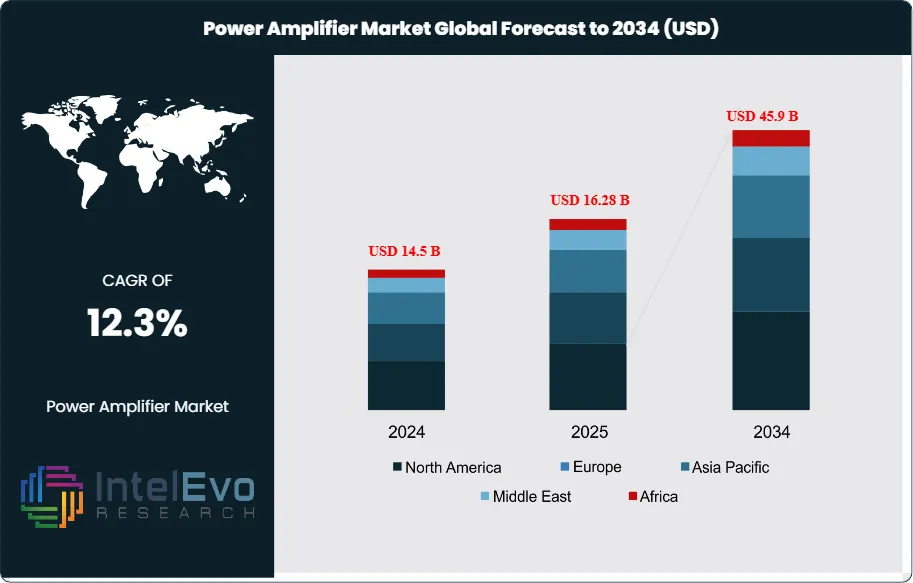
The Power Amplifier Market size is projected to be worth around USD 45.9 billion by 2034, up from USD 14.5 billion in 2024, growing at a CAGR of 12.3% during the forecast period from 2025 to 2034. The market growth is driven by the surging demand for high-efficiency amplifiers across consumer electronics, 5G infrastructure, and automotive applications. As connectivity expands and IoT devices multiply, power amplifiers are becoming crucial for delivering seamless performance and superior signal strength. The rising focus on energy-efficient and compact amplifier solutions is expected to further accelerate market adoption globally.
Get More Information about this report -
Request Free Sample ReportA power amplifier is an essential electronic device designed to increase the power level of an input signal, enabling it to drive a load such as a speaker, antenna, or other output devices. It functions by taking a low-power signal and amplifying it in terms of voltage, current, or both, to produce a higher-power output while maintaining the integrity of the original signal. Power amplifiers are commonly used in various applications, including audio systems, broadcasting, telecommunications, and industrial machinery. For instance, in audio systems, power amplifiers boost weak audio signals to a level that can effectively power loudspeakers, while in wireless communication systems, they amplify radio frequency (RF) signals for transmission over long distances. Different types of power amplifiers—such as audio, RF, and operational amplifiers—are designed to meet specific application needs. Their ability to deliver clean, efficient amplification makes them crucial components in both consumer electronics and high-performance industrial systems.
The growth dynamics of the power amplifier market are influenced by increasing demand across various sectors, including telecommunications, consumer electronics, automotive, and industrial applications. The rapid global rollout of 4G and 5G networks has significantly driven the need for RF power amplifiers, which are crucial for signal transmission in mobile and wireless communication infrastructure. At the same time, the rising popularity of smart devices, portable audio systems, and home entertainment has spurred demand for compact, energy-efficient audio power amplifiers. In the automotive sector, advancements in electric vehicles and in-car infotainment systems are further expanding the use of power amplifiers. Additionally, emerging technologies such as the Internet of Things (IoT), satellite communication, and defense electronics are opening new avenues for growth. Innovations in semiconductor materials, particularly gallium nitride (GaN) and silicon carbide (SiC), are also enhancing the efficiency, power density, and thermal performance of modern power amplifiers. These combined factors are contributing to a robust and evolving global power amplifier market.
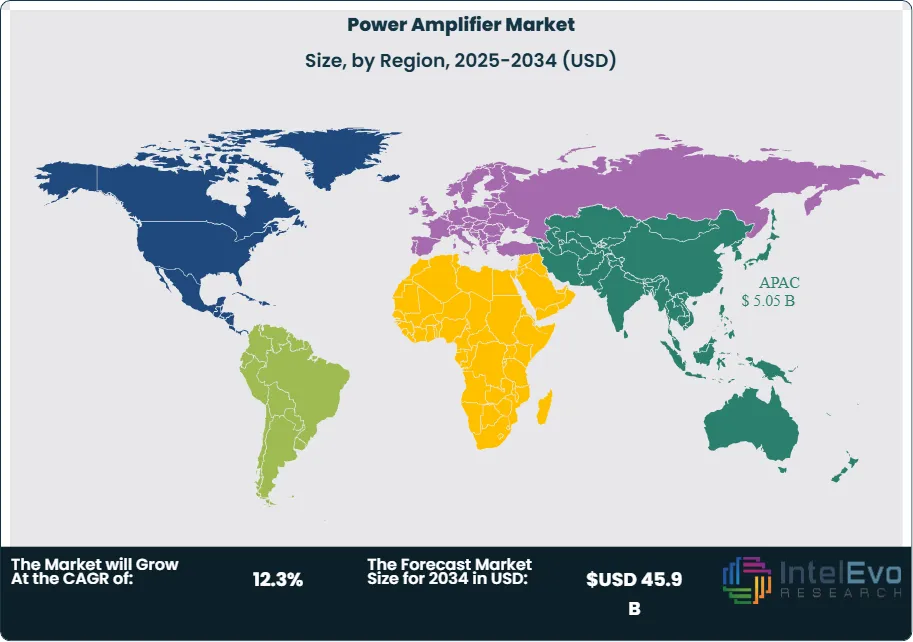
The Asia-Pacific power amplifier market is experiencing robust growth, driven by the rapid expansion of telecommunications infrastructure, increasing adoption of consumer electronics, and advancements in semiconductor technologies. This dominance is attributed to strong manufacturing capabilities and the presence of key industry players in countries like China, South Korea, and Japan, which are at the forefront of consumer electronics, telecommunications, and technological innovation. The proliferation of 5G networks and the surge in Internet of Things (IoT) devices have significantly boosted the demand for RF power amplifiers in the region. These amplifiers are essential for enabling wireless communication between IoT devices, which include sensors, actuators, and other smart devices embedded with wireless connectivity.
The COVID-19 pandemic significantly accelerated the adoption of power amplifiers across various industries. As companies faced strict social distancing protocols and labor shortages due to health concerns, the need for contactless and efficient material handling became more urgent. Warehouses and distribution centers turned to automation to maintain operations with fewer on-site workers, and power amplifiers proved to be a practical solution. These machines helped ensure business continuity while minimizing human interaction. The pandemic also exposed vulnerabilities in global supply chains, prompting companies to invest in resilient and flexible automation technologies. As a result, the demand for power amplifiers surged and continues to grow as businesses prioritize safety, efficiency, and long-term preparedness.

Key Takeaways
- Market Growth: The power amplifier market is expected to reach USD 45.9 billion by 2034, growing at a robust CAGR of 12.3%, indicating strong market expansion.
- Product Segment Dominance: The product segment is dominated by RF power amplifier, accounting for over 58% of the market share. The RF Power Amplifier segment is driven by TWTAs and SSPAs. TWTAs are ideal for high-power, broadband uses like satellite and radar due to their high-frequency efficiency. SSPAs offer compact, energy-efficient solutions for telecom and aerospace, making both crucial to advancing RF communications
- Vertical Segment Insights: Consumer electronics are anticipated to hold the largest market share. The consumer electronics segment dominates the segment due to the high use of amplifiers in smartphones, tablets, and smart devices. Growing adoption of IoT and connected technology continues to boost demand, reinforcing the segment’s leadership.
- Driver: The power amplifier market is growing fast, mainly because of the global rollout of 5G, which needs strong, reliable signal boosters. More people are using smart devices like phones, wearables, and home gadgets—all of which rely on amplifiers. The rise of electric vehicles and smart technologies in homes and industries also adds to the demand. Plus, new materials like GaN and GaAs are making amplifiers more efficient and powerful, helping them perform better in smaller spaces.
- Restraint: The power amplifier market faces restraints like high power consumption, heat generation, complex design requirements, and supply chain disruptions. These challenges make production costly and limit adoption in some regions.
- Opportunity: The power amplifier market has big opportunities in areas like 5G expansion, IoT growth, and electric vehicles. Emerging markets in Asia, Africa, and Latin America offer strong potential as telecom and tech infrastructure grows. There's also rising demand in defense, aerospace, and medical fields. Plus, advancements in GaN and GaAs semiconductors are opening doors for more powerful, energy-efficient designs.
- Trend: Modern gadgets like smartphones, smartwatches, wireless earbuds, and smart TVs all depend on power amplifiers for features like better sound and stronger wireless signals. As more people use these devices daily, the market for compact and efficient amplifiers keeps growing.
- Regional Analysis: The Asia-Pacific power amplifier market is growing rapidly, driven by the expansion of 5G networks, rising IoT adoption, and strong demand in consumer electronics and automotive sectors. Technological advancements in GaN and GaAs semiconductors are further boosting performance and efficiency across applications.
Product Analysis:
The product segment is divided into audio power amplifiers and RF power amplifiers. The RF power amplifiers segment dominated the market, with a market share of around 58% accounting for 7.9 billion 2024. The RF power amplifier segment is largely propelled by two key technologies: Traveling-Wave Tube Amplifiers (TWTAs) and Solid State Power Amplifiers (SSPAs). TWTAs are essential for applications that require high power output and wide bandwidth, making them a go-to choice for satellite communication, radar systems, and electronic warfare. Their ability to operate efficiently at very high frequencies with stable and robust performance makes them highly reliable in demanding environments. On the other hand, SSPAs offer benefits like compact size, energy efficiency, and long operational life, and are increasingly favored in commercial telecom, broadcasting, and aerospace systems. Together, these technologies drive innovation and meet the growing demand for high-speed, high-frequency communication systems across both defense and commercial sectors.
Vertical Analysis:
The vertical segment is divided into consumer electronics, industrial, telecommunication, automotive, military & defense, and others. The consumer electronics segment dominated the market, with a market share of around 24% accounting for 3.2 billion 2024. The consumer electronics segment leads the vertical segment due to the widespread use of devices like smartphones, tablets, and home entertainment systems, all of which rely on power amplifiers to improve audio and signal quality. The rapid growth of IoT and smart devices has further boosted this demand, as more products now require reliable, compact, and energy-efficient amplifiers to support advanced connectivity features. As technology continues to evolve and connected living becomes the norm, this segment is expected to maintain its strong position in the market.
Region Analysis:
Asia Pacific Leads With 34.8% Market Share in the Power Amplifier Market. Asia Pacific is really at the heart of the power amplifier market right now. Countries like China, Japan, South Korea, and India are leading the charge, mainly because they’re investing heavily in things like 5G networks, smart devices, and electric vehicles—all of which rely on power amplifiers to work efficiently. On top of that, the region is packed with manufacturers and tech innovators who are pushing the limits with next-gen semiconductor materials like gallium nitride (GaN), which make amplifiers more powerful and energy-efficient. What’s also driving the momentum is the huge growth in consumer electronics and IoT devices—everything from smartphones to smart home systems needs reliable amplification. With urban areas expanding, internet access improving, and a tech-savvy population demanding better, faster devices, Asia Pacific isn’t just growing—it’s shaping the future of the power amplifier industry. It’s safe to say this region will stay a global leader in the market for years to come.
Get More Information about this report -
Request Free Sample ReportKey Market Segment
By Product Type
- Radio Frequency (RF) Power Amplifiers
- Audio Power Amplifiers
- Microwave Power Amplifiers
- Operational Amplifiers (Op-Amps)
- Others
By Technology
- Gallium Nitride (GaN) Amplifiers
- Gallium Arsenide (GaAs) Amplifiers
- Silicon LDMOS Amplifiers
- Others
By Application
- Telecommunications & 5G Networks
- Consumer Electronics (Smartphones, Audio Systems)
- Automotive & EVs
- Aerospace & Defense
- Industrial & Energy
By End User
- Original Equipment Manufacturers (OEMs)
- Telecom Operators
- Automotive Manufacturers
- Consumer Electronics Companies
- Others
By Region
- North America
- Latin America
- East Asia And Pacific
- Sea And South Asia
- Eastern Europe
- Western Europe
- Middle East & Africa
| Report Attribute | Details |
| Market size (2025) | USD 16.28 B |
| Forecast Revenue (2034) | USD 45.9 B |
| CAGR (2025-2034) | 12.3% |
| Historical data | 2018-2023 |
| Base Year For Estimation | 2024 |
| Forecast Period | 2025-2034 |
| Report coverage | Revenue Forecast, Competitive Landscape, Market Dynamics, Growth Factors, Trends and Recent Developments |
| Segments covered | By Product Type (Radio Frequency (RF) Power Amplifiers, Audio Power Amplifiers, Microwave Power Amplifiers, Operational Amplifiers (Op-Amps), Others), By Technology (Gallium Nitride (GaN) Amplifiers, Gallium Arsenide (GaAs) Amplifiers, Silicon LDMOS Amplifiers, Others), By Application (Telecommunications & 5G Networks, Consumer Electronics (Smartphones, Audio Systems), Automotive & EVs, Aerospace & Defense, Industrial & Energy), By End User (Original Equipment Manufacturers (OEMs), Telecom Operators, Automotive Manufacturers, Consumer Electronics Companies, Others) |
| Research Methodology |
|
| Regional scope |
|
| Competitive Landscape | Texas Instruments, Toshiba, Maxim Integrated, Qorvo, Analog Devices, QSC Audio Products, Qualcomm, Bonn Elektronik, ETL System, Broadcom, STMicroelectronics, Yamaha, NXP Semiconductors, Skyworks, Peavey Electronics, Macom, Renesas Electronics, Ophir RF |
| Customization Scope | Customization for segments, region/country-level will be provided. Moreover, additional customization can be done based on the requirements. |
| Pricing and Purchase Options | Avail customized purchase options to meet your exact research needs. We have three licenses to opt for: Single User License, Multi-User License (Up to 5 Users), Corporate Use License (Unlimited User and Printable PDF). |


Frequently Asked Questions
How big is the Power Amplifier Market ?
Explore the Global Power Amplifier Market projected to reach USD 45.9B by 2034, driven by 5G, consumer electronics, and energy-efficient amplifier innovations.
Who are the major players in the Power Amplifier Market ?
Texas Instruments, Toshiba, Maxim Integrated, Qorvo, Analog Devices, QSC Audio Products, Qualcomm, Bonn Elektronik, ETL System, Broadcom, STMicroelectronics, Yamaha, NXP Semiconductors, Skyworks, Peavey Electronics, Macom, Renesas Electronics, Ophir RF
Which segments covered the Power Amplifier Market ?
By Product Type (Radio Frequency (RF) Power Amplifiers, Audio Power Amplifiers, Microwave Power Amplifiers, Operational Amplifiers (Op-Amps), Others), By Technology (Gallium Nitride (GaN) Amplifiers, Gallium Arsenide (GaAs) Amplifiers, Silicon LDMOS Amplifiers, Others), By Application (Telecommunications & 5G Networks, Consumer Electronics (Smartphones, Audio Systems), Automotive & EVs, Aerospace & Defense, Industrial & Energy), By End User (Original Equipment Manufacturers (OEMs), Telecom Operators, Automotive Manufacturers, Consumer Electronics Companies, Others)
How can this market research report help my business make strategic decisions?
Our market research reports provide actionable intelligence, including verified market size data, CAGR projections, competitive benchmarking, and segment-level opportunity analysis. These insights support strategic planning, investment decisions, product development, and market entry strategies for enterprises and startups alike.
How frequently is the data updated?
We continuously monitor industry developments and update our reports to reflect regulatory changes, technological advancements, and macroeconomic shifts. Updated editions ensure you receive the latest market intelligence.

Select Licence Type
Connect with our sales team

Why IntelEvoResearch
100%
Customer
Satisfaction
24x7+
Availability - we are always
there when you need us
200+
Fortune 50 Companies trust
IntelEvoResearch
80%
of our reports are exclusive
and first in the industry
100%
more data
and analysis
1000+
reports published
till date