
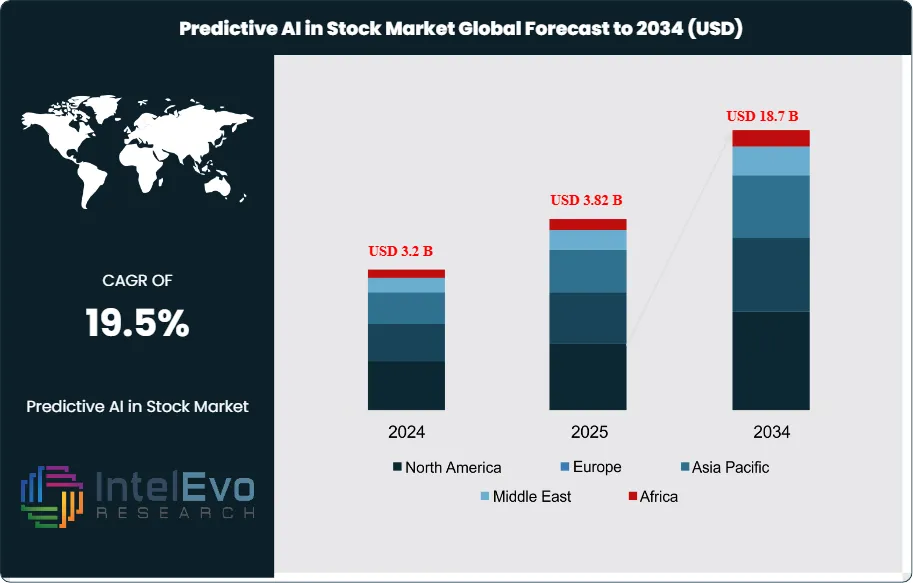
The Predictive AI in Stock Market size is projected to reach approximately USD 18.7 billion by 2034, rising from USD 3.2 billion in 2024, and expanding at a CAGR of 19.5% during the forecast period from 2024 to 2034. This rapid growth is driven by increasing adoption of machine learning models, quantitative trading strategies, and real-time data analytics by hedge funds, asset managers, and retail investors. Advancements in big data processing, alternative data usage, and AI-driven risk management tools are further enhancing market forecasting accuracy, positioning predictive AI as a critical enabler of next-generation algorithmic and data-driven investment strategies worldwide.
Predictive AI in the stock market represents the cutting edge of financial technology, utilizing advanced artificial intelligence and machine learning algorithms to anticipate stock prices, market trends, and trading opportunities. This dynamic market includes a broad spectrum of solutions such as algorithmic trading platforms, sentiment analysis tools, risk management systems, and portfolio optimization engines. The sector’s rapid growth is fueled by the explosion of big data, ongoing advancements in deep learning and natural language processing, and a rising demand for automated, data-driven investment strategies among both institutional and retail investors. By integrating AI, traders and asset managers can analyze vast datasets in real time—including historical prices, financial news, social media sentiment, and macroeconomic indicators—gaining actionable insights and a significant competitive edge.
The ecosystem supporting predictive AI in the stock market is evolving at a remarkable pace, shaped by technological breakthroughs in cloud computing, quantum computing, and edge analytics. These innovations enable faster data processing, more sophisticated modeling, and the ability to deploy AI solutions at scale. The proliferation of alternative data sources, such as satellite imagery and IoT signals, further enhances the predictive power of AI models, allowing for deeper and more nuanced market analysis. As a result, AI-driven tools are becoming increasingly indispensable for modern investment decision-making.
Regulatory support for fintech innovation, the democratization of trading platforms, and the rise of robo-advisors are also accelerating the adoption of AI in the financial sector. These trends are making advanced investment tools accessible to a broader range of users, from large asset managers to individual retail investors. The COVID-19 pandemic further underscored the importance of agile, automated trading systems, as heightened market volatility and the shift to remote work increased reliance on digital solutions for portfolio management and risk mitigation.
Predictive AI is transforming the stock market by enabling real-time, data-driven decision-making and opening new frontiers in financial analysis. As technology continues to advance and alternative data becomes more integrated, the role of AI in investment strategy is set to grow even more prominent, shaping the future of global financial markets.
Market Growth: The Predictive AI in Stock Market sector is expected to reach USD 18.7 Billion by 2034, as financial institutions and individual investors increasingly adopt AI-powered tools for forecasting, trading, and risk management. The convergence of big data analytics, cloud infrastructure, and advanced machine learning is fueling sustained growth across global markets.
Type Dominance: Algorithmic trading platforms and AI-powered portfolio management solutions dominate the market, accounting for over 60% share in 2024, due to their ability to deliver high-frequency, data-driven trading decisions and optimize investment returns.
Platform Dominance: Cloud-based AI platforms hold the largest share, with over 55% of deployments, as they offer scalability, real-time data processing, and seamless integration with trading systems and data feeds.
End-User Industry Dominance: Institutional investors, including hedge funds, asset managers, and proprietary trading firms, represent 48% of the market in 2024, followed by retail investors (28%) and financial advisory firms (15%).
Driver: The surge in market data volume, the need for real-time decision-making, and the quest for alpha generation are driving rapid adoption. Advances in deep learning, NLP, and reinforcement learning are enabling more accurate and adaptive predictive models.
Restraint: Data privacy concerns, model interpretability challenges, and regulatory scrutiny present barriers to adoption, especially in highly regulated markets. The risk of overfitting and algorithmic bias also poses challenges for widespread deployment.
Opportunity: The emergence of explainable AI, integration of alternative data, and expansion into emerging markets offer significant opportunities to enhance predictive accuracy and broaden adoption. The rise of AI-powered ESG (Environmental, Social, Governance) analytics is unlocking new investment strategies.
Trend: Integration of real-time sentiment analysis, AI-driven risk management, and autonomous trading bots are redefining how investors approach the stock market. Partnerships between fintech startups and traditional financial institutions are accelerating innovation and market maturity.
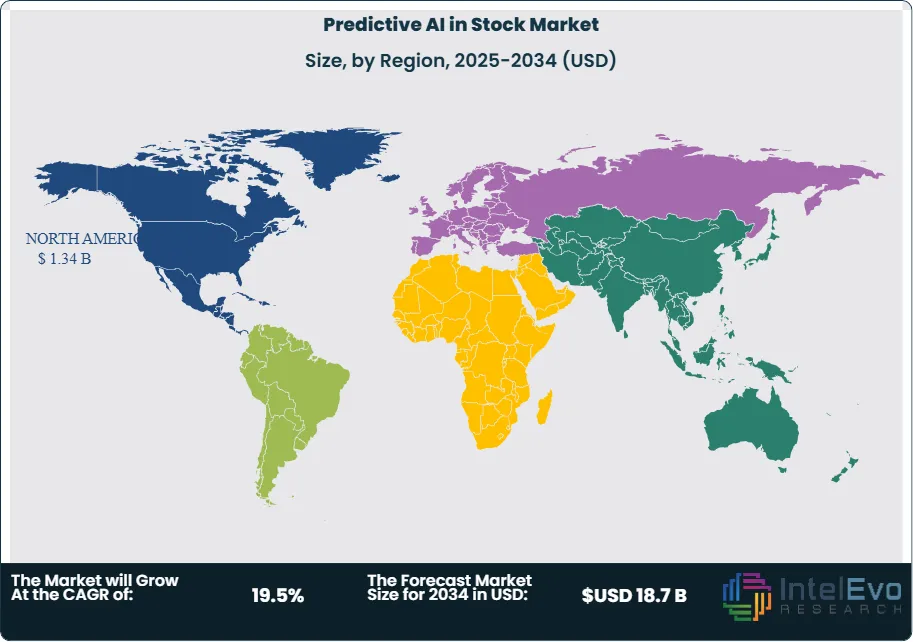
Regional Analysis: North America leads the global predictive AI in stock market sector, holding 42% market share in 2024, driven by the presence of major financial hubs, advanced technology infrastructure, and supportive regulatory frameworks. Asia Pacific follows with 31%, fueled by rapid fintech adoption in China, India, and Southeast Asia. Europe holds 20%, with strong growth in the UK, Germany, and Switzerland. Latin America and the Middle East & Africa are emerging markets with rising fintech investment and digital trading adoption.
Type Analysis:
Algorithmic Trading Platforms and AI Portfolio Management solutions are the cornerstone of the predictive AI in stock market sector, accounting for the largest share among solution types. Their dominance is rooted in the ability to process massive datasets, identify trading signals, and execute trades at high speed and accuracy. These platforms leverage machine learning, deep learning, and reinforcement learning to adapt to changing market conditions and optimize investment strategies.
Sentiment Analysis Tools and Alternative Data Analytics are gaining traction, enabling investors to incorporate real-time news, social media, and non-traditional data sources into their predictive models. These tools enhance market forecasting by capturing market sentiment and identifying emerging trends before they are reflected in prices.
Platform Analysis:
Cloud-Based AI Platforms Lead With Over 55% Market Share. Cloud-based platforms have become the dominant deployment model for predictive AI in the stock market, offering scalability, flexibility, and real-time data processing capabilities. These platforms enable seamless integration with trading systems, data feeds, and third-party analytics, making them ideal for both institutional and retail investors. The adoption of cloud infrastructure reduces operational costs and accelerates the deployment of AI models, driving continued investment and innovation in this segment. On-premises solutions remain relevant for large financial institutions with stringent data security and compliance requirements, but the trend is shifting toward hybrid and cloud-native architectures.
End-User Industry Analysis:
Institutional Investors Lead Adoption With 48% Market Share. Institutional investors, including hedge funds, asset managers, and proprietary trading firms, are the primary adopters of predictive AI solutions, leveraging advanced analytics to gain competitive advantages in trading and portfolio management. Retail investors are increasingly accessing AI-powered tools through robo-advisors and online trading platforms, democratizing access to sophisticated investment strategies. Financial advisory firms are also integrating AI to enhance client services and optimize portfolio recommendations.
Region Analysis:
North America Leads With 42% Market Share. North America dominates the global predictive AI in stock market sector, driven by the concentration of major financial institutions, fintech startups, and technology providers in the US and Canada. The region benefits from advanced digital infrastructure, regulatory support for innovation, and a mature investment ecosystem. Asia Pacific is the fastest-growing region, fueled by rapid fintech adoption, expanding capital markets, and government initiatives supporting AI research and development. Europe maintains a strong presence, particularly in the UK, Germany, and Switzerland, where financial services innovation and regulatory clarity support market growth. Emerging markets in Latin America, Africa, and Southeast Asia are expected to see significant growth as digital trading adoption accelerates.
Type (Algorithmic Trading Platforms, AI Portfolio Management, Sentiment Analysis Tools, Alternative Data Analytics, Risk Management Systems) Platform (Cloud-Based AI Platforms, On-Premises Solutions, Hybrid Architectures) End-User Industry (Institutional Investors, Retail Investors, Financial Advisory Firms, Others)
Research Methodology
Primary Research- 100 Interviews of Stakeholders
Secondary Research
Desk Research
Regional scope
North America (United States, Canada, Mexico)
Latin America (Brazil, Argentina, Columbia)
East Asia And Pacific (China, Japan, South Korea, Australia, Cambodia, Fiji, Indonesia)
Sea And South Asia (India, Singapore, Thailand, Taiwan, Malaysia)
Eastern Europe (Poland, Russia, Czech Republic, Romania)
Western Europe (Germany, U.K., France, Spain, Itlay)
Middle East & Africa (GCC Countries, Egypt, Nigeria, South Africa, Israel)
Competitive Landscape
IBM Corporation, Google LLC (Alphabet Inc.), Microsoft Corporation, Bloomberg L.P., Refinitiv (London Stock Exchange Group), Alpaca, Kensho Technologies (S&P Global), Numerai, Sentifi, Dataminr, Trade Ideas LLC, Upstox, QuantConnect, BlackRock, Inc., Two Sigma Investments
Customization Scope
Customization for segments, region/country-level will be provided. Moreover, additional customization can be done based on the requirements.
Pricing and Purchase Options
Avail customized purchase options to meet your exact research needs. We have three licenses to opt for: Single User License, Multi-User License (Up to 5 Users), Corporate Use License (Unlimited User and Printable PDF).
TABLE OF CONTENTS
1. EXECUTIVE SUMMARY
1.1. MARKET SNAPSHOT
1.2. KEY FINDINGS & INSIGHTS
1.3. ANALYST RECOMMENDATIONS
1.4. FUTURE OUTLOOK
2. RESEARCH METHODOLOGY
2.1. MARKET DEFINITION & SCOPE
2.2. RESEARCH OBJECTIVES: PRIMARY & SECONDARY DATA SOURCES
2.3. DATA COLLECTION SOURCES
2.3.1. COVERAGE OF 100+ PRIMARY RESEARCH/CONSULTATION CALLS WITH INDUSTRY STAKEHOLDERS
FIGURE 17 NORTH AMERICA PREDICTIVE AI IN STOCK CURRENT AND FUTURE TYPE ANALYSIS, 2025–2034, (USD MILLION)
FIGURE 18 NORTH AMERICA PREDICTIVE AI IN STOCK CURRENT AND FUTURE END USER ANALYSIS, 2025–2034, (USD MILLION)
FIGURE 19 MARKET SHARE BY COUNTRY
FIGURE 20 LATIN AMERICA PREDICTIVE AI IN STOCK CURRENT AND FUTURE TYPE ANALYSIS, 2025–2034, (USD MILLION)
FIGURE 21 LATIN AMERICA PREDICTIVE AI IN STOCK CURRENT AND FUTURE END USER ANALYSIS, 2025–2034, (USD MILLION)
FIGURE 22 MARKET SHARE BY COUNTRY
FIGURE 23 EASTERN EUROPE PREDICTIVE AI IN STOCK CURRENT AND FUTURE TYPE ANALYSIS, 2025–2034, (USD MILLION)
FIGURE 24 EASTERN EUROPE PREDICTIVE AI IN STOCK CURRENT AND FUTURE END USER ANALYSIS, 2025–2034, (USD MILLION)
FIGURE 25 MARKET SHARE BY COUNTRY
FIGURE 26 WESTERN EUROPE PREDICTIVE AI IN STOCK CURRENT AND FUTURE TYPE ANALYSIS, 2025–2034, (USD MILLION)
FIGURE 27 WESTERN EUROPE PREDICTIVE AI IN STOCK CURRENT AND FUTURE END USER ANALYSIS, 2025–2034, (USD MILLION)
FIGURE 28 MARKET SHARE BY COUNTRY
FIGURE 29 EAST ASIA AND PACIFIC PREDICTIVE AI IN STOCK CURRENT AND FUTURE TYPE ANALYSIS, 2025–2034, (USD MILLION)
FIGURE 30 EAST ASIA AND PACIFIC PREDICTIVE AI IN STOCK CURRENT AND FUTURE END USER ANALYSIS, 2025–2034, (USD MILLION)
FIGURE 31 MARKET SHARE BY COUNTRY
FIGURE 32 SEA AND SOUTH ASIA PREDICTIVE AI IN STOCK CURRENT AND FUTURE TYPE ANALYSIS, 2025–2034, (USD MILLION)
FIGURE 33 SEA AND SOUTH ASIA PREDICTIVE AI IN STOCK CURRENT AND FUTURE END USER ANALYSIS, 2025–2034, (USD MILLION)
FIGURE 34 MARKET SHARE BY COUNTRY
FIGURE 35 MIDDLE EAST AND AFRICA PREDICTIVE AI IN STOCK CURRENT AND FUTURE TYPE ANALYSIS, 2025–2034, (USD MILLION)
FIGURE 36 MIDDLE EAST AND AFRICA PREDICTIVE AI IN STOCK CURRENT AND FUTURE END USER ANALYSIS, 2025–2034, (USD MILLION)
FIGURE 37 NORTH AMERICA PREDICTIVE AI IN STOCK CURRENT AND FUTURE MARKET VOLUME SHARE REGIONAL ANALYSIS, 2025–2034, (USD MILLION)
FIGURE 38 U.S. PREDICTIVE AI IN STOCK CURRENT AND FUTURE TYPE ANALYSIS, 2025–2034, (USD MILLION)
FIGURE 39 U.S. PREDICTIVE AI IN STOCK CURRENT AND FUTURE END USER ANALYSIS, 2025–2034, (USD MILLION)
FIGURE 40 CANADA PREDICTIVE AI IN STOCK CURRENT AND FUTURE TYPE ANALYSIS, 2025–2034, (USD MILLION)
FIGURE 41 CANADA PREDICTIVE AI IN STOCK CURRENT AND FUTURE END USER ANALYSIS, 2025–2034, (USD MILLION)
FIGURE 42 LATIN AMERICA PREDICTIVE AI IN STOCK CURRENT AND FUTURE MARKET VOLUME SHARE REGIONAL ANALYSIS, 2025–2034, (USD MILLION)
FIGURE 43 MEXICO PREDICTIVE AI IN STOCK CURRENT AND FUTURE TYPE ANALYSIS, 2025–2034, (USD MILLION)
FIGURE 44 MEXICO PREDICTIVE AI IN STOCK CURRENT AND FUTURE END USER ANALYSIS, 2025–2034, (USD MILLION)
FIGURE 45 BRAZIL PREDICTIVE AI IN STOCK CURRENT AND FUTURE TYPE ANALYSIS, 2025–2034, (USD MILLION)
FIGURE 46 BRAZIL PREDICTIVE AI IN STOCK CURRENT AND FUTURE END USER ANALYSIS, 2025–2034, (USD MILLION)
FIGURE 47 ARGENTINA PREDICTIVE AI IN STOCK CURRENT AND FUTURE TYPE ANALYSIS, 2025–2034, (USD MILLION)
FIGURE 48 ARGENTINA PREDICTIVE AI IN STOCK CURRENT AND FUTURE END USER ANALYSIS, 2025–2034, (USD MILLION)
FIGURE 49 COLUMBIA PREDICTIVE AI IN STOCK CURRENT AND FUTURE TYPE ANALYSIS, 2025–2034, (USD MILLION)
FIGURE 50 COLUMBIA PREDICTIVE AI IN STOCK CURRENT AND FUTURE END USER ANALYSIS, 2025–2034, (USD MILLION)
FIGURE 51 REST OF LATIN AMERICA PREDICTIVE AI IN STOCK CURRENT AND FUTURE TYPE ANALYSIS, 2025–2034, (USD MILLION)
FIGURE 52 REST OF LATIN AMERICA PREDICTIVE AI IN STOCK CURRENT AND FUTURE END USER ANALYSIS, 2025–2034, (USD MILLION)
FIGURE 53 EASTERN EUROPE PREDICTIVE AI IN STOCK CURRENT AND FUTURE MARKET VOLUME SHARE REGIONAL ANALYSIS, 2025–2034, (USD MILLION)
FIGURE 54 POLAND PREDICTIVE AI IN STOCK CURRENT AND FUTURE TYPE ANALYSIS, 2025–2034, (USD MILLION)
FIGURE 55 POLAND PREDICTIVE AI IN STOCK CURRENT AND FUTURE END USER ANALYSIS, 2025–2034, (USD MILLION)
FIGURE 56 RUSSIA PREDICTIVE AI IN STOCK CURRENT AND FUTURE TYPE ANALYSIS, 2025–2034, (USD MILLION)
FIGURE 57 RUSSIA PREDICTIVE AI IN STOCK CURRENT AND FUTURE END USER ANALYSIS, 2025–2034, (USD MILLION)
FIGURE 58 CZECH REPUBLIC PREDICTIVE AI IN STOCK CURRENT AND FUTURE TYPE ANALYSIS, 2025–2034, (USD MILLION)
FIGURE 59 CZECH REPUBLIC PREDICTIVE AI IN STOCK CURRENT AND FUTURE END USER ANALYSIS, 2025–2034, (USD MILLION)
FIGURE 60 ROMANIA PREDICTIVE AI IN STOCK CURRENT AND FUTURE TYPE ANALYSIS, 2025–2034, (USD MILLION)
FIGURE 61 ROMANIA PREDICTIVE AI IN STOCK CURRENT AND FUTURE END USER ANALYSIS, 2025–2034, (USD MILLION)
FIGURE 62 REST OF EASTERN EUROPE PREDICTIVE AI IN STOCK CURRENT AND FUTURE TYPE ANALYSIS, 2025–2034, (USD MILLION)
FIGURE 63 REST OF EASTERN EUROPE PREDICTIVE AI IN STOCK CURRENT AND FUTURE END USER ANALYSIS, 2025–2034, (USD MILLION)
FIGURE 64 WESTERN EUROPE PREDICTIVE AI IN STOCK CURRENT AND FUTURE MARKET VOLUME SHARE REGIONAL ANALYSIS, 2025–2034, (USD MILLION)
FIGURE 65 GERMANY PREDICTIVE AI IN STOCK CURRENT AND FUTURE TYPE ANALYSIS, 2025–2034, (USD MILLION)
FIGURE 66 GERMANY PREDICTIVE AI IN STOCK CURRENT AND FUTURE END USER ANALYSIS, 2025–2034, (USD MILLION)
FIGURE 67 FRANCE PREDICTIVE AI IN STOCK CURRENT AND FUTURE TYPE ANALYSIS, 2025–2034, (USD MILLION)
FIGURE 68 FRANCE PREDICTIVE AI IN STOCK CURRENT AND FUTURE END USER ANALYSIS, 2025–2034, (USD MILLION)
FIGURE 69 UK PREDICTIVE AI IN STOCK CURRENT AND FUTURE TYPE ANALYSIS, 2025–2034, (USD MILLION)
FIGURE 70 UK PREDICTIVE AI IN STOCK CURRENT AND FUTURE END USER ANALYSIS, 2025–2034, (USD MILLION)
FIGURE 71 SPAIN PREDICTIVE AI IN STOCK CURRENT AND FUTURE TYPE ANALYSIS, 2025–2034, (USD MILLION)
FIGURE 72 SPAIN PREDICTIVE AI IN STOCK CURRENT AND FUTURE END USER ANALYSIS, 2025–2034, (USD MILLION)
FIGURE 73 ITALY PREDICTIVE AI IN STOCK CURRENT AND FUTURE TYPE ANALYSIS, 2025–2034, (USD MILLION)
FIGURE 74 ITALY PREDICTIVE AI IN STOCK CURRENT AND FUTURE END USER ANALYSIS, 2025–2034, (USD MILLION)
FIGURE 75 REST OF WESTERN EUROPE PREDICTIVE AI IN STOCK CURRENT AND FUTURE TYPE ANALYSIS, 2025–2034, (USD MILLION)
FIGURE 76 REST OF WESTERN EUROPE PREDICTIVE AI IN STOCK CURRENT AND FUTURE END USER ANALYSIS, 2025–2034, (USD MILLION)
FIGURE 77 EAST ASIA AND PACIFIC PREDICTIVE AI IN STOCK CURRENT AND FUTURE MARKET VOLUME SHARE REGIONAL ANALYSIS, 2025–2034, (USD MILLION)
FIGURE 78 CHINA PREDICTIVE AI IN STOCK CURRENT AND FUTURE TYPE ANALYSIS, 2025–2034, (USD MILLION)
FIGURE 79 CHINA PREDICTIVE AI IN STOCK CURRENT AND FUTURE END USER ANALYSIS, 2025–2034, (USD MILLION)
FIGURE 80 JAPAN PREDICTIVE AI IN STOCK CURRENT AND FUTURE TYPE ANALYSIS, 2025–2034, (USD MILLION)
FIGURE 81 JAPAN PREDICTIVE AI IN STOCK CURRENT AND FUTURE END USER ANALYSIS, 2025–2034, (USD MILLION)
FIGURE 82 AUSTRALIA PREDICTIVE AI IN STOCK CURRENT AND FUTURE TYPE ANALYSIS, 2025–2034, (USD MILLION)
FIGURE 83 AUSTRALIA PREDICTIVE AI IN STOCK CURRENT AND FUTURE END USER ANALYSIS, 2025–2034, (USD MILLION)
FIGURE 84 CAMBODIA PREDICTIVE AI IN STOCK CURRENT AND FUTURE TYPE ANALYSIS, 2025–2034, (USD MILLION)
FIGURE 85 CAMBODIA PREDICTIVE AI IN STOCK CURRENT AND FUTURE END USER ANALYSIS, 2025–2034, (USD MILLION)
FIGURE 86 FIJI PREDICTIVE AI IN STOCK CURRENT AND FUTURE TYPE ANALYSIS, 2025–2034, (USD MILLION)
FIGURE 87 FIJI PREDICTIVE AI IN STOCK CURRENT AND FUTURE END USER ANALYSIS, 2025–2034, (USD MILLION)
FIGURE 88 INDONESIA PREDICTIVE AI IN STOCK CURRENT AND FUTURE TYPE ANALYSIS, 2025–2034, (USD MILLION)
FIGURE 89 INDONESIA PREDICTIVE AI IN STOCK CURRENT AND FUTURE END USER ANALYSIS, 2025–2034, (USD MILLION)
FIGURE 90 SOUTH KOREA PREDICTIVE AI IN STOCK CURRENT AND FUTURE TYPE ANALYSIS, 2025–2034, (USD MILLION)
FIGURE 91 SOUTH KOREA PREDICTIVE AI IN STOCK CURRENT AND FUTURE END USER ANALYSIS, 2025–2034, (USD MILLION)
FIGURE 92 REST OF EAST ASIA AND PACIFIC PREDICTIVE AI IN STOCK CURRENT AND FUTURE TYPE ANALYSIS, 2025–2034, (USD MILLION)
FIGURE 93 REST OF EAST ASIA AND PACIFIC PREDICTIVE AI IN STOCK CURRENT AND FUTURE END USER ANALYSIS, 2025–2034, (USD MILLION)
FIGURE 94 SEA AND SOUTH ASIA PREDICTIVE AI IN STOCK CURRENT AND FUTURE MARKET VOLUME SHARE REGIONAL ANALYSIS, 2025–2034, (USD MILLION)
FIGURE 95 BANGLADESH PREDICTIVE AI IN STOCK CURRENT AND FUTURE TYPE ANALYSIS, 2025–2034, (USD MILLION)
FIGURE 96 BANGLADESH PREDICTIVE AI IN STOCK CURRENT AND FUTURE END USER ANALYSIS, 2025–2034, (USD MILLION)
FIGURE 97 NEW ZEALAND PREDICTIVE AI IN STOCK CURRENT AND FUTURE TYPE ANALYSIS, 2025–2034, (USD MILLION)
FIGURE 98 NEW ZEALAND PREDICTIVE AI IN STOCK CURRENT AND FUTURE END USER ANALYSIS, 2025–2034, (USD MILLION)
FIGURE 99 INDIA PREDICTIVE AI IN STOCK CURRENT AND FUTURE TYPE ANALYSIS, 2025–2034, (USD MILLION)
FIGURE 100 INDIA PREDICTIVE AI IN STOCK CURRENT AND FUTURE END USER ANALYSIS, 2025–2034, (USD MILLION)
FIGURE 101 SINGAPORE PREDICTIVE AI IN STOCK CURRENT AND FUTURE TYPE ANALYSIS, 2025–2034, (USD MILLION)
FIGURE 102 SINGAPORE PREDICTIVE AI IN STOCK CURRENT AND FUTURE END USER ANALYSIS, 2025–2034, (USD MILLION)
FIGURE 103 THAILAND PREDICTIVE AI IN STOCK CURRENT AND FUTURE TYPE ANALYSIS, 2025–2034, (USD MILLION)
FIGURE 104 THAILAND PREDICTIVE AI IN STOCK CURRENT AND FUTURE END USER ANALYSIS, 2025–2034, (USD MILLION)
FIGURE 105 TAIWAN PREDICTIVE AI IN STOCK CURRENT AND FUTURE TYPE ANALYSIS, 2025–2034, (USD MILLION)
FIGURE 106 TAIWAN PREDICTIVE AI IN STOCK CURRENT AND FUTURE END USER ANALYSIS, 2025–2034, (USD MILLION)
FIGURE 107 MALAYSIA PREDICTIVE AI IN STOCK CURRENT AND FUTURE TYPE ANALYSIS, 2025–2034, (USD MILLION)
FIGURE 108 MALAYSIA PREDICTIVE AI IN STOCK CURRENT AND FUTURE END USER ANALYSIS, 2025–2034, (USD MILLION)
FIGURE 109 REST OF SEA AND SOUTH ASIA PREDICTIVE AI IN STOCK CURRENT AND FUTURE TYPE ANALYSIS, 2025–2034, (USD MILLION)
FIGURE 110 REST OF SEA AND SOUTH ASIA PREDICTIVE AI IN STOCK CURRENT AND FUTURE END USER ANALYSIS, 2025–2034, (USD MILLION)
FIGURE 111 MIDDLE EAST AND AFRICA PREDICTIVE AI IN STOCK CURRENT AND FUTURE MARKET VOLUME SHARE REGIONAL ANALYSIS, 2025–2034, (USD MILLION)
FIGURE 112 GCC COUNTRIES PREDICTIVE AI IN STOCK CURRENT AND FUTURE TYPE ANALYSIS, 2025–2034, (USD MILLION)
FIGURE 113 GCC COUNTRIES PREDICTIVE AI IN STOCK CURRENT AND FUTURE END USER ANALYSIS, 2025–2034, (USD MILLION)
FIGURE 114 SAUDI ARABIA PREDICTIVE AI IN STOCK CURRENT AND FUTURE TYPE ANALYSIS, 2025–2034, (USD MILLION)
FIGURE 115 SAUDI ARABIA PREDICTIVE AI IN STOCK CURRENT AND FUTURE END USER ANALYSIS, 2025–2034, (USD MILLION)
FIGURE 116 UAE PREDICTIVE AI IN STOCK CURRENT AND FUTURE TYPE ANALYSIS, 2025–2034, (USD MILLION)
FIGURE 117 UAE PREDICTIVE AI IN STOCK CURRENT AND FUTURE END USER ANALYSIS, 2025–2034, (USD MILLION)
FIGURE 118 BAHRAIN PREDICTIVE AI IN STOCK CURRENT AND FUTURE TYPE ANALYSIS, 2025–2034, (USD MILLION)
FIGURE 119 BAHRAIN PREDICTIVE AI IN STOCK CURRENT AND FUTURE END USER ANALYSIS, 2025–2034, (USD MILLION)
FIGURE 120 KUWAIT PREDICTIVE AI IN STOCK CURRENT AND FUTURE TYPE ANALYSIS, 2025–2034, (USD MILLION)
FIGURE 121 KUWAIT PREDICTIVE AI IN STOCK CURRENT AND FUTURE END USER ANALYSIS, 2025–2034, (USD MILLION)
FIGURE 122 OMAN PREDICTIVE AI IN STOCK CURRENT AND FUTURE TYPE ANALYSIS, 2025–2034, (USD MILLION)
FIGURE 123 OMAN PREDICTIVE AI IN STOCK CURRENT AND FUTURE END USER ANALYSIS, 2025–2034, (USD MILLION)
FIGURE 124 QATAR PREDICTIVE AI IN STOCK CURRENT AND FUTURE TYPE ANALYSIS, 2025–2034, (USD MILLION)
FIGURE 125 QATAR PREDICTIVE AI IN STOCK CURRENT AND FUTURE END USER ANALYSIS, 2025–2034, (USD MILLION)
FIGURE 126 EGYPT PREDICTIVE AI IN STOCK CURRENT AND FUTURE TYPE ANALYSIS, 2025–2034, (USD MILLION)
FIGURE 127 EGYPT PREDICTIVE AI IN STOCK CURRENT AND FUTURE END USER ANALYSIS, 2025–2034, (USD MILLION)
FIGURE 128 NIGERIA PREDICTIVE AI IN STOCK CURRENT AND FUTURE TYPE ANALYSIS, 2025–2034, (USD MILLION)
FIGURE 129 NIGERIA PREDICTIVE AI IN STOCK CURRENT AND FUTURE END USER ANALYSIS, 2025–2034, (USD MILLION)
FIGURE 130 SOUTH AFRICA PREDICTIVE AI IN STOCK CURRENT AND FUTURE TYPE ANALYSIS, 2025–2034, (USD MILLION)
FIGURE 131 SOUTH AFRICA PREDICTIVE AI IN STOCK CURRENT AND FUTURE END USER ANALYSIS, 2025–2034, (USD MILLION)
FIGURE 132 ISRAEL PREDICTIVE AI IN STOCK CURRENT AND FUTURE TYPE ANALYSIS, 2025–2034, (USD MILLION)
FIGURE 133 ISRAEL PREDICTIVE AI IN STOCK CURRENT AND FUTURE END USER ANALYSIS, 2025–2034, (USD MILLION)
FIGURE 134 REST OF MEA PREDICTIVE AI IN STOCK CURRENT AND FUTURE TYPE ANALYSIS, 2025–2034, (USD MILLION)
FIGURE 135 REST OF MEA PREDICTIVE AI IN STOCK CURRENT AND FUTURE END USER ANALYSIS, 2025–2034, (USD MILLION)
FIGURE 136 U. S. MARKET SHARE ANALYSIS BY TYPE (2024)
FIGURE 137 U. S. MARKET SHARE ANALYSIS BY END USER (2024)
FIGURE 138 CANADA MARKET SHARE ANALYSIS BY TYPE (2024)
FIGURE 139 CANADA MARKET SHARE ANALYSIS BY END USER (2024)
FIGURE 140 MEXICO MARKET SHARE ANALYSIS BY TYPE (2024)
FIGURE 141 MEXICO MARKET SHARE ANALYSIS BY END USER (2024)
FIGURE 142 CHINA MARKET SHARE ANALYSIS BY TYPE (2024)
FIGURE 143 CHINA MARKET SHARE ANALYSIS BY END USER (2024)
FIGURE 144 JAPAN MARKET SHARE ANALYSIS BY TYPE (2024)
FIGURE 145 JAPAN MARKET SHARE ANALYSIS BY END USER (2024)
FIGURE 146 INDIA MARKET SHARE ANALYSIS BY TYPE (2024)
FIGURE 147 INDIA MARKET SHARE ANALYSIS BY END USER (2024)
FIGURE 148 SOUTH KOREA MARKET SHARE ANALYSIS BY TYPE (2024)
FIGURE 149 SOUTH KOREA MARKET SHARE ANALYSIS BY END USER (2024)
FIGURE 150 SAUDI ARABIA MARKET SHARE ANALYSIS BY TYPE (2024)
FIGURE 151 SAUDI ARABIA MARKET SHARE ANALYSIS BY END USER (2024)
FIGURE 152 UAE MARKET SHARE ANALYSIS BY TYPE (2024)
FIGURE 153 UAE MARKET SHARE ANALYSIS BY END USER (2024)
FIGURE 154 EGYPT MARKET SHARE ANALYSIS BY TYPE (2024)
FIGURE 155 EGYPT MARKET SHARE ANALYSIS BY END USER (2024)
FIGURE 156 NIGERIA MARKET SHARE ANALYSIS BY TYPE (2024)
FIGURE 157 NIGERIA MARKET SHARE ANALYSIS BY END USER (2024)
FIGURE 158 SOUTH AFRICA MARKET SHARE ANALYSIS BY TYPE (2024)
FIGURE 159 SOUTH AFRICA MARKET SHARE ANALYSIS BY END USER (2024)
FIGURE 160 GERMANY MARKET SHARE ANALYSIS BY TYPE (2024)
FIGURE 161 GERMANY MARKET SHARE ANALYSIS BY END USER (2024)
FIGURE 162 FRANCE MARKET SHARE ANALYSIS BY TYPE (2024)
FIGURE 163 FRANCE MARKET SHARE ANALYSIS BY END USER (2024)
FIGURE 164 UK MARKET SHARE ANALYSIS BY TYPE (2024)
FIGURE 165 UK MARKET SHARE ANALYSIS BY END USER (2024)
FIGURE 166 SPAIN MARKET SHARE ANALYSIS BY TYPE (2024)
FIGURE 167 SPAIN MARKET SHARE ANALYSIS BY END USER (2024)
FIGURE 168 ITALY MARKET SHARE ANALYSIS BY TYPE (2024)
FIGURE 169 ITALY MARKET SHARE ANALYSIS BY END USER (2024)
FIGURE 170 BRAZIL MARKET SHARE ANALYSIS BY TYPE (2024)
FIGURE 171 BRAZIL MARKET SHARE ANALYSIS BY END USER (2024)
FIGURE 172 ARGENTINA MARKET SHARE ANALYSIS BY TYPE (2024)
FIGURE 173 ARGENTINA MARKET SHARE ANALYSIS BY END USER (2024)
FIGURE 174 COLUMBIA MARKET SHARE ANALYSIS BY TYPE (2024)
FIGURE 175 COLUMBIA MARKET SHARE ANALYSIS BY END USER (2024)
FIGURE 176 GLOBAL PREDICTIVE AI IN STOCK CURRENT AND FUTURE MARKET KEY COUNTRY LEVEL ANALYSIS, 2024–2034, (USD MILLION)
FIGURE 177 FINANCIAL OVERVIEW:
Key Players Analysis
IBM Corporation
Google LLC (Alphabet Inc.)
Microsoft Corporation
Bloomberg L.P.
Refinitiv (London Stock Exchange Group)
Alpaca
Kensho Technologies (S&P Global)
Numerai
Sentifi
Dataminr
Trade Ideas LLC
Upstox
QuantConnect
BlackRock, Inc.
Two Sigma Investments
Driver:
Explosion of Market Data and Real-Time Analytics:
The stock market now generates an enormous volume of data every second, including tick-level price feeds, breaking news, and alternative data sources like social media and satellite imagery. Predictive AI leverages this data, processing and analyzing it in real time to help investors spot trading opportunities, manage risk, and react to market events with unmatched speed and precision. This real-time capability is crucial for gaining a competitive edge in today’s fast-moving markets.
Advances in Machine Learning and Deep Learning:
Recent breakthroughs in machine learning, deep learning, and reinforcement learning have made predictive models more accurate and adaptive. These AI systems can learn from vast historical datasets, recognize complex patterns, and adjust to changing market conditions, continuously improving their forecasting performance. This adaptability allows investors to stay ahead of market trends and optimize their trading strategies.
Restraint
Data Privacy, Model Interpretability, and Regulatory Challenges:
The adoption of predictive AI in finance faces hurdles such as data privacy concerns, the opaque or “black box” nature of many AI models, and evolving regulatory requirements. Financial institutions must comply with strict data protection laws and ensure that their AI-driven decisions are transparent and explainable. Additionally, there are risks related to algorithmic trading and potential market manipulation, which regulators are increasingly scrutinizing.
Opportunities
Explainable AI and Alternative Data Integration:
The development of explainable AI techniques is making it easier for investors and regulators to understand how AI models make decisions, building trust and facilitating adoption. Integrating alternative data sources—such as ESG (Environmental, Social, Governance) metrics, satellite data, and IoT signals—enhances the predictive power and accuracy of AI models. The rise of AI-powered ESG analytics is also opening up new investment strategies, especially for sustainability-focused investors.
Trends
Real-Time Sentiment Analysis and Autonomous Trading Bots:
The use of real-time sentiment analysis tools allows investors to gauge market mood instantly by analyzing news, social media, and other sources. AI-driven risk management systems and autonomous trading bots are becoming more prevalent, enabling fully automated, adaptive trading strategies. These trends are driving higher engagement, better risk-adjusted returns, and greater efficiency in the stock market, fundamentally changing how both institutional and retail investors operate.
Recent Developments
In June 2025: Bloomberg launched a cutting-edge AI-powered market forecasting tool designed specifically for institutional clients. This tool stands out by integrating real-time news sentiment analysis with alternative data sources—such as social media trends, macroeconomic indicators, and even satellite imagery. By leveraging advanced natural language processing (NLP) and machine learning algorithms, the platform can rapidly interpret breaking news and market-moving events, quantifying their likely impact on stock prices and market trends.
In May 2025: Microsoft Azure introduced a comprehensive suite of AI-driven trading APIs, targeting fintech startups and quantitative trading firms. These APIs provide developers with the building blocks to create custom predictive models for stock market analysis, including tools for data ingestion, feature engineering, model training, and real-time inference. The APIs are designed to be highly scalable and secure, allowing users to process large volumes of market data and deploy models in production with minimal latency.
In April 2025: Google Cloud announced a strategic partnership with a leading hedge fund to deploy quantum-enhanced AI models for high-frequency trading. This collaboration leverages Google’s advancements in quantum computing to solve complex optimization problems and process vast datasets at unprecedented speeds. Quantum-enhanced AI models can identify subtle patterns and correlations in market data that are often missed by classical algorithms, enabling more accurate predictions and faster trade execution.
In March 2025: Refinitiv expanded its AI analytics platform to include ESG (Environmental, Social, and Governance) sentiment analysis and alternative data integration for global asset managers. The platform now uses advanced AI and NLP to analyze millions of news articles, social media posts, and regulatory filings in near real-time, providing granular ESG sentiment scores for thousands of companies worldwide. Asset managers can use these insights to assess corporate sustainability, monitor reputational risks, and align portfolios with ESG investment mandates.
