
Global Private Tutoring Market Size, Share & Analysis By Type (Academic, Non-Academic), By Delivery Mode (Online, Offline), By End-User (Preschool and Primary Students, Middle School Students, High School Students, College Students), EdTech Integration, Pricing Models & Forecast 2025–2034
The Private Tutoring Market size is expected to reach approximately USD 100.5 billion in 2024 and around USD 205.6 billion by 2034, up from USD 93.6 billion in 2023, growing at a CAGR of 7.8% during the forecast period from 2025 to 2034. This steady expansion reflects the sector’s critical role in meeting the rising demand for personalized learning solutions in an increasingly competitive academic landscape. The market’s evolution is marked by the growing integration of technology, the increasing emphasis on supplemental education, and the cultural prioritization of academic excellence across key regions.
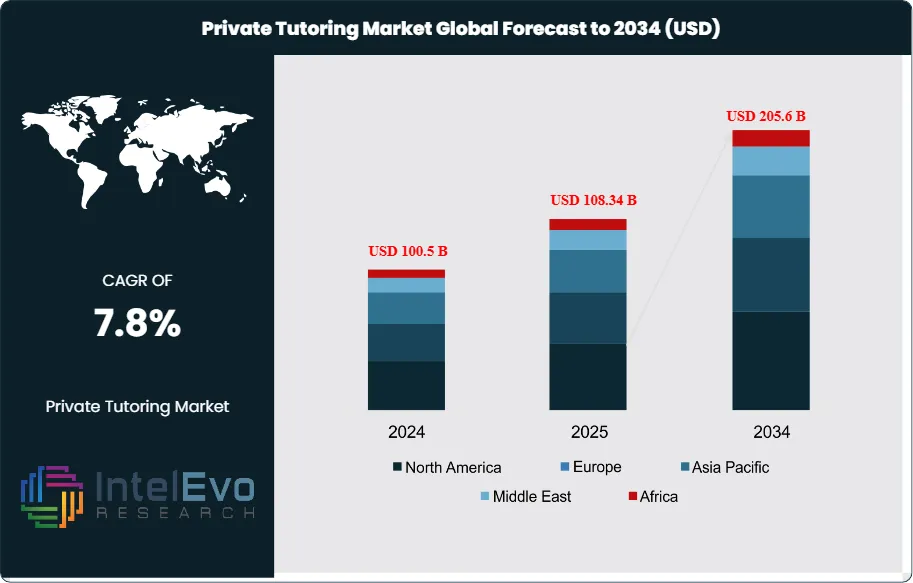
Private tutoring, which provides individualized academic support outside the classroom, has gained prominence as students and parents seek tailored approaches to strengthen subject mastery and improve overall performance. The sector has benefitted significantly from advancements in digital learning platforms, offering flexible scheduling, remote access, and adaptive learning capabilities. This transformation has not only expanded the market’s reach but also positioned digital tutoring as a scalable solution to bridge accessibility gaps, particularly in underserved regions.
Key growth drivers include the global focus on STEM education, the rapid rise in internet penetration, and heightened parental investment in extracurricular learning. However, challenges remain, especially in mature markets such as the United States, where tutoring adoption is relatively low—only 15% of students currently participate, and just 2% access high-quality support. This imbalance underscores untapped potential for providers to expand offerings and address systemic accessibility issues.
In terms of delivery modes, offline tutoring continues to dominate with approximately 74% market share, while online tutoring accounts for 26%. Despite this disparity, online platforms are gaining momentum at an accelerated pace, spurred by the post-COVID normalization of remote learning. This segment is emerging as a focal point for innovation, with opportunities tied to AI-driven adaptive learning tools, interactive platforms, and mobile-first solutions that enhance engagement and learning outcomes.
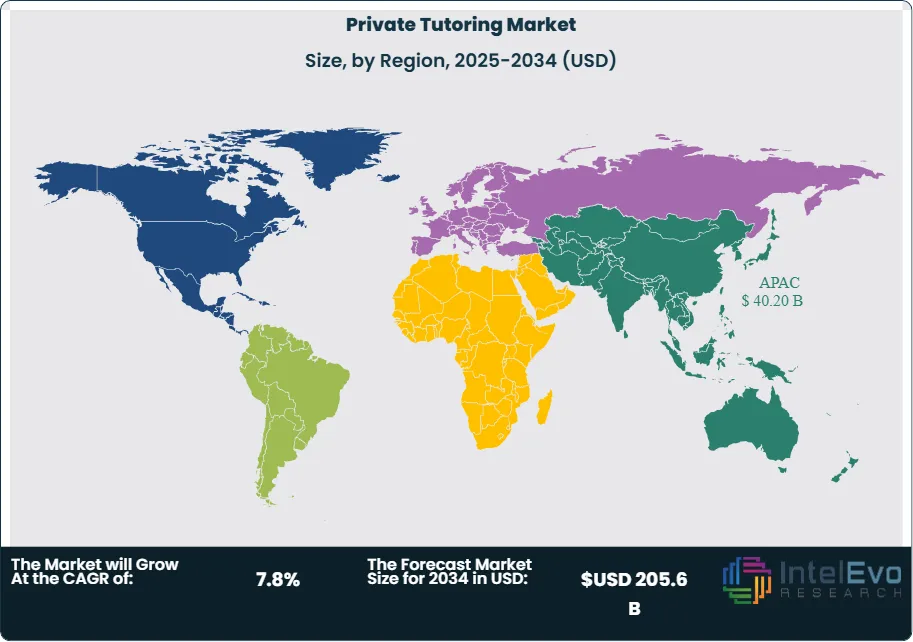
Regionally, Asia Pacific leads the market with a commanding 39.2% share, equivalent to USD 36.69 billion in 2023, supported by its vast student population and strong educational culture. Meanwhile, emerging economies in Latin America, the Middle East, and Africa are increasingly viewed as investment hotspots, driven by rising household spending on education and growing adoption of digital tutoring models.
Overall, the private tutoring industry is undergoing a profound shift, balancing traditional in-person sessions with the scalability of digital platforms. As technology integration deepens and demand for personalized learning accelerates, the market is positioned for sustained, long-term growth.
Market Growth: The Global Private Tutoring Market is anticipated to expand from USD 93.6 billion in 2023 to nearly USD 205.6 billion by 2034, reflecting a CAGR of 7.8% between 2025 and 2034. Expansion is fueled by intensifying academic competition, a rising preference for personalized learning, and the continued shift toward digital education models.
Type: Academic tutoring dominated in 2023 with 67.6% of total revenues, largely due to strong demand for subject-focused support in mathematics, sciences, languages, and exam preparation. This category continues to anchor market growth as education systems worldwide emphasize STEM and standardized testing outcomes.
Delivery Mode: In-person tutoring remained the most widely adopted approach in 2023, securing a 72.5% share, as parents value direct interaction and structured guidance. Nevertheless, online tutoring is scaling quickly, supported by post-pandemic acceptance of virtual learning, better internet infrastructure, and the convenience of flexible scheduling.
End User: High school students accounted for 40.5% of the market in 2023, reflecting their critical stage in preparing for competitive examinations and university admissions. This group is expected to remain the largest consumer segment, with tutoring often viewed as a strategic investment in securing future opportunities.
Driver: Rising global emphasis on STEM proficiency and competitive exam readiness continues to accelerate demand. In Asia Pacific especially, growing household spending on supplemental education is amplifying adoption rates.
Restraint: Penetration remains low in mature economies such as the United States, where only about 15% of students use tutoring services and fewer than 2% receive premium-quality support. This limited adoption underscores untapped potential but also represents a growth bottleneck.
Opportunity: Digital innovation—particularly adaptive AI learning tools, mobile-first tutoring platforms, and real-time performance tracking—offers significant headroom for growth, especially in underserved emerging markets where access to quality educators remains constrained.
Trend: The market is undergoing a structural shift toward hybrid tutoring ecosystems that blend offline engagement with online platforms. The rising participation of younger, digitally skilled tutors is accelerating the integration of interactive technologies and shaping more engaging student experiences.
Regional Analysis: Asia Pacific led the market in 2023 with a 39.2% share, equivalent to USD 36.69 billion, supported by a large student base and strong cultural commitment to education. Meanwhile, Latin America, the Middle East, and Africa are seeing faster adoption, propelled by rising household incomes, improving digital connectivity, and educational reforms.
Type Analysis
As of 2025, academic tutoring continues to dominate the global private tutoring market, holding more than two-thirds of total share. This leadership reflects the rising demand for structured, curriculum-aligned support in core subjects such as mathematics, science, and languages. The intensifying competition for admission into top universities and the growing importance of standardized examinations further reinforce the need for academic-focused tutoring services. Parents and students alike are increasingly viewing supplemental academic coaching as essential to maintaining a competitive edge in today’s education-driven economies.
In contrast, the non-academic tutoring segment, while comparatively smaller, is experiencing steady momentum. This category covers extracurricular domains such as arts, music, sports, and life-skills coaching, which are gaining importance as education systems worldwide adopt more holistic approaches. Shifting parental priorities and recognition of the value of creative and interpersonal skills in the future workforce are expected to accelerate demand for non-academic tutoring. Although it represents a smaller portion of market revenues, this segment is poised for long-term expansion as schools and families emphasize balanced development beyond academics.
Together, both academic and non-academic categories highlight the sector’s dual growth trajectory, where rigorous academic support remains central, but complementary learning pathways are gradually gaining market share. This reflects a broader trend of personalized education shaping the future of the tutoring industry.
Delivery Mode Analysis
Offline tutoring retained a commanding position in 2025, representing over 70% of the global market. Its dominance underscores the enduring preference for face-to-face interaction, where students benefit from immediate feedback, structured learning routines, and stronger tutor-student engagement. In many regions, particularly in Asia and parts of Europe, cultural expectations and trust in in-person learning environments continue to anchor offline tutoring’s strength.
That said, the online tutoring segment has emerged as the fastest-growing channel, propelled by widespread digital adoption, improved internet connectivity, and technological innovations such as AI-driven adaptive platforms. Online tutoring offers unmatched accessibility and cost-efficiency, enabling learners from diverse geographies to access quality instruction. Post-pandemic normalization of virtual learning has further legitimized this delivery mode, opening opportunities for global platforms and startups to scale rapidly.
Looking ahead, while offline tutoring is expected to maintain its lead in the near term, the growth momentum of online services is likely to narrow the gap. Hybrid models that blend physical and digital interactions are also gaining traction, catering to families seeking flexibility without compromising quality.
End-User Analysis
High school students represent the largest share of private tutoring demand in 2025, accounting for more than 40% of total market revenues. This dominance reflects the critical importance of secondary education in shaping career trajectories, particularly through competitive exams, advanced coursework, and university entrance assessments. Parents view tutoring at this stage as a strategic investment to improve academic performance and secure better admission outcomes, reinforcing high school tutoring as the market’s cornerstone.
Other segments, while smaller, fulfill distinct needs. Preschool and primary students often receive tutoring to build foundational literacy and numeracy skills, laying the groundwork for future learning. Middle school learners, facing a more complex curriculum, increasingly require targeted academic support to transition smoothly into secondary education. Meanwhile, college students represent a niche but vital segment, relying on tutoring for professional exam preparation, specialized subject guidance, and skills enhancement aligned with career goals.
Overall, demand across all age groups is expanding as educational pressures rise worldwide, though high school tutoring is expected to remain the most influential category due to its direct impact on academic and career outcomes.
Regional Analysis
Regionally, Asia Pacific continues to lead the global private tutoring market in 2025, capturing close to 40% of total revenues. The region’s dominance is supported by a large student population, strong cultural emphasis on academic achievement, and a rapidly expanding middle class willing to invest heavily in education. Countries such as China, India, and South Korea remain central to this growth, with technology-enabled tutoring platforms gaining significant traction alongside traditional coaching centers.
North America demonstrates robust demand, particularly in standardized test preparation, advanced placement tutoring, and digital learning adoption. Europe mirrors these patterns, with high uptake in language tutoring and exam readiness programs, supported by widespread digital infrastructure. The Middle East and Africa are emerging as high-growth regions, where government-led education reforms and private-sector investments—especially in Gulf nations—are fostering rapid adoption of tutoring services. Latin America, meanwhile, is benefiting from advancements in digital learning platforms and policy initiatives aimed at improving educational accessibility, making tutoring increasingly mainstream across diverse income groups.
Collectively, these regional dynamics underscore a globally expanding market where Asia Pacific maintains clear dominance, but emerging regions such as the Middle East, Africa, and Latin America are becoming critical growth frontiers for investors and service providers.
By Type (Academic, Non-Academic), By Delivery Mode (Online, Offline), By End-User (Preschool and Primary Students, Middle School Students, High School Students, College Students)
Research Methodology
Primary Research- 100 Interviews of Stakeholders
Secondary Research
Desk Research
Regional scope
North America (United States, Canada, Mexico)
Latin America (Brazil, Argentina, Columbia)
East Asia And Pacific (China, Japan, South Korea, Australia, Cambodia, Fiji, Indonesia)
Sea And South Asia (India, Singapore, Thailand, Taiwan, Malaysia)
Eastern Europe (Poland, Russia, Czech Republic, Romania)
Western Europe (Germany, U.K., France, Spain, Itlay)
Middle East & Africa (GCC Countries, Egypt, Nigeria, South Africa, Israel)
Competitive Landscape
Educomp Solutions Ltd., Sylvan Learning, Kumon Institute of Education Co., Chegg, Inc., Kaplan Inc., Action Tutoring, Ambow Education Holding Ltd., TAL Education Group, Mathnasium LLC
Customization Scope
Customization for segments, region/country-level will be provided. Moreover, additional customization can be done based on the requirements.
Pricing and Purchase Options
Avail customized purchase options to meet your exact research needs. We have three licenses to opt for: Single User License, Multi-User License (Up to 5 Users), Corporate Use License (Unlimited User and Printable PDF).
TABLE OF CONTENTS
1. EXECUTIVE SUMMARY
1.1. MARKET SNAPSHOT
1.2. KEY FINDINGS & INSIGHTS
1.3. ANALYST RECOMMENDATIONS
1.4. FUTURE OUTLOOK
2. RESEARCH METHODOLOGY
2.1. MARKET DEFINITION & SCOPE
2.2. RESEARCH OBJECTIVES: PRIMARY & SECONDARY DATA SOURCES
2.3. DATA COLLECTION SOURCES
2.3.1. COVERAGE OF 100+ PRIMARY RESEARCH/CONSULTATION CALLS WITH INDUSTRY STAKEHOLDERS
FIGURE 17 NORTH AMERICA PRIVATE TUTORING CURRENT AND FUTURE TYPE ANALYSIS, 2025–2034, (USD MILLION)
FIGURE 18 NORTH AMERICA PRIVATE TUTORING CURRENT AND FUTURE END USER ANALYSIS, 2025–2034, (USD MILLION)
FIGURE 19 MARKET SHARE BY COUNTRY
FIGURE 20 LATIN AMERICA PRIVATE TUTORING CURRENT AND FUTURE TYPE ANALYSIS, 2025–2034, (USD MILLION)
FIGURE 21 LATIN AMERICA PRIVATE TUTORING CURRENT AND FUTURE END USER ANALYSIS, 2025–2034, (USD MILLION)
FIGURE 22 MARKET SHARE BY COUNTRY
FIGURE 23 EASTERN EUROPE PRIVATE TUTORING CURRENT AND FUTURE TYPE ANALYSIS, 2025–2034, (USD MILLION)
FIGURE 24 EASTERN EUROPE PRIVATE TUTORING CURRENT AND FUTURE END USER ANALYSIS, 2025–2034, (USD MILLION)
FIGURE 25 MARKET SHARE BY COUNTRY
FIGURE 26 WESTERN EUROPE PRIVATE TUTORING CURRENT AND FUTURE TYPE ANALYSIS, 2025–2034, (USD MILLION)
FIGURE 27 WESTERN EUROPE PRIVATE TUTORING CURRENT AND FUTURE END USER ANALYSIS, 2025–2034, (USD MILLION)
FIGURE 28 MARKET SHARE BY COUNTRY
FIGURE 29 EAST ASIA AND PACIFIC PRIVATE TUTORING CURRENT AND FUTURE TYPE ANALYSIS, 2025–2034, (USD MILLION)
FIGURE 30 EAST ASIA AND PACIFIC PRIVATE TUTORING CURRENT AND FUTURE END USER ANALYSIS, 2025–2034, (USD MILLION)
FIGURE 31 MARKET SHARE BY COUNTRY
FIGURE 32 SEA AND SOUTH ASIA PRIVATE TUTORING CURRENT AND FUTURE TYPE ANALYSIS, 2025–2034, (USD MILLION)
FIGURE 33 SEA AND SOUTH ASIA PRIVATE TUTORING CURRENT AND FUTURE END USER ANALYSIS, 2025–2034, (USD MILLION)
FIGURE 34 MARKET SHARE BY COUNTRY
FIGURE 35 MIDDLE EAST AND AFRICA PRIVATE TUTORING CURRENT AND FUTURE TYPE ANALYSIS, 2025–2034, (USD MILLION)
FIGURE 36 MIDDLE EAST AND AFRICA PRIVATE TUTORING CURRENT AND FUTURE END USER ANALYSIS, 2025–2034, (USD MILLION)
FIGURE 37 NORTH AMERICA PRIVATE TUTORING CURRENT AND FUTURE MARKET VOLUME SHARE REGIONAL ANALYSIS, 2025–2034, (USD MILLION)
FIGURE 38 U.S. PRIVATE TUTORING CURRENT AND FUTURE TYPE ANALYSIS, 2025–2034, (USD MILLION)
FIGURE 39 U.S. PRIVATE TUTORING CURRENT AND FUTURE END USER ANALYSIS, 2025–2034, (USD MILLION)
FIGURE 40 CANADA PRIVATE TUTORING CURRENT AND FUTURE TYPE ANALYSIS, 2025–2034, (USD MILLION)
FIGURE 41 CANADA PRIVATE TUTORING CURRENT AND FUTURE END USER ANALYSIS, 2025–2034, (USD MILLION)
FIGURE 42 LATIN AMERICA PRIVATE TUTORING CURRENT AND FUTURE MARKET VOLUME SHARE REGIONAL ANALYSIS, 2025–2034, (USD MILLION)
FIGURE 43 MEXICO PRIVATE TUTORING CURRENT AND FUTURE TYPE ANALYSIS, 2025–2034, (USD MILLION)
FIGURE 44 MEXICO PRIVATE TUTORING CURRENT AND FUTURE END USER ANALYSIS, 2025–2034, (USD MILLION)
FIGURE 45 BRAZIL PRIVATE TUTORING CURRENT AND FUTURE TYPE ANALYSIS, 2025–2034, (USD MILLION)
FIGURE 46 BRAZIL PRIVATE TUTORING CURRENT AND FUTURE END USER ANALYSIS, 2025–2034, (USD MILLION)
FIGURE 47 ARGENTINA PRIVATE TUTORING CURRENT AND FUTURE TYPE ANALYSIS, 2025–2034, (USD MILLION)
FIGURE 48 ARGENTINA PRIVATE TUTORING CURRENT AND FUTURE END USER ANALYSIS, 2025–2034, (USD MILLION)
FIGURE 49 COLUMBIA PRIVATE TUTORING CURRENT AND FUTURE TYPE ANALYSIS, 2025–2034, (USD MILLION)
FIGURE 50 COLUMBIA PRIVATE TUTORING CURRENT AND FUTURE END USER ANALYSIS, 2025–2034, (USD MILLION)
FIGURE 51 REST OF LATIN AMERICA PRIVATE TUTORING CURRENT AND FUTURE TYPE ANALYSIS, 2025–2034, (USD MILLION)
FIGURE 52 REST OF LATIN AMERICA PRIVATE TUTORING CURRENT AND FUTURE END USER ANALYSIS, 2025–2034, (USD MILLION)
FIGURE 53 EASTERN EUROPE PRIVATE TUTORING CURRENT AND FUTURE MARKET VOLUME SHARE REGIONAL ANALYSIS, 2025–2034, (USD MILLION)
FIGURE 54 POLAND PRIVATE TUTORING CURRENT AND FUTURE TYPE ANALYSIS, 2025–2034, (USD MILLION)
FIGURE 55 POLAND PRIVATE TUTORING CURRENT AND FUTURE END USER ANALYSIS, 2025–2034, (USD MILLION)
FIGURE 56 RUSSIA PRIVATE TUTORING CURRENT AND FUTURE TYPE ANALYSIS, 2025–2034, (USD MILLION)
FIGURE 57 RUSSIA PRIVATE TUTORING CURRENT AND FUTURE END USER ANALYSIS, 2025–2034, (USD MILLION)
FIGURE 58 CZECH REPUBLIC PRIVATE TUTORING CURRENT AND FUTURE TYPE ANALYSIS, 2025–2034, (USD MILLION)
FIGURE 59 CZECH REPUBLIC PRIVATE TUTORING CURRENT AND FUTURE END USER ANALYSIS, 2025–2034, (USD MILLION)
FIGURE 60 ROMANIA PRIVATE TUTORING CURRENT AND FUTURE TYPE ANALYSIS, 2025–2034, (USD MILLION)
FIGURE 61 ROMANIA PRIVATE TUTORING CURRENT AND FUTURE END USER ANALYSIS, 2025–2034, (USD MILLION)
FIGURE 62 REST OF EASTERN EUROPE PRIVATE TUTORING CURRENT AND FUTURE TYPE ANALYSIS, 2025–2034, (USD MILLION)
FIGURE 63 REST OF EASTERN EUROPE PRIVATE TUTORING CURRENT AND FUTURE END USER ANALYSIS, 2025–2034, (USD MILLION)
FIGURE 64 WESTERN EUROPE PRIVATE TUTORING CURRENT AND FUTURE MARKET VOLUME SHARE REGIONAL ANALYSIS, 2025–2034, (USD MILLION)
FIGURE 65 GERMANY PRIVATE TUTORING CURRENT AND FUTURE TYPE ANALYSIS, 2025–2034, (USD MILLION)
FIGURE 66 GERMANY PRIVATE TUTORING CURRENT AND FUTURE END USER ANALYSIS, 2025–2034, (USD MILLION)
FIGURE 67 FRANCE PRIVATE TUTORING CURRENT AND FUTURE TYPE ANALYSIS, 2025–2034, (USD MILLION)
FIGURE 68 FRANCE PRIVATE TUTORING CURRENT AND FUTURE END USER ANALYSIS, 2025–2034, (USD MILLION)
FIGURE 69 UK PRIVATE TUTORING CURRENT AND FUTURE TYPE ANALYSIS, 2025–2034, (USD MILLION)
FIGURE 70 UK PRIVATE TUTORING CURRENT AND FUTURE END USER ANALYSIS, 2025–2034, (USD MILLION)
FIGURE 71 SPAIN PRIVATE TUTORING CURRENT AND FUTURE TYPE ANALYSIS, 2025–2034, (USD MILLION)
FIGURE 72 SPAIN PRIVATE TUTORING CURRENT AND FUTURE END USER ANALYSIS, 2025–2034, (USD MILLION)
FIGURE 73 ITALY PRIVATE TUTORING CURRENT AND FUTURE TYPE ANALYSIS, 2025–2034, (USD MILLION)
FIGURE 74 ITALY PRIVATE TUTORING CURRENT AND FUTURE END USER ANALYSIS, 2025–2034, (USD MILLION)
FIGURE 75 REST OF WESTERN EUROPE PRIVATE TUTORING CURRENT AND FUTURE TYPE ANALYSIS, 2025–2034, (USD MILLION)
FIGURE 76 REST OF WESTERN EUROPE PRIVATE TUTORING CURRENT AND FUTURE END USER ANALYSIS, 2025–2034, (USD MILLION)
FIGURE 77 EAST ASIA AND PACIFIC PRIVATE TUTORING CURRENT AND FUTURE MARKET VOLUME SHARE REGIONAL ANALYSIS, 2025–2034, (USD MILLION)
FIGURE 78 CHINA PRIVATE TUTORING CURRENT AND FUTURE TYPE ANALYSIS, 2025–2034, (USD MILLION)
FIGURE 79 CHINA PRIVATE TUTORING CURRENT AND FUTURE END USER ANALYSIS, 2025–2034, (USD MILLION)
FIGURE 80 JAPAN PRIVATE TUTORING CURRENT AND FUTURE TYPE ANALYSIS, 2025–2034, (USD MILLION)
FIGURE 81 JAPAN PRIVATE TUTORING CURRENT AND FUTURE END USER ANALYSIS, 2025–2034, (USD MILLION)
FIGURE 82 AUSTRALIA PRIVATE TUTORING CURRENT AND FUTURE TYPE ANALYSIS, 2025–2034, (USD MILLION)
FIGURE 83 AUSTRALIA PRIVATE TUTORING CURRENT AND FUTURE END USER ANALYSIS, 2025–2034, (USD MILLION)
FIGURE 84 CAMBODIA PRIVATE TUTORING CURRENT AND FUTURE TYPE ANALYSIS, 2025–2034, (USD MILLION)
FIGURE 85 CAMBODIA PRIVATE TUTORING CURRENT AND FUTURE END USER ANALYSIS, 2025–2034, (USD MILLION)
FIGURE 86 FIJI PRIVATE TUTORING CURRENT AND FUTURE TYPE ANALYSIS, 2025–2034, (USD MILLION)
FIGURE 87 FIJI PRIVATE TUTORING CURRENT AND FUTURE END USER ANALYSIS, 2025–2034, (USD MILLION)
FIGURE 88 INDONESIA PRIVATE TUTORING CURRENT AND FUTURE TYPE ANALYSIS, 2025–2034, (USD MILLION)
FIGURE 89 INDONESIA PRIVATE TUTORING CURRENT AND FUTURE END USER ANALYSIS, 2025–2034, (USD MILLION)
FIGURE 90 SOUTH KOREA PRIVATE TUTORING CURRENT AND FUTURE TYPE ANALYSIS, 2025–2034, (USD MILLION)
FIGURE 91 SOUTH KOREA PRIVATE TUTORING CURRENT AND FUTURE END USER ANALYSIS, 2025–2034, (USD MILLION)
FIGURE 92 REST OF EAST ASIA AND PACIFIC PRIVATE TUTORING CURRENT AND FUTURE TYPE ANALYSIS, 2025–2034, (USD MILLION)
FIGURE 93 REST OF EAST ASIA AND PACIFIC PRIVATE TUTORING CURRENT AND FUTURE END USER ANALYSIS, 2025–2034, (USD MILLION)
FIGURE 94 SEA AND SOUTH ASIA PRIVATE TUTORING CURRENT AND FUTURE MARKET VOLUME SHARE REGIONAL ANALYSIS, 2025–2034, (USD MILLION)
FIGURE 95 BANGLADESH PRIVATE TUTORING CURRENT AND FUTURE TYPE ANALYSIS, 2025–2034, (USD MILLION)
FIGURE 96 BANGLADESH PRIVATE TUTORING CURRENT AND FUTURE END USER ANALYSIS, 2025–2034, (USD MILLION)
FIGURE 97 NEW ZEALAND PRIVATE TUTORING CURRENT AND FUTURE TYPE ANALYSIS, 2025–2034, (USD MILLION)
FIGURE 98 NEW ZEALAND PRIVATE TUTORING CURRENT AND FUTURE END USER ANALYSIS, 2025–2034, (USD MILLION)
FIGURE 99 INDIA PRIVATE TUTORING CURRENT AND FUTURE TYPE ANALYSIS, 2025–2034, (USD MILLION)
FIGURE 100 INDIA PRIVATE TUTORING CURRENT AND FUTURE END USER ANALYSIS, 2025–2034, (USD MILLION)
FIGURE 101 SINGAPORE PRIVATE TUTORING CURRENT AND FUTURE TYPE ANALYSIS, 2025–2034, (USD MILLION)
FIGURE 102 SINGAPORE PRIVATE TUTORING CURRENT AND FUTURE END USER ANALYSIS, 2025–2034, (USD MILLION)
FIGURE 103 THAILAND PRIVATE TUTORING CURRENT AND FUTURE TYPE ANALYSIS, 2025–2034, (USD MILLION)
FIGURE 104 THAILAND PRIVATE TUTORING CURRENT AND FUTURE END USER ANALYSIS, 2025–2034, (USD MILLION)
FIGURE 105 TAIWAN PRIVATE TUTORING CURRENT AND FUTURE TYPE ANALYSIS, 2025–2034, (USD MILLION)
FIGURE 106 TAIWAN PRIVATE TUTORING CURRENT AND FUTURE END USER ANALYSIS, 2025–2034, (USD MILLION)
FIGURE 107 MALAYSIA PRIVATE TUTORING CURRENT AND FUTURE TYPE ANALYSIS, 2025–2034, (USD MILLION)
FIGURE 108 MALAYSIA PRIVATE TUTORING CURRENT AND FUTURE END USER ANALYSIS, 2025–2034, (USD MILLION)
FIGURE 109 REST OF SEA AND SOUTH ASIA PRIVATE TUTORING CURRENT AND FUTURE TYPE ANALYSIS, 2025–2034, (USD MILLION)
FIGURE 110 REST OF SEA AND SOUTH ASIA PRIVATE TUTORING CURRENT AND FUTURE END USER ANALYSIS, 2025–2034, (USD MILLION)
FIGURE 111 MIDDLE EAST AND AFRICA PRIVATE TUTORING CURRENT AND FUTURE MARKET VOLUME SHARE REGIONAL ANALYSIS, 2025–2034, (USD MILLION)
FIGURE 112 GCC COUNTRIES PRIVATE TUTORING CURRENT AND FUTURE TYPE ANALYSIS, 2025–2034, (USD MILLION)
FIGURE 113 GCC COUNTRIES PRIVATE TUTORING CURRENT AND FUTURE END USER ANALYSIS, 2025–2034, (USD MILLION)
FIGURE 114 SAUDI ARABIA PRIVATE TUTORING CURRENT AND FUTURE TYPE ANALYSIS, 2025–2034, (USD MILLION)
FIGURE 115 SAUDI ARABIA PRIVATE TUTORING CURRENT AND FUTURE END USER ANALYSIS, 2025–2034, (USD MILLION)
FIGURE 116 UAE PRIVATE TUTORING CURRENT AND FUTURE TYPE ANALYSIS, 2025–2034, (USD MILLION)
FIGURE 117 UAE PRIVATE TUTORING CURRENT AND FUTURE END USER ANALYSIS, 2025–2034, (USD MILLION)
FIGURE 118 BAHRAIN PRIVATE TUTORING CURRENT AND FUTURE TYPE ANALYSIS, 2025–2034, (USD MILLION)
FIGURE 119 BAHRAIN PRIVATE TUTORING CURRENT AND FUTURE END USER ANALYSIS, 2025–2034, (USD MILLION)
FIGURE 120 KUWAIT PRIVATE TUTORING CURRENT AND FUTURE TYPE ANALYSIS, 2025–2034, (USD MILLION)
FIGURE 121 KUWAIT PRIVATE TUTORING CURRENT AND FUTURE END USER ANALYSIS, 2025–2034, (USD MILLION)
FIGURE 122 OMAN PRIVATE TUTORING CURRENT AND FUTURE TYPE ANALYSIS, 2025–2034, (USD MILLION)
FIGURE 123 OMAN PRIVATE TUTORING CURRENT AND FUTURE END USER ANALYSIS, 2025–2034, (USD MILLION)
FIGURE 124 QATAR PRIVATE TUTORING CURRENT AND FUTURE TYPE ANALYSIS, 2025–2034, (USD MILLION)
FIGURE 125 QATAR PRIVATE TUTORING CURRENT AND FUTURE END USER ANALYSIS, 2025–2034, (USD MILLION)
FIGURE 126 EGYPT PRIVATE TUTORING CURRENT AND FUTURE TYPE ANALYSIS, 2025–2034, (USD MILLION)
FIGURE 127 EGYPT PRIVATE TUTORING CURRENT AND FUTURE END USER ANALYSIS, 2025–2034, (USD MILLION)
FIGURE 128 NIGERIA PRIVATE TUTORING CURRENT AND FUTURE TYPE ANALYSIS, 2025–2034, (USD MILLION)
FIGURE 129 NIGERIA PRIVATE TUTORING CURRENT AND FUTURE END USER ANALYSIS, 2025–2034, (USD MILLION)
FIGURE 130 SOUTH AFRICA PRIVATE TUTORING CURRENT AND FUTURE TYPE ANALYSIS, 2025–2034, (USD MILLION)
FIGURE 131 SOUTH AFRICA PRIVATE TUTORING CURRENT AND FUTURE END USER ANALYSIS, 2025–2034, (USD MILLION)
FIGURE 132 ISRAEL PRIVATE TUTORING CURRENT AND FUTURE TYPE ANALYSIS, 2025–2034, (USD MILLION)
FIGURE 133 ISRAEL PRIVATE TUTORING CURRENT AND FUTURE END USER ANALYSIS, 2025–2034, (USD MILLION)
FIGURE 134 REST OF MEA PRIVATE TUTORING CURRENT AND FUTURE TYPE ANALYSIS, 2025–2034, (USD MILLION)
FIGURE 135 REST OF MEA PRIVATE TUTORING CURRENT AND FUTURE END USER ANALYSIS, 2025–2034, (USD MILLION)
FIGURE 136 U. S. MARKET SHARE ANALYSIS BY TYPE (2024)
FIGURE 137 U. S. MARKET SHARE ANALYSIS BY END USER (2024)
FIGURE 138 CANADA MARKET SHARE ANALYSIS BY TYPE (2024)
FIGURE 139 CANADA MARKET SHARE ANALYSIS BY END USER (2024)
FIGURE 140 MEXICO MARKET SHARE ANALYSIS BY TYPE (2024)
FIGURE 141 MEXICO MARKET SHARE ANALYSIS BY END USER (2024)
FIGURE 142 CHINA MARKET SHARE ANALYSIS BY TYPE (2024)
FIGURE 143 CHINA MARKET SHARE ANALYSIS BY END USER (2024)
FIGURE 144 JAPAN MARKET SHARE ANALYSIS BY TYPE (2024)
FIGURE 145 JAPAN MARKET SHARE ANALYSIS BY END USER (2024)
FIGURE 146 INDIA MARKET SHARE ANALYSIS BY TYPE (2024)
FIGURE 147 INDIA MARKET SHARE ANALYSIS BY END USER (2024)
FIGURE 148 SOUTH KOREA MARKET SHARE ANALYSIS BY TYPE (2024)
FIGURE 149 SOUTH KOREA MARKET SHARE ANALYSIS BY END USER (2024)
FIGURE 150 SAUDI ARABIA MARKET SHARE ANALYSIS BY TYPE (2024)
FIGURE 151 SAUDI ARABIA MARKET SHARE ANALYSIS BY END USER (2024)
FIGURE 152 UAE MARKET SHARE ANALYSIS BY TYPE (2024)
FIGURE 153 UAE MARKET SHARE ANALYSIS BY END USER (2024)
FIGURE 154 EGYPT MARKET SHARE ANALYSIS BY TYPE (2024)
FIGURE 155 EGYPT MARKET SHARE ANALYSIS BY END USER (2024)
FIGURE 156 NIGERIA MARKET SHARE ANALYSIS BY TYPE (2024)
FIGURE 157 NIGERIA MARKET SHARE ANALYSIS BY END USER (2024)
FIGURE 158 SOUTH AFRICA MARKET SHARE ANALYSIS BY TYPE (2024)
FIGURE 159 SOUTH AFRICA MARKET SHARE ANALYSIS BY END USER (2024)
FIGURE 160 GERMANY MARKET SHARE ANALYSIS BY TYPE (2024)
FIGURE 161 GERMANY MARKET SHARE ANALYSIS BY END USER (2024)
FIGURE 162 FRANCE MARKET SHARE ANALYSIS BY TYPE (2024)
FIGURE 163 FRANCE MARKET SHARE ANALYSIS BY END USER (2024)
FIGURE 164 UK MARKET SHARE ANALYSIS BY TYPE (2024)
FIGURE 165 UK MARKET SHARE ANALYSIS BY END USER (2024)
FIGURE 166 SPAIN MARKET SHARE ANALYSIS BY TYPE (2024)
FIGURE 167 SPAIN MARKET SHARE ANALYSIS BY END USER (2024)
FIGURE 168 ITALY MARKET SHARE ANALYSIS BY TYPE (2024)
FIGURE 169 ITALY MARKET SHARE ANALYSIS BY END USER (2024)
FIGURE 170 BRAZIL MARKET SHARE ANALYSIS BY TYPE (2024)
FIGURE 171 BRAZIL MARKET SHARE ANALYSIS BY END USER (2024)
FIGURE 172 ARGENTINA MARKET SHARE ANALYSIS BY TYPE (2024)
FIGURE 173 ARGENTINA MARKET SHARE ANALYSIS BY END USER (2024)
FIGURE 174 COLUMBIA MARKET SHARE ANALYSIS BY TYPE (2024)
FIGURE 175 COLUMBIA MARKET SHARE ANALYSIS BY END USER (2024)
FIGURE 176 GLOBAL PRIVATE TUTORING CURRENT AND FUTURE MARKET KEY COUNTRY LEVEL ANALYSIS, 2024–2034, (USD MILLION)
FIGURE 177 FINANCIAL OVERVIEW:
Key Player Analysis
Educomp Solutions Ltd.: Educomp Solutions Ltd. remains one of the most established players in India’s education technology ecosystem, with a strong legacy in digital classrooms and supplemental education services. By 2025, the company has increasingly shifted its focus toward AI-enhanced tutoring platforms that integrate adaptive learning systems for personalized instruction. Its investments in cloud-based solutions and digital content libraries have positioned it as a critical enabler of scalable, cost-efficient private tutoring across emerging markets. Educomp’s strength lies in leveraging automation and data-driven analytics to tailor learning paths, making it a competitive force in both academic tutoring and skills-based education.
Sylvan Learning: Sylvan Learning continues to hold a strong footprint in North America, where its hybrid model combining physical learning centers with advanced online platforms has proven highly resilient. By integrating AI-powered progress tracking and real-time performance analytics, Sylvan is aligning its services with the 2025 trend of data-driven learning outcomes. Strategic partnerships with edtech firms have expanded its digital ecosystem, allowing it to compete effectively with fully online disruptors. Its differentiation lies in blending personalized face-to-face support with digital enhancements, making it particularly appealing for students preparing for standardized tests and advanced coursework.
Kumon Institute of Education Co.: Kumon Institute maintains its position as a global leader in structured, worksheet-based learning, serving millions of students across Asia, North America, and Europe. In 2025, the company has complemented its traditional model with AI-assisted tools that optimize pacing, error detection, and personalized reinforcement. Kumon’s emphasis on self-learning methodologies remains its core strength, but its gradual adoption of digital platforms, including AI-integrated apps, is expanding its reach into younger, tech-savvy demographics. This balance of tradition and innovation enables Kumon to maintain brand loyalty while staying relevant in a rapidly digitizing tutoring landscape.
Chegg, Inc.: Chegg, Inc. stands out as one of the most disruptive players in the private tutoring space, leveraging its strong digital-first approach and AI-driven platforms. By 2025, Chegg has advanced its capabilities in generative AI tutoring assistants, offering real-time problem-solving, interactive study guides, and adaptive learning experiences at scale. The company’s integration of generative AI into its core platform has significantly reduced delivery costs while improving learning personalization. Additionally, Chegg’s expansion into non-academic tutoring—covering skills such as coding, professional certifications, and language learning—underscores its strategy of positioning as a comprehensive, global education partner for both students and lifelong learners.
Market Key Players
Educomp Solutions Ltd.
Sylvan Learning
Kumon Institute of Education Co.
Chegg, Inc.
Kaplan Inc.
Action Tutoring
Ambow Education Holding Ltd.
TAL Education Group
Mathnasium LLC
Driver:
Rising Demand for Personalized Learning Fuels Market Growth
Academic competition continues to intensify, with parents increasingly investing in tailored tutoring to improve performance in STEM subjects, languages, and standardized examinations. Digital platforms are further amplifying this demand by enabling real-time interactive sessions, adaptive learning algorithms, and broader reach across remote and underserved geographies. The convergence of technology and education is positioning tutoring as a strategic tool for both academic advancement and skills development, ensuring sustained market momentum.
Restraint:
Affordability Challenges Remain a Key Barrier in 2025
Private tutoring services are often cost-intensive, restricting access for lower- and middle-income households, particularly in emerging markets. Quality disparities also persist, as the absence of global standards for tutor certification results in inconsistent service delivery and undermines trust. Furthermore, the availability of free online resources and open-access learning platforms presents a low-cost substitute for paid tutoring, adding pricing pressure to formal providers. These structural challenges continue to limit the sector’s scalability and equitable access.
Opportunity:
Tech-Driven Innovation Unlocks New Tutoring Opportunities
The integration of AI-powered adaptive learning platforms, gamified educational content, and multilingual digital solutions is expanding accessibility while improving learning outcomes. Markets in Latin America, the Middle East, and Africa—where internet penetration is rising and educational reforms are accelerating—are becoming attractive frontiers for expansion. Additionally, the growing importance of non-academic skills such as coding, digital literacy, and critical thinking is creating new revenue streams beyond traditional subject tutoring, positioning providers to tap into lifelong learning markets.
Trend:
Hybrid Tutoring Ecosystems Reshape the Learning Landscape
This blended approach offers students the personalization and trust of face-to-face sessions while leveraging technology for flexibility, scalability, and data-driven performance tracking. AI-based tutoring assistants, interactive whiteboards, and immersive tools such as augmented reality are enhancing the overall experience, particularly for high-demand subjects like mathematics and science. Simultaneously, niche tutoring in coding, foreign languages, and test preparation is witnessing accelerated adoption, reflecting shifting educational priorities in an increasingly digital and globalized economy.
Recent Developments
December 2024 – Tutor Doctor: Tutor Doctor forged a global partnership with MindPrint Learning, leveraging cognitive data science to deliver personalized learning strategies tailored to each student’s cognitive strengths. This collaboration positions Tutor Doctor at the forefront of evidence-based, adaptive tutoring solutions.
March 2025 – K12 Tutoring: K12 Tutoring established a strategic partnership with Lake Forest School District following the abrupt closure of the district’s previous provider, ensuring continuity in targeted, data-driven high-impact tutoring services. This move underscores K12 Tutoring’s agility and commitment to serving institutional needs quickly and effectively.
February 2025 – Technavio Report Highlight: According to Technavio, the U.S. private tutoring market is forecast to grow by USD 28.85 billion from 2025–2029, with a robust CAGR of 11.1%, propelled by intensified demand for STEM education and microlearning formats. This insight signals strong market momentum and underscores the critical role of technology-enabled personalization.
July 2025 – U.S. Online Tutoring Market Projection: The U.S. online private tutoring segment—valued at USD 4.32 billion in 2024—is projected to nearly double to USD 8.08 billion by 2030, at an 11.1% CAGR. The growth is being driven by expanding adoption of tailored digital tools, AI-enhanced tutoring aids, and remote test-prep capabilities, reinforcing the market’s digital acceleration.
