

- Home
- Industries
 Aerospace And Defence
 Agriculture
 Automotive And Transportation
 Banking And Finance
 Business
 Chemicals And Materials
 Consumer And Retail
 Electronics And Semiconductors
 Food And Beverages
 Machinery & Equipments
 Manufacturing And Construction
 Medical Devices
 Others
 Pharmaceuticals And Healthcare
 Power And Energy
 Sports
 Technology
- Services
- News Room
- About us
- Contact Us
-
Global Small Language Models Market Size & Forecast 2034 | CAGR 27.9%
Global Small Language Models Market Size, Share, Growth & Industry Analysis By Parameter Count (<1B, 1B–5B, 5B–10B Parameters), By Deployment Mode (On-Device/Edge, Cloud-Based, Hybrid), By Offering (Models/Software, Fine-Tuning & Optimization Services, Support & Maintenance), By Vertical (Consumer Electronics, IT & Telecom, Healthcare, Automotive, Industrial, BFSI, Retail & E-Commerce) Industry Trends & Forecast 2026–2034

Report Overview
| Market Size (2025) | Forecast Value (2034) | CAGR (2026–2034) | Largest Region (2025) |
| USD 12.50 Billion | USD 115.00 Billion | 27.9% | North America, 41.2% |
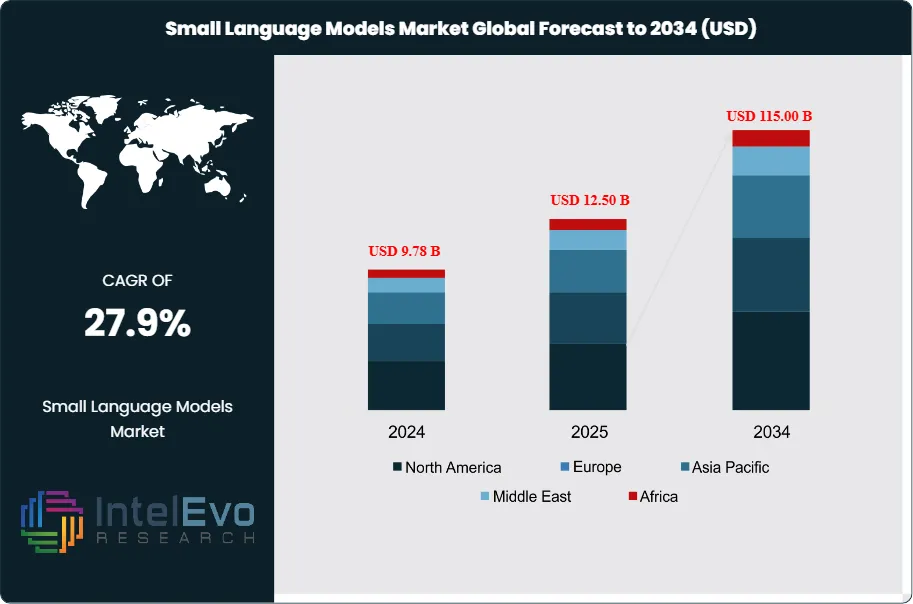
The Small Language Models Market was valued at approximately USD 9.78 Billion in 2024 and reached USD 12.50 Billion in 2025. The market is projected to grow to USD 115.00 Billion by 2034, expanding at a CAGR of 27.9% during the forecast period from 2026 to 2034. This represents an absolute dollar opportunity of USD 102.50 Billion over the analysis period. Current market assessment shows a fundamental shift in the artificial intelligence sector, moving away from monolithic, trillion-parameter architectures toward highly efficient, domain-specific small language models (SLMs). These models, typically defined by having fewer than 10 billion parameters, are increasingly favored for their lower inference latency and reduced computational requirements. Based on supply-chain and demand-side evaluation, the adoption of SLMs is primarily driven by the need for on-device processing in consumer electronics, automotive infotainment systems, and secure industrial IoT environments.
Get More Information about this report -
Request Free Sample ReportIndustry analysis indicates that the market is entering a phase of rapid diversification as enterprises seek to mitigate the high costs and latency associated with cloud-based hyperscale models. Regulatory influences, such as the EU AI Act and the NIST AI Risk Management Framework, have further accelerated this trend by encouraging localized data processing to enhance privacy and security. Trade data suggests a significant uptick in the shipment of AI-optimized silicon, specifically Neural Processing Units (NPUs), which are essential for executing SLM workloads on edge devices. Current evaluation shows that SLMs are not merely stripped-down versions of larger models but are often trained using higher-quality, curated datasets that allow them to match or exceed the performance of Large Language Models (LLMs) in specific vertical applications.
Risk factors for the market include the potential for performance ceilings in general-purpose reasoning compared to hyperscale counterparts and the complexities of managing decentralized model updates. However, technology effects, such as advanced model distillation, quantization, and Low-Rank Adaptation (LoRA) fine-tuning, have significantly boosted the viability of SLMs in enterprise settings. Regional highlights indicate that North America remains the primary investment hub, while the Asia Pacific region is emerging as a high-volume market for on-device AI integration in smartphones and appliances. Based on current infrastructure trends, the deployment of 5G and early 6G frameworks will provide the necessary bandwidth for hybrid AI architectures that leverage SLMs for immediate edge-based inference while offloading complex queries to the cloud.

Key Takeaways
- Market Growth: The Small Language Models market size is projected to expand from USD 12.50 Billion in 2025 to USD 115.00 Billion by 2034, maintaining a consistent CAGR of 27.9%.
- Segment Dominance: The 3B to 7B parameter segment accounted for a 46.5% market share in 2025, serving as the "sweet spot" for balancing model performance with hardware constraints.
- Segment Dominance: By vertical, the Consumer Electronics industry led the market with a 32.4% share in 2025, driven by the integration of generative AI features into mobile devices and PCs.
- Driver: Demand for on-device AI and edge computing is a primary driver, with NPUs capable of 40+ TOPS (Tera Operations Per Second) expected to see a 45.0% adoption rate in new laptops by late 2025.
- Restraint: Hardware fragmentation remains a critical constraint, where varying NPU architectures across different chipsets increase the complexity of model optimization, potentially slowing adoption by 12.2% in heterogeneous IoT environments.
- Opportunity: Personalized medical AI represents a USD 14.80 Billion untapped opportunity, as SLMs allow for the secure, local processing of patient data within clinical settings without cloud exposure.
- Trend: The shift toward "Hybrid AI" architectures is a dominant trend, with 65.0% of enterprises planning to use SLMs for 2025 data preprocessing before engaging larger cloud models.
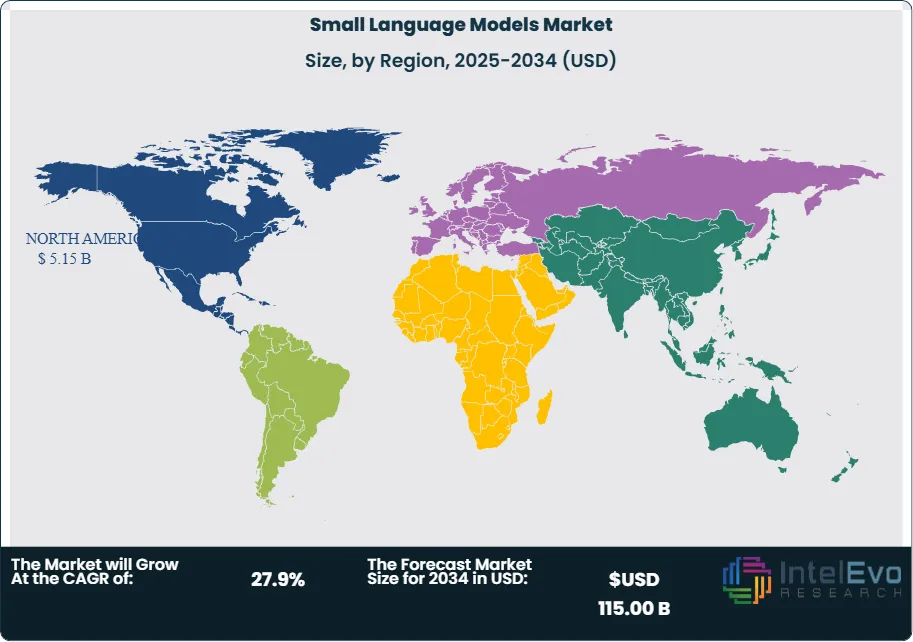
- Regional Analysis: North America is the leading region with a 41.2% market share, valued at USD 5.15 Billion in 2025, supported by the presence of major hyperscalers and semiconductor innovators.
Competitive Landscape Overview
The Global Small Language Models Market is currently moderately consolidated, with a cluster of established technology giants and agile pure-play AI firms capturing approximately 58.0% of total revenue. Current market assessment indicates that the nature of competition is shifting from pure parameter size to token throughput efficiency and domain-specific accuracy. Hyperscalers are increasingly launching lightweight versions of their flagship models to protect their market share in edge computing, while vertical specialists are focusing on "sovereign AI" solutions that prioritize data localization. Competitive intensity is particularly high in the mobile chipset sector, where software-hardware co-optimization has become a prerequisite for market leadership.
Competitive Landscape Matrix
| Company Name | Headquarters | Market Position | Key Product/Solution | Geographic Strength | Recent Strategic Move |
| MICROSOFT | USA | Leader | Phi-3 Series | Global | Launched Phi-3.5 MoE for enhanced reasoning in 2025 |
| META | USA | Leader | Llama 3.1 (8B) | Global | Integrated 8B model across the WhatsApp/Instagram ecosystem |
| USA | Leader | Gemma 2 (2B/9B) | Global | Optimized Gemma for Android on-device inference in mid-2025 | |
| MISTRAL AI | France | Challenger | Mistral 7B | Europe | Partnered with major cloud providers for sovereign hosting |
| APPLE | USA | Leader | OpenELM / Ferret | North America | Integrated Apple Intelligence across the M-series/A-series chips |
| HUGGING FACE | USA | Niche Player | Zephyr | Global | Expanded the "SmolLM" initiative for <1B parameter models |
| NVIDIA | USA | Leader | Nemotron-3 (8B) | Global | Launched edge-optimized inference microservices (NIMs) |
| ANTHROPIC | USA | Challenger | Claude Haiku | North America | Optimized Haiku for low-latency enterprise API calls |
| QUALCOMM | USA | Challenger | Snapdragon AI Engine | Asia Pacific | Announced native support for 7B+ models in mid-tier chips |
| ALIBABA | China | Challenger | Qwen-2.5 (1.5B/7B) | Asia Pacific | Open-sourced high-performance SLMs for retail automation |
By Parameter Count
Industry analysis indicates that the Small Language Models market by parameter count is segmented into <1B parameters, 1B–5B parameters, and 5B–10B parameters. The 5B–10B parameter segment represented the largest portion of the market in 2025, accounting for 48.2% of the share with a revenue value of USD 6.03 Billion. This dominance is due to the segment's ability to offer reasoning capabilities that rival larger models while still being compressible through quantization for high-end consumer hardware. Models in this range, such as Llama-8B and Gemma-9B, have become the industry standard for enterprise fine-tuning and retrieval-augmented generation (RAG) tasks.
The 1B–5B parameter segment is the fastest-growing category, expected to see significant adoption in the smartphone and tablet sectors. In 2025, this segment held a 35.6% share, valued at USD 4.45 Billion. Based on supply-chain evaluation, the rise of specialized AI silicon in mobile devices allows these models to run at speeds exceeding 50 tokens per second, making them ideal for real-time text summarization and smart reply features. The <1B parameter segment, while smaller at 16.2% share (USD 2.03 Billion), is critical for low-power IoT devices and wearable technology, where battery life and minimal memory footprint are the primary design constraints.
By Deployment Mode
The deployment segmentation of the Small Language Models market includes On-device/Edge and Cloud-based deployment. On-device/Edge deployment is the core value proposition of this industry, capturing a 62.4% market share in 2025, valued at USD 7.80 Billion. This shift toward edge deployment is motivated by a 40.0% reduction in latency compared to cloud-based inference and a significant decrease in recurring API costs. Current market assessment shows that sectors like defense and healthcare are migrating to on-device SLMs to ensure that sensitive data never leaves the local environment, thereby fulfilling strict compliance requirements like HIPAA and GDPR.
Cloud-based deployment of SLMs accounted for 37.6% of the market in 2025, worth USD 4.70 Billion. Although SLMs are designed for the edge, many organizations utilize them in the cloud to manage high-throughput, low-cost microservices. For example, using an SLM for initial intent classification or query routing can reduce total cloud compute expenditure by up to 25.0%. As cloud providers introduce "serverless inference" for small models, this segment is expected to remain a vital component of the hybrid AI ecosystem, particularly for developers who prioritize ease of integration over localized processing.
By Vertical/End-user
The vertical analysis of the Small Language Models market identifies Consumer Electronics, IT & Telecommunications, Healthcare, Automotive, and Industrial/Manufacturing as key segments. Consumer Electronics led the market in 2025 with a 32.4% share, generating USD 4.05 Billion in revenue. The integration of generative AI into "AI PCs" and premium smartphones has created a massive installed base for SLMs. Industry data suggests that by the end of 2025, over 250 million devices will be shipped with native SLM support, enabling features like offline translation and on-the-fly photo editing.
The Automotive vertical is an emerging powerhouse, holding an 18.5% share in 2025 (USD 2.31 Billion). Small models are being integrated into cockpit domain controllers to provide natural language interfaces that do not require an active internet connection, which is critical for safety and reliability. Healthcare followed with a 15.2% share (USD 1.90 Billion), where SLMs are used in medical transcription and bedside monitoring devices. The Industrial/Manufacturing sector (14.8%) utilizes SLMs for predictive maintenance and on-site technical documentation, while the IT & Telecommunications segment (19.1%) focuses on network automation and edge-based customer support bots.
Regional Analysis
North America
North America is the dominant region in the Global Small Language Models Market, commanding a 41.2% market share in 2025, with revenue reaching USD 5.15 Billion. The region benefits from a robust ecosystem of semiconductor designers, software giants, and a high concentration of venture capital focused on "efficiency-first" AI. Current industry analysis indicates that U.S.-based hyperscalers are leading the transition from LLMs to SLMs to provide more cost-effective enterprise solutions. The NIST AI Risk Management Framework has also played a role in encouraging North American firms to adopt the transparent and controllable architectures offered by smaller models. The presence of major silicon innovators in Silicon Valley ensures that hardware-software co-optimization remains a primary competitive advantage for the region.
Europe
Europe held a 24.5% market share in 2025, valued at USD 3.06 Billion, with the market heavily influenced by stringent data privacy regulations. The EU AI Act has acted as a catalyst for SLM adoption, as these models facilitate localized data processing that aligns with GDPR mandates. Based on trade data and regulatory filings, European enterprises are increasingly investing in "Sovereign AI" to reduce their dependency on non-EU cloud providers. France and Germany have emerged as significant hubs for SLM development, with French firms particularly active in the open-source community. The European automotive industry is also a major consumer of SLMs, integrating them into high-end vehicle infotainment systems to provide privacy-focused voice assistants.
Asia Pacific
The Asia Pacific region is the fastest-growing market for Small Language Models, accounting for an 21.8% share in 2025, worth USD 2.73 Billion. The region's growth is fueled by its status as the global manufacturing hub for consumer electronics. China, Japan, and South Korea are at the forefront of integrating SLMs into mobile hardware and home appliances. In China, local tech giants have released high-performance SLMs that are optimized for Mandarin and regional dialects, driving adoption in retail and customer service. India is also seeing a surge in SLM demand as domestic software firms develop edge-AI solutions for the country's massive digital infrastructure. The expansion of 5G networks across the region further supports the deployment of edge-based SLM services.
Latin America and Middle East & Africa
Latin America represented 6.4% of the market in 2025 (USD 0.80 Billion), with Brazil and Mexico leading the adoption in the financial and retail sectors. Small language models are being used to enhance mobile banking apps in areas with intermittent connectivity. The Middle East & Africa region held a 6.1% share in 2025 (USD 0.76 Billion). Growth in this region is driven by "Smart City" initiatives in Saudi Arabia and the UAE, where SLMs are used in autonomous systems and government service kiosks. Investment in AI localized for Arabic and regional languages is a key trend in the Gulf Cooperation Council (GCC) countries.
Get More Information about this report -
Request Free Sample ReportMarket Key Segments
By Parameter Count
- <1B Parameters
- 1B-5B Parameters
- 5B-10B Parameters
By Deployment Mode
- On-device/Edge
- Cloud-based
- Hybrid
By Offering
- Models/Software
- Fine-tuning & Optimization Services
- Support & Maintenance
By Vertical
- Consumer Electronics
- IT & Telecommunications
- Healthcare & Life Sciences
- Automotive & Transportation
- Industrial & Manufacturing
- BFSI (Banking, Financial Services, and Insurance)
- Retail & E-commerce
Regional Analysis and Coverage
- North America
- Latin America
- East Asia And Pacific
- Sea And South Asia
- Eastern Europe
- Western Europe
- Middle East & Africa
| Report Attribute | Details |
| Market size (2025) | USD 12.50 B |
| Forecast Revenue (2034) | USD 115.00 B |
| CAGR (2025-2034) | 27.9% |
| Historical data | 2021-2024 |
| Base Year For Estimation | 2025 |
| Forecast Period | 2026-2034 |
| Report coverage | Revenue Forecast, Competitive Landscape, Market Dynamics, Growth Factors, Trends and Recent Developments |
| Segments covered | By Parameter Count, (<1B Parameters, 1B-5B Parameters, 5B-10B Parameters), By Deployment Mode, (On-device/Edge, Cloud-based, Hybrid), By Offering, (Models/Software, Fine-tuning & Optimization Services, Support & Maintenance), By Vertical, (Consumer Electronics, IT & Telecommunications, Healthcare & Life Sciences, Automotive & Transportation, Industrial & Manufacturing, BFSI (Banking, Financial Services, and Insurance), Retail & E-commerce) |
| Research Methodology |
|
| Regional scope |
|
| Competitive Landscape | MICROSOFT, META, MISTRAL AI, APPLE, GOOGLE, NVIDIA, ANTHROPIC, HUGGING FACE, QUALCOMM, ALIBABA, BAIDU, IBM, COHERE, UPSTAGE, AI21 LABS, Others |
| Customization Scope | Customization for segments, region/country-level will be provided. Moreover, additional customization can be done based on the requirements. |
| Pricing and Purchase Options | Avail customized purchase options to meet your exact research needs. We have three licenses to opt for: Single User License, Multi-User License (Up to 5 Users), Corporate Use License (Unlimited User and Printable PDF). |


Frequently Asked Questions
How big is the Small Language Models Market?
Global Small language models market valued at USD 9.78B in 2024, reaching USD 115.0B by 2034, growing at a CAGR of 27.9% from 2026–2034.
Who are the major players in the Small Language Models Market?
MICROSOFT, META, MISTRAL AI, APPLE, GOOGLE, NVIDIA, ANTHROPIC, HUGGING FACE, QUALCOMM, ALIBABA, BAIDU, IBM, COHERE, UPSTAGE, AI21 LABS, Others
Which segments covered the Small Language Models Market?
By Parameter Count, (<1B Parameters, 1B-5B Parameters, 5B-10B Parameters), By Deployment Mode, (On-device/Edge, Cloud-based, Hybrid), By Offering, (Models/Software, Fine-tuning & Optimization Services, Support & Maintenance), By Vertical, (Consumer Electronics, IT & Telecommunications, Healthcare & Life Sciences, Automotive & Transportation, Industrial & Manufacturing, BFSI (Banking, Financial Services, and Insurance), Retail & E-commerce)
How can this market research report help my business make strategic decisions?
Our market research reports provide actionable intelligence, including verified market size data, CAGR projections, competitive benchmarking, and segment-level opportunity analysis. These insights support strategic planning, investment decisions, product development, and market entry strategies for enterprises and startups alike.
How frequently is the data updated?
We continuously monitor industry developments and update our reports to reflect regulatory changes, technological advancements, and macroeconomic shifts. Updated editions ensure you receive the latest market intelligence.

Select Licence Type
Connect with our sales team

Small Language Models Market
Published Date : 08 Apr 2026 | Formats :Why IntelEvoResearch
100%
Customer
Satisfaction
24x7+
Availability - we are always
there when you need us
200+
Fortune 50 Companies trust
IntelEvoResearch
80%
of our reports are exclusive
and first in the industry
100%
more data
and analysis
1000+
reports published
till date
