
The Global Smart Cities Infrastructure Market size is projected to be worth around USD 2,750.5 million by 2034, up from USD 690.4 million in 2024, growing at a CAGR of 15.8% during the forecast period from 2024 to 2034. This growth is driven by rapid urbanization, rising adoption of IoT, AI, and 5G technologies, and strong government initiatives to build sustainable and connected cities. With smart mobility, energy-efficient buildings, and advanced public safety solutions at the core, smart city infrastructure is set to redefine urban living and attract large-scale investments from both public and private sectors.
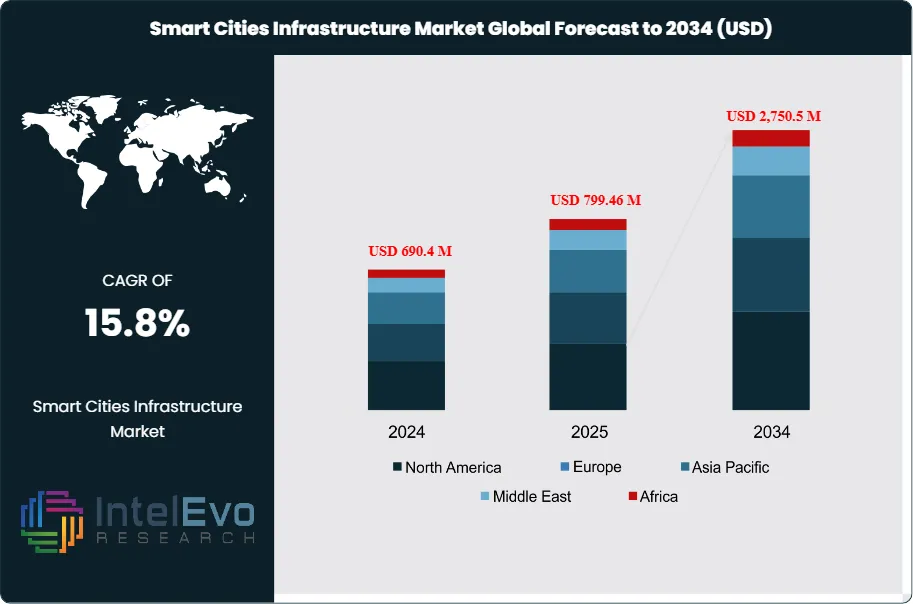
The Global Smart Cities Infrastructure Market includes an enormous variety of technologies and services aimed at the upgrade of urban life through intelligent solutions. This market is comprised of smart lighting, traffic management systems, waste management, and smart buildings, amongst others, all working toward better sustainability and efficiency in the urban domain. The dynamics within the market based on current conditions will be related to urban population growth, with regard to the speed at which technology advances, and the demand for smart city solutions. The valuation of approximately USD 690.4 million in 2024 will be witnessing a growth in the market up to approximately USD 2,750.5 million by the end of 2034, with tremendous growth opportunities presented by innovative infrastructure integration.
The dynamics of the Smart Cities Infrastructure Market are highly influenced by enhanced urban management, increased investments in technology, and related government initiatives for smart city developments. However, critical factors that sustain the market's growth are urbanization, as large areas per unit with high population require efficient management and infrastructure; development in IoT technologies that really empower connectivity; and increasing environmental concerns that push cities toward sustainable practices. Moreover, artificial intelligence advancements and massive data analytics allow cities to utilize the data in their decision-making process. This will further enhance the overall operational effectiveness. Therefore, these will include an exceptional compound annual growth rate (CAGR) of almost 15.8% between 2024 and 2034.
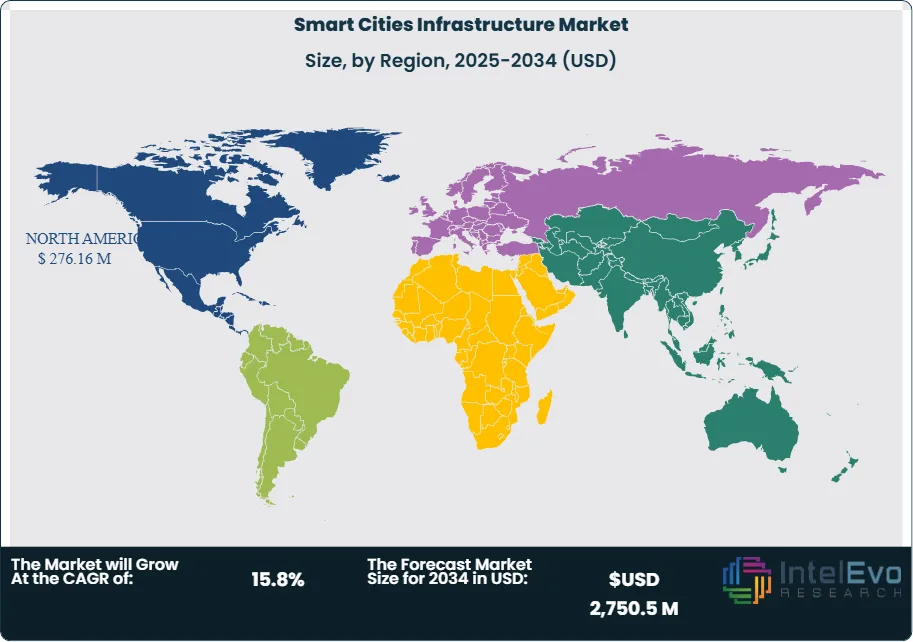
North America currently holds the largest market share of about 31.2% of the Smart Cities Infrastructure Market, with heavy investments in smart technologies and upbeat government policies visualized. Europe and the Asia-Pacific region are expected to grow at a healthy pace for the foreseeable future primarily due to the increasing pace of urbanization every day, with initiatives for sustainable cities on the rise. China and India are the others who are rapidly advancing countries in smart city projects where technology is used to address city problems. But then again, the Middle East and Africa seem to open promising growth opportunities because governments seek smart solutions in upgrading infrastructure and improving living standards.
The COVID-19 epidemic had a profound impact on the Smart Cities Infrastructure Market. On one hand, the initial impact of the outbreak came in terms of delaying projects and investment due to economic uncertainty. It also heightened demand for smart solutions as cities tried to strengthen public health and safety systems. The growing need for digital infrastructure and remote services was ever more clearly recognized during the period, compelling a trend of smart technologies in the urban planning and management of cities. Cities are recovering, but the concerns of such resilient and adaptive urban environments may gain pace, pushing investment deeper into smart city initiatives.
Key Takeaways:
Market Growth: The Global Smart Cities Infrastructure Market is expected to reach USD $2,750.5 million by 2034, growing at a robust CAGR of 15.8% from its current value of USD $690.4 million in 2024.
Smart Transportation Analysis: The smart transportation segment focuses on intelligent traffic management and public transportation systems, enhancing mobility and reducing congestion. It aims to improve urban mobility through real-time data analysis and connectivity.
Smart Utilities Analysis: Smart utilities encompass solutions for water, waste, and energy management. These technologies aim to optimize resource consumption and enhance sustainability, contributing to efficient urban operations and reduced environmental impact.
Driver: Increasing urbanization is a significant driver for the Smart Cities Infrastructure Market, as cities seek innovative solutions to manage growing populations, enhance quality of life, and address environmental challenges through smart technologies.
Restraint: High implementation costs and the complexity of integrating new technologies into existing urban frameworks can restrain market growth. Additionally, varying regulatory standards across regions may hinder project execution and investor confidence.
Opportunity: The demand for sustainable urban solutions presents significant opportunities for growth, particularly in developing regions. Investing in smart technologies that promote energy efficiency and waste reduction can lead to new market avenues and revenue streams.
Trend: The adoption of Internet of Things (IoT) technologies is a prevailing trend, enabling cities to gather and analyze data effectively, fostering smarter decision-making and improved urban services.
Regional Analysis: North America leads the Smart Cities Infrastructure Market, driven by substantial investments and innovation. Asia-Pacific is expected to witness significant growth due to rapid urbanization and government initiatives focused on sustainable city development.
By Component:
The Smart Cities Infrastructure Market includes various components such as energy, mobility, water, governance, healthcare, housing, and security systems. Smart Grids and Energy Management aim to improve energy distribution and integrate renewable sources. Smart Transportation and Mobility help with the adoption of electric vehicles, connected vehicles, and traffic management. Smart Water and Waste Management support sustainability by monitoring resources and treating them efficiently. Smart Governance and E-Government Platforms enhance citizen services and make administration more efficient. Smart Healthcare Infrastructure uses telemedicine and IoT-enabled health systems. Smart Buildings and Homes encourage energy-efficient living through automation. Smart Security and Surveillance ensure public safety with AI-powered monitoring and predictive analytics. Together, these components make up the foundation of modern smart cities.
By Deployment Model:
Deployment models in smart city infrastructure are changing to meet various needs. On-Premises solutions give governments and businesses strong control, security, and the ability to customize their infrastructure systems. Cloud-Based models are becoming popular because they are scalable, cost-effective, and allow real-time data processing for applications like smart traffic management, governance platforms, and healthcare. Hybrid deployment models combine the best of both worlds, providing flexibility, agility, and data security by handling critical operations locally while using the cloud for large-scale analytics and scalability. As cities become more digital, hybrid deployment is becoming the preferred choice, balancing cost and security.
By Technology:
Smart city infrastructure relies on various technologies that promote efficiency, innovation, and connectivity. The Internet of Things (IoT) links billions of devices across energy grids, mobility systems, and governance. Artificial Intelligence (AI) and Machine Learning analyze large data sets to support predictive decision-making in areas like traffic control, healthcare, and surveillance. Blockchain facilitates secure and transparent transactions in governance and energy trading. 5G connectivity boosts smart mobility, remote healthcare, and real-time surveillance. Big Data and Analytics help city authorities predict demand and manage resources more effectively. Edge Computing reduces latency by processing data closer to its source. All these technologies create the digital backbone of smart cities around the world.
By Application:
Smart city infrastructure has applications across key sectors, enhancing urban efficiency and sustainability. Energy and Utilities benefit from smart grids, renewable integration, and efficient power distribution. Transportation and Mobility applications support intelligent traffic systems, electric vehicle infrastructure, and shared mobility options. Healthcare integrates digital hospitals, telemedicine, and IoT-based health monitoring. Public Safety uses surveillance, emergency response systems, and disaster management tools. Governance applications improve citizen engagement and e-services. Education enjoys smart classrooms, e-learning platforms, and connected institutions. Other areas include innovations in retail, tourism, and waste management. Together, these applications change how cities provide services and improve quality of life.
By End-User:
Smart city infrastructure is adopted by various end-users. Government and Municipalities are the main drivers, implementing policies, smart utilities, and governance solutions. Commercial and Corporate Enterprises use smart infrastructure for office complexes, IT parks, and sustainable business practices. The Residential Sector gains from smart homes, community surveillance, and energy-efficient housing options. The Industrial Sector incorporates smart grids, automation, and waste management for sustainable operations. Each end-user segment plays a unique role in adopting smart technologies, leading to improved efficiency, sustainability, and user experience in urban environments. Governments are expected to lead in adoption, while private enterprises increasingly invest and innovate.
By Region Analysis:
North America Holds the Largest Market Share in the Smart Cities Infrastructure Market: North America dominates the Smart Cities Infrastructure Market, accounting for approximately 40% of the total market share. The region's leadership is attributed to significant investments in smart technology by both the public and private sectors. Major cities like New York and San Francisco are pioneers in implementing smart transportation and utility systems, fostering improved quality of life and operational efficiency. Additionally, supportive government policies and funding for innovative urban solutions further enhance market growth. The presence of established technology firms and startups in this region accelerates advancements in smart infrastructure, ensuring North America remains at the forefront of the smart cities revolution.
Asia-Pacific is projected to be the fastest-growing region in the Smart Cities Infrastructure Market, with a CAGR of approximately 18% over the next decade. Rapid urbanization, especially in countries like China and India, drives the demand for smart city solutions to address challenges related to infrastructure and public services. The increasing population density and government initiatives aimed at sustainable urban development significantly contribute to this growth. Furthermore, cities in this region are adopting advanced technologies, such as IoT and AI, to enhance public transportation and energy management systems. Other regions, including Europe and Latin America, are also witnessing growth, with Europe focusing on sustainable energy solutions and Latin America exploring smart governance and urban mobility initiatives. The Middle East and Africa, while currently smaller in market share, are gradually adopting smart city solutions, driven by investments in infrastructure and technology.
By Component (Smart Grids & Energy Management, Smart Transportation & Mobility, Smart Water & Waste Management, Smart Governance & E-Government Platforms, Smart Healthcare Infrastructure, Smart Buildings & Homes, Smart Security & Surveillance), By Deployment Model (On-Premises, Cloud-Based, Hybrid), By Technology (Internet of Things (IoT), Artificial Intelligence (AI) & Machine Learning, Blockchain, 5G Connectivity, Big Data & Analytics, Edge Computing), By Application (Energy & Utilities, Transportation & Mobility, Healthcare, Public Safety, Governance, Education, Others), By End-User (Government & Municipalities, Commercial & Corporate Enterprises, Residential Sector, Industrial Sector)
Research Methodology
Primary Research- 100 Interviews of Stakeholders
Secondary Research
Desk Research
Regional scope
North America (United States, Canada, Mexico)
Latin America (Brazil, Argentina, Columbia)
East Asia And Pacific (China, Japan, South Korea, Australia, Cambodia, Fiji, Indonesia)
Sea And South Asia (India, Singapore, Thailand, Taiwan, Malaysia)
Eastern Europe (Poland, Russia, Czech Republic, Romania)
Western Europe (Germany, U.K., France, Spain, Itlay)
Middle East & Africa (GCC Countries, Egypt, Nigeria, South Africa, Israel)
Competitive Landscape
IBM Corporation, Cisco Systems Inc., Siemens AG, Schneider Electric SE, Honeywell International Inc., Microsoft Corporation, Oracle Corporation, Ericsson, Intel Corporation, Accenture PLC, General Electric Company, Huawei Technologies Co. Ltd., Hitachi Ltd., Samsung Electronics Co. Ltd., Mitsubishi Electric Corporation, Veolia Environnement S.A., Siemens Mobility, ABB Ltd., AECOM, Arup Group Limited
Customization Scope
Customization for segments, region/country-level will be provided. Moreover, additional customization can be done based on the requirements.
Pricing and Purchase Options
Avail customized purchase options to meet your exact research needs. We have three licenses to opt for: Single User License, Multi-User License (Up to 5 Users), Corporate Use License (Unlimited User and Printable PDF).
TABLE OF CONTENTS
1. EXECUTIVE SUMMARY
1.1. MARKET SNAPSHOT
1.2. KEY FINDINGS & INSIGHTS
1.3. ANALYST RECOMMENDATIONS
1.4. FUTURE OUTLOOK
2. RESEARCH METHODOLOGY
2.1. MARKET DEFINITION & SCOPE
2.2. RESEARCH OBJECTIVES: PRIMARY & SECONDARY DATA SOURCES
2.3. DATA COLLECTION SOURCES
2.3.1. COVERAGE OF 100+ PRIMARY RESEARCH/CONSULTATION CALLS WITH INDUSTRY STAKEHOLDERS
FIGURE 17 NORTH AMERICA SMART CITIES INFRASTRUCTURE CURRENT AND FUTURE TYPE ANALYSIS, 2025–2034, (USD MILLION)
FIGURE 18 NORTH AMERICA SMART CITIES INFRASTRUCTURE CURRENT AND FUTURE END USER ANALYSIS, 2025–2034, (USD MILLION)
FIGURE 19 MARKET SHARE BY COUNTRY
FIGURE 20 LATIN AMERICA SMART CITIES INFRASTRUCTURE CURRENT AND FUTURE TYPE ANALYSIS, 2025–2034, (USD MILLION)
FIGURE 21 LATIN AMERICA SMART CITIES INFRASTRUCTURE CURRENT AND FUTURE END USER ANALYSIS, 2025–2034, (USD MILLION)
FIGURE 22 MARKET SHARE BY COUNTRY
FIGURE 23 EASTERN EUROPE SMART CITIES INFRASTRUCTURE CURRENT AND FUTURE TYPE ANALYSIS, 2025–2034, (USD MILLION)
FIGURE 24 EASTERN EUROPE SMART CITIES INFRASTRUCTURE CURRENT AND FUTURE END USER ANALYSIS, 2025–2034, (USD MILLION)
FIGURE 25 MARKET SHARE BY COUNTRY
FIGURE 26 WESTERN EUROPE SMART CITIES INFRASTRUCTURE CURRENT AND FUTURE TYPE ANALYSIS, 2025–2034, (USD MILLION)
FIGURE 27 WESTERN EUROPE SMART CITIES INFRASTRUCTURE CURRENT AND FUTURE END USER ANALYSIS, 2025–2034, (USD MILLION)
FIGURE 28 MARKET SHARE BY COUNTRY
FIGURE 29 EAST ASIA AND PACIFIC SMART CITIES INFRASTRUCTURE CURRENT AND FUTURE TYPE ANALYSIS, 2025–2034, (USD MILLION)
FIGURE 30 EAST ASIA AND PACIFIC SMART CITIES INFRASTRUCTURE CURRENT AND FUTURE END USER ANALYSIS, 2025–2034, (USD MILLION)
FIGURE 31 MARKET SHARE BY COUNTRY
FIGURE 32 SEA AND SOUTH ASIA SMART CITIES INFRASTRUCTURE CURRENT AND FUTURE TYPE ANALYSIS, 2025–2034, (USD MILLION)
FIGURE 33 SEA AND SOUTH ASIA SMART CITIES INFRASTRUCTURE CURRENT AND FUTURE END USER ANALYSIS, 2025–2034, (USD MILLION)
FIGURE 34 MARKET SHARE BY COUNTRY
FIGURE 35 MIDDLE EAST AND AFRICA SMART CITIES INFRASTRUCTURE CURRENT AND FUTURE TYPE ANALYSIS, 2025–2034, (USD MILLION)
FIGURE 36 MIDDLE EAST AND AFRICA SMART CITIES INFRASTRUCTURE CURRENT AND FUTURE END USER ANALYSIS, 2025–2034, (USD MILLION)
FIGURE 37 NORTH AMERICA SMART CITIES INFRASTRUCTURE CURRENT AND FUTURE MARKET VOLUME SHARE REGIONAL ANALYSIS, 2025–2034, (USD MILLION)
FIGURE 38 U.S. SMART CITIES INFRASTRUCTURE CURRENT AND FUTURE TYPE ANALYSIS, 2025–2034, (USD MILLION)
FIGURE 39 U.S. SMART CITIES INFRASTRUCTURE CURRENT AND FUTURE END USER ANALYSIS, 2025–2034, (USD MILLION)
FIGURE 40 CANADA SMART CITIES INFRASTRUCTURE CURRENT AND FUTURE TYPE ANALYSIS, 2025–2034, (USD MILLION)
FIGURE 41 CANADA SMART CITIES INFRASTRUCTURE CURRENT AND FUTURE END USER ANALYSIS, 2025–2034, (USD MILLION)
FIGURE 42 LATIN AMERICA SMART CITIES INFRASTRUCTURE CURRENT AND FUTURE MARKET VOLUME SHARE REGIONAL ANALYSIS, 2025–2034, (USD MILLION)
FIGURE 43 MEXICO SMART CITIES INFRASTRUCTURE CURRENT AND FUTURE TYPE ANALYSIS, 2025–2034, (USD MILLION)
FIGURE 44 MEXICO SMART CITIES INFRASTRUCTURE CURRENT AND FUTURE END USER ANALYSIS, 2025–2034, (USD MILLION)
FIGURE 45 BRAZIL SMART CITIES INFRASTRUCTURE CURRENT AND FUTURE TYPE ANALYSIS, 2025–2034, (USD MILLION)
FIGURE 46 BRAZIL SMART CITIES INFRASTRUCTURE CURRENT AND FUTURE END USER ANALYSIS, 2025–2034, (USD MILLION)
FIGURE 47 ARGENTINA SMART CITIES INFRASTRUCTURE CURRENT AND FUTURE TYPE ANALYSIS, 2025–2034, (USD MILLION)
FIGURE 48 ARGENTINA SMART CITIES INFRASTRUCTURE CURRENT AND FUTURE END USER ANALYSIS, 2025–2034, (USD MILLION)
FIGURE 49 COLUMBIA SMART CITIES INFRASTRUCTURE CURRENT AND FUTURE TYPE ANALYSIS, 2025–2034, (USD MILLION)
FIGURE 50 COLUMBIA SMART CITIES INFRASTRUCTURE CURRENT AND FUTURE END USER ANALYSIS, 2025–2034, (USD MILLION)
FIGURE 51 REST OF LATIN AMERICA SMART CITIES INFRASTRUCTURE CURRENT AND FUTURE TYPE ANALYSIS, 2025–2034, (USD MILLION)
FIGURE 52 REST OF LATIN AMERICA SMART CITIES INFRASTRUCTURE CURRENT AND FUTURE END USER ANALYSIS, 2025–2034, (USD MILLION)
FIGURE 53 EASTERN EUROPE SMART CITIES INFRASTRUCTURE CURRENT AND FUTURE MARKET VOLUME SHARE REGIONAL ANALYSIS, 2025–2034, (USD MILLION)
FIGURE 54 POLAND SMART CITIES INFRASTRUCTURE CURRENT AND FUTURE TYPE ANALYSIS, 2025–2034, (USD MILLION)
FIGURE 55 POLAND SMART CITIES INFRASTRUCTURE CURRENT AND FUTURE END USER ANALYSIS, 2025–2034, (USD MILLION)
FIGURE 56 RUSSIA SMART CITIES INFRASTRUCTURE CURRENT AND FUTURE TYPE ANALYSIS, 2025–2034, (USD MILLION)
FIGURE 57 RUSSIA SMART CITIES INFRASTRUCTURE CURRENT AND FUTURE END USER ANALYSIS, 2025–2034, (USD MILLION)
FIGURE 58 CZECH REPUBLIC SMART CITIES INFRASTRUCTURE CURRENT AND FUTURE TYPE ANALYSIS, 2025–2034, (USD MILLION)
FIGURE 59 CZECH REPUBLIC SMART CITIES INFRASTRUCTURE CURRENT AND FUTURE END USER ANALYSIS, 2025–2034, (USD MILLION)
FIGURE 60 ROMANIA SMART CITIES INFRASTRUCTURE CURRENT AND FUTURE TYPE ANALYSIS, 2025–2034, (USD MILLION)
FIGURE 61 ROMANIA SMART CITIES INFRASTRUCTURE CURRENT AND FUTURE END USER ANALYSIS, 2025–2034, (USD MILLION)
FIGURE 62 REST OF EASTERN EUROPE SMART CITIES INFRASTRUCTURE CURRENT AND FUTURE TYPE ANALYSIS, 2025–2034, (USD MILLION)
FIGURE 63 REST OF EASTERN EUROPE SMART CITIES INFRASTRUCTURE CURRENT AND FUTURE END USER ANALYSIS, 2025–2034, (USD MILLION)
FIGURE 64 WESTERN EUROPE SMART CITIES INFRASTRUCTURE CURRENT AND FUTURE MARKET VOLUME SHARE REGIONAL ANALYSIS, 2025–2034, (USD MILLION)
FIGURE 65 GERMANY SMART CITIES INFRASTRUCTURE CURRENT AND FUTURE TYPE ANALYSIS, 2025–2034, (USD MILLION)
FIGURE 66 GERMANY SMART CITIES INFRASTRUCTURE CURRENT AND FUTURE END USER ANALYSIS, 2025–2034, (USD MILLION)
FIGURE 67 FRANCE SMART CITIES INFRASTRUCTURE CURRENT AND FUTURE TYPE ANALYSIS, 2025–2034, (USD MILLION)
FIGURE 68 FRANCE SMART CITIES INFRASTRUCTURE CURRENT AND FUTURE END USER ANALYSIS, 2025–2034, (USD MILLION)
FIGURE 69 UK SMART CITIES INFRASTRUCTURE CURRENT AND FUTURE TYPE ANALYSIS, 2025–2034, (USD MILLION)
FIGURE 70 UK SMART CITIES INFRASTRUCTURE CURRENT AND FUTURE END USER ANALYSIS, 2025–2034, (USD MILLION)
FIGURE 71 SPAIN SMART CITIES INFRASTRUCTURE CURRENT AND FUTURE TYPE ANALYSIS, 2025–2034, (USD MILLION)
FIGURE 72 SPAIN SMART CITIES INFRASTRUCTURE CURRENT AND FUTURE END USER ANALYSIS, 2025–2034, (USD MILLION)
FIGURE 73 ITALY SMART CITIES INFRASTRUCTURE CURRENT AND FUTURE TYPE ANALYSIS, 2025–2034, (USD MILLION)
FIGURE 74 ITALY SMART CITIES INFRASTRUCTURE CURRENT AND FUTURE END USER ANALYSIS, 2025–2034, (USD MILLION)
FIGURE 75 REST OF WESTERN EUROPE SMART CITIES INFRASTRUCTURE CURRENT AND FUTURE TYPE ANALYSIS, 2025–2034, (USD MILLION)
FIGURE 76 REST OF WESTERN EUROPE SMART CITIES INFRASTRUCTURE CURRENT AND FUTURE END USER ANALYSIS, 2025–2034, (USD MILLION)
FIGURE 77 EAST ASIA AND PACIFIC SMART CITIES INFRASTRUCTURE CURRENT AND FUTURE MARKET VOLUME SHARE REGIONAL ANALYSIS, 2025–2034, (USD MILLION)
FIGURE 78 CHINA SMART CITIES INFRASTRUCTURE CURRENT AND FUTURE TYPE ANALYSIS, 2025–2034, (USD MILLION)
FIGURE 79 CHINA SMART CITIES INFRASTRUCTURE CURRENT AND FUTURE END USER ANALYSIS, 2025–2034, (USD MILLION)
FIGURE 80 JAPAN SMART CITIES INFRASTRUCTURE CURRENT AND FUTURE TYPE ANALYSIS, 2025–2034, (USD MILLION)
FIGURE 81 JAPAN SMART CITIES INFRASTRUCTURE CURRENT AND FUTURE END USER ANALYSIS, 2025–2034, (USD MILLION)
FIGURE 82 AUSTRALIA SMART CITIES INFRASTRUCTURE CURRENT AND FUTURE TYPE ANALYSIS, 2025–2034, (USD MILLION)
FIGURE 83 AUSTRALIA SMART CITIES INFRASTRUCTURE CURRENT AND FUTURE END USER ANALYSIS, 2025–2034, (USD MILLION)
FIGURE 84 CAMBODIA SMART CITIES INFRASTRUCTURE CURRENT AND FUTURE TYPE ANALYSIS, 2025–2034, (USD MILLION)
FIGURE 85 CAMBODIA SMART CITIES INFRASTRUCTURE CURRENT AND FUTURE END USER ANALYSIS, 2025–2034, (USD MILLION)
FIGURE 86 FIJI SMART CITIES INFRASTRUCTURE CURRENT AND FUTURE TYPE ANALYSIS, 2025–2034, (USD MILLION)
FIGURE 87 FIJI SMART CITIES INFRASTRUCTURE CURRENT AND FUTURE END USER ANALYSIS, 2025–2034, (USD MILLION)
FIGURE 88 INDONESIA SMART CITIES INFRASTRUCTURE CURRENT AND FUTURE TYPE ANALYSIS, 2025–2034, (USD MILLION)
FIGURE 89 INDONESIA SMART CITIES INFRASTRUCTURE CURRENT AND FUTURE END USER ANALYSIS, 2025–2034, (USD MILLION)
FIGURE 90 SOUTH KOREA SMART CITIES INFRASTRUCTURE CURRENT AND FUTURE TYPE ANALYSIS, 2025–2034, (USD MILLION)
FIGURE 91 SOUTH KOREA SMART CITIES INFRASTRUCTURE CURRENT AND FUTURE END USER ANALYSIS, 2025–2034, (USD MILLION)
FIGURE 92 REST OF EAST ASIA AND PACIFIC SMART CITIES INFRASTRUCTURE CURRENT AND FUTURE TYPE ANALYSIS, 2025–2034, (USD MILLION)
FIGURE 93 REST OF EAST ASIA AND PACIFIC SMART CITIES INFRASTRUCTURE CURRENT AND FUTURE END USER ANALYSIS, 2025–2034, (USD MILLION)
FIGURE 94 SEA AND SOUTH ASIA SMART CITIES INFRASTRUCTURE CURRENT AND FUTURE MARKET VOLUME SHARE REGIONAL ANALYSIS, 2025–2034, (USD MILLION)
FIGURE 95 BANGLADESH SMART CITIES INFRASTRUCTURE CURRENT AND FUTURE TYPE ANALYSIS, 2025–2034, (USD MILLION)
FIGURE 96 BANGLADESH SMART CITIES INFRASTRUCTURE CURRENT AND FUTURE END USER ANALYSIS, 2025–2034, (USD MILLION)
FIGURE 97 NEW ZEALAND SMART CITIES INFRASTRUCTURE CURRENT AND FUTURE TYPE ANALYSIS, 2025–2034, (USD MILLION)
FIGURE 98 NEW ZEALAND SMART CITIES INFRASTRUCTURE CURRENT AND FUTURE END USER ANALYSIS, 2025–2034, (USD MILLION)
FIGURE 99 INDIA SMART CITIES INFRASTRUCTURE CURRENT AND FUTURE TYPE ANALYSIS, 2025–2034, (USD MILLION)
FIGURE 100 INDIA SMART CITIES INFRASTRUCTURE CURRENT AND FUTURE END USER ANALYSIS, 2025–2034, (USD MILLION)
FIGURE 101 SINGAPORE SMART CITIES INFRASTRUCTURE CURRENT AND FUTURE TYPE ANALYSIS, 2025–2034, (USD MILLION)
FIGURE 102 SINGAPORE SMART CITIES INFRASTRUCTURE CURRENT AND FUTURE END USER ANALYSIS, 2025–2034, (USD MILLION)
FIGURE 103 THAILAND SMART CITIES INFRASTRUCTURE CURRENT AND FUTURE TYPE ANALYSIS, 2025–2034, (USD MILLION)
FIGURE 104 THAILAND SMART CITIES INFRASTRUCTURE CURRENT AND FUTURE END USER ANALYSIS, 2025–2034, (USD MILLION)
FIGURE 105 TAIWAN SMART CITIES INFRASTRUCTURE CURRENT AND FUTURE TYPE ANALYSIS, 2025–2034, (USD MILLION)
FIGURE 106 TAIWAN SMART CITIES INFRASTRUCTURE CURRENT AND FUTURE END USER ANALYSIS, 2025–2034, (USD MILLION)
FIGURE 107 MALAYSIA SMART CITIES INFRASTRUCTURE CURRENT AND FUTURE TYPE ANALYSIS, 2025–2034, (USD MILLION)
FIGURE 108 MALAYSIA SMART CITIES INFRASTRUCTURE CURRENT AND FUTURE END USER ANALYSIS, 2025–2034, (USD MILLION)
FIGURE 109 REST OF SEA AND SOUTH ASIA SMART CITIES INFRASTRUCTURE CURRENT AND FUTURE TYPE ANALYSIS, 2025–2034, (USD MILLION)
FIGURE 110 REST OF SEA AND SOUTH ASIA SMART CITIES INFRASTRUCTURE CURRENT AND FUTURE END USER ANALYSIS, 2025–2034, (USD MILLION)
FIGURE 111 MIDDLE EAST AND AFRICA SMART CITIES INFRASTRUCTURE CURRENT AND FUTURE MARKET VOLUME SHARE REGIONAL ANALYSIS, 2025–2034, (USD MILLION)
FIGURE 112 GCC COUNTRIES SMART CITIES INFRASTRUCTURE CURRENT AND FUTURE TYPE ANALYSIS, 2025–2034, (USD MILLION)
FIGURE 113 GCC COUNTRIES SMART CITIES INFRASTRUCTURE CURRENT AND FUTURE END USER ANALYSIS, 2025–2034, (USD MILLION)
FIGURE 114 SAUDI ARABIA SMART CITIES INFRASTRUCTURE CURRENT AND FUTURE TYPE ANALYSIS, 2025–2034, (USD MILLION)
FIGURE 115 SAUDI ARABIA SMART CITIES INFRASTRUCTURE CURRENT AND FUTURE END USER ANALYSIS, 2025–2034, (USD MILLION)
FIGURE 116 UAE SMART CITIES INFRASTRUCTURE CURRENT AND FUTURE TYPE ANALYSIS, 2025–2034, (USD MILLION)
FIGURE 117 UAE SMART CITIES INFRASTRUCTURE CURRENT AND FUTURE END USER ANALYSIS, 2025–2034, (USD MILLION)
FIGURE 118 BAHRAIN SMART CITIES INFRASTRUCTURE CURRENT AND FUTURE TYPE ANALYSIS, 2025–2034, (USD MILLION)
FIGURE 119 BAHRAIN SMART CITIES INFRASTRUCTURE CURRENT AND FUTURE END USER ANALYSIS, 2025–2034, (USD MILLION)
FIGURE 120 KUWAIT SMART CITIES INFRASTRUCTURE CURRENT AND FUTURE TYPE ANALYSIS, 2025–2034, (USD MILLION)
FIGURE 121 KUWAIT SMART CITIES INFRASTRUCTURE CURRENT AND FUTURE END USER ANALYSIS, 2025–2034, (USD MILLION)
FIGURE 122 OMAN SMART CITIES INFRASTRUCTURE CURRENT AND FUTURE TYPE ANALYSIS, 2025–2034, (USD MILLION)
FIGURE 123 OMAN SMART CITIES INFRASTRUCTURE CURRENT AND FUTURE END USER ANALYSIS, 2025–2034, (USD MILLION)
FIGURE 124 QATAR SMART CITIES INFRASTRUCTURE CURRENT AND FUTURE TYPE ANALYSIS, 2025–2034, (USD MILLION)
FIGURE 125 QATAR SMART CITIES INFRASTRUCTURE CURRENT AND FUTURE END USER ANALYSIS, 2025–2034, (USD MILLION)
FIGURE 126 EGYPT SMART CITIES INFRASTRUCTURE CURRENT AND FUTURE TYPE ANALYSIS, 2025–2034, (USD MILLION)
FIGURE 127 EGYPT SMART CITIES INFRASTRUCTURE CURRENT AND FUTURE END USER ANALYSIS, 2025–2034, (USD MILLION)
FIGURE 128 NIGERIA SMART CITIES INFRASTRUCTURE CURRENT AND FUTURE TYPE ANALYSIS, 2025–2034, (USD MILLION)
FIGURE 129 NIGERIA SMART CITIES INFRASTRUCTURE CURRENT AND FUTURE END USER ANALYSIS, 2025–2034, (USD MILLION)
FIGURE 130 SOUTH AFRICA SMART CITIES INFRASTRUCTURE CURRENT AND FUTURE TYPE ANALYSIS, 2025–2034, (USD MILLION)
FIGURE 131 SOUTH AFRICA SMART CITIES INFRASTRUCTURE CURRENT AND FUTURE END USER ANALYSIS, 2025–2034, (USD MILLION)
FIGURE 132 ISRAEL SMART CITIES INFRASTRUCTURE CURRENT AND FUTURE TYPE ANALYSIS, 2025–2034, (USD MILLION)
FIGURE 133 ISRAEL SMART CITIES INFRASTRUCTURE CURRENT AND FUTURE END USER ANALYSIS, 2025–2034, (USD MILLION)
FIGURE 134 REST OF MEA SMART CITIES INFRASTRUCTURE CURRENT AND FUTURE TYPE ANALYSIS, 2025–2034, (USD MILLION)
FIGURE 135 REST OF MEA SMART CITIES INFRASTRUCTURE CURRENT AND FUTURE END USER ANALYSIS, 2025–2034, (USD MILLION)
FIGURE 136 U. S. MARKET SHARE ANALYSIS BY TYPE (2024)
FIGURE 137 U. S. MARKET SHARE ANALYSIS BY END USER (2024)
FIGURE 138 CANADA MARKET SHARE ANALYSIS BY TYPE (2024)
FIGURE 139 CANADA MARKET SHARE ANALYSIS BY END USER (2024)
FIGURE 140 MEXICO MARKET SHARE ANALYSIS BY TYPE (2024)
FIGURE 141 MEXICO MARKET SHARE ANALYSIS BY END USER (2024)
FIGURE 142 CHINA MARKET SHARE ANALYSIS BY TYPE (2024)
FIGURE 143 CHINA MARKET SHARE ANALYSIS BY END USER (2024)
FIGURE 144 JAPAN MARKET SHARE ANALYSIS BY TYPE (2024)
FIGURE 145 JAPAN MARKET SHARE ANALYSIS BY END USER (2024)
FIGURE 146 INDIA MARKET SHARE ANALYSIS BY TYPE (2024)
FIGURE 147 INDIA MARKET SHARE ANALYSIS BY END USER (2024)
FIGURE 148 SOUTH KOREA MARKET SHARE ANALYSIS BY TYPE (2024)
FIGURE 149 SOUTH KOREA MARKET SHARE ANALYSIS BY END USER (2024)
FIGURE 150 SAUDI ARABIA MARKET SHARE ANALYSIS BY TYPE (2024)
FIGURE 151 SAUDI ARABIA MARKET SHARE ANALYSIS BY END USER (2024)
FIGURE 152 UAE MARKET SHARE ANALYSIS BY TYPE (2024)
FIGURE 153 UAE MARKET SHARE ANALYSIS BY END USER (2024)
FIGURE 154 EGYPT MARKET SHARE ANALYSIS BY TYPE (2024)
FIGURE 155 EGYPT MARKET SHARE ANALYSIS BY END USER (2024)
FIGURE 156 NIGERIA MARKET SHARE ANALYSIS BY TYPE (2024)
FIGURE 157 NIGERIA MARKET SHARE ANALYSIS BY END USER (2024)
FIGURE 158 SOUTH AFRICA MARKET SHARE ANALYSIS BY TYPE (2024)
FIGURE 159 SOUTH AFRICA MARKET SHARE ANALYSIS BY END USER (2024)
FIGURE 160 GERMANY MARKET SHARE ANALYSIS BY TYPE (2024)
FIGURE 161 GERMANY MARKET SHARE ANALYSIS BY END USER (2024)
FIGURE 162 FRANCE MARKET SHARE ANALYSIS BY TYPE (2024)
FIGURE 163 FRANCE MARKET SHARE ANALYSIS BY END USER (2024)
FIGURE 164 UK MARKET SHARE ANALYSIS BY TYPE (2024)
FIGURE 165 UK MARKET SHARE ANALYSIS BY END USER (2024)
FIGURE 166 SPAIN MARKET SHARE ANALYSIS BY TYPE (2024)
FIGURE 167 SPAIN MARKET SHARE ANALYSIS BY END USER (2024)
FIGURE 168 ITALY MARKET SHARE ANALYSIS BY TYPE (2024)
FIGURE 169 ITALY MARKET SHARE ANALYSIS BY END USER (2024)
FIGURE 170 BRAZIL MARKET SHARE ANALYSIS BY TYPE (2024)
FIGURE 171 BRAZIL MARKET SHARE ANALYSIS BY END USER (2024)
FIGURE 172 ARGENTINA MARKET SHARE ANALYSIS BY TYPE (2024)
FIGURE 173 ARGENTINA MARKET SHARE ANALYSIS BY END USER (2024)
FIGURE 174 COLUMBIA MARKET SHARE ANALYSIS BY TYPE (2024)
FIGURE 175 COLUMBIA MARKET SHARE ANALYSIS BY END USER (2024)
FIGURE 176 GLOBAL SMART CITIES INFRASTRUCTURE CURRENT AND FUTURE MARKET KEY COUNTRY LEVEL ANALYSIS, 2024–2034, (USD MILLION)
FIGURE 177 FINANCIAL OVERVIEW:
Key Players Analysis:
Cisco Systems, Inc.: Based in San Jose, California, Cisco specializes in networking hardware and telecommunications equipment. Its smart city solutions focus on creating secure, connected urban environments through IoT and cybersecurity technologies. The company aims to drive innovation by integrating data analytics with infrastructure, enhancing public safety, and improving transportation systems.
IBM Corporation: IBM, headquartered in Armonk, New York, offers a range of smart city solutions that leverage AI and cloud computing. Their focus is on enhancing urban operations through data-driven insights, particularly in traffic management, public safety, and energy efficiency. IBM's business strategy revolves around partnerships and collaborations to accelerate urban transformation.
Siemens AG: This German multinational, with its headquarters in Munich, provides smart infrastructure solutions that improve building efficiency, transportation, and energy management. Siemens focuses on digitalization to enhance urban resilience and sustainability. Their strategy includes investments in smart infrastructure projects globally, emphasizing green technologies and services.
Schneider Electric: Located in Rueil-Malmaison, France, Schneider Electric specializes in energy management and automation solutions. Their EcoStruxure platform aims to optimize energy consumption in buildings and cities. The company's strategy centers on sustainability and innovation, promoting renewable energy and smart grid technologies to drive efficiency in urban environments.
Huawei Technologies Co., Ltd.: Based in Shenzhen, China, Huawei offers a wide range of smart city solutions, including telecommunications infrastructure and cloud services. The company's strategy focuses on building a digital ecosystem that integrates AI, big data, and IoT for enhanced urban management and services. Huawei aims to empower cities to become smarter and more connected.
Hitachi, Ltd.: Hitachi, headquartered in Tokyo, Japan, delivers smart city solutions that integrate transportation, energy, and healthcare systems. Their strategy emphasizes innovation through data analytics and collaboration with local governments to create sustainable urban environments. Hitachi aims to improve the quality of life in cities through advanced technology applications.
Microsoft Corporation: Based in Redmond, Washington, Microsoft focuses on providing cloud computing solutions that support smart city initiatives. Their Azure platform enables cities to utilize data analytics, AI, and IoT for urban planning and management. Microsoft’s strategy includes forming partnerships with local governments to drive digital transformation in urban settings.
ABB Ltd.: This Swiss multinational is based in Zurich and specializes in electrification and automation technologies. ABB provides smart grid solutions and sustainable energy management systems for cities. Their business strategy focuses on innovation and sustainability, aiming to enhance energy efficiency and reduce carbon footprints in urban areas.
Oracle Corporation: Headquartered in Redwood City, California, Oracle offers cloud solutions for data management and analytics in smart city applications. Their focus is on enabling cities to harness data for better decision-making in public safety, transportation, and energy management. Oracle's strategy includes expanding its cloud services to support urban innovation.
Intel Corporation: Based in Santa Clara, California, Intel provides hardware and software solutions that support smart city infrastructure, including IoT and edge computing technologies. Their strategy emphasizes collaboration with industry partners to create a robust ecosystem for smart cities, focusing on enhancing data analytics and processing capabilities for urban applications.
Market Key Players
IBM Corporation
Cisco Systems, Inc.
Siemens AG
Schneider Electric SE
Honeywell International Inc.
Microsoft Corporation
Oracle Corporation
Ericsson
Intel Corporation
Accenture PLC
General Electric Company
Huawei Technologies Co., Ltd.
Hitachi, Ltd.
Samsung Electronics Co., Ltd.
Mitsubishi Electric Corporation
Veolia Environnement S.A.
Siemens Mobility
ABB Ltd.
AECOM
Arup Group Limited
Driver:
Urbanization and Population Growth
Rapid urbanization and increasing population density in metropolitan areas are driving the Smart Cities Infrastructure Market. As more people migrate to urban centers, there is an urgent need to enhance infrastructure, services, and sustainability. Cities face challenges like traffic congestion, inadequate public transport, and resource scarcity, prompting governments to adopt smart city technologies. These solutions improve the efficiency of urban services and provide better quality of life for residents. Additionally, urban areas are focusing on sustainable practices to manage environmental concerns, further fueling the demand for smart infrastructure that can efficiently address the needs of growing populations.
Technological Advancements
The integration of advanced technologies such as the Internet of Things (IoT), artificial intelligence (AI), and big data analytics is a significant driver of growth in the Smart Cities Infrastructure Market. These technologies enable real-time data collection and analysis, allowing cities to optimize operations and improve services. For instance, smart transportation systems use data to manage traffic flows, while smart utilities enhance resource management through automated monitoring. As technology continues to evolve, its applications in urban settings expand, creating new opportunities for innovation. The push for digital transformation in urban areas ensures ongoing investment in smart city solutions, driving market growth.
Government Initiatives and Funding
Government support through initiatives, regulations, and funding plays a crucial role in promoting smart city development. Many governments worldwide are recognizing the importance of sustainability and efficiency in urban planning and are allocating budgets to implement smart technologies. This includes grants, subsidies, and public-private partnerships aimed at fostering innovation and attracting investment in smart infrastructure projects. Policies that encourage collaboration between technology providers and city planners further enhance the development of smart cities. As governments focus on improving quality of life and sustainability, their commitment to funding and implementing smart city projects will continue to drive market growth.
Restraints:
High Implementation Costs
One of the significant restraints in the Smart Cities Infrastructure Market is the high cost of implementing smart technologies. Integrating advanced systems requires substantial investment in infrastructure, technology, and skilled workforce training. Many cities, particularly in developing regions, may struggle to allocate sufficient budgets for such initiatives, leading to slow adoption rates. Furthermore, the initial costs associated with smart city projects can deter public and private sector stakeholders from pursuing these solutions, despite their long-term benefits. As a result, high implementation costs can limit the accessibility and scalability of smart city technologies, hindering market growth.
Data Privacy and Security Concerns
Data privacy and security are pressing concerns that can restrain the growth of the Smart Cities Infrastructure Market. As cities adopt smart technologies that rely on extensive data collection, the potential for cyber threats and data breaches increases. Citizens may be apprehensive about how their personal information is handled, leading to resistance against smart city initiatives. Furthermore, regulatory frameworks surrounding data protection can complicate the implementation of smart solutions, as cities must ensure compliance with varying standards. Addressing these concerns is crucial for fostering public trust and encouraging the widespread adoption of smart technologies in urban environments.
Opportunities:
Sustainable Urban Development
The growing emphasis on sustainability presents significant opportunities for the Smart Cities Infrastructure Market. As cities face challenges related to climate change and resource depletion, there is an increasing demand for solutions that promote environmental sustainability. Smart technologies can help cities manage energy consumption, reduce emissions, and optimize waste management. For example, integrating renewable energy sources with smart grids can lead to more efficient energy distribution. As governments and organizations prioritize sustainable urban development, the demand for smart city solutions that align with these objectives will continue to grow, creating lucrative opportunities for market players.
Rising Demand for Smart Mobility Solutions
The increasing demand for smart mobility solutions is a vital opportunity for growth in the Smart Cities Infrastructure Market. As urban populations expand, cities must address transportation challenges such as congestion and pollution. Smart mobility solutions, including intelligent transportation systems, electric vehicle charging infrastructure, and shared mobility services, offer efficient alternatives to traditional transport methods. The shift towards sustainable transport options and the growing acceptance of electric vehicles are also driving investments in smart mobility. As cities implement these technologies to enhance mobility and reduce their carbon footprint, the demand for smart mobility solutions will present substantial growth opportunities for market stakeholders.
Trends:
Increased Focus on Sustainability
There is a notable trend towards sustainability in the Smart Cities Infrastructure Market, driven by global awareness of environmental issues and climate change. Cities are increasingly adopting green technologies and practices to reduce carbon emissions and enhance energy efficiency. This includes implementing smart grids, which optimize energy consumption and integrate renewable energy sources. Additionally, urban planners are focusing on sustainable transportation solutions, such as electric vehicles and smart public transit systems, to minimize the environmental impact of urban mobility. As a result, sustainable practices are becoming integral to smart city development, attracting investments and aligning with government initiatives aimed at creating eco-friendly urban environments.
Recent Development:
In August 2024: The transportation service provider Senzar has announced a strategic partnership with Zycus to enhance its operational efficiency and customer service. This collaboration focuses on leveraging Zycus' procurement solutions to streamline operations and improve service delivery. The partnership is expected to bolster Senzar's capabilities in providing on-demand mobility solutions and enhance customer experiences.
In August 2024: The Smart Cities Week APAC 2024 event held in Adelaide showcased advancements in smart city initiatives, including mobility innovations. During the event, representatives from various sectors discussed the integration of AI and blockchain technologies to enhance urban mobility solutions. This reflects a growing trend in the MaaS sector, aiming to create more efficient and sustainable urban transportation systems.
