
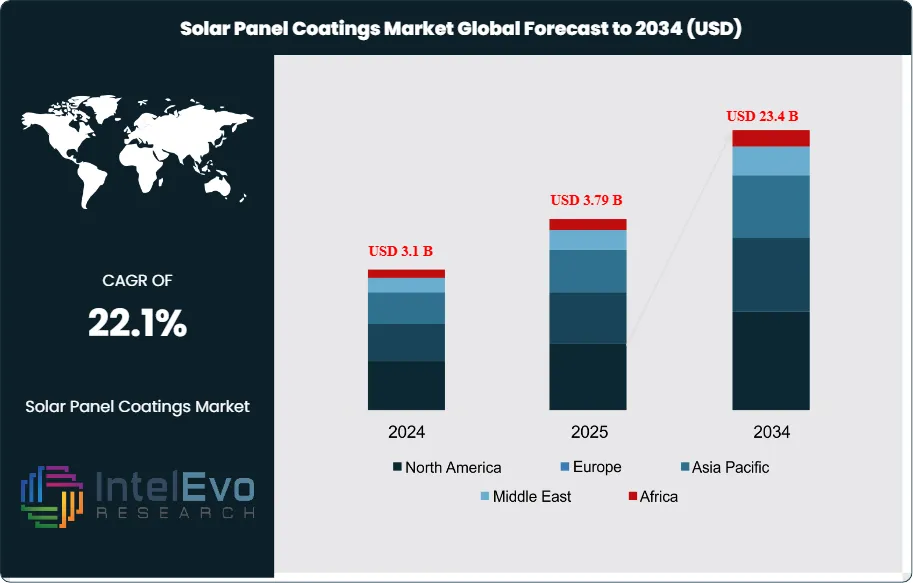
The Solar Panel Coatings Market size is projected to reach USD 23.4 billion by 2034, up from USD 3.1 billion in 2024, growing at a CAGR of 22.1% during the forecast period (2025–2034). The demand for solar panel coatings is surging due to increasing investments in solar energy infrastructure, the rising focus on efficiency enhancement, and global initiatives toward clean energy adoption. As innovations in nanotechnology and hydrophobic coatings accelerate, the market is set to witness exponential growth across residential, commercial, and utility-scale applications.
Solar panel coating is a specialized layer applied to the surface of solar panels to improve their efficiency, durability, and overall performance. These coatings serve various functions, such as reducing the reflection of sunlight, allowing more light to be absorbed for energy conversion. Anti-reflective coatings are commonly used for this purpose. Additionally, hydrophobic or self-cleaning coatings help repel water and dust, ensuring that the panel surface remains clean and operational with minimal maintenance. In dusty or polluted environments, anti-soiling coatings are particularly beneficial as they prevent dirt accumulation that could hinder energy generation. Some coatings also offer protection against ultraviolet (UV) radiation and scratches, extending the lifespan of the panels. Overall, solar panel coatings play a crucial role in enhancing the productivity and resilience of solar energy systems, especially in challenging environmental conditions.
Solar panel coatings are gaining importance as solar energy adoption increases globally. These coatings serve a crucial function: they protect the panels from environmental damage while enhancing their efficiency by improving light absorption and reducing reflection. As the demand for renewable energy rises, manufacturers are focusing more on advanced coatings that can withstand harsh weather conditions, repel dust and dirt, and even self-clean. The growth of this market is being shaped by a few key factors. First, governments around the world are promoting clean energy through subsidies and regulatory support, pushing both consumers and industries to shift to solar power. This shift fuels the need for better-performing, long-lasting panels—something coatings help achieve. Second, advancements in material science, especially in nano-technology, are leading to the development of innovative coatings that improve energy conversion efficiency and reduce maintenance costs.
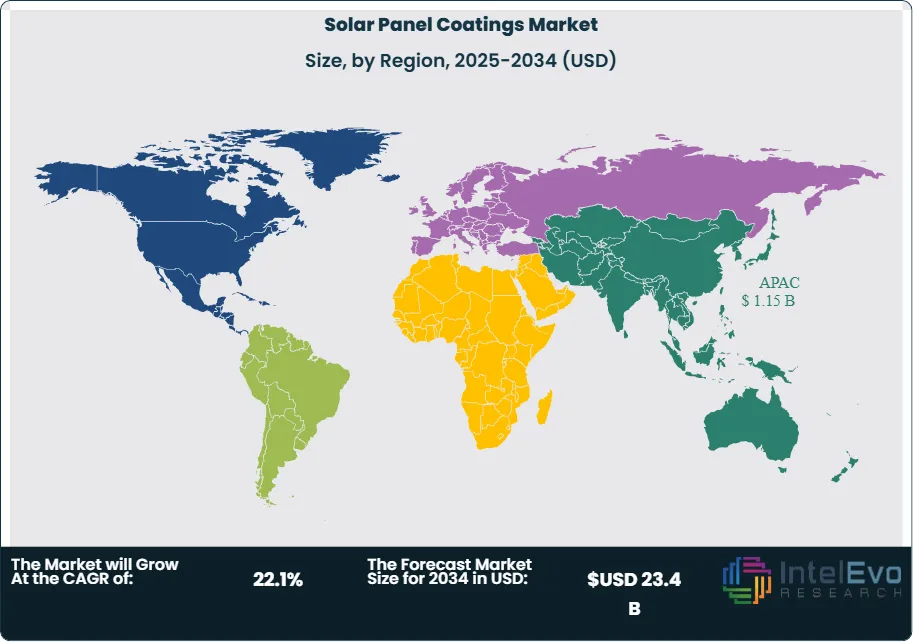
The Asia-Pacific region plays a pivotal role in the growth of the solar panel coatings market due to its rapid expansion of solar energy infrastructure. Countries like China, India, Japan, and South Korea are investing heavily in renewable energy to meet rising electricity demand and reduce carbon emissions. These investments drive the need for more efficient and durable solar panels, boosting demand for advanced coating solutions.
The COVID-19 pandemic had a temporary but notable impact on the solar panel coatings market. Disruptions in global supply chains, labor shortages, and lockdown restrictions slowed the production and installation of solar panels, which in turn affected the demand for coatings. Many infrastructure and renewable energy projects faced delays or were put on hold due to economic uncertainty and shifting government priorities. However, the long-term outlook remains positive. As countries began focusing on sustainable recovery plans, investment in renewable energy—including solar power—resumed with greater momentum.
Key Takeaways
Market Growth: The solar panel coatings market is expected to reach USD 23.4 billion by 2034, growing at a robust CAGR of 22.1%, indicating strong market expansion.
Type Segment Dominance: The type segment is dominated by anti-reflective, accounting for over 24% of the market share. Anti-reflective coatings are crucial for solar panels as they reduce light reflection and increase light absorption, boosting energy efficiency. This leads to higher energy output, particularly in areas with less direct sunlight, enhancing solar panel performance and making solar energy more viable.
Application Segment Insights: The significant market share of Photovoltaic Cells (PV) in solar panel technology highlights their key role in improving the efficiency of Anti-reflective coatings (AR coatings). These coatings minimize light reflection and enhance light absorption, increasing the overall energy generation from sunlight and boosting the performance of solar panels.
Driver: A key driver for the solar panel coatings market is the rising adoption of solar energy due to increasing demand for clean, renewable power. Coatings improve panel efficiency and durability by reducing reflection, repelling dust, and protecting against harsh weather, making solar energy more viable and cost-effective across various regions.
Restraint: One major restraint in the solar panel coatings market is the high cost of advanced coating technologies. These specialized coatings, while enhancing performance, often require complex manufacturing processes and materials, which can increase overall production costs—posing challenges for widespread adoption, especially in price-sensitive markets.
Opportunity: The solar panel coatings market offers strong growth potential due to rising solar energy adoption. Innovations like self-cleaning and anti-reflective coatings improve efficiency and reduce maintenance, creating new opportunities for manufacturers and investors.
Trend: The adoption of self-cleaning coatings is a key trend in the solar panel coatings market. These coatings minimize the need for frequent maintenance by preventing dust and debris buildup on solar panels, thereby boosting their efficiency and ensuring consistent performance. This trend is especially valuable in regions with high dust accumulation, as it helps maintain optimal energy production without the need for regular cleaning.
Regional Analysis: Asia-Pacific leads the solar panel coatings market due to rapid solar energy expansion, especially in China and India. Government support, large-scale installations, and harsh environmental conditions drive demand for advanced coatings like anti-reflective and self-cleaning types. Local innovation and strong manufacturing capabilities further fuel market growth in the region.
Type Analysis:
The type segment is divided into hydrophobic, anti-soiling, anti-reflective, self-cleaning, anti-abrasion, and others. The anti-reflective segment dominated the market, with a market share of around 24% accounting for 0.6 billion 2024. Anti-reflective coatings are highly valued in the solar panel industry due to their ability to reduce light reflection and maximize light absorption. By minimizing the amount of sunlight that is reflected off the surface of the solar panel, more sunlight is captured, improving the overall energy efficiency of the panel. This results in higher energy output and better performance, particularly in areas with less direct sunlight or variable weather conditions. As a result, anti-reflective coatings play a crucial role in enhancing the performance and economic viability of solar energy systems, making them a key technology in the growth of the renewable energy sector.
Application Analysis:
The application segment is divided into concentrated solar power (CSP), solar roof tiles, photovoltaic cells (PV), solar thermal panels, and others. The photovoltaic cells (PV) segment dominated the market, with a market share of around 28% accounting for 0.7 billion 2024. The widespread use of photovoltaic (PV) cells in solar panels for generating electricity from sunlight is significantly boosted by the application of advanced coatings. These coatings, such as anti-reflective (AR) coatings, play a vital role in improving the overall efficiency of solar panels. Without such coatings, a portion of the sunlight that hits the panel is reflected away, reducing the amount of light available for conversion into electricity. Advanced coatings, particularly AR coatings, reduce this reflection and allow more light to be absorbed by the PV cells. This leads to an increase in the amount of solar energy captured, enhancing the efficiency of the panel. As a result, the efficiency improvements provided by these coatings make solar energy generation more effective, contributing to the growing use of solar technology in various applications, from residential solar panels to large-scale solar power plants.
Material Analysis:
The material segment is divided into titanium dioxide (TiO2) coatings, ceramic coatings, silica-based coatings, and fluoropolymer coatings. The silica-based coatings segment dominated the market, with a market share of around 33% accounting for 0.9 billion 2024. Silica-based coatings are highly valued for their anti-reflective properties, which significantly boost the performance of solar panels. By reducing the amount of sunlight that is reflected off the surface of the panel, lighter is absorbed into the photovoltaic cells. This increases the amount of energy that can be converted from sunlight into electricity, thereby enhancing the overall efficiency of the solar panel. As a result, solar panels with anti-reflective coatings are more effective at harnessing solar energy, making them a preferred choice in the renewable energy sector.
End-user Analysis:
The end-user segment is divided into commercial, agriculture, residential, energy, automotive, and others. The commercial segment dominated the market, with a market share of around 21% accounting for 0.5 billion 2024. The substantial market share highlights the growing use of solar technologies in commercial buildings, where improving energy efficiency and meeting sustainability goals are top priorities. Solar panel coatings play a crucial role in these settings by boosting panel performance and longevity. They help commercial facilities lower electricity costs and reduce environmental impact, making them an attractive solution for businesses aiming to operate more sustainably.
Region Analysis:
Asia-Pacific Leads With 37% Market Share in the Solar Panel Coatings Market, The Asia-Pacific region plays a pivotal role in the growth of the solar panel coatings market due to its rapid expansion of solar energy infrastructure. China, as the world’s largest solar panel manufacturer and installer, significantly contributes to the demand for high-performance coatings that enhance energy output and reduce maintenance costs. In India, government initiatives such as the National Solar Mission support large-scale solar deployments, encouraging the adoption of coatings that can withstand dust, heat, and humidity—common environmental challenges in the region. Additionally, the region benefits from a strong manufacturing base and ongoing advancements in nanotechnology and material sciences. Local companies and research institutions are developing innovative coating materials, such as anti-reflective and self-cleaning coatings, to improve solar panel efficiency in diverse climatic conditions. In summary, Asia-Pacific’s combination of large-scale solar expansion, favorable government policies, and technological innovation makes it a key driver in the global solar panel coatings market.
By Type (Hydrophobic Coatings, Anti-Reflective Coatings, Anti-Soiling Coatings, Self-Cleaning Coatings, Anti-abrasion, Conductive Coatings, Others (UV Protection, Scratch Resistant, etc.)), By Material Type (Titanium Dioxide (TiO2), Silicon Dioxide (SiO2), Fluoropolymers, Polysiloxanes, Nanomaterials, Others), By Application (Monocrystalline Solar Panels, Polycrystalline Solar Panels, Thin Film Solar Panels, Perovskite Solar Cells, Concentrated Solar Power (CSP), Others), By End User (Residential, Commercial, Industrial, Utility-Scale Power Plants, Agriculture, Automotive, Others)
Research Methodology
Primary Research- 100 Interviews of Stakeholders
Secondary Research
Desk Research
Regional scope
North America (United States, Canada, Mexico)
Latin America (Brazil, Argentina, Columbia)
East Asia And Pacific (China, Japan, South Korea, Australia, Cambodia, Fiji, Indonesia)
Sea And South Asia (India, Singapore, Thailand, Taiwan, Malaysia)
Eastern Europe (Poland, Russia, Czech Republic, Romania)
Western Europe (Germany, U.K., France, Spain, Itlay)
Middle East & Africa (GCC Countries, Egypt, Nigeria, South Africa, Israel)
Competitive Landscape
Advanced Nanotech Lab, Diamon-Fusion International Inc., Element 119, Koninklijke DSM N.V., Optitune Oy, Sinovoltaics Group, Unelko Corporation, Arkema Group, DSM, FENZI S.p.A., NanoTech Types Pty. Ltd., PPG Industries Inc., Solar Sharc, 3M, ZSD, BASF SE, Kansai Paint Co. Ltd, Nanopool GmbH, Akzo Nobel N.V.
Customization Scope
Customization for segments, region/country-level will be provided. Moreover, additional customization can be done based on the requirements.
Pricing and Purchase Options
Avail customized purchase options to meet your exact research needs. We have three licenses to opt for: Single User License, Multi-User License (Up to 5 Users), Corporate Use License (Unlimited User and Printable PDF).
TABLE OF CONTENTS
1. EXECUTIVE SUMMARY
1.1. MARKET SNAPSHOT
1.2. KEY FINDINGS & INSIGHTS
1.3. ANALYST RECOMMENDATIONS
1.4. FUTURE OUTLOOK
2. RESEARCH METHODOLOGY
2.1. MARKET DEFINITION & SCOPE
2.2. RESEARCH OBJECTIVES: PRIMARY & SECONDARY DATA SOURCES
2.3. DATA COLLECTION SOURCES
2.3.1. COVERAGE OF 100+ PRIMARY RESEARCH/CONSULTATION CALLS WITH INDUSTRY STAKEHOLDERS
FIGURE 17 NORTH AMERICA SOLAR PANEL COATINGS CURRENT AND FUTURE TYPE ANALYSIS, 2025–2034, (USD MILLION)
FIGURE 18 NORTH AMERICA SOLAR PANEL COATINGS CURRENT AND FUTURE END USER ANALYSIS, 2025–2034, (USD MILLION)
FIGURE 19 MARKET SHARE BY COUNTRY
FIGURE 20 LATIN AMERICA SOLAR PANEL COATINGS CURRENT AND FUTURE TYPE ANALYSIS, 2025–2034, (USD MILLION)
FIGURE 21 LATIN AMERICA SOLAR PANEL COATINGS CURRENT AND FUTURE END USER ANALYSIS, 2025–2034, (USD MILLION)
FIGURE 22 MARKET SHARE BY COUNTRY
FIGURE 23 EASTERN EUROPE SOLAR PANEL COATINGS CURRENT AND FUTURE TYPE ANALYSIS, 2025–2034, (USD MILLION)
FIGURE 24 EASTERN EUROPE SOLAR PANEL COATINGS CURRENT AND FUTURE END USER ANALYSIS, 2025–2034, (USD MILLION)
FIGURE 25 MARKET SHARE BY COUNTRY
FIGURE 26 WESTERN EUROPE SOLAR PANEL COATINGS CURRENT AND FUTURE TYPE ANALYSIS, 2025–2034, (USD MILLION)
FIGURE 27 WESTERN EUROPE SOLAR PANEL COATINGS CURRENT AND FUTURE END USER ANALYSIS, 2025–2034, (USD MILLION)
FIGURE 28 MARKET SHARE BY COUNTRY
FIGURE 29 EAST ASIA AND PACIFIC SOLAR PANEL COATINGS CURRENT AND FUTURE TYPE ANALYSIS, 2025–2034, (USD MILLION)
FIGURE 30 EAST ASIA AND PACIFIC SOLAR PANEL COATINGS CURRENT AND FUTURE END USER ANALYSIS, 2025–2034, (USD MILLION)
FIGURE 31 MARKET SHARE BY COUNTRY
FIGURE 32 SEA AND SOUTH ASIA SOLAR PANEL COATINGS CURRENT AND FUTURE TYPE ANALYSIS, 2025–2034, (USD MILLION)
FIGURE 33 SEA AND SOUTH ASIA SOLAR PANEL COATINGS CURRENT AND FUTURE END USER ANALYSIS, 2025–2034, (USD MILLION)
FIGURE 34 MARKET SHARE BY COUNTRY
FIGURE 35 MIDDLE EAST AND AFRICA SOLAR PANEL COATINGS CURRENT AND FUTURE TYPE ANALYSIS, 2025–2034, (USD MILLION)
FIGURE 36 MIDDLE EAST AND AFRICA SOLAR PANEL COATINGS CURRENT AND FUTURE END USER ANALYSIS, 2025–2034, (USD MILLION)
FIGURE 37 NORTH AMERICA SOLAR PANEL COATINGS CURRENT AND FUTURE MARKET VOLUME SHARE REGIONAL ANALYSIS, 2025–2034, (USD MILLION)
FIGURE 38 U.S. SOLAR PANEL COATINGS CURRENT AND FUTURE TYPE ANALYSIS, 2025–2034, (USD MILLION)
FIGURE 39 U.S. SOLAR PANEL COATINGS CURRENT AND FUTURE END USER ANALYSIS, 2025–2034, (USD MILLION)
FIGURE 40 CANADA SOLAR PANEL COATINGS CURRENT AND FUTURE TYPE ANALYSIS, 2025–2034, (USD MILLION)
FIGURE 41 CANADA SOLAR PANEL COATINGS CURRENT AND FUTURE END USER ANALYSIS, 2025–2034, (USD MILLION)
FIGURE 42 LATIN AMERICA SOLAR PANEL COATINGS CURRENT AND FUTURE MARKET VOLUME SHARE REGIONAL ANALYSIS, 2025–2034, (USD MILLION)
FIGURE 43 MEXICO SOLAR PANEL COATINGS CURRENT AND FUTURE TYPE ANALYSIS, 2025–2034, (USD MILLION)
FIGURE 44 MEXICO SOLAR PANEL COATINGS CURRENT AND FUTURE END USER ANALYSIS, 2025–2034, (USD MILLION)
FIGURE 45 BRAZIL SOLAR PANEL COATINGS CURRENT AND FUTURE TYPE ANALYSIS, 2025–2034, (USD MILLION)
FIGURE 46 BRAZIL SOLAR PANEL COATINGS CURRENT AND FUTURE END USER ANALYSIS, 2025–2034, (USD MILLION)
FIGURE 47 ARGENTINA SOLAR PANEL COATINGS CURRENT AND FUTURE TYPE ANALYSIS, 2025–2034, (USD MILLION)
FIGURE 48 ARGENTINA SOLAR PANEL COATINGS CURRENT AND FUTURE END USER ANALYSIS, 2025–2034, (USD MILLION)
FIGURE 49 COLUMBIA SOLAR PANEL COATINGS CURRENT AND FUTURE TYPE ANALYSIS, 2025–2034, (USD MILLION)
FIGURE 50 COLUMBIA SOLAR PANEL COATINGS CURRENT AND FUTURE END USER ANALYSIS, 2025–2034, (USD MILLION)
FIGURE 51 REST OF LATIN AMERICA SOLAR PANEL COATINGS CURRENT AND FUTURE TYPE ANALYSIS, 2025–2034, (USD MILLION)
FIGURE 52 REST OF LATIN AMERICA SOLAR PANEL COATINGS CURRENT AND FUTURE END USER ANALYSIS, 2025–2034, (USD MILLION)
FIGURE 53 EASTERN EUROPE SOLAR PANEL COATINGS CURRENT AND FUTURE MARKET VOLUME SHARE REGIONAL ANALYSIS, 2025–2034, (USD MILLION)
FIGURE 54 POLAND SOLAR PANEL COATINGS CURRENT AND FUTURE TYPE ANALYSIS, 2025–2034, (USD MILLION)
FIGURE 55 POLAND SOLAR PANEL COATINGS CURRENT AND FUTURE END USER ANALYSIS, 2025–2034, (USD MILLION)
FIGURE 56 RUSSIA SOLAR PANEL COATINGS CURRENT AND FUTURE TYPE ANALYSIS, 2025–2034, (USD MILLION)
FIGURE 57 RUSSIA SOLAR PANEL COATINGS CURRENT AND FUTURE END USER ANALYSIS, 2025–2034, (USD MILLION)
FIGURE 58 CZECH REPUBLIC SOLAR PANEL COATINGS CURRENT AND FUTURE TYPE ANALYSIS, 2025–2034, (USD MILLION)
FIGURE 59 CZECH REPUBLIC SOLAR PANEL COATINGS CURRENT AND FUTURE END USER ANALYSIS, 2025–2034, (USD MILLION)
FIGURE 60 ROMANIA SOLAR PANEL COATINGS CURRENT AND FUTURE TYPE ANALYSIS, 2025–2034, (USD MILLION)
FIGURE 61 ROMANIA SOLAR PANEL COATINGS CURRENT AND FUTURE END USER ANALYSIS, 2025–2034, (USD MILLION)
FIGURE 62 REST OF EASTERN EUROPE SOLAR PANEL COATINGS CURRENT AND FUTURE TYPE ANALYSIS, 2025–2034, (USD MILLION)
FIGURE 63 REST OF EASTERN EUROPE SOLAR PANEL COATINGS CURRENT AND FUTURE END USER ANALYSIS, 2025–2034, (USD MILLION)
FIGURE 64 WESTERN EUROPE SOLAR PANEL COATINGS CURRENT AND FUTURE MARKET VOLUME SHARE REGIONAL ANALYSIS, 2025–2034, (USD MILLION)
FIGURE 65 GERMANY SOLAR PANEL COATINGS CURRENT AND FUTURE TYPE ANALYSIS, 2025–2034, (USD MILLION)
FIGURE 66 GERMANY SOLAR PANEL COATINGS CURRENT AND FUTURE END USER ANALYSIS, 2025–2034, (USD MILLION)
FIGURE 67 FRANCE SOLAR PANEL COATINGS CURRENT AND FUTURE TYPE ANALYSIS, 2025–2034, (USD MILLION)
FIGURE 68 FRANCE SOLAR PANEL COATINGS CURRENT AND FUTURE END USER ANALYSIS, 2025–2034, (USD MILLION)
FIGURE 69 UK SOLAR PANEL COATINGS CURRENT AND FUTURE TYPE ANALYSIS, 2025–2034, (USD MILLION)
FIGURE 70 UK SOLAR PANEL COATINGS CURRENT AND FUTURE END USER ANALYSIS, 2025–2034, (USD MILLION)
FIGURE 71 SPAIN SOLAR PANEL COATINGS CURRENT AND FUTURE TYPE ANALYSIS, 2025–2034, (USD MILLION)
FIGURE 72 SPAIN SOLAR PANEL COATINGS CURRENT AND FUTURE END USER ANALYSIS, 2025–2034, (USD MILLION)
FIGURE 73 ITALY SOLAR PANEL COATINGS CURRENT AND FUTURE TYPE ANALYSIS, 2025–2034, (USD MILLION)
FIGURE 74 ITALY SOLAR PANEL COATINGS CURRENT AND FUTURE END USER ANALYSIS, 2025–2034, (USD MILLION)
FIGURE 75 REST OF WESTERN EUROPE SOLAR PANEL COATINGS CURRENT AND FUTURE TYPE ANALYSIS, 2025–2034, (USD MILLION)
FIGURE 76 REST OF WESTERN EUROPE SOLAR PANEL COATINGS CURRENT AND FUTURE END USER ANALYSIS, 2025–2034, (USD MILLION)
FIGURE 77 EAST ASIA AND PACIFIC SOLAR PANEL COATINGS CURRENT AND FUTURE MARKET VOLUME SHARE REGIONAL ANALYSIS, 2025–2034, (USD MILLION)
FIGURE 78 CHINA SOLAR PANEL COATINGS CURRENT AND FUTURE TYPE ANALYSIS, 2025–2034, (USD MILLION)
FIGURE 79 CHINA SOLAR PANEL COATINGS CURRENT AND FUTURE END USER ANALYSIS, 2025–2034, (USD MILLION)
FIGURE 80 JAPAN SOLAR PANEL COATINGS CURRENT AND FUTURE TYPE ANALYSIS, 2025–2034, (USD MILLION)
FIGURE 81 JAPAN SOLAR PANEL COATINGS CURRENT AND FUTURE END USER ANALYSIS, 2025–2034, (USD MILLION)
FIGURE 82 AUSTRALIA SOLAR PANEL COATINGS CURRENT AND FUTURE TYPE ANALYSIS, 2025–2034, (USD MILLION)
FIGURE 83 AUSTRALIA SOLAR PANEL COATINGS CURRENT AND FUTURE END USER ANALYSIS, 2025–2034, (USD MILLION)
FIGURE 84 CAMBODIA SOLAR PANEL COATINGS CURRENT AND FUTURE TYPE ANALYSIS, 2025–2034, (USD MILLION)
FIGURE 85 CAMBODIA SOLAR PANEL COATINGS CURRENT AND FUTURE END USER ANALYSIS, 2025–2034, (USD MILLION)
FIGURE 86 FIJI SOLAR PANEL COATINGS CURRENT AND FUTURE TYPE ANALYSIS, 2025–2034, (USD MILLION)
FIGURE 87 FIJI SOLAR PANEL COATINGS CURRENT AND FUTURE END USER ANALYSIS, 2025–2034, (USD MILLION)
FIGURE 88 INDONESIA SOLAR PANEL COATINGS CURRENT AND FUTURE TYPE ANALYSIS, 2025–2034, (USD MILLION)
FIGURE 89 INDONESIA SOLAR PANEL COATINGS CURRENT AND FUTURE END USER ANALYSIS, 2025–2034, (USD MILLION)
FIGURE 90 SOUTH KOREA SOLAR PANEL COATINGS CURRENT AND FUTURE TYPE ANALYSIS, 2025–2034, (USD MILLION)
FIGURE 91 SOUTH KOREA SOLAR PANEL COATINGS CURRENT AND FUTURE END USER ANALYSIS, 2025–2034, (USD MILLION)
FIGURE 92 REST OF EAST ASIA AND PACIFIC SOLAR PANEL COATINGS CURRENT AND FUTURE TYPE ANALYSIS, 2025–2034, (USD MILLION)
FIGURE 93 REST OF EAST ASIA AND PACIFIC SOLAR PANEL COATINGS CURRENT AND FUTURE END USER ANALYSIS, 2025–2034, (USD MILLION)
FIGURE 94 SEA AND SOUTH ASIA SOLAR PANEL COATINGS CURRENT AND FUTURE MARKET VOLUME SHARE REGIONAL ANALYSIS, 2025–2034, (USD MILLION)
FIGURE 95 BANGLADESH SOLAR PANEL COATINGS CURRENT AND FUTURE TYPE ANALYSIS, 2025–2034, (USD MILLION)
FIGURE 96 BANGLADESH SOLAR PANEL COATINGS CURRENT AND FUTURE END USER ANALYSIS, 2025–2034, (USD MILLION)
FIGURE 97 NEW ZEALAND SOLAR PANEL COATINGS CURRENT AND FUTURE TYPE ANALYSIS, 2025–2034, (USD MILLION)
FIGURE 98 NEW ZEALAND SOLAR PANEL COATINGS CURRENT AND FUTURE END USER ANALYSIS, 2025–2034, (USD MILLION)
FIGURE 99 INDIA SOLAR PANEL COATINGS CURRENT AND FUTURE TYPE ANALYSIS, 2025–2034, (USD MILLION)
FIGURE 100 INDIA SOLAR PANEL COATINGS CURRENT AND FUTURE END USER ANALYSIS, 2025–2034, (USD MILLION)
FIGURE 101 SINGAPORE SOLAR PANEL COATINGS CURRENT AND FUTURE TYPE ANALYSIS, 2025–2034, (USD MILLION)
FIGURE 102 SINGAPORE SOLAR PANEL COATINGS CURRENT AND FUTURE END USER ANALYSIS, 2025–2034, (USD MILLION)
FIGURE 103 THAILAND SOLAR PANEL COATINGS CURRENT AND FUTURE TYPE ANALYSIS, 2025–2034, (USD MILLION)
FIGURE 104 THAILAND SOLAR PANEL COATINGS CURRENT AND FUTURE END USER ANALYSIS, 2025–2034, (USD MILLION)
FIGURE 105 TAIWAN SOLAR PANEL COATINGS CURRENT AND FUTURE TYPE ANALYSIS, 2025–2034, (USD MILLION)
FIGURE 106 TAIWAN SOLAR PANEL COATINGS CURRENT AND FUTURE END USER ANALYSIS, 2025–2034, (USD MILLION)
FIGURE 107 MALAYSIA SOLAR PANEL COATINGS CURRENT AND FUTURE TYPE ANALYSIS, 2025–2034, (USD MILLION)
FIGURE 108 MALAYSIA SOLAR PANEL COATINGS CURRENT AND FUTURE END USER ANALYSIS, 2025–2034, (USD MILLION)
FIGURE 109 REST OF SEA AND SOUTH ASIA SOLAR PANEL COATINGS CURRENT AND FUTURE TYPE ANALYSIS, 2025–2034, (USD MILLION)
FIGURE 110 REST OF SEA AND SOUTH ASIA SOLAR PANEL COATINGS CURRENT AND FUTURE END USER ANALYSIS, 2025–2034, (USD MILLION)
FIGURE 111 MIDDLE EAST AND AFRICA SOLAR PANEL COATINGS CURRENT AND FUTURE MARKET VOLUME SHARE REGIONAL ANALYSIS, 2025–2034, (USD MILLION)
FIGURE 112 GCC COUNTRIES SOLAR PANEL COATINGS CURRENT AND FUTURE TYPE ANALYSIS, 2025–2034, (USD MILLION)
FIGURE 113 GCC COUNTRIES SOLAR PANEL COATINGS CURRENT AND FUTURE END USER ANALYSIS, 2025–2034, (USD MILLION)
FIGURE 114 SAUDI ARABIA SOLAR PANEL COATINGS CURRENT AND FUTURE TYPE ANALYSIS, 2025–2034, (USD MILLION)
FIGURE 115 SAUDI ARABIA SOLAR PANEL COATINGS CURRENT AND FUTURE END USER ANALYSIS, 2025–2034, (USD MILLION)
FIGURE 116 UAE SOLAR PANEL COATINGS CURRENT AND FUTURE TYPE ANALYSIS, 2025–2034, (USD MILLION)
FIGURE 117 UAE SOLAR PANEL COATINGS CURRENT AND FUTURE END USER ANALYSIS, 2025–2034, (USD MILLION)
FIGURE 118 BAHRAIN SOLAR PANEL COATINGS CURRENT AND FUTURE TYPE ANALYSIS, 2025–2034, (USD MILLION)
FIGURE 119 BAHRAIN SOLAR PANEL COATINGS CURRENT AND FUTURE END USER ANALYSIS, 2025–2034, (USD MILLION)
FIGURE 120 KUWAIT SOLAR PANEL COATINGS CURRENT AND FUTURE TYPE ANALYSIS, 2025–2034, (USD MILLION)
FIGURE 121 KUWAIT SOLAR PANEL COATINGS CURRENT AND FUTURE END USER ANALYSIS, 2025–2034, (USD MILLION)
FIGURE 122 OMAN SOLAR PANEL COATINGS CURRENT AND FUTURE TYPE ANALYSIS, 2025–2034, (USD MILLION)
FIGURE 123 OMAN SOLAR PANEL COATINGS CURRENT AND FUTURE END USER ANALYSIS, 2025–2034, (USD MILLION)
FIGURE 124 QATAR SOLAR PANEL COATINGS CURRENT AND FUTURE TYPE ANALYSIS, 2025–2034, (USD MILLION)
FIGURE 125 QATAR SOLAR PANEL COATINGS CURRENT AND FUTURE END USER ANALYSIS, 2025–2034, (USD MILLION)
FIGURE 126 EGYPT SOLAR PANEL COATINGS CURRENT AND FUTURE TYPE ANALYSIS, 2025–2034, (USD MILLION)
FIGURE 127 EGYPT SOLAR PANEL COATINGS CURRENT AND FUTURE END USER ANALYSIS, 2025–2034, (USD MILLION)
FIGURE 128 NIGERIA SOLAR PANEL COATINGS CURRENT AND FUTURE TYPE ANALYSIS, 2025–2034, (USD MILLION)
FIGURE 129 NIGERIA SOLAR PANEL COATINGS CURRENT AND FUTURE END USER ANALYSIS, 2025–2034, (USD MILLION)
FIGURE 130 SOUTH AFRICA SOLAR PANEL COATINGS CURRENT AND FUTURE TYPE ANALYSIS, 2025–2034, (USD MILLION)
FIGURE 131 SOUTH AFRICA SOLAR PANEL COATINGS CURRENT AND FUTURE END USER ANALYSIS, 2025–2034, (USD MILLION)
FIGURE 132 ISRAEL SOLAR PANEL COATINGS CURRENT AND FUTURE TYPE ANALYSIS, 2025–2034, (USD MILLION)
FIGURE 133 ISRAEL SOLAR PANEL COATINGS CURRENT AND FUTURE END USER ANALYSIS, 2025–2034, (USD MILLION)
FIGURE 134 REST OF MEA SOLAR PANEL COATINGS CURRENT AND FUTURE TYPE ANALYSIS, 2025–2034, (USD MILLION)
FIGURE 135 REST OF MEA SOLAR PANEL COATINGS CURRENT AND FUTURE END USER ANALYSIS, 2025–2034, (USD MILLION)
FIGURE 136 U. S. MARKET SHARE ANALYSIS BY TYPE (2024)
FIGURE 137 U. S. MARKET SHARE ANALYSIS BY END USER (2024)
FIGURE 138 CANADA MARKET SHARE ANALYSIS BY TYPE (2024)
FIGURE 139 CANADA MARKET SHARE ANALYSIS BY END USER (2024)
FIGURE 140 MEXICO MARKET SHARE ANALYSIS BY TYPE (2024)
FIGURE 141 MEXICO MARKET SHARE ANALYSIS BY END USER (2024)
FIGURE 142 CHINA MARKET SHARE ANALYSIS BY TYPE (2024)
FIGURE 143 CHINA MARKET SHARE ANALYSIS BY END USER (2024)
FIGURE 144 JAPAN MARKET SHARE ANALYSIS BY TYPE (2024)
FIGURE 145 JAPAN MARKET SHARE ANALYSIS BY END USER (2024)
FIGURE 146 INDIA MARKET SHARE ANALYSIS BY TYPE (2024)
FIGURE 147 INDIA MARKET SHARE ANALYSIS BY END USER (2024)
FIGURE 148 SOUTH KOREA MARKET SHARE ANALYSIS BY TYPE (2024)
FIGURE 149 SOUTH KOREA MARKET SHARE ANALYSIS BY END USER (2024)
FIGURE 150 SAUDI ARABIA MARKET SHARE ANALYSIS BY TYPE (2024)
FIGURE 151 SAUDI ARABIA MARKET SHARE ANALYSIS BY END USER (2024)
FIGURE 152 UAE MARKET SHARE ANALYSIS BY TYPE (2024)
FIGURE 153 UAE MARKET SHARE ANALYSIS BY END USER (2024)
FIGURE 154 EGYPT MARKET SHARE ANALYSIS BY TYPE (2024)
FIGURE 155 EGYPT MARKET SHARE ANALYSIS BY END USER (2024)
FIGURE 156 NIGERIA MARKET SHARE ANALYSIS BY TYPE (2024)
FIGURE 157 NIGERIA MARKET SHARE ANALYSIS BY END USER (2024)
FIGURE 158 SOUTH AFRICA MARKET SHARE ANALYSIS BY TYPE (2024)
FIGURE 159 SOUTH AFRICA MARKET SHARE ANALYSIS BY END USER (2024)
FIGURE 160 GERMANY MARKET SHARE ANALYSIS BY TYPE (2024)
FIGURE 161 GERMANY MARKET SHARE ANALYSIS BY END USER (2024)
FIGURE 162 FRANCE MARKET SHARE ANALYSIS BY TYPE (2024)
FIGURE 163 FRANCE MARKET SHARE ANALYSIS BY END USER (2024)
FIGURE 164 UK MARKET SHARE ANALYSIS BY TYPE (2024)
FIGURE 165 UK MARKET SHARE ANALYSIS BY END USER (2024)
FIGURE 166 SPAIN MARKET SHARE ANALYSIS BY TYPE (2024)
FIGURE 167 SPAIN MARKET SHARE ANALYSIS BY END USER (2024)
FIGURE 168 ITALY MARKET SHARE ANALYSIS BY TYPE (2024)
FIGURE 169 ITALY MARKET SHARE ANALYSIS BY END USER (2024)
FIGURE 170 BRAZIL MARKET SHARE ANALYSIS BY TYPE (2024)
FIGURE 171 BRAZIL MARKET SHARE ANALYSIS BY END USER (2024)
FIGURE 172 ARGENTINA MARKET SHARE ANALYSIS BY TYPE (2024)
FIGURE 173 ARGENTINA MARKET SHARE ANALYSIS BY END USER (2024)
FIGURE 174 COLUMBIA MARKET SHARE ANALYSIS BY TYPE (2024)
FIGURE 175 COLUMBIA MARKET SHARE ANALYSIS BY END USER (2024)
FIGURE 176 GLOBAL SOLAR PANEL COATINGS CURRENT AND FUTURE MARKET KEY COUNTRY LEVEL ANALYSIS, 2024–2034, (USD MILLION)
FIGURE 177 FINANCIAL OVERVIEW:
Key Players Analysis:
Fenzi SpA: Fenzi SpA, based in Italy, focuses on coatings for solar thermal applications through its Fenzi Solar Coatings division. Their Duralux Solar Coatings are specifically designed for solar mirrors, offering exceptional resistance against environmental factors like sand abrasion, UV exposure, saline mist, and thermal cycling. These coatings ensure that solar mirrors maintain optimal performance in harsh conditions, which is critical for maximizing the efficiency of solar thermal systems. Fenzi’s commitment to innovation is reflected in its development of cutting-edge technologies aimed at enhancing solar energy applications.
Arkema: Arkema, a global leader in specialty chemicals, offers advanced solutions for photovoltaic (PV) applications. They have developed Kynar PVDF films, which are used to protect the backside of solar panels. These films guard against humidity and UV degradation, significantly extending the life of solar panels beyond 20 years. In addition, Arkema’s Luperox Solar product helps accelerate the crosslinking of EVA (ethylene-vinyl acetate) encapsulants, improving the manufacturing process and durability of solar panels. The company also provides Apolhya Solar, a nanostructured thermoplastic polymer used for flexible, thin-film PV modules that enhances encapsulation and overall performance. Arkema’s sustainable practices are evident in its recent achievements, such as obtaining ISCC PLUS certifications for its coatings, which contribute to reducing carbon footprints in the solar industry.
3M: 3M is a significant player in the solar panel coatings market, known for its innovative solutions that enhance the efficiency and durability of solar panels. The company's advancements in coating technologies, particularly in anti-reflective coatings and protective films, have played a crucial role in improving the performance of solar panels. 3M's anti-reflective coatings, for example, reduce the amount of light reflected off solar panels, allowing for greater light absorption and thereby boosting energy production. These coatings are essential in maximizing the efficiency of solar panels, especially in regions with less than optimal sunlight or in residential and commercial installations where space and energy output are critical.
Market Key Players
Advanced Nanotech Lab
Diamon-Fusion International Inc.
Element 119
Koninklijke DSM N.V.
Optitune Oy
Sinovoltaics Group
Unelko Corporation
Arkema Group
DSM
FENZI S.p.A.
NanoTech Types Pty. Ltd.
PPG Industries Inc.
Solar Sharc
3M
ZSD
BASF SE
Kansai Paint Co., Ltd
Nanopool GmbH
Akzo Nobel N.V.
Driver:
Technological advancements in coating applications
Technological advancements in coating applications are a key driver of the solar panel coatings market. Innovations like anti-reflective, hydrophobic, self-cleaning, and anti-soiling coatings are enhancing solar panel performance and longevity. Anti-reflective coatings reduce light reflection, allowing more light to be absorbed, while hydrophobic and self-cleaning coatings help maintain cleanliness and efficiency, even in harsh weather conditions. These advancements are crucial for increasing solar panel efficiency and lifespan, and are supported by significant investments in renewable energy technologies.
Restrain:
High Cost and technological complexity
The high cost and technological complexity of advanced solar panel coatings pose significant challenges to the market. Coatings like anti-reflective, hydrophobic, and self-cleaning types require specialized materials and sophisticated manufacturing processes, which increase production costs. These higher costs are often transferred to consumers, making coated solar panels more expensive than standard options. Additionally, the use of advanced technologies such as nanotechnology and specialized chemicals can create scalability issues, as maintaining precise manufacturing standards at larger scales becomes challenging. The high cost of advanced solar panel coatings not only makes them less affordable for end consumers but also hinders the adoption of solar technologies in less developed regions where budget constraints are more significant. Although enhanced solar panels offer long-term savings and environmental benefits, the substantial upfront investment and technological complexity pose significant barriers to their widespread market penetration. This cost challenge remains a key obstacle in driving global adoption of advanced solar technologies.
Opportunities:
Increasing demand for Anti-reflective solar panel coatings
Anti-reflective solar panel coatings are a key growth driver in the solar panel coatings market. These coatings enhance the energy efficiency of solar panels by reducing the reflectivity of the glass, allowing more light to be absorbed and improving the overall performance of solar power systems. This technology is crucial for maximizing the energy output of solar installations, making it increasingly popular in both residential and commercial sectors where energy efficiency is a priority.
Government initiatives and regulatory support
Government incentives and regulatory support for renewable energy are key factors driving the adoption of advanced solar panel coatings, particularly anti-reflective coatings. In regions like North America and Europe, governmental policies aimed at reducing carbon footprints and promoting renewable energy sources are increasingly encouraging the use of solar energy solutions. These policies not only enhance the demand for solar panels but also boost the need for coatings that improve the durability and performance of these panels. The expanding market for anti-reflective solar panel coatings represents a significant growth opportunity, supported by continuous technological advancements, rising environmental awareness, and favorable government policies. As these factors collectively drive the market, the ongoing development of coatings that enhance solar panel efficiency aligns with global sustainability goals, making this area a key focus for investment in the renewable energy sector.
Trends:
Rise of Self-Cleaning Solar Panel Coatings
A significant trend in the solar panel coatings market is the growing adoption of self-cleaning coatings. These coatings are designed to reduce maintenance needs by preventing the buildup of dust and debris, which can significantly hinder solar panel efficiency. The growth of the self-cleaning coatings segment is supported by technological advancements that make these coatings highly effective in minimizing dirt accumulation. This is especially important in arid and semi-arid regions, where dust accumulation is rapid and can drastically reduce a solar panel's output if not regularly cleaned. By improving light absorption efficiency and reducing the frequency of manual cleaning, self-cleaning coatings help extend the lifespan and optimize the performance of solar panels, making them more cost-effective and reliable over time.
Recent Development:
In May 2023, 3M made significant contributions to the solar panel coatings market, driven by the increasing global adoption of solar energy in both developed and emerging markets. The company has focused on innovations that address the demand for more sustainable and efficient energy solutions. 3M’s advancements in solar panel coatings, such as anti-reflective and self-cleaning coatings, enhance the performance and longevity of solar panels, making solar energy more viable and cost-effective. These contributions align with the broader trend of improving energy efficiency and supporting renewable energy adoption worldwide.
In June 2023, Advanced Nanotech Lab, based in Mumbai, made notable strides in the solar panel coatings market by developing innovative nanotechnology solutions designed to improve solar panel efficiency. One of their key innovations is HYDRASOL, a hydrophobic nano-coating that gives solar panels self-cleaning properties. This coating reduces the accumulation of dust, dirt, and debris on solar panels, which can significantly hinder their ability to absorb sunlight and generate energy.
In May 2022, Ant Lab, a leading technology company, secured a multi-million contract to produce 9H and 10H ceramic coatings, along with hybrid variants, for one of Asia's top automakers. These high-performance coatings are designed to provide superior protection for vehicles, offering enhanced durability, scratch resistance, and long-lasting shine. The 9H and 10H ratings refer to the hardness level of the coatings, with 10H offering the highest level of protection, making it ideal for automotive applications where long-term performance is critical.
