
Global Super Abrasive Market Size, Share, Analysis Report By Type (Cubic Boron Nitride, Diamond), Bonding Agent (Resin Bond, Electroplated, Metal Bond, Vitrified), Application (Grinding, Polishing, Cutting, Drilling), End-Use (Automotive, Aerospace, Oil and Gas, Electrical and Electronics, Medical), Region and Key Players - Industry Segment Overview, Market Dynamics, Competitive Strategies, Trends and Forecast 2025-2034
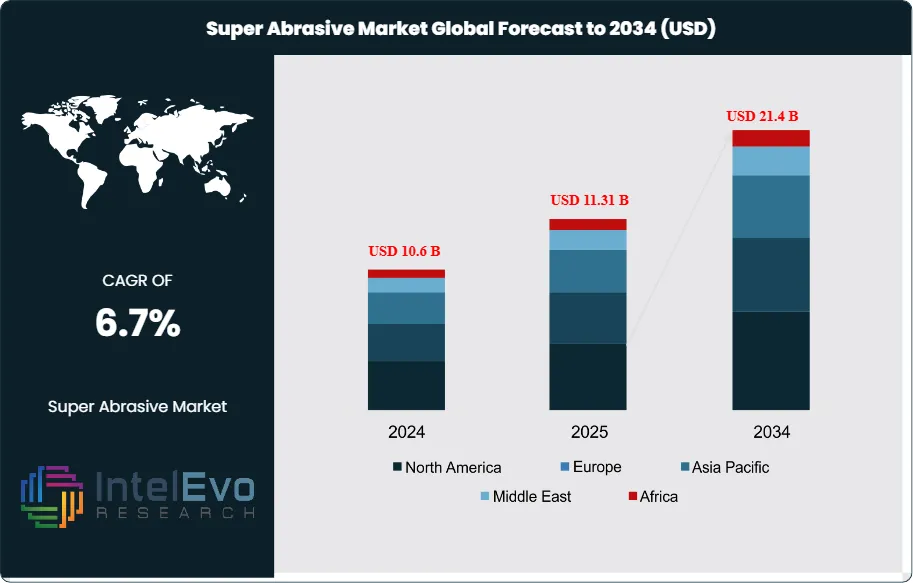
The Super Abrasive Market size is expected to be worth around USD 21.4 billion by 2034, up from USD 10.6 billion in 2024, growing at a CAGR of 6.7% during the forecast period from 2025 to 2034. The market is witnessing strong momentum, driven by the increasing demand for precision machining and ultra-hard materials across automotive, aerospace, electronics, and medical sectors. With the global shift toward automation, smart manufacturing, and electric vehicle production, the adoption of super abrasives such as diamond and cubic boron nitride (CBN) tools is accelerating rapidly. As industries focus on enhancing performance, durability, and sustainability, the Super Abrasive Market is emerging as a key enabler of next-generation manufacturing technologies worldwide.
Super abrasives are specialized grinding materials known for their exceptional hardness and durability, primarily comprising diamond and cubic boron nitride (CBN). These materials are integral to precision machining processes across various industries, including automotive, aerospace, electronics, and medical devices. Their superior performance in cutting, grinding, and polishing applications makes them indispensable in modern manufacturing.
The super abrasives market is poised for steady growth, driven by technological advancements, increasing demand for precision tools, and expanding applications across various industries. Emerging trends such as the adoption of electric vehicles, advancements in aerospace engineering, and the miniaturization of electronic components will further propel market growth. However, addressing challenges related to high production costs and environmental regulations will be crucial for sustained development.
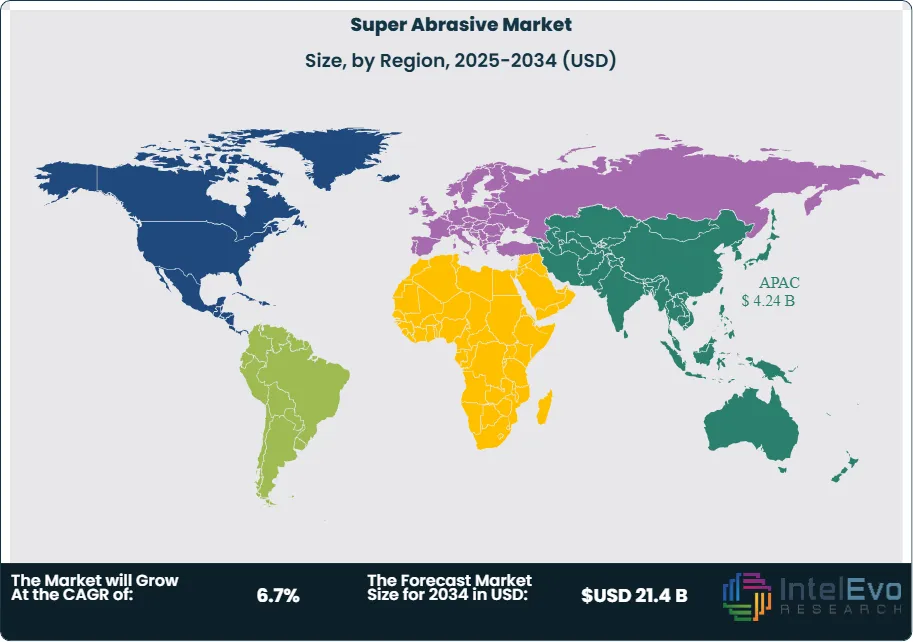
The Asia-Pacific region dominates the super abrasives market, accounting for approximately 45% of the global revenue share. This is attributed to rapid industrialization, growing automotive and electronics sectors, and significant investments in manufacturing infrastructure in countries like China and India. North America holds the second-largest market share, driven by advanced technological capabilities and a strong presence of key industries. Europe follows, with a focus on research and development and stringent quality standards in manufacturing processes.
The COVID-19 pandemic had a significant impact on the super abrasives market. Disruptions in the global supply chain, temporary shutdowns of manufacturing facilities, and reduced demand from end-user industries led to a decline in market growth in 2020. However, as economies gradually reopened and industrial activities resumed, the market began to recover, reaching pre-pandemic levels by late 2021. The pandemic also highlighted the importance of automation and digitalization in manufacturing, leading to increased investments in advanced machining technologies that utilize super abrasives.
Key Takeaways:
Strong Market Expansion: The Super Abrasive Market is projected to grow from USD 10.6 billion in 2024 to approximately USD 21.4 billion by 2034, exhibiting a CAGR of 6.7% during 2025–2034. This growth reflects rising demand for ultra-precision machining and advanced material processing technologies.
Dominance of Diamond-Based Super Abrasives: Diamond abrasives hold the largest market share due to their superior hardness, wear resistance, and extensive use in cutting and grinding applications across automotive, aerospace, and electronics sectors.
Type Dominance: Diamond abrasives dominate the market due to their superior hardness and broad industrial applications, while CBN is gaining traction in metalworking and automotive sectors.
Bonding Agent Dominance: Resin bond currently leads due to its versatility and cost-effectiveness, while vitrified bonds are poised for significant future growth owing to their strength and thermal resistance.
Application Dominance: Grinding dominates the market due to its extensive use in manufacturing and precision engineering, while cutting and drilling applications are expected to witness strong growth in advanced material processing and construction sectors.
End-Use Dominance: Automotive sector leads the market due to high-volume precision manufacturing, while the medical and electronics sectors are projected to grow significantly owing to rising demand for miniaturization and advanced materials.
Driver: The super abrasive market is primarily driven by the growing demand from the automotive, electronics, and aerospace industries, along with increasing adoption in precision machining and high-performance tools. Technological advancements have also contributed to the widespread use of super abrasives for complex and high-tolerance applications.
Restraint: High initial investment costs and complex manufacturing processes pose major challenges for widespread adoption of super abrasives. Additionally, limited awareness in emerging markets and reliance on skilled labor restrict market expansion.
Opportunity: Expansion into emerging markets, particularly in Asia-Pacific and Latin America, offers vast growth potential. Furthermore, the increasing emphasis on sustainability and eco-friendly manufacturing processes is creating demand for energy-efficient and durable abrasive solutions.
Trend: The market is witnessing a trend toward customization and application-specific abrasive tools, along with the adoption of AI and IoT in machining processes. Furthermore, nanotechnology is becoming a game-changer in enhancing tool performance and wear resistance.
Regional Analysis: Asia-Pacific leads the market, driven by robust manufacturing sectors in China, Japan, India, and South Korea.
Type Analysis:
Diamond Leads With more than 60% Market Share in Super Abrasive Market, Diamond-based abrasives are the most widely used, owing to their exceptional hardness, thermal conductivity, and versatility in machining non-ferrous materials like ceramics, glass, and composites. They are extensively utilized in industries requiring ultra-precise grinding and polishing, making them the dominant type in the market.
CBN (Cubic Boron Nitride), though slightly less hard than diamond, excels in cutting ferrous materials, where diamond is chemically reactive and degrades quickly. This makes CBN ideal for high-speed steel and hardened alloy machining in automotive and aerospace industries.
The “Others” category includes materials like aluminum oxide and silicon carbide but remains niche due to limited performance compared to diamond and CBN.
Bonding Agent Analysis:
Resin bond abrasives dominate the market because they are adaptable, economical, and can be used in both wet and dry grinding applications. They offer excellent cutting ability and are suitable for precision grinding of materials like carbide tools, ceramics, and glass. Their widespread application across automotive, electronics, and tool manufacturing industries secures their leading market share.
Vitrified bond abrasives, made from a mixture of clays and ceramic materials, are gaining attention due to their rigidity, porosity, and thermal conductivity. They are highly efficient in high-speed and heavy-duty grinding operations, especially for hardened steel components. As manufacturing processes demand greater precision, longer tool life, and thermal resistance, vitrified bonds are expected to grow rapidly, particularly in aerospace and automotive sectors.
Other bond types like metal bond (for ultra-fine grinding) and electroplated (for aggressive stock removal) serve niche markets but remain secondary in volume.
Application Analysis:
Grinding is the leading application for super abrasives, primarily because of its critical role in finishing processes across industries like automotive, aerospace, and tooling. Super abrasives like diamond and cubic boron nitride (CBN) are essential in grinding operations for their durability, hardness, and ability to retain sharpness over extended use. These abrasives help achieve ultra-smooth finishes, tight tolerances, and efficient material removal making them indispensable for high-precision parts and components.
Polishing and cutting also account for a notable share of the market. While polishing is vital in electronics, optics, and decorative applications, cutting is growing in importance with the rise of advanced composite materials, ceramics, and high-strength metals in construction, energy, and aerospace. Diamond-coated super abrasives provide fast, clean cuts with minimal material damage.
Drilling applications, particularly in oil & gas, mining, and construction, are also on the rise, with super abrasives enabling deeper, faster drilling into hard rock and metals.
End-Use Analysis:
The automotive industry is the largest consumer of super abrasives, primarily for grinding and finishing critical components like crankshafts, camshafts, engine blocks, and transmission parts. The demand for high precision, surface quality, and durability has led to widespread use of diamond and CBN-based abrasives. The growth of electric vehicles (EVs) further amplifies demand due to the complexity and precision required in battery and motor component manufacturing.
The aerospace sector also significantly contributes to market growth, driven by its need for precision machining of high-strength materials like titanium, nickel alloys, and composites.
Meanwhile, the medical industry is emerging as a high-growth segment. With the increasing production of surgical tools, implants, and diagnostic devices, there is a rising need for ultra-precise finishing and cutting capabilities well supported by super abrasives. The electronics industry is also witnessing growth as demand rises for semiconductor wafers, microcomponents, and optical lenses—where surface smoothness and dimensional accuracy are critical.
Region Analysis:
Asia-Pacific Leads With over 40% Market Share in Super Abrasive Market. Asia-Pacific holds the largest share of the super abrasive market due to the presence of well-established manufacturing hubs and significant demand from end-use industries like automotive, electronics, and metal fabrication. Countries like China, Japan, and South Korea have heavily invested in precision machining and high-volume manufacturing, which necessitates the use of diamond and CBN super abrasives. Moreover, the rapid growth of the electric vehicle (EV) market in this region further fuels the demand for high-performance grinding and cutting tools.
North America, particularly the U.S., is witnessing strong growth owing to its technologically advanced aerospace and medical sectors. The demand for super abrasives in surgical instruments, orthopedic implants, and aerospace components is rising due to their precision and durability.
Europe also maintains a substantial market share, driven by Germany’s advanced automotive and industrial machining sectors. Meanwhile, Latin America and the Middle East & Africa represent emerging markets with growing infrastructure and manufacturing development.
By Product Type (Diamond, Cubic Boron Nitride (CBN), Others (Ceramic, Composite Abrasives)), By Application (Precision Grinding, Cutting and Polishing, Tool Grinding, Drilling and Boring, Others), By Industry Vertical (Automotive, Aerospace & Defense, Electronics & Semiconductor, Metal Fabrication, Medical Devices, Oil & Gas, Others), By Form (Wheels, Belts, Discs, Blades, Others), By Bonding Agent (Resin Bond, Electroplated, Metal Bond, Vitrified, Others)
Research Methodology
Primary Research- 100 Interviews of Stakeholders
Secondary Research
Desk Research
Regional scope
North America (United States, Canada, Mexico)
Latin America (Brazil, Argentina, Columbia)
East Asia And Pacific (China, Japan, South Korea, Australia, Cambodia, Fiji, Indonesia)
Sea And South Asia (India, Singapore, Thailand, Taiwan, Malaysia)
Eastern Europe (Poland, Russia, Czech Republic, Romania)
Western Europe (Germany, U.K., France, Spain, Itlay)
Middle East & Africa (GCC Countries, Egypt, Nigeria, South Africa, Israel)
Customization for segments, region/country-level will be provided. Moreover, additional customization can be done based on the requirements.
Pricing and Purchase Options
Avail customized purchase options to meet your exact research needs. We have three licenses to opt for: Single User License, Multi-User License (Up to 5 Users), Corporate Use License (Unlimited User and Printable PDF).
TABLE OF CONTENTS
1. EXECUTIVE SUMMARY
1.1. MARKET SNAPSHOT
1.2. KEY FINDINGS & INSIGHTS
1.3. ANALYST RECOMMENDATIONS
1.4. FUTURE OUTLOOK
2. RESEARCH METHODOLOGY
2.1. MARKET DEFINITION & SCOPE
2.2. RESEARCH OBJECTIVES: PRIMARY & SECONDARY DATA SOURCES
2.3. DATA COLLECTION SOURCES
2.3.1. COVERAGE OF 100+ PRIMARY RESEARCH/CONSULTATION CALLS WITH INDUSTRY STAKEHOLDERS
FIGURE 17 NORTH AMERICA SUPER ABRASIVE CURRENT AND FUTURE TYPE ANALYSIS, 2025–2034, (USD MILLION)
FIGURE 18 NORTH AMERICA SUPER ABRASIVE CURRENT AND FUTURE END USER ANALYSIS, 2025–2034, (USD MILLION)
FIGURE 19 MARKET SHARE BY COUNTRY
FIGURE 20 LATIN AMERICA SUPER ABRASIVE CURRENT AND FUTURE TYPE ANALYSIS, 2025–2034, (USD MILLION)
FIGURE 21 LATIN AMERICA SUPER ABRASIVE CURRENT AND FUTURE END USER ANALYSIS, 2025–2034, (USD MILLION)
FIGURE 22 MARKET SHARE BY COUNTRY
FIGURE 23 EASTERN EUROPE SUPER ABRASIVE CURRENT AND FUTURE TYPE ANALYSIS, 2025–2034, (USD MILLION)
FIGURE 24 EASTERN EUROPE SUPER ABRASIVE CURRENT AND FUTURE END USER ANALYSIS, 2025–2034, (USD MILLION)
FIGURE 25 MARKET SHARE BY COUNTRY
FIGURE 26 WESTERN EUROPE SUPER ABRASIVE CURRENT AND FUTURE TYPE ANALYSIS, 2025–2034, (USD MILLION)
FIGURE 27 WESTERN EUROPE SUPER ABRASIVE CURRENT AND FUTURE END USER ANALYSIS, 2025–2034, (USD MILLION)
FIGURE 28 MARKET SHARE BY COUNTRY
FIGURE 29 EAST ASIA AND PACIFIC SUPER ABRASIVE CURRENT AND FUTURE TYPE ANALYSIS, 2025–2034, (USD MILLION)
FIGURE 30 EAST ASIA AND PACIFIC SUPER ABRASIVE CURRENT AND FUTURE END USER ANALYSIS, 2025–2034, (USD MILLION)
FIGURE 31 MARKET SHARE BY COUNTRY
FIGURE 32 SEA AND SOUTH ASIA SUPER ABRASIVE CURRENT AND FUTURE TYPE ANALYSIS, 2025–2034, (USD MILLION)
FIGURE 33 SEA AND SOUTH ASIA SUPER ABRASIVE CURRENT AND FUTURE END USER ANALYSIS, 2025–2034, (USD MILLION)
FIGURE 34 MARKET SHARE BY COUNTRY
FIGURE 35 MIDDLE EAST AND AFRICA SUPER ABRASIVE CURRENT AND FUTURE TYPE ANALYSIS, 2025–2034, (USD MILLION)
FIGURE 36 MIDDLE EAST AND AFRICA SUPER ABRASIVE CURRENT AND FUTURE END USER ANALYSIS, 2025–2034, (USD MILLION)
FIGURE 37 NORTH AMERICA SUPER ABRASIVE CURRENT AND FUTURE MARKET VOLUME SHARE REGIONAL ANALYSIS, 2025–2034, (USD MILLION)
FIGURE 38 U.S. SUPER ABRASIVE CURRENT AND FUTURE TYPE ANALYSIS, 2025–2034, (USD MILLION)
FIGURE 39 U.S. SUPER ABRASIVE CURRENT AND FUTURE END USER ANALYSIS, 2025–2034, (USD MILLION)
FIGURE 40 CANADA SUPER ABRASIVE CURRENT AND FUTURE TYPE ANALYSIS, 2025–2034, (USD MILLION)
FIGURE 41 CANADA SUPER ABRASIVE CURRENT AND FUTURE END USER ANALYSIS, 2025–2034, (USD MILLION)
FIGURE 42 LATIN AMERICA SUPER ABRASIVE CURRENT AND FUTURE MARKET VOLUME SHARE REGIONAL ANALYSIS, 2025–2034, (USD MILLION)
FIGURE 43 MEXICO SUPER ABRASIVE CURRENT AND FUTURE TYPE ANALYSIS, 2025–2034, (USD MILLION)
FIGURE 44 MEXICO SUPER ABRASIVE CURRENT AND FUTURE END USER ANALYSIS, 2025–2034, (USD MILLION)
FIGURE 45 BRAZIL SUPER ABRASIVE CURRENT AND FUTURE TYPE ANALYSIS, 2025–2034, (USD MILLION)
FIGURE 46 BRAZIL SUPER ABRASIVE CURRENT AND FUTURE END USER ANALYSIS, 2025–2034, (USD MILLION)
FIGURE 47 ARGENTINA SUPER ABRASIVE CURRENT AND FUTURE TYPE ANALYSIS, 2025–2034, (USD MILLION)
FIGURE 48 ARGENTINA SUPER ABRASIVE CURRENT AND FUTURE END USER ANALYSIS, 2025–2034, (USD MILLION)
FIGURE 49 COLUMBIA SUPER ABRASIVE CURRENT AND FUTURE TYPE ANALYSIS, 2025–2034, (USD MILLION)
FIGURE 50 COLUMBIA SUPER ABRASIVE CURRENT AND FUTURE END USER ANALYSIS, 2025–2034, (USD MILLION)
FIGURE 51 REST OF LATIN AMERICA SUPER ABRASIVE CURRENT AND FUTURE TYPE ANALYSIS, 2025–2034, (USD MILLION)
FIGURE 52 REST OF LATIN AMERICA SUPER ABRASIVE CURRENT AND FUTURE END USER ANALYSIS, 2025–2034, (USD MILLION)
FIGURE 53 EASTERN EUROPE SUPER ABRASIVE CURRENT AND FUTURE MARKET VOLUME SHARE REGIONAL ANALYSIS, 2025–2034, (USD MILLION)
FIGURE 54 POLAND SUPER ABRASIVE CURRENT AND FUTURE TYPE ANALYSIS, 2025–2034, (USD MILLION)
FIGURE 55 POLAND SUPER ABRASIVE CURRENT AND FUTURE END USER ANALYSIS, 2025–2034, (USD MILLION)
FIGURE 56 RUSSIA SUPER ABRASIVE CURRENT AND FUTURE TYPE ANALYSIS, 2025–2034, (USD MILLION)
FIGURE 57 RUSSIA SUPER ABRASIVE CURRENT AND FUTURE END USER ANALYSIS, 2025–2034, (USD MILLION)
FIGURE 58 CZECH REPUBLIC SUPER ABRASIVE CURRENT AND FUTURE TYPE ANALYSIS, 2025–2034, (USD MILLION)
FIGURE 59 CZECH REPUBLIC SUPER ABRASIVE CURRENT AND FUTURE END USER ANALYSIS, 2025–2034, (USD MILLION)
FIGURE 60 ROMANIA SUPER ABRASIVE CURRENT AND FUTURE TYPE ANALYSIS, 2025–2034, (USD MILLION)
FIGURE 61 ROMANIA SUPER ABRASIVE CURRENT AND FUTURE END USER ANALYSIS, 2025–2034, (USD MILLION)
FIGURE 62 REST OF EASTERN EUROPE SUPER ABRASIVE CURRENT AND FUTURE TYPE ANALYSIS, 2025–2034, (USD MILLION)
FIGURE 63 REST OF EASTERN EUROPE SUPER ABRASIVE CURRENT AND FUTURE END USER ANALYSIS, 2025–2034, (USD MILLION)
FIGURE 64 WESTERN EUROPE SUPER ABRASIVE CURRENT AND FUTURE MARKET VOLUME SHARE REGIONAL ANALYSIS, 2025–2034, (USD MILLION)
FIGURE 65 GERMANY SUPER ABRASIVE CURRENT AND FUTURE TYPE ANALYSIS, 2025–2034, (USD MILLION)
FIGURE 66 GERMANY SUPER ABRASIVE CURRENT AND FUTURE END USER ANALYSIS, 2025–2034, (USD MILLION)
FIGURE 67 FRANCE SUPER ABRASIVE CURRENT AND FUTURE TYPE ANALYSIS, 2025–2034, (USD MILLION)
FIGURE 68 FRANCE SUPER ABRASIVE CURRENT AND FUTURE END USER ANALYSIS, 2025–2034, (USD MILLION)
FIGURE 69 UK SUPER ABRASIVE CURRENT AND FUTURE TYPE ANALYSIS, 2025–2034, (USD MILLION)
FIGURE 70 UK SUPER ABRASIVE CURRENT AND FUTURE END USER ANALYSIS, 2025–2034, (USD MILLION)
FIGURE 71 SPAIN SUPER ABRASIVE CURRENT AND FUTURE TYPE ANALYSIS, 2025–2034, (USD MILLION)
FIGURE 72 SPAIN SUPER ABRASIVE CURRENT AND FUTURE END USER ANALYSIS, 2025–2034, (USD MILLION)
FIGURE 73 ITALY SUPER ABRASIVE CURRENT AND FUTURE TYPE ANALYSIS, 2025–2034, (USD MILLION)
FIGURE 74 ITALY SUPER ABRASIVE CURRENT AND FUTURE END USER ANALYSIS, 2025–2034, (USD MILLION)
FIGURE 75 REST OF WESTERN EUROPE SUPER ABRASIVE CURRENT AND FUTURE TYPE ANALYSIS, 2025–2034, (USD MILLION)
FIGURE 76 REST OF WESTERN EUROPE SUPER ABRASIVE CURRENT AND FUTURE END USER ANALYSIS, 2025–2034, (USD MILLION)
FIGURE 77 EAST ASIA AND PACIFIC SUPER ABRASIVE CURRENT AND FUTURE MARKET VOLUME SHARE REGIONAL ANALYSIS, 2025–2034, (USD MILLION)
FIGURE 78 CHINA SUPER ABRASIVE CURRENT AND FUTURE TYPE ANALYSIS, 2025–2034, (USD MILLION)
FIGURE 79 CHINA SUPER ABRASIVE CURRENT AND FUTURE END USER ANALYSIS, 2025–2034, (USD MILLION)
FIGURE 80 JAPAN SUPER ABRASIVE CURRENT AND FUTURE TYPE ANALYSIS, 2025–2034, (USD MILLION)
FIGURE 81 JAPAN SUPER ABRASIVE CURRENT AND FUTURE END USER ANALYSIS, 2025–2034, (USD MILLION)
FIGURE 82 AUSTRALIA SUPER ABRASIVE CURRENT AND FUTURE TYPE ANALYSIS, 2025–2034, (USD MILLION)
FIGURE 83 AUSTRALIA SUPER ABRASIVE CURRENT AND FUTURE END USER ANALYSIS, 2025–2034, (USD MILLION)
FIGURE 84 CAMBODIA SUPER ABRASIVE CURRENT AND FUTURE TYPE ANALYSIS, 2025–2034, (USD MILLION)
FIGURE 85 CAMBODIA SUPER ABRASIVE CURRENT AND FUTURE END USER ANALYSIS, 2025–2034, (USD MILLION)
FIGURE 86 FIJI SUPER ABRASIVE CURRENT AND FUTURE TYPE ANALYSIS, 2025–2034, (USD MILLION)
FIGURE 87 FIJI SUPER ABRASIVE CURRENT AND FUTURE END USER ANALYSIS, 2025–2034, (USD MILLION)
FIGURE 88 INDONESIA SUPER ABRASIVE CURRENT AND FUTURE TYPE ANALYSIS, 2025–2034, (USD MILLION)
FIGURE 89 INDONESIA SUPER ABRASIVE CURRENT AND FUTURE END USER ANALYSIS, 2025–2034, (USD MILLION)
FIGURE 90 SOUTH KOREA SUPER ABRASIVE CURRENT AND FUTURE TYPE ANALYSIS, 2025–2034, (USD MILLION)
FIGURE 91 SOUTH KOREA SUPER ABRASIVE CURRENT AND FUTURE END USER ANALYSIS, 2025–2034, (USD MILLION)
FIGURE 92 REST OF EAST ASIA AND PACIFIC SUPER ABRASIVE CURRENT AND FUTURE TYPE ANALYSIS, 2025–2034, (USD MILLION)
FIGURE 93 REST OF EAST ASIA AND PACIFIC SUPER ABRASIVE CURRENT AND FUTURE END USER ANALYSIS, 2025–2034, (USD MILLION)
FIGURE 94 SEA AND SOUTH ASIA SUPER ABRASIVE CURRENT AND FUTURE MARKET VOLUME SHARE REGIONAL ANALYSIS, 2025–2034, (USD MILLION)
FIGURE 95 BANGLADESH SUPER ABRASIVE CURRENT AND FUTURE TYPE ANALYSIS, 2025–2034, (USD MILLION)
FIGURE 96 BANGLADESH SUPER ABRASIVE CURRENT AND FUTURE END USER ANALYSIS, 2025–2034, (USD MILLION)
FIGURE 97 NEW ZEALAND SUPER ABRASIVE CURRENT AND FUTURE TYPE ANALYSIS, 2025–2034, (USD MILLION)
FIGURE 98 NEW ZEALAND SUPER ABRASIVE CURRENT AND FUTURE END USER ANALYSIS, 2025–2034, (USD MILLION)
FIGURE 99 INDIA SUPER ABRASIVE CURRENT AND FUTURE TYPE ANALYSIS, 2025–2034, (USD MILLION)
FIGURE 100 INDIA SUPER ABRASIVE CURRENT AND FUTURE END USER ANALYSIS, 2025–2034, (USD MILLION)
FIGURE 101 SINGAPORE SUPER ABRASIVE CURRENT AND FUTURE TYPE ANALYSIS, 2025–2034, (USD MILLION)
FIGURE 102 SINGAPORE SUPER ABRASIVE CURRENT AND FUTURE END USER ANALYSIS, 2025–2034, (USD MILLION)
FIGURE 103 THAILAND SUPER ABRASIVE CURRENT AND FUTURE TYPE ANALYSIS, 2025–2034, (USD MILLION)
FIGURE 104 THAILAND SUPER ABRASIVE CURRENT AND FUTURE END USER ANALYSIS, 2025–2034, (USD MILLION)
FIGURE 105 TAIWAN SUPER ABRASIVE CURRENT AND FUTURE TYPE ANALYSIS, 2025–2034, (USD MILLION)
FIGURE 106 TAIWAN SUPER ABRASIVE CURRENT AND FUTURE END USER ANALYSIS, 2025–2034, (USD MILLION)
FIGURE 107 MALAYSIA SUPER ABRASIVE CURRENT AND FUTURE TYPE ANALYSIS, 2025–2034, (USD MILLION)
FIGURE 108 MALAYSIA SUPER ABRASIVE CURRENT AND FUTURE END USER ANALYSIS, 2025–2034, (USD MILLION)
FIGURE 109 REST OF SEA AND SOUTH ASIA SUPER ABRASIVE CURRENT AND FUTURE TYPE ANALYSIS, 2025–2034, (USD MILLION)
FIGURE 110 REST OF SEA AND SOUTH ASIA SUPER ABRASIVE CURRENT AND FUTURE END USER ANALYSIS, 2025–2034, (USD MILLION)
FIGURE 111 MIDDLE EAST AND AFRICA SUPER ABRASIVE CURRENT AND FUTURE MARKET VOLUME SHARE REGIONAL ANALYSIS, 2025–2034, (USD MILLION)
FIGURE 112 GCC COUNTRIES SUPER ABRASIVE CURRENT AND FUTURE TYPE ANALYSIS, 2025–2034, (USD MILLION)
FIGURE 113 GCC COUNTRIES SUPER ABRASIVE CURRENT AND FUTURE END USER ANALYSIS, 2025–2034, (USD MILLION)
FIGURE 114 SAUDI ARABIA SUPER ABRASIVE CURRENT AND FUTURE TYPE ANALYSIS, 2025–2034, (USD MILLION)
FIGURE 115 SAUDI ARABIA SUPER ABRASIVE CURRENT AND FUTURE END USER ANALYSIS, 2025–2034, (USD MILLION)
FIGURE 116 UAE SUPER ABRASIVE CURRENT AND FUTURE TYPE ANALYSIS, 2025–2034, (USD MILLION)
FIGURE 117 UAE SUPER ABRASIVE CURRENT AND FUTURE END USER ANALYSIS, 2025–2034, (USD MILLION)
FIGURE 118 BAHRAIN SUPER ABRASIVE CURRENT AND FUTURE TYPE ANALYSIS, 2025–2034, (USD MILLION)
FIGURE 119 BAHRAIN SUPER ABRASIVE CURRENT AND FUTURE END USER ANALYSIS, 2025–2034, (USD MILLION)
FIGURE 120 KUWAIT SUPER ABRASIVE CURRENT AND FUTURE TYPE ANALYSIS, 2025–2034, (USD MILLION)
FIGURE 121 KUWAIT SUPER ABRASIVE CURRENT AND FUTURE END USER ANALYSIS, 2025–2034, (USD MILLION)
FIGURE 122 OMAN SUPER ABRASIVE CURRENT AND FUTURE TYPE ANALYSIS, 2025–2034, (USD MILLION)
FIGURE 123 OMAN SUPER ABRASIVE CURRENT AND FUTURE END USER ANALYSIS, 2025–2034, (USD MILLION)
FIGURE 124 QATAR SUPER ABRASIVE CURRENT AND FUTURE TYPE ANALYSIS, 2025–2034, (USD MILLION)
FIGURE 125 QATAR SUPER ABRASIVE CURRENT AND FUTURE END USER ANALYSIS, 2025–2034, (USD MILLION)
FIGURE 126 EGYPT SUPER ABRASIVE CURRENT AND FUTURE TYPE ANALYSIS, 2025–2034, (USD MILLION)
FIGURE 127 EGYPT SUPER ABRASIVE CURRENT AND FUTURE END USER ANALYSIS, 2025–2034, (USD MILLION)
FIGURE 128 NIGERIA SUPER ABRASIVE CURRENT AND FUTURE TYPE ANALYSIS, 2025–2034, (USD MILLION)
FIGURE 129 NIGERIA SUPER ABRASIVE CURRENT AND FUTURE END USER ANALYSIS, 2025–2034, (USD MILLION)
FIGURE 130 SOUTH AFRICA SUPER ABRASIVE CURRENT AND FUTURE TYPE ANALYSIS, 2025–2034, (USD MILLION)
FIGURE 131 SOUTH AFRICA SUPER ABRASIVE CURRENT AND FUTURE END USER ANALYSIS, 2025–2034, (USD MILLION)
FIGURE 132 ISRAEL SUPER ABRASIVE CURRENT AND FUTURE TYPE ANALYSIS, 2025–2034, (USD MILLION)
FIGURE 133 ISRAEL SUPER ABRASIVE CURRENT AND FUTURE END USER ANALYSIS, 2025–2034, (USD MILLION)
FIGURE 134 REST OF MEA SUPER ABRASIVE CURRENT AND FUTURE TYPE ANALYSIS, 2025–2034, (USD MILLION)
FIGURE 135 REST OF MEA SUPER ABRASIVE CURRENT AND FUTURE END USER ANALYSIS, 2025–2034, (USD MILLION)
FIGURE 136 U. S. MARKET SHARE ANALYSIS BY TYPE (2024)
FIGURE 137 U. S. MARKET SHARE ANALYSIS BY END USER (2024)
FIGURE 138 CANADA MARKET SHARE ANALYSIS BY TYPE (2024)
FIGURE 139 CANADA MARKET SHARE ANALYSIS BY END USER (2024)
FIGURE 140 MEXICO MARKET SHARE ANALYSIS BY TYPE (2024)
FIGURE 141 MEXICO MARKET SHARE ANALYSIS BY END USER (2024)
FIGURE 142 CHINA MARKET SHARE ANALYSIS BY TYPE (2024)
FIGURE 143 CHINA MARKET SHARE ANALYSIS BY END USER (2024)
FIGURE 144 JAPAN MARKET SHARE ANALYSIS BY TYPE (2024)
FIGURE 145 JAPAN MARKET SHARE ANALYSIS BY END USER (2024)
FIGURE 146 INDIA MARKET SHARE ANALYSIS BY TYPE (2024)
FIGURE 147 INDIA MARKET SHARE ANALYSIS BY END USER (2024)
FIGURE 148 SOUTH KOREA MARKET SHARE ANALYSIS BY TYPE (2024)
FIGURE 149 SOUTH KOREA MARKET SHARE ANALYSIS BY END USER (2024)
FIGURE 150 SAUDI ARABIA MARKET SHARE ANALYSIS BY TYPE (2024)
FIGURE 151 SAUDI ARABIA MARKET SHARE ANALYSIS BY END USER (2024)
FIGURE 152 UAE MARKET SHARE ANALYSIS BY TYPE (2024)
FIGURE 153 UAE MARKET SHARE ANALYSIS BY END USER (2024)
FIGURE 154 EGYPT MARKET SHARE ANALYSIS BY TYPE (2024)
FIGURE 155 EGYPT MARKET SHARE ANALYSIS BY END USER (2024)
FIGURE 156 NIGERIA MARKET SHARE ANALYSIS BY TYPE (2024)
FIGURE 157 NIGERIA MARKET SHARE ANALYSIS BY END USER (2024)
FIGURE 158 SOUTH AFRICA MARKET SHARE ANALYSIS BY TYPE (2024)
FIGURE 159 SOUTH AFRICA MARKET SHARE ANALYSIS BY END USER (2024)
FIGURE 160 GERMANY MARKET SHARE ANALYSIS BY TYPE (2024)
FIGURE 161 GERMANY MARKET SHARE ANALYSIS BY END USER (2024)
FIGURE 162 FRANCE MARKET SHARE ANALYSIS BY TYPE (2024)
FIGURE 163 FRANCE MARKET SHARE ANALYSIS BY END USER (2024)
FIGURE 164 UK MARKET SHARE ANALYSIS BY TYPE (2024)
FIGURE 165 UK MARKET SHARE ANALYSIS BY END USER (2024)
FIGURE 166 SPAIN MARKET SHARE ANALYSIS BY TYPE (2024)
FIGURE 167 SPAIN MARKET SHARE ANALYSIS BY END USER (2024)
FIGURE 168 ITALY MARKET SHARE ANALYSIS BY TYPE (2024)
FIGURE 169 ITALY MARKET SHARE ANALYSIS BY END USER (2024)
FIGURE 170 BRAZIL MARKET SHARE ANALYSIS BY TYPE (2024)
FIGURE 171 BRAZIL MARKET SHARE ANALYSIS BY END USER (2024)
FIGURE 172 ARGENTINA MARKET SHARE ANALYSIS BY TYPE (2024)
FIGURE 173 ARGENTINA MARKET SHARE ANALYSIS BY END USER (2024)
FIGURE 174 COLUMBIA MARKET SHARE ANALYSIS BY TYPE (2024)
FIGURE 175 COLUMBIA MARKET SHARE ANALYSIS BY END USER (2024)
FIGURE 176 GLOBAL SUPER ABRASIVE CURRENT AND FUTURE MARKET KEY COUNTRY LEVEL ANALYSIS, 2024–2034, (USD MILLION)
FIGURE 177 FINANCIAL OVERVIEW:
Key Players Analysis:
3M Company: 3M stands as a global leader in the super abrasives market, commanding a significant share due to its extensive product portfolio and continuous innovation. The company's expertise in materials science has led to the development of advanced super abrasive solutions catering to various industries, including automotive, aerospace, electronics, and medical devices. In 2022, 3M expanded its production facilities in China to meet the rising demand for super abrasives, highlighting its commitment to global market needs. Additionally, the acquisition of Diamond Productions Inc. in 2022 enhanced 3M's capabilities in manufacturing super abrasive diamonds and CBN wheels, further solidifying its market position.
Saint-Gobain: Saint-Gobain, through its Norton brand, is a prominent player in the super abrasives industry, offering a wide range of high-quality products designed for precision grinding applications. In 2021, the company launched a new line of diamond and CBN grinding wheels under the Norton brand, targeting the aerospace industry's demanding requirements. Saint-Gobain's strategic focus on innovation and its global distribution network have enabled it to maintain a strong market presence, contributing significantly to the industry's growth.
Asahi Diamond Industrial Co., Ltd.: Established in 1937, Asahi Diamond Industrial Co., Ltd. has been a pioneer in the development of diamond tools, offering a diverse range of products such as blades, wheels, cutters, and dressers. The company's products are extensively used across various industries, including electronics, semiconductors, transportation equipment, and construction. Asahi's commitment to research and development has led to the creation of custom-made diamond tools that meet specific customer needs, reinforcing its position as a leading manufacturer in the super abrasives market.
Tyrolit Group: Tyrolit Group, a part of the Swarovski Group, is one of the world's largest producers of bonded abrasives, including superabrasive grinding wheels and diamond tools. With 29 production locations across five continents, Tyrolit serves various industries such as metal fabrication, construction, and stone processing. The company's global presence and diverse product offerings have solidified its position as a key player in the super abrasives market.
Noritake Co., Limited: Noritake Co., Limited is a comprehensive manufacturer of grinding and polishing tools, supporting essential processes in manufacturing through its world-class technologies. The company's products are integral to industries like automotive, steel, bearings, aircraft, shipbuilding, medical care, and semiconductors. Noritake's commitment to innovation and quality has made it a significant contributor to the super abrasives market.
Market Key Players
3M Company
Asahi Diamond Industrial Co.,Ltd.
Tyrolit Group
Noritake Co., Limited
Saint-Gobain
VSM AG
CUMI
Heger GmbH Excellent Diamond Tools
Gunter Effgen GmbH
Super Abrasives
Hyperion Materials & Technologies
Continental Diamond Tool Corporation
White Dove Abrasives Co., Ltd
Luoyang Runbao Super Abrasives Co. Ltd.
Norton Abrasives
Zhuhai Elephant Abrasives Co., Ltd
Protech Diamond Tools Inc.
Zhengzhou Hongtuo Super Abrasive Products Co. Ltd
Radiac Abrasives, Inc.
Driver:
Rising Demand in Automotive and Aerospace Industries
The automotive and aerospace sectors require high-precision, wear-resistant materials for engine components, bearings, and transmission systems. Super abrasives such as synthetic diamonds and CBN (Cubic Boron Nitride) enable efficient cutting and polishing of hard metals, resulting in extended tool life and improved productivity. As these industries focus more on lightweight and durable components, the demand for precision grinding rises, significantly fueling the growth of super abrasives.
Technological Advancements in Manufacturing Tools
Innovations in bonding technologies and synthetic diamond production have expanded the application scope of super abrasives. New-generation tools offer higher heat resistance, better performance at high speeds, and reduced environmental impact. Additionally, integration of automation and CNC machines boosts the adoption of super abrasives, especially in high-volume manufacturing environments requiring consistency and precision.
Restrain:
High Cost of Super Abrasive Materials and Tools
Super abrasive tools are significantly more expensive than conventional abrasives due to their specialized raw materials, such as synthetic diamonds and CBN. Moreover, the machinery required to manufacture and use these tools involves high capital investment. For small to medium enterprises (SMEs), this presents a barrier to entry, limiting adoption despite long-term cost savings through durability and efficiency.
Skilled Labor and Technical Expertise Requirement
Operating super abrasive tools and precision grinding machinery often demands highly trained professionals. In regions where technical training is lacking or the workforce is unskilled, manufacturers struggle with implementation. Additionally, improper use can lead to tool damage or subpar machining results, dissuading businesses from transitioning to super abrasives without adequate support and training infrastructure.
Opportunities:
Expansion in Emerging Markets and Infrastructure Development
Countries like India, Brazil, and Southeast Asian nations are experiencing industrial growth, infrastructure upgrades, and an influx of foreign investment. This creates opportunities for super abrasive tool manufacturers to penetrate new markets. Rising consumer electronics demand and automotive production in these regions are also opening up avenues for growth, particularly as local manufacturers seek higher precision and productivity.
Sustainability and Green Manufacturing Demand
As industries aim to reduce environmental impact, there's a shift toward long-lasting, energy-efficient tools. Super abrasives, due to their extended lifespan and reduced material waste, align well with sustainable manufacturing practices. This environmental advantage is increasingly being recognized by regulators and eco-conscious companies, offering a strategic growth opportunity for manufacturers investing in sustainable technologies and recyclable tool designs.
Trends:
Integration of Smart Technologies in Machining
The incorporation of IoT sensors, AI algorithms, and machine learning in grinding and cutting machines is revolutionizing the way super abrasives are used. Real-time monitoring of wear, heat, and pressure enables better predictive maintenance and optimization of grinding operations. This trend is especially strong in advanced manufacturing hubs in North America and Europe, driving up demand for smart-compatible abrasive tools.
Adoption of Nanotechnology and Custom Abrasive Solutions
Nanotechnology is being leveraged to improve the structural properties of super abrasives, such as hardness, thermal conductivity, and grit uniformity. This enables superior performance in delicate and high-tolerance applications, including semiconductor manufacturing and medical devices. In addition, manufacturers are focusing on custom abrasives designed for industry-specific applications, ensuring higher productivity and better ROI for end users.
Recent Development:
In 2024 - The Tyrolit Group, a global leader in the abrasives industry, has acquired a majority stake in Abrasive Tools Specialists (ATS), a respected Australian wholesaler, importer, and converter of abrasive tools. This strategic investment strengthens Tyrolit's presence in the Australian market and is part of the company’s broader expansion strategy. By integrating ATS, Tyrolit aims to diversify its product range-particularly in industrial trade products and precision abrasives-and better serve a wider array of customer needs. The acquisition is expected to generate substantial growth opportunities, leveraging ATS’s established infrastructure and expertise while providing customers with access to Tyrolit’s extensive global portfolio.
In August 2023 - Saint-Gobain Abrasives, a global leader in abrasive solutions, has entered into a partnership with Dedeco®, a renowned specialty abrasives manufacturer established in 1937. Through this collaboration, Saint-Gobain Abrasives will distribute Dedeco’s SUNBURST® line of thermoplastic-bonded abrasives across North America. The addition of the SUNBURST portfolio significantly broadens the range of abrasive products available to Saint-Gobain’s industrial customers, offering solutions for deburring, cleaning, finishing, and polishing a wide variety of materials including metals, plastics, composites, and wood.
