

- Home
- Industries
 Aerospace And Defence
 Agriculture
 Automotive And Transportation
 Banking And Finance
 Business
 Chemicals And Materials
 Consumer And Retail
 Electronics And Semiconductors
 Food And Beverages
 Machinery & Equipments
 Manufacturing And Construction
 Medical Devices
 Others
 Pharmaceuticals And Healthcare
 Power And Energy
 Sports
 Technology
- Services
- News Room
- About us
- Contact Us
-
Global Tumor-Infiltrating Lymphocyte Therapy Market Size | CAGR of 31.4%
Global Tumor-Infiltrating Lymphocyte (TIL) Therapy Market Size, Share, Analysis By Cell Source (Autologous, Allogeneic), By Type (Monotherapy, Combination), By Indication (Melanoma, Lung, Cervical, Head & Neck), By End-User (Hospitals, Research) Region, Key Players – Dynamics, Adoptive Cell Transfer (ACT) & Solid Tumor Immunotherapy Pipelines & Forecast 2026-2034

Report Overview
| Market Size (2025) | Forecast Value (2034) | CAGR (2026-2034) | Largest Region (2025) |
| USD 0.30 Billion | USD 3.50 Billion | 31.4% | North America, 71.0% |
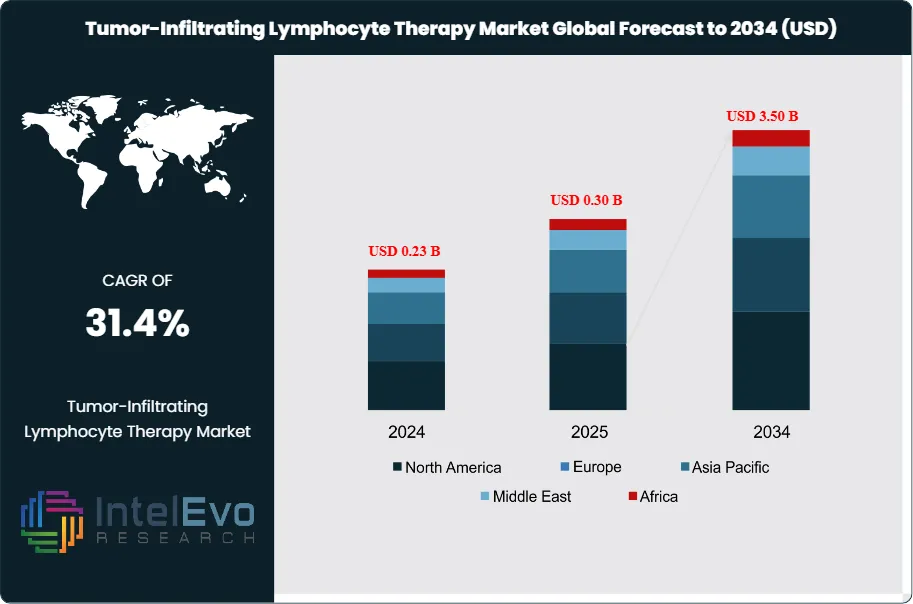
The Tumor-Infiltrating Lymphocyte Therapy Market was valued at approximately USD 0.23 Billion in 2024 and reached USD 0.30 Billion in 2025. The market is projected to grow significantly, reaching USD 3.50 Billion by 2034, expanding at a CAGR of 31.4% during the forecast period from 2026 to 2034. This represents an absolute dollar opportunity of USD 3.20 Billion over the analysis period. Demand is anchored to a single commercial product through 2025, with multiple late-stage candidates expected to broaden the tumor-infiltrating lymphocyte therapy market during the second half of the decade.
Get More Information about this report -
Request Free Sample ReportThe accelerated approval of Amtagvi (lifileucel) by the U.S. Food and Drug Administration on 16 February 2024 created the first reimbursable revenue line for autologous tumor-infiltrating lymphocyte therapy in any solid tumor. Iovance Biotherapeutics priced the one-time treatment at a wholesale acquisition cost of USD 515,000 per patient, anchoring per-patient economics for the category. Iovance posted USD 58 million in third-quarter 2025 Amtagvi product revenue, drawn from a network of more than 80 authorized treatment centers operating across roughly 40 U.S. states.
Regulatory expansion accelerated through 2025 and into early 2026. Health Canada issued a Notice of Compliance with Conditions on 18 August 2025, granting Amtagvi the first ex-U.S. marketing authorization for any solid-tumor T cell therapy. Reviews remain active with the United Kingdom Medicines and Healthcare products Regulatory Agency and Australia’s Therapeutic Goods Administration, with Iovance guiding to first-half 2026 decisions in both jurisdictions. The European marketing application was withdrawn on 22 July 2025 after misalignment with the EMA Committee for Medicinal Products for Human Use, removing near-term EU exposure from the tumor-infiltrating lymphocyte therapy market and shifting management focus to a virtual-control-arm resubmission strategy.
Pipeline depth supports the forecast. Industry analysis indicates more than 75 tumor-infiltrating lymphocyte programs are progressing across preclinical and clinical development globally, with over 100 active clinical trials on file at clinicaltrials.gov. Second-generation engineered candidates are advancing on three technical lines: membrane-bound IL-15 armored TIL (Obsidian OBX-115), CRISPR-edited dual-knockout TIL (KSQ-004EX with SOCS1 and Regnase-1 inactivation), and oncolytic-virus-paired TIL (TILT-123). The IOV-LUN-202 readout in non-squamous non-small cell lung cancer reported a 25.6% objective response rate on 3 November 2025, supporting a 2026 supplemental Biologics License Application and a second indication launch in the second half of 2027.
Manufacturing economics remain the principal constraint on market velocity. Mean vein-to-vein turnaround for Amtagvi sits near 32 days as of third-quarter 2025, and Iovance gross margin reached 43% during the same period, climbing from 31% mid-year as the Iovance Cell Therapy Center scaled. Forecasts through 2034 assume continued reduction in turnaround time, broader payer coverage outside MS-DRG 018, and label expansion into NSCLC, endometrial cancer, and frontline melanoma.
Market Definition & Scope
The tumor-infiltrating lymphocyte therapy market is defined as the worldwide commercial and clinical-development activity for adoptive cell therapies in which T cells are isolated from a patient’s resected tumor tissue, expanded ex vivo with interleukin-2, and reinfused following non-myeloablative lymphodepleting chemotherapy. The market encompasses unmodified autologous TIL products, neoantigen-selected TIL products, and gene-edited or transgene-armored engineered TIL therapies (eTIL).
The scope includes commercial revenue from approved TIL products, clinical-trial-stage spending by sponsors, contract manufacturing services dedicated to TIL expansion, and authorized-treatment-center service revenue tied to TIL administration. The scope explicitly excludes CAR-T cell therapies, T cell receptor (TCR-T) therapies, natural killer cell therapies, and TIL-derived diagnostic biomarker testing. The parent market is autologous T cell immunotherapy, of which the tumor-infiltrating lymphocyte therapy market represented approximately 4.6% of disclosed product revenue in 2025.

Key Takeaways
- Market Growth: The tumor-infiltrating lymphocyte therapy market expanded from USD 0.30 Billion in 2025 toward a forecast of USD 3.50 Billion by 2034, reflecting a CAGR of 31.4% through the analysis period.
- Segment Dominance (By Cell Source): Autologous TIL therapies captured approximately 96.5% of revenue in 2025 because every approved and late-stage candidate uses patient-derived starting material.
- Segment Dominance (By Indication): Advanced melanoma accounted for 91.2% of 2025 revenue, anchored by Amtagvi’s post-anti-PD-1 label and 102 commercial patients infused in second-quarter 2025 alone.
- Driver: A 31.5% objective response rate in registrational C-144-01 melanoma data, combined with a 43.5% durability rate beyond 12 months, has converted a 7,500-patient annual U.S. third-line melanoma pool into addressable demand.
- Restraint: A 7.5% treatment-related mortality rate observed in C-144-01, paired with hospital-only administration requirements under MS-DRG 018, limits referral conversion to roughly 60-70% of biologically eligible patients.
- Opportunity: Lifileucel’s NSCLC opportunity is roughly 7 times the melanoma opportunity per Iovance management commentary, representing approximately USD 3 to USD 4 Billion in incremental U.S. addressable revenue if approved in 2027.
- Trend: Engineered TIL adoption is climbing rapidly; the share of pipeline candidates carrying gene editing or armored cytokines reached approximately 28% in 2025, up from less than 10% in 2022.
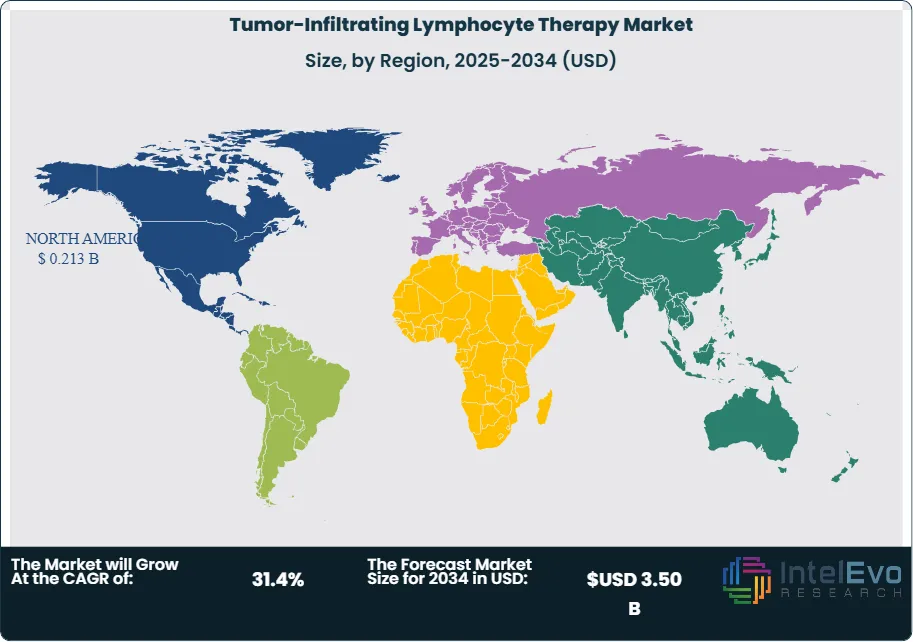
- Regional: North America led the tumor-infiltrating lymphocyte therapy market with 71.0% share and USD 0.213 Billion in 2025, driven entirely by U.S. Amtagvi commercial uptake.
Key Insights Summary
- U.S. Amtagvi Commercial Footprint: As of November 2025, Iovance disclosed that more than 80 authorized treatment centers had been activated across nearly 40 U.S. states, placing roughly 95% of eligible melanoma patients within a two-hour travel radius of a TIL infusion site.
- NSCLC Phase 2 Readout: The IOV-LUN-202 trial reported on 3 November 2025 a 25.6% objective response rate in 39 evaluable advanced non-squamous NSCLC patients, with a 71.8% disease control rate and a median duration of response not reached at 25.4 months of follow-up.
- Health Canada Conditional Clearance: On 18 August 2025, Health Canada granted lifileucel a Notice of Compliance with Conditions for advanced melanoma after anti-PD-1 and targeted therapy, registering the first solid-tumor T cell therapy authorization in Canada.
- EMA Withdrawal: Iovance pulled the European marketing application on 22 July 2025 following CHMP discussions, with formal noting at the 15-18 September 2025 CHMP meeting; no near-term EU revenue is projected for the tumor-infiltrating lymphocyte therapy market.
- CRISPR-Engineered TIL Milestone: On 9 April 2025, KSQ Therapeutics dosed the first patient with KSQ-004EX (SOCS1 and Regnase-1 dual knockout) at MD Anderson Cancer Center, marking the first CRISPR-edited TIL product to reach clinical evaluation in solid tumors.
- Manufacturing Turnaround Compression: Iovance reported a mean vein-to-vein cycle of approximately 32 days for Amtagvi during third-quarter 2025, down from the 34-day baseline reported at FDA approval and approaching the company target of 28 days by year-end 2026.
- Pricing Anchor: Amtagvi carries a wholesale acquisition cost of USD 515,000 per single-dose treatment, slightly above autologous CAR-T benchmarks and assigned to MS-DRG 018 reimbursement under Medicare inpatient rules.
Competitive Landscape Overview
The tumor-infiltrating lymphocyte therapy market remains highly consolidated, with one commercial product and a fragmented clinical pipeline behind it. Iovance Biotherapeutics held approximately 99% of disclosed product revenue in 2025, making the top-1 share larger than the entire challenger field combined. The next four most clinically advanced sponsors (Obsidian Therapeutics, KSQ Therapeutics, Instil Bio, and Biosyngen) collectively account for less than 1% of revenue but roughly 35% of late-stage TIL pipeline volume. Competition is differentiated on three vectors: manufacturing turnaround, engineering enhancements (CRISPR knockouts, armored cytokines, oncolytic virus combinations), and indication breadth beyond melanoma.
Competitive intensity is rising on the engineered-TIL line. Obsidian’s mbIL15-armored OBX-115 is positioned as an IL-2-sparing therapy, KSQ-004EX targets superior anti-tumor functionality through dual gene knockouts, and TILT-123 pairs autologous TIL with an oncolytic adenovirus. Several mid-stage sponsors that had been visible in TIL through 2024 (Achilles Therapeutics, Lyell Immunopharma, and Turnstone Biologics) exited or paused their TIL programs through 2024-2025, removing roughly USD 250 million in committed clinical-stage spend from the field.
Competitive Landscape Matrix
| Company | Headquarters | Position | Lead TIL Asset | Geographic Strength | Recent Strategic Move |
|---|---|---|---|---|---|
| Iovance Biotherapeutics, Inc. | San Carlos, CA, USA | Leader | Amtagvi (lifileucel) | US, Canada | Health Canada NOC/c clearance secured 18 August 2025 |
| Obsidian Therapeutics, Inc. | Cambridge, MA, USA | Challenger | OBX-115 engineered TIL | US clinical sites | Phase 2 melanoma readout slated for ASCO 2026 |
| KSQ Therapeutics, Inc. | Lexington, MA, USA | Challenger | KSQ-004EX (CRISPR eTIL) | US (MD Anderson lead site) | First Phase 1/2 patient dosed 9 April 2025 |
| Instil Bio, Inc. | Los Angeles, CA, USA | Niche Player | CoStAR-engineered TIL platform | US, China (via partner) | Pivot toward bispecific antibody development in 2025 |
| Bristol-Myers Squibb | Princeton, NJ, USA | Niche Player | TIL research collaborations | Global | Continued sponsorship of academic TIL trials through 2025 |
| Biosyngen Pte. Ltd. | Singapore | Niche Player | BST02 TIL therapy | APAC | Liver cancer Phase 1 trial advancing across APAC sites |
| Juncell Therapeutics | Shanghai, China | Niche Player | Autologous TIL pipeline | China | Domestic NMPA-track trial expansion through 2025 |
| TILT Biotherapeutics Ltd | Helsinki, Finland | Niche Player | TILT-123 oncolytic-TIL combo | Europe | Phase 1 combination trial enrollment ongoing in 2025 |
| Turnstone Biologics Corp. | Cambridge, MA, USA | Niche Player | Selected TIL (TIDAL-01) | US | Strategic review and program rationalization announced 2025 |
Segmentation Analysis
The tumor-infiltrating lymphocyte therapy market segments along four dimensions that reflect commercial reimbursement and clinical development structure: cell source, therapy type, indication, and end-user setting. Segment shares below reflect 2025 base-year revenue and clinical-trial activity.
By Cell Source
The tumor-infiltrating lymphocyte therapy market is led by autologous TIL products, which captured 96.5% of 2025 revenue and roughly USD 0.290 Billion in absolute value. Every approved or registrational-stage TIL product on the market is autologous, including Amtagvi (lifileucel), OBX-115, and KSQ-004EX. Autologous design preserves the polyclonal antigen specificity drawn from the patient’s native anti-tumor immune response, which is the mechanistic basis for activity in heavily pretreated melanoma. Manufacturing complexity remains the principal trade-off, with vein-to-vein cycles still in the 28-35 day range across the field.
Allogeneic and donor-derived TIL approaches accounted for approximately 3.5% of 2025 revenue, reflecting research-only positioning across a small number of academic Phase 1 programs led by Cellectis and university centers. Allogeneic TIL faces the same antigen-recognition limits that have constrained allogeneic CAR-T progress in solid tumors.
By Therapy Type
Unmodified autologous TIL captured 92.0% of revenue and approximately USD 0.276 Billion in 2025, driven by Amtagvi sales and a small contribution from academic-investigator-sponsored protocols at the National Cancer Institute and MD Anderson. The category benefits from the largest evidence base, including the 5-year C-144-01 follow-up published in the Journal of Clinical Oncology in June 2025.
Engineered TIL therapies (eTIL) held approximately 8.0% of 2025 revenue but represented roughly 28% of the active clinical pipeline by program count, up from under 10% in 2022. Three sub-classes are advancing: gene-edited TIL such as KSQ-004EX with CRISPR/Cas9 inactivation of SOCS1 and Regnase-1; cytokine-armored TIL such as Obsidian’s OBX-115 carrying pharmacologically regulatable membrane-bound IL-15; and neoantigen-selected TIL such as TBio-4101 from Turnstone Biologics. Obsidian’s 2 June 2025 ASCO data showed that low-dose lymphodepletion (approximately 50% reduction in cyclophosphamide) is feasible with mbIL15 armoring, hinting at a future outpatient TIL profile that could expand the addressable patient pool.
By Indication
Melanoma anchored the tumor-infiltrating lymphocyte therapy market with 91.2% of 2025 revenue, roughly USD 0.274 Billion, driven by Amtagvi’s post-anti-PD-1 melanoma label and approximately 7,500 eligible third-line U.S. patients annually. Iovance treated 102 commercial Amtagvi patients in second-quarter 2025 alone. Real-world data presented in 2025 also showed a 60% objective response rate in the second-line setting, supporting label-expansion economics tied to the TILVANCE-301 Phase 3 confirmatory trial active at more than 75 clinical sites.
Non-small cell lung cancer accounted for approximately 4.6% of 2025 revenue, generated through Phase 2 trial activity rather than commercial sales. The IOV-LUN-202 readout in November 2025 (25.6% ORR, 71.8% disease control rate) supports a sBLA filing in 2026 and a launch in the second half of 2027. Iovance management has described the NSCLC commercial opportunity as roughly 7 times the melanoma opportunity. Cervical, head and neck, endometrial, and other gynecologic carcinomas combined for the remaining 4.2% of 2025 revenue, with the IOV-END-201 endometrial cancer trial expected to report initial data in 2026.
By End-User
Academic medical centers and dedicated cancer centers captured 76.4% of 2025 tumor-infiltrating lymphocyte therapy market revenue and approximately USD 0.229 Billion, reflecting the concentration of authorized treatment centers at top-tier oncology institutions including Stanford University, Roswell Park Cancer Institute, MD Anderson Cancer Center, and Memorial Sloan Kettering. These sites carry the surgical, ICU, and cell-therapy infrastructure required to handle the lymphodepleting regimen plus high-dose IL-2 (Proleukin) coadministration that follows TIL infusion.
Community oncology centers and specialty hospitals contributed roughly 23.6% of 2025 revenue and continue to scale; Iovance reported the first community-ATC patient infusions during third-quarter 2025. Distribution was further broadened by a specialty-pharmacy agreement with InspiroGene by McKesson. Community ATC growth is the most likely volume lever through 2027 because academic-center capacity is constrained by surgical OR scheduling and ICU bed availability.
Regional Analysis
The tumor-infiltrating lymphocyte therapy market is divided across five regions, with North America capturing the dominant share due to the Amtagvi commercial launch and regulatory advantages tied to the FDA accelerated-approval pathway.
North America led with 71.0% share and USD 0.213 Billion in 2025. The United States contributed roughly 98% of regional revenue, with Canada beginning commercial activity in late 2025 following the 18 August 2025 Health Canada conditional approval. The U.S. ATC network reached more than 80 sites across 40 states by November 2025. Iovance’s Iovance Cell Therapy Center in Philadelphia anchors regional manufacturing capacity, with mean vein-to-vein turnaround near 32 days.
Europe represented approximately 11.5% of 2025 revenue, almost entirely through clinical-trial spending and academic protocols at Karolinska Institutet, Vall d’Hebron Institute of Oncology, and the National Center for Tumor Diseases Dresden. Iovance withdrew its EMA marketing authorization application on 22 July 2025 after CHMP feedback, removing the previously expected late-2025 commercial launch. A revised EU strategy involving a virtual control arm is under discussion, with no resubmission timeline confirmed by year-end 2025.
Asia Pacific accounted for 12.8% of 2025 revenue, the second-largest regional share. China carried the bulk of activity through Juncell Therapeutics, HanchorBio (HS-IT101), and academic centers, while Singapore-based Biosyngen advanced BST02 in liver cancer trials. Japan, South Korea, and Australia remain in the regulatory-readiness phase, with the Therapeutic Goods Administration’s Priority Review for Amtagvi expected to deliver a first-half 2026 decision.
Latin America contributed approximately 2.4% of 2025 revenue, driven by Brazil’s Hospital Israelita Albert Einstein and a small set of investigator-initiated melanoma protocols. ANVISA has not received a TIL marketing application as of year-end 2025, leaving the region in a research-only posture. Cost-per-dose remains the principal barrier to commercial introduction.
The Middle East and Africa held 2.3% of 2025 revenue. The United Arab Emirates and Saudi Arabia have signaled interest in cell therapy infrastructure investment through King Faisal Specialist Hospital and Cleveland Clinic Abu Dhabi, but no TIL approvals or commercial deployments existed at year-end 2025. The region is forecast to remain below 3% of revenue through the entire forecast period.
Country Analysis
The United States anchored the tumor-infiltrating lymphocyte therapy market with USD 0.209 Billion in 2025 revenue and a country-specific CAGR of 30.8% through 2034. FDA accelerated approval under the Regenerative Medicine Advanced Therapy framework, codified in section 506(g) of the Federal Food, Drug, and Cosmetic Act and updated in draft guidance issued 20 September 2025, gives U.S. sponsors the fastest path to market for novel TIL products. As of June 2025, 13 RMAT-designated cell and gene therapy products had reached the U.S. market, with Amtagvi the first solid-tumor TIL among them. Medicare assigns Amtagvi to MS-DRG 018, the same diagnosis-related group covering CAR-T therapies for hematologic cancers.
Canada generated USD 0.004 Billion in 2025 (commercial activity beginning in the fourth quarter only) with a country-specific CAGR projected at 38.0% through 2034 from a small base. Health Canada’s Notice of Compliance with Conditions, issued 18 August 2025 under Submission Control Number 293019, applied a 200-day prioritized review process. Iovance authorized its first Canadian treatment center within months of approval, distributing Amtagvi via Bioscript Logistics in Oakville, Ontario. Provincial drug-formulary listings remain the principal commercial bottleneck.
China contributed USD 0.027 Billion in 2025, driven entirely by clinical-trial activity rather than commercial sales. The country-specific CAGR is forecast at 36.5% through 2034, supported by NMPA 2025 reforms expanding conditional approvals and recognizing foreign clinical data under harmonized ICH guidelines. China hosted approximately 3,365 cell therapy trials cumulatively as of October 2025, second only to the United States. Domestic developers including Juncell Therapeutics and HanchorBio (HS-IT101 demonstrated 50% ORR in 6 melanoma patients at ASCO 2025) lead the local pipeline.
The United Kingdom registered USD 0.012 Billion in 2025 trial-stage activity with a country-specific CAGR of 41.2% through 2034 contingent on MHRA authorization. NICE evaluation under reference ID3863 remains active for lifileucel. Iovance submitted its UK application in October 2024 and guides toward a first-half 2026 approval decision. Australia carried USD 0.005 Billion in 2025 revenue and is expected to follow a similar 2026 commercial-launch path under the TGA Priority Review pathway.
Get More Information about this report -
Request Free Sample ReportKey Market Segment
By Cell Source
- Autologous TIL Therapy
- Allogeneic TIL Therapy
By Therapy Type
- Monotherapy
- Combination Therapy
By Indication
- Melanoma
- Lung Cancer
- Cervical Cancer
- Head & Neck Cancer
- Others
By End-User
- Hospitals
- Cancer Treatment Centers
- Research Institutes
- Others
By Regional Coverage
- North America
- Latin America
- East Asia And Pacific
- Sea And South Asia
- Eastern Europe
- Western Europe
- Middle East & Africa
| Report Attribute | Details |
| Market size (2025) | USD 0.30 B |
| Forecast Revenue (2034) | USD 3.50 B |
| CAGR (2025-2034) | 31.4% |
| Historical data | 2021-2025 |
| Base Year For Estimation | 2025 |
| Forecast Period | 2026-2034 |
| Report coverage | Revenue Forecast, Competitive Landscape, Market Dynamics, Growth Factors, Trends and Recent Developments |
| Segments covered | By Cell Source, (Autologous TIL Therapy, Allogeneic TIL Therapy), By Therapy Type, (Monotherapy, Combination Therapy), By Indication, (Melanoma, Lung Cancer, Cervical Cancer, Head & Neck Cancer, Others), By End-User, (Hospitals, Cancer Treatment Centers, Research Institutes, Others), |
| Research Methodology |
|
| Regional scope |
|
| Competitive Landscape | IOVANCE BIOTHERAPEUTICS, INC., OBSIDIAN THERAPEUTICS, INC., KSQ THERAPEUTICS, INC., INSTIL BIO, INC., BRISTOL-MYERS SQUIBB COMPANY, BIOSYNGEN PTE. LTD., JUNCELL THERAPEUTICS, TILT BIOTHERAPEUTICS LTD, TURNSTONE BIOLOGICS CORP., LYTIX BIOPHARMA AS, PHIO PHARMACEUTICALS CORP., CELLECTIS S.A., CAR-T (SHANGHAI) CELL BIOTECHNOLOGY, PROMETHEUS LABORATORIES, INC., INCYTE CORPORATION, OTHERS |
| Customization Scope | Customization for segments, region/country-level will be provided. Moreover, additional customization can be done based on the requirements. |
| Pricing and Purchase Options | Avail customized purchase options to meet your exact research needs. We have three licenses to opt for: Single User License, Multi-User License (Up to 5 Users), Corporate Use License (Unlimited User and Printable PDF). |


Frequently Asked Questions
How big is the Tumor-Infiltrating Lymphocyte Therapy Market?
Global Tumor-Infiltrating Lymphocyte Therapy Market was valued at USD 0.23 billion in 2024 and is projected to reach USD 3.50 billion by 2034, at a CAGR of 31.4% during 2026–2034.
Who are the major players in the Tumor-Infiltrating Lymphocyte Therapy Market?
IOVANCE BIOTHERAPEUTICS, INC., OBSIDIAN THERAPEUTICS, INC., KSQ THERAPEUTICS, INC., INSTIL BIO, INC., BRISTOL-MYERS SQUIBB COMPANY, BIOSYNGEN PTE. LTD., JUNCELL THERAPEUTICS, TILT BIOTHERAPEUTICS LTD, TURNSTONE BIOLOGICS CORP., LYTIX BIOPHARMA AS, PHIO PHARMACEUTICALS CORP., CELLECTIS S.A., CAR-T (SHANGHAI) CELL BIOTECHNOLOGY, PROMETHEUS LABORATORIES, INC., INCYTE CORPORATION, OTHERS
Which segments covered the Tumor-Infiltrating Lymphocyte Therapy Market?
By Cell Source, (Autologous TIL Therapy, Allogeneic TIL Therapy), By Therapy Type, (Monotherapy, Combination Therapy), By Indication, (Melanoma, Lung Cancer, Cervical Cancer, Head & Neck Cancer, Others), By End-User, (Hospitals, Cancer Treatment Centers, Research Institutes, Others),
How can this market research report help my business make strategic decisions?
Our market research reports provide actionable intelligence, including verified market size data, CAGR projections, competitive benchmarking, and segment-level opportunity analysis. These insights support strategic planning, investment decisions, product development, and market entry strategies for enterprises and startups alike.
How frequently is the data updated?
We continuously monitor industry developments and update our reports to reflect regulatory changes, technological advancements, and macroeconomic shifts. Updated editions ensure you receive the latest market intelligence.

Select Licence Type
Connect with our sales team

Tumor-Infiltrating Lymphocyte Therapy Market
Published Date : 20 Jul 2026 | Formats :Why IntelEvoResearch
100%
Customer
Satisfaction
24x7+
Availability - we are always
there when you need us
200+
Fortune 50 Companies trust
IntelEvoResearch
80%
of our reports are exclusive
and first in the industry
100%
more data
and analysis
1000+
reports published
till date