
The Global Urban Air Mobility Market size is expected to be worth around USD 21,485 million by 2034, up from USD 2,580 million in 2024, growing at a CAGR of 25.1% during the forecast period from 2025 to 2034. The market is witnessing strong momentum driven by the rising need for efficient urban transportation, rapid advancements in eVTOL (electric Vertical Take-Off and Landing) aircraft, and increasing investments in smart city infrastructure. With major aerospace players and tech innovators entering the space, Urban Air Mobility is set to revolutionize the future of urban commuting and redefine sustainable transportation globally.
Urban Air Mobility (UAM) refers to the use of air transportation systems, typically electric Vertical Takeoff and Landing (eVTOL) aircraft, for urban passenger and cargo transport. This market includes the development, production, and deployment of aerial vehicles designed for short-distance travel within metropolitan areas. The UAM market is in its nascent stage, with companies focusing on developing advanced air vehicles, infrastructure, and air traffic management systems. Currently, the market is driven by increasing congestion in urban areas, advancements in battery technology, and the growing interest in sustainable transportation options. The market is gaining traction as major players such as Airbus, Boeing, and startups invest heavily in prototypes and partnerships with urban planners and local governments.
The UAM market is set for exponential growth due to several key drivers. The rising demand for faster and more efficient urban transport solutions in congested cities is one of the primary catalysts. Advances in electric propulsion, autonomy, and artificial intelligence have significantly improved the feasibility of eVTOLs. Furthermore, increased awareness about carbon emissions and sustainability goals are pushing governments and corporations to adopt cleaner transportation modes, driving interest in electric-powered UAM solutions. In addition, large investments from aerospace companies, venture capital firms, and public-private partnerships are accelerating the development and commercialization of UAM systems. Innovations in infrastructure, like vertiports, will also boost the sector's expansion.
North America is expected to lead the UAM market, driven by strong investments in aerospace technology and favorable regulatory initiatives from organizations like the Federal Aviation Administration (FAA). The United States, in particular, is at the forefront, with urban centers such as Los Angeles and Dallas being identified as testbeds for UAM deployment. Europe follows closely, with countries like Germany and the UK making significant strides in developing their UAM ecosystems. In the Asia-Pacific region, countries like Japan and South Korea are increasingly investing in UAM, focusing on integrating these systems to alleviate congestion in megacities. The Middle East is also exploring UAM technologies for their smart city initiatives.
The COVID-19 pandemic had a mixed impact on the UAM market. On one hand, it delayed the development and testing of prototypes due to supply chain disruptions and travel restrictions. On the other hand, it accelerated the need for contactless, efficient transportation, which aligned with UAM's core advantages. The pandemic also heightened the interest in using UAM vehicles for medical and emergency services, further highlighting its potential in crisis situations. Despite short-term setbacks, the long-term outlook for UAM remains positive, with increased interest and investment from both public and private sectors in the post-pandemic recovery period.
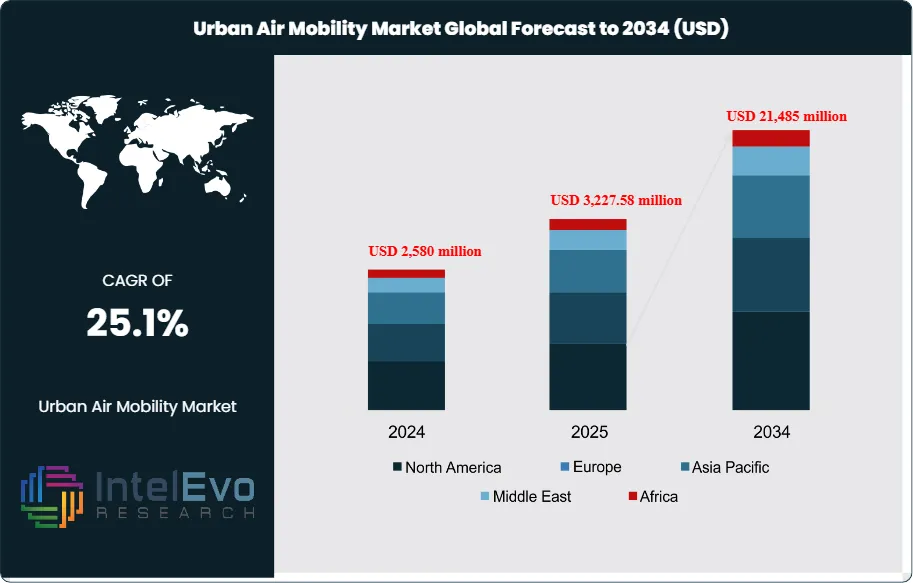
Market Growth: The Urban Air Mobility market is expected to reach USD 21,485 million by 2034, growing at a robust CAGR of 25.1%, indicating strong market expansion driven by technological advancements and increasing urbanization.
Passenger Air Vehicle Dominance: The passenger air vehicle segment is anticipated to dominate the market, accounting for over 60% of the overall share due to rising consumer demand for efficient urban transportation solutions and the growing acceptance of aerial taxis.
Cargo Air Vehicle Preference: The cargo air vehicle segment is likely to witness substantial growth, driven by the increasing demand for efficient last-mile delivery solutions in urban areas, as companies seek to enhance their logistics operations through UAM technologies.
Driver: The growing urban population and rising traffic congestion are significant drivers for the UAM market. Increasing investments in infrastructure and technology for eVTOL vehicles are expected to support the expansion of urban air transportation networks.
Restraint: Regulatory hurdles and safety concerns surrounding UAM operations may impede market growth. The need for comprehensive air traffic management systems and public acceptance of aerial transport solutions can pose challenges for industry stakeholders.
Opportunity: The development of vertiport infrastructure in urban areas presents a substantial opportunity for growth. Collaborations between private companies and government bodies can facilitate the successful integration of UAM services into existing transportation networks.
Trend: The focus on sustainability is driving innovation in eVTOL designs, with many companies prioritizing electric and hybrid propulsion systems to minimize environmental impact.
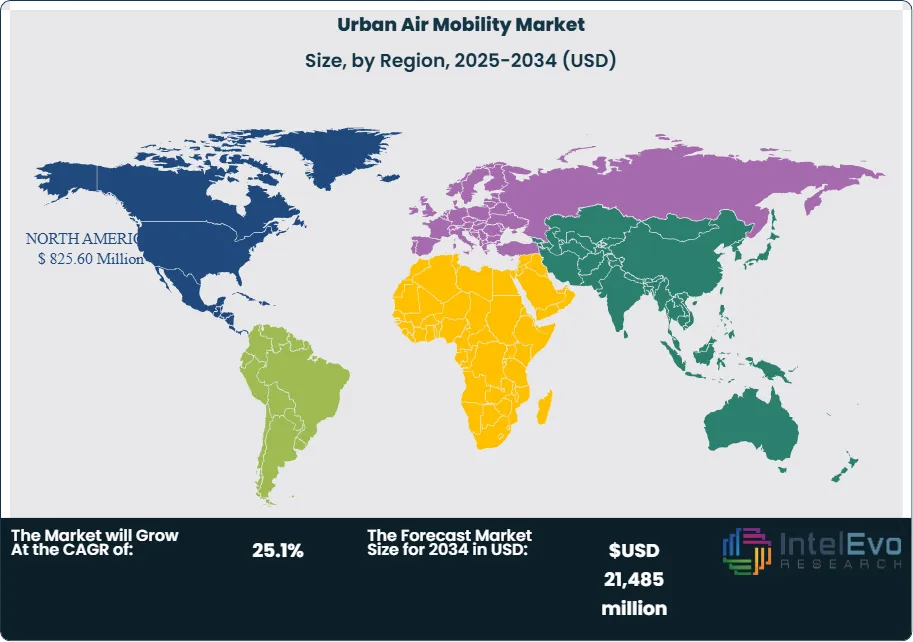
Regional Analysis: North America is projected to hold the largest market share due to substantial investments in UAM technology, while the Asia-Pacific region shows the fastest growth potential, fueled by increasing urbanization and government initiatives promoting aerial mobility solutions.
Component Analysis:
The UAM market is divided into platforms and infrastructure. The platform segment includes air taxis, shuttles, personal aerial vehicles, cargo vehicles, and air ambulances, which are key to transforming urban transportation. Air taxis are gaining significant attention due to their potential to reduce congestion. Infrastructure covers vertiports, charging stations, and air traffic management systems, essential for the operational success of UAM systems. Vertiports, designed for takeoff and landing, and robust air traffic management systems will facilitate safe, scalable deployment of UAM in cities.
Range Analysis:
UAM operations are classified as intercity and intracity. Intracity UAM focuses on short-range flights within cities, addressing urban congestion and reducing travel time. These services target high-density urban areas, offering quick and efficient alternatives to ground transportation. Intercity operations, on the other hand, span longer distances, connecting different cities and potentially replacing regional travel modes like trains or short-haul flights. Intracity applications are currently the primary focus, as they are expected to grow faster due to the immediate need for solutions in urban centers with high traffic density.
Vehicle Type Analysis:
UAM vehicles can be manned or unmanned. Manned vehicles are piloted aircraft designed for passenger or cargo transportation, providing a more familiar model during the initial phases of UAM. Unmanned vehicles, or drones, operate autonomously or remotely, mainly serving in cargo, emergency services, or even passenger transport in the future. The unmanned vehicle segment is expected to witness rapid growth, driven by advancements in autonomy, safety, and the regulatory landscape, which is increasingly favoring the adoption of autonomous aerial systems in urban environments.
Operation Insights:
UAM operations can be piloted or autonomous. Piloted vehicles are currently dominating the market due to safety concerns and regulatory barriers surrounding fully autonomous systems. However, autonomous operations are poised for significant growth as technology matures and regulations evolve. Autonomous UAM promises to revolutionize urban transport by reducing the need for human intervention, increasing efficiency, and lowering operational costs. Companies are heavily investing in autonomous systems, foreseeing a future where fully automated air taxis and cargo drones can operate safely within urban environments.
End-Use Insights:
The end-use segment includes passenger transportation, freight/logistics, emergency services, military, and other niche applications. Passenger transport is anticipated to lead the market, driven by the need for faster, more efficient urban mobility solutions. Freight and logistics are also gaining importance, with cargo drones providing quick deliveries. Emergency services, such as air ambulances, are increasingly adopting UAM for rapid response in medical emergencies. Additionally, the military is showing interest in using UAM for reconnaissance and supply missions, further driving the market’s expansion across various sectors.
Mode of Operation Insights:
UAM vehicles operate in different modes, including fixed-wing, rotorcraft, tilt-wing, and hybrid configurations. Fixed-wing aircraft offer greater efficiency for longer intercity flights, while rotorcraft (eVTOL) are more suitable for vertical takeoffs and landings, ideal for intracity travel. Tilt-wing aircraft combine the advantages of both, providing versatility for varying urban and regional needs. Hybrid vehicles, combining multiple operational modes, aim to deliver flexibility in complex environments. Rotorcraft eVTOLs are currently leading the market due to their ability to maneuver in dense urban spaces with minimal infrastructure.
Propulsion Type Insights:
The UAM market is segmented by propulsion type into electric battery, hydrogen fuel cells, and hybrid electric systems. Electric battery-powered UAM vehicles dominate the market due to advancements in battery technology, offering a cleaner and more sustainable mode of transport. Hydrogen fuel cells, while less common, present a promising alternative due to their high energy density and potential for longer flights. Hybrid-electric systems, combining electric propulsion with conventional engines, provide extended range and reliability, particularly for longer intercity operations. The transition to fully electric systems is a major trend in the UAM market.
Region Analysis:
North America Leads With the Largest Market Share in the Global Urban Air Mobility Market: North America holds the largest market share in the Global Urban Air Mobility (UAM) market, driven by technological advancements, strong investments, and regulatory support. The United States is a key player due to its well-established aerospace industry, significant investments in electric Vertical Takeoff and Landing (eVTOL) aircraft, and initiatives by the Federal Aviation Administration (FAA) to develop air traffic management systems for UAM. Cities like Los Angeles and Dallas are early adopters, with infrastructure development projects underway. Government support for sustainable transportation solutions and the presence of major UAM developers like Boeing and Joby Aviation further strengthen the region’s dominance.
Asia-Pacific is projected to be the fastest-growing region, fueled by high urban population density, increasing investments in smart city initiatives, and government support for sustainable transport systems. Countries like Japan, South Korea, and China are investing heavily in UAM infrastructure and R&D. In Japan, UAM is a key component of the "Smart Mobility" framework, while South Korea's government-backed urban air transport projects aim for deployment by 2030. Europe is also advancing rapidly, with Germany and the UK taking a leadership role, while regions like Latin America and the Middle East are exploring UAM solutions for congestion and emergency services.
By Platform Type (Air Taxis, Passenger Drones, Personal Aerial Vehicles, Cargo Air Vehicles, Air Shuttles, Air Ambulances), By Operation (Piloted, Fully Autonomous), By Range (Intracity (≤50 km), Intercity (>50 km)), By Vehicle Type (Manned Vehicles, Unmanned Vehicles), By Mode of Operation (Fixed-Wing, Rotorcraft, Tilt-Wing Aircraft, Hybrid Aircraft), By Propulsion Type (Electric (Battery-Electric), Hybrid-Electric, Hydrogen Fuel Cell), By Infrastructure (Vertiports, Charging Stations, Air Traffic Management Systems), By End-Use Application (Ride-Sharing Companies, Private Owners, Emergency Medical Services, Cargo & Logistics, Military & Defense, Others)
Research Methodology
Primary Research- 100 Interviews of Stakeholders
Secondary Research
Desk Research
Regional scope
North America (United States, Canada, Mexico)
Latin America (Brazil, Argentina, Columbia)
East Asia And Pacific (China, Japan, South Korea, Australia, Cambodia, Fiji, Indonesia)
Sea And South Asia (India, Singapore, Thailand, Taiwan, Malaysia)
Eastern Europe (Poland, Russia, Czech Republic, Romania)
Western Europe (Germany, U.K., France, Spain, Itlay)
Middle East & Africa (GCC Countries, Egypt, Nigeria, South Africa, Israel)
Customization for segments, region/country-level will be provided. Moreover, additional customization can be done based on the requirements.
Pricing and Purchase Options
Avail customized purchase options to meet your exact research needs. We have three licenses to opt for: Single User License, Multi-User License (Up to 5 Users), Corporate Use License (Unlimited User and Printable PDF).
TABLE OF CONTENTS
1. EXECUTIVE SUMMARY
1.1. MARKET SNAPSHOT
1.2. KEY FINDINGS & INSIGHTS
1.3. ANALYST RECOMMENDATIONS
1.4. FUTURE OUTLOOK
2. RESEARCH METHODOLOGY
2.1. MARKET DEFINITION & SCOPE
2.2. RESEARCH OBJECTIVES: PRIMARY & SECONDARY DATA SOURCES
2.3. DATA COLLECTION SOURCES
2.3.1. COVERAGE OF 100+ PRIMARY RESEARCH/CONSULTATION CALLS WITH INDUSTRY STAKEHOLDERS
FIGURE 17 NORTH AMERICA URBAN AIR MOBILITY CURRENT AND FUTURE TYPE ANALYSIS, 2025–2034, (USD MILLION)
FIGURE 18 NORTH AMERICA URBAN AIR MOBILITY CURRENT AND FUTURE END USER ANALYSIS, 2025–2034, (USD MILLION)
FIGURE 19 MARKET SHARE BY COUNTRY
FIGURE 20 LATIN AMERICA URBAN AIR MOBILITY CURRENT AND FUTURE TYPE ANALYSIS, 2025–2034, (USD MILLION)
FIGURE 21 LATIN AMERICA URBAN AIR MOBILITY CURRENT AND FUTURE END USER ANALYSIS, 2025–2034, (USD MILLION)
FIGURE 22 MARKET SHARE BY COUNTRY
FIGURE 23 EASTERN EUROPE URBAN AIR MOBILITY CURRENT AND FUTURE TYPE ANALYSIS, 2025–2034, (USD MILLION)
FIGURE 24 EASTERN EUROPE URBAN AIR MOBILITY CURRENT AND FUTURE END USER ANALYSIS, 2025–2034, (USD MILLION)
FIGURE 25 MARKET SHARE BY COUNTRY
FIGURE 26 WESTERN EUROPE URBAN AIR MOBILITY CURRENT AND FUTURE TYPE ANALYSIS, 2025–2034, (USD MILLION)
FIGURE 27 WESTERN EUROPE URBAN AIR MOBILITY CURRENT AND FUTURE END USER ANALYSIS, 2025–2034, (USD MILLION)
FIGURE 28 MARKET SHARE BY COUNTRY
FIGURE 29 EAST ASIA AND PACIFIC URBAN AIR MOBILITY CURRENT AND FUTURE TYPE ANALYSIS, 2025–2034, (USD MILLION)
FIGURE 30 EAST ASIA AND PACIFIC URBAN AIR MOBILITY CURRENT AND FUTURE END USER ANALYSIS, 2025–2034, (USD MILLION)
FIGURE 31 MARKET SHARE BY COUNTRY
FIGURE 32 SEA AND SOUTH ASIA URBAN AIR MOBILITY CURRENT AND FUTURE TYPE ANALYSIS, 2025–2034, (USD MILLION)
FIGURE 33 SEA AND SOUTH ASIA URBAN AIR MOBILITY CURRENT AND FUTURE END USER ANALYSIS, 2025–2034, (USD MILLION)
FIGURE 34 MARKET SHARE BY COUNTRY
FIGURE 35 MIDDLE EAST AND AFRICA URBAN AIR MOBILITY CURRENT AND FUTURE TYPE ANALYSIS, 2025–2034, (USD MILLION)
FIGURE 36 MIDDLE EAST AND AFRICA URBAN AIR MOBILITY CURRENT AND FUTURE END USER ANALYSIS, 2025–2034, (USD MILLION)
FIGURE 37 NORTH AMERICA URBAN AIR MOBILITY CURRENT AND FUTURE MARKET VOLUME SHARE REGIONAL ANALYSIS, 2025–2034, (USD MILLION)
FIGURE 38 U.S. URBAN AIR MOBILITY CURRENT AND FUTURE TYPE ANALYSIS, 2025–2034, (USD MILLION)
FIGURE 39 U.S. URBAN AIR MOBILITY CURRENT AND FUTURE END USER ANALYSIS, 2025–2034, (USD MILLION)
FIGURE 40 CANADA URBAN AIR MOBILITY CURRENT AND FUTURE TYPE ANALYSIS, 2025–2034, (USD MILLION)
FIGURE 41 CANADA URBAN AIR MOBILITY CURRENT AND FUTURE END USER ANALYSIS, 2025–2034, (USD MILLION)
FIGURE 42 LATIN AMERICA URBAN AIR MOBILITY CURRENT AND FUTURE MARKET VOLUME SHARE REGIONAL ANALYSIS, 2025–2034, (USD MILLION)
FIGURE 43 MEXICO URBAN AIR MOBILITY CURRENT AND FUTURE TYPE ANALYSIS, 2025–2034, (USD MILLION)
FIGURE 44 MEXICO URBAN AIR MOBILITY CURRENT AND FUTURE END USER ANALYSIS, 2025–2034, (USD MILLION)
FIGURE 45 BRAZIL URBAN AIR MOBILITY CURRENT AND FUTURE TYPE ANALYSIS, 2025–2034, (USD MILLION)
FIGURE 46 BRAZIL URBAN AIR MOBILITY CURRENT AND FUTURE END USER ANALYSIS, 2025–2034, (USD MILLION)
FIGURE 47 ARGENTINA URBAN AIR MOBILITY CURRENT AND FUTURE TYPE ANALYSIS, 2025–2034, (USD MILLION)
FIGURE 48 ARGENTINA URBAN AIR MOBILITY CURRENT AND FUTURE END USER ANALYSIS, 2025–2034, (USD MILLION)
FIGURE 49 COLUMBIA URBAN AIR MOBILITY CURRENT AND FUTURE TYPE ANALYSIS, 2025–2034, (USD MILLION)
FIGURE 50 COLUMBIA URBAN AIR MOBILITY CURRENT AND FUTURE END USER ANALYSIS, 2025–2034, (USD MILLION)
FIGURE 51 REST OF LATIN AMERICA URBAN AIR MOBILITY CURRENT AND FUTURE TYPE ANALYSIS, 2025–2034, (USD MILLION)
FIGURE 52 REST OF LATIN AMERICA URBAN AIR MOBILITY CURRENT AND FUTURE END USER ANALYSIS, 2025–2034, (USD MILLION)
FIGURE 53 EASTERN EUROPE URBAN AIR MOBILITY CURRENT AND FUTURE MARKET VOLUME SHARE REGIONAL ANALYSIS, 2025–2034, (USD MILLION)
FIGURE 54 POLAND URBAN AIR MOBILITY CURRENT AND FUTURE TYPE ANALYSIS, 2025–2034, (USD MILLION)
FIGURE 55 POLAND URBAN AIR MOBILITY CURRENT AND FUTURE END USER ANALYSIS, 2025–2034, (USD MILLION)
FIGURE 56 RUSSIA URBAN AIR MOBILITY CURRENT AND FUTURE TYPE ANALYSIS, 2025–2034, (USD MILLION)
FIGURE 57 RUSSIA URBAN AIR MOBILITY CURRENT AND FUTURE END USER ANALYSIS, 2025–2034, (USD MILLION)
FIGURE 58 CZECH REPUBLIC URBAN AIR MOBILITY CURRENT AND FUTURE TYPE ANALYSIS, 2025–2034, (USD MILLION)
FIGURE 59 CZECH REPUBLIC URBAN AIR MOBILITY CURRENT AND FUTURE END USER ANALYSIS, 2025–2034, (USD MILLION)
FIGURE 60 ROMANIA URBAN AIR MOBILITY CURRENT AND FUTURE TYPE ANALYSIS, 2025–2034, (USD MILLION)
FIGURE 61 ROMANIA URBAN AIR MOBILITY CURRENT AND FUTURE END USER ANALYSIS, 2025–2034, (USD MILLION)
FIGURE 62 REST OF EASTERN EUROPE URBAN AIR MOBILITY CURRENT AND FUTURE TYPE ANALYSIS, 2025–2034, (USD MILLION)
FIGURE 63 REST OF EASTERN EUROPE URBAN AIR MOBILITY CURRENT AND FUTURE END USER ANALYSIS, 2025–2034, (USD MILLION)
FIGURE 64 WESTERN EUROPE URBAN AIR MOBILITY CURRENT AND FUTURE MARKET VOLUME SHARE REGIONAL ANALYSIS, 2025–2034, (USD MILLION)
FIGURE 65 GERMANY URBAN AIR MOBILITY CURRENT AND FUTURE TYPE ANALYSIS, 2025–2034, (USD MILLION)
FIGURE 66 GERMANY URBAN AIR MOBILITY CURRENT AND FUTURE END USER ANALYSIS, 2025–2034, (USD MILLION)
FIGURE 67 FRANCE URBAN AIR MOBILITY CURRENT AND FUTURE TYPE ANALYSIS, 2025–2034, (USD MILLION)
FIGURE 68 FRANCE URBAN AIR MOBILITY CURRENT AND FUTURE END USER ANALYSIS, 2025–2034, (USD MILLION)
FIGURE 69 UK URBAN AIR MOBILITY CURRENT AND FUTURE TYPE ANALYSIS, 2025–2034, (USD MILLION)
FIGURE 70 UK URBAN AIR MOBILITY CURRENT AND FUTURE END USER ANALYSIS, 2025–2034, (USD MILLION)
FIGURE 71 SPAIN URBAN AIR MOBILITY CURRENT AND FUTURE TYPE ANALYSIS, 2025–2034, (USD MILLION)
FIGURE 72 SPAIN URBAN AIR MOBILITY CURRENT AND FUTURE END USER ANALYSIS, 2025–2034, (USD MILLION)
FIGURE 73 ITALY URBAN AIR MOBILITY CURRENT AND FUTURE TYPE ANALYSIS, 2025–2034, (USD MILLION)
FIGURE 74 ITALY URBAN AIR MOBILITY CURRENT AND FUTURE END USER ANALYSIS, 2025–2034, (USD MILLION)
FIGURE 75 REST OF WESTERN EUROPE URBAN AIR MOBILITY CURRENT AND FUTURE TYPE ANALYSIS, 2025–2034, (USD MILLION)
FIGURE 76 REST OF WESTERN EUROPE URBAN AIR MOBILITY CURRENT AND FUTURE END USER ANALYSIS, 2025–2034, (USD MILLION)
FIGURE 77 EAST ASIA AND PACIFIC URBAN AIR MOBILITY CURRENT AND FUTURE MARKET VOLUME SHARE REGIONAL ANALYSIS, 2025–2034, (USD MILLION)
FIGURE 78 CHINA URBAN AIR MOBILITY CURRENT AND FUTURE TYPE ANALYSIS, 2025–2034, (USD MILLION)
FIGURE 79 CHINA URBAN AIR MOBILITY CURRENT AND FUTURE END USER ANALYSIS, 2025–2034, (USD MILLION)
FIGURE 80 JAPAN URBAN AIR MOBILITY CURRENT AND FUTURE TYPE ANALYSIS, 2025–2034, (USD MILLION)
FIGURE 81 JAPAN URBAN AIR MOBILITY CURRENT AND FUTURE END USER ANALYSIS, 2025–2034, (USD MILLION)
FIGURE 82 AUSTRALIA URBAN AIR MOBILITY CURRENT AND FUTURE TYPE ANALYSIS, 2025–2034, (USD MILLION)
FIGURE 83 AUSTRALIA URBAN AIR MOBILITY CURRENT AND FUTURE END USER ANALYSIS, 2025–2034, (USD MILLION)
FIGURE 84 CAMBODIA URBAN AIR MOBILITY CURRENT AND FUTURE TYPE ANALYSIS, 2025–2034, (USD MILLION)
FIGURE 85 CAMBODIA URBAN AIR MOBILITY CURRENT AND FUTURE END USER ANALYSIS, 2025–2034, (USD MILLION)
FIGURE 86 FIJI URBAN AIR MOBILITY CURRENT AND FUTURE TYPE ANALYSIS, 2025–2034, (USD MILLION)
FIGURE 87 FIJI URBAN AIR MOBILITY CURRENT AND FUTURE END USER ANALYSIS, 2025–2034, (USD MILLION)
FIGURE 88 INDONESIA URBAN AIR MOBILITY CURRENT AND FUTURE TYPE ANALYSIS, 2025–2034, (USD MILLION)
FIGURE 89 INDONESIA URBAN AIR MOBILITY CURRENT AND FUTURE END USER ANALYSIS, 2025–2034, (USD MILLION)
FIGURE 90 SOUTH KOREA URBAN AIR MOBILITY CURRENT AND FUTURE TYPE ANALYSIS, 2025–2034, (USD MILLION)
FIGURE 91 SOUTH KOREA URBAN AIR MOBILITY CURRENT AND FUTURE END USER ANALYSIS, 2025–2034, (USD MILLION)
FIGURE 92 REST OF EAST ASIA AND PACIFIC URBAN AIR MOBILITY CURRENT AND FUTURE TYPE ANALYSIS, 2025–2034, (USD MILLION)
FIGURE 93 REST OF EAST ASIA AND PACIFIC URBAN AIR MOBILITY CURRENT AND FUTURE END USER ANALYSIS, 2025–2034, (USD MILLION)
FIGURE 94 SEA AND SOUTH ASIA URBAN AIR MOBILITY CURRENT AND FUTURE MARKET VOLUME SHARE REGIONAL ANALYSIS, 2025–2034, (USD MILLION)
FIGURE 95 BANGLADESH URBAN AIR MOBILITY CURRENT AND FUTURE TYPE ANALYSIS, 2025–2034, (USD MILLION)
FIGURE 96 BANGLADESH URBAN AIR MOBILITY CURRENT AND FUTURE END USER ANALYSIS, 2025–2034, (USD MILLION)
FIGURE 97 NEW ZEALAND URBAN AIR MOBILITY CURRENT AND FUTURE TYPE ANALYSIS, 2025–2034, (USD MILLION)
FIGURE 98 NEW ZEALAND URBAN AIR MOBILITY CURRENT AND FUTURE END USER ANALYSIS, 2025–2034, (USD MILLION)
FIGURE 99 INDIA URBAN AIR MOBILITY CURRENT AND FUTURE TYPE ANALYSIS, 2025–2034, (USD MILLION)
FIGURE 100 INDIA URBAN AIR MOBILITY CURRENT AND FUTURE END USER ANALYSIS, 2025–2034, (USD MILLION)
FIGURE 101 SINGAPORE URBAN AIR MOBILITY CURRENT AND FUTURE TYPE ANALYSIS, 2025–2034, (USD MILLION)
FIGURE 102 SINGAPORE URBAN AIR MOBILITY CURRENT AND FUTURE END USER ANALYSIS, 2025–2034, (USD MILLION)
FIGURE 103 THAILAND URBAN AIR MOBILITY CURRENT AND FUTURE TYPE ANALYSIS, 2025–2034, (USD MILLION)
FIGURE 104 THAILAND URBAN AIR MOBILITY CURRENT AND FUTURE END USER ANALYSIS, 2025–2034, (USD MILLION)
FIGURE 105 TAIWAN URBAN AIR MOBILITY CURRENT AND FUTURE TYPE ANALYSIS, 2025–2034, (USD MILLION)
FIGURE 106 TAIWAN URBAN AIR MOBILITY CURRENT AND FUTURE END USER ANALYSIS, 2025–2034, (USD MILLION)
FIGURE 107 MALAYSIA URBAN AIR MOBILITY CURRENT AND FUTURE TYPE ANALYSIS, 2025–2034, (USD MILLION)
FIGURE 108 MALAYSIA URBAN AIR MOBILITY CURRENT AND FUTURE END USER ANALYSIS, 2025–2034, (USD MILLION)
FIGURE 109 REST OF SEA AND SOUTH ASIA URBAN AIR MOBILITY CURRENT AND FUTURE TYPE ANALYSIS, 2025–2034, (USD MILLION)
FIGURE 110 REST OF SEA AND SOUTH ASIA URBAN AIR MOBILITY CURRENT AND FUTURE END USER ANALYSIS, 2025–2034, (USD MILLION)
FIGURE 111 MIDDLE EAST AND AFRICA URBAN AIR MOBILITY CURRENT AND FUTURE MARKET VOLUME SHARE REGIONAL ANALYSIS, 2025–2034, (USD MILLION)
FIGURE 112 GCC COUNTRIES URBAN AIR MOBILITY CURRENT AND FUTURE TYPE ANALYSIS, 2025–2034, (USD MILLION)
FIGURE 113 GCC COUNTRIES URBAN AIR MOBILITY CURRENT AND FUTURE END USER ANALYSIS, 2025–2034, (USD MILLION)
FIGURE 114 SAUDI ARABIA URBAN AIR MOBILITY CURRENT AND FUTURE TYPE ANALYSIS, 2025–2034, (USD MILLION)
FIGURE 115 SAUDI ARABIA URBAN AIR MOBILITY CURRENT AND FUTURE END USER ANALYSIS, 2025–2034, (USD MILLION)
FIGURE 116 UAE URBAN AIR MOBILITY CURRENT AND FUTURE TYPE ANALYSIS, 2025–2034, (USD MILLION)
FIGURE 117 UAE URBAN AIR MOBILITY CURRENT AND FUTURE END USER ANALYSIS, 2025–2034, (USD MILLION)
FIGURE 118 BAHRAIN URBAN AIR MOBILITY CURRENT AND FUTURE TYPE ANALYSIS, 2025–2034, (USD MILLION)
FIGURE 119 BAHRAIN URBAN AIR MOBILITY CURRENT AND FUTURE END USER ANALYSIS, 2025–2034, (USD MILLION)
FIGURE 120 KUWAIT URBAN AIR MOBILITY CURRENT AND FUTURE TYPE ANALYSIS, 2025–2034, (USD MILLION)
FIGURE 121 KUWAIT URBAN AIR MOBILITY CURRENT AND FUTURE END USER ANALYSIS, 2025–2034, (USD MILLION)
FIGURE 122 OMAN URBAN AIR MOBILITY CURRENT AND FUTURE TYPE ANALYSIS, 2025–2034, (USD MILLION)
FIGURE 123 OMAN URBAN AIR MOBILITY CURRENT AND FUTURE END USER ANALYSIS, 2025–2034, (USD MILLION)
FIGURE 124 QATAR URBAN AIR MOBILITY CURRENT AND FUTURE TYPE ANALYSIS, 2025–2034, (USD MILLION)
FIGURE 125 QATAR URBAN AIR MOBILITY CURRENT AND FUTURE END USER ANALYSIS, 2025–2034, (USD MILLION)
FIGURE 126 EGYPT URBAN AIR MOBILITY CURRENT AND FUTURE TYPE ANALYSIS, 2025–2034, (USD MILLION)
FIGURE 127 EGYPT URBAN AIR MOBILITY CURRENT AND FUTURE END USER ANALYSIS, 2025–2034, (USD MILLION)
FIGURE 128 NIGERIA URBAN AIR MOBILITY CURRENT AND FUTURE TYPE ANALYSIS, 2025–2034, (USD MILLION)
FIGURE 129 NIGERIA URBAN AIR MOBILITY CURRENT AND FUTURE END USER ANALYSIS, 2025–2034, (USD MILLION)
FIGURE 130 SOUTH AFRICA URBAN AIR MOBILITY CURRENT AND FUTURE TYPE ANALYSIS, 2025–2034, (USD MILLION)
FIGURE 131 SOUTH AFRICA URBAN AIR MOBILITY CURRENT AND FUTURE END USER ANALYSIS, 2025–2034, (USD MILLION)
FIGURE 132 ISRAEL URBAN AIR MOBILITY CURRENT AND FUTURE TYPE ANALYSIS, 2025–2034, (USD MILLION)
FIGURE 133 ISRAEL URBAN AIR MOBILITY CURRENT AND FUTURE END USER ANALYSIS, 2025–2034, (USD MILLION)
FIGURE 134 REST OF MEA URBAN AIR MOBILITY CURRENT AND FUTURE TYPE ANALYSIS, 2025–2034, (USD MILLION)
FIGURE 135 REST OF MEA URBAN AIR MOBILITY CURRENT AND FUTURE END USER ANALYSIS, 2025–2034, (USD MILLION)
FIGURE 136 U. S. MARKET SHARE ANALYSIS BY TYPE (2024)
FIGURE 137 U. S. MARKET SHARE ANALYSIS BY END USER (2024)
FIGURE 138 CANADA MARKET SHARE ANALYSIS BY TYPE (2024)
FIGURE 139 CANADA MARKET SHARE ANALYSIS BY END USER (2024)
FIGURE 140 MEXICO MARKET SHARE ANALYSIS BY TYPE (2024)
FIGURE 141 MEXICO MARKET SHARE ANALYSIS BY END USER (2024)
FIGURE 142 CHINA MARKET SHARE ANALYSIS BY TYPE (2024)
FIGURE 143 CHINA MARKET SHARE ANALYSIS BY END USER (2024)
FIGURE 144 JAPAN MARKET SHARE ANALYSIS BY TYPE (2024)
FIGURE 145 JAPAN MARKET SHARE ANALYSIS BY END USER (2024)
FIGURE 146 INDIA MARKET SHARE ANALYSIS BY TYPE (2024)
FIGURE 147 INDIA MARKET SHARE ANALYSIS BY END USER (2024)
FIGURE 148 SOUTH KOREA MARKET SHARE ANALYSIS BY TYPE (2024)
FIGURE 149 SOUTH KOREA MARKET SHARE ANALYSIS BY END USER (2024)
FIGURE 150 SAUDI ARABIA MARKET SHARE ANALYSIS BY TYPE (2024)
FIGURE 151 SAUDI ARABIA MARKET SHARE ANALYSIS BY END USER (2024)
FIGURE 152 UAE MARKET SHARE ANALYSIS BY TYPE (2024)
FIGURE 153 UAE MARKET SHARE ANALYSIS BY END USER (2024)
FIGURE 154 EGYPT MARKET SHARE ANALYSIS BY TYPE (2024)
FIGURE 155 EGYPT MARKET SHARE ANALYSIS BY END USER (2024)
FIGURE 156 NIGERIA MARKET SHARE ANALYSIS BY TYPE (2024)
FIGURE 157 NIGERIA MARKET SHARE ANALYSIS BY END USER (2024)
FIGURE 158 SOUTH AFRICA MARKET SHARE ANALYSIS BY TYPE (2024)
FIGURE 159 SOUTH AFRICA MARKET SHARE ANALYSIS BY END USER (2024)
FIGURE 160 GERMANY MARKET SHARE ANALYSIS BY TYPE (2024)
FIGURE 161 GERMANY MARKET SHARE ANALYSIS BY END USER (2024)
FIGURE 162 FRANCE MARKET SHARE ANALYSIS BY TYPE (2024)
FIGURE 163 FRANCE MARKET SHARE ANALYSIS BY END USER (2024)
FIGURE 164 UK MARKET SHARE ANALYSIS BY TYPE (2024)
FIGURE 165 UK MARKET SHARE ANALYSIS BY END USER (2024)
FIGURE 166 SPAIN MARKET SHARE ANALYSIS BY TYPE (2024)
FIGURE 167 SPAIN MARKET SHARE ANALYSIS BY END USER (2024)
FIGURE 168 ITALY MARKET SHARE ANALYSIS BY TYPE (2024)
FIGURE 169 ITALY MARKET SHARE ANALYSIS BY END USER (2024)
FIGURE 170 BRAZIL MARKET SHARE ANALYSIS BY TYPE (2024)
FIGURE 171 BRAZIL MARKET SHARE ANALYSIS BY END USER (2024)
FIGURE 172 ARGENTINA MARKET SHARE ANALYSIS BY TYPE (2024)
FIGURE 173 ARGENTINA MARKET SHARE ANALYSIS BY END USER (2024)
FIGURE 174 COLUMBIA MARKET SHARE ANALYSIS BY TYPE (2024)
FIGURE 175 COLUMBIA MARKET SHARE ANALYSIS BY END USER (2024)
FIGURE 176 GLOBAL URBAN AIR MOBILITY CURRENT AND FUTURE MARKET KEY COUNTRY LEVEL ANALYSIS, 2024–2034, (USD MILLION)
FIGURE 177 FINANCIAL OVERVIEW:
Key Players Analysis:
Joby Aviation: Joby Aviation, based in Santa Cruz, California, is developing an all-electric eVTOL aircraft designed for urban air taxi services. Their aircraft aims to reduce congestion and emissions. Joby focuses on regulatory partnerships and technology development to accelerate commercial launch, planning to operate air taxi services by 2024.
Volocopter GmbH: Volocopter, headquartered in Bruchsal, Germany, specializes in electric air taxis and cargo drones. Their flagship product, the Volocopter 2X, is designed for urban transportation. Volocopter's strategy includes strategic partnerships with cities for pilot projects and a strong emphasis on regulatory compliance to facilitate urban air mobility integration.
Boeing: Boeing, a major player in aerospace based in Chicago, Illinois, is involved in UAM through its subsidiary, Aurora Flight Sciences. Boeing is developing autonomous air vehicles for cargo and passenger transport. The company focuses on leveraging its aerospace expertise and collaborating with regulatory bodies to ensure safe integration of UAM into air traffic systems.
Airbus: Airbus, headquartered in Toulouse, France, is actively developing UAM solutions, including the Vahana and CityAirbus eVTOL concepts. Their strategy emphasizes sustainable urban air transport and collaboration with city authorities. Airbus aims to create a robust ecosystem for urban air mobility by integrating its aircraft with existing transportation networks.
Bell Textron Inc.: Based in Fort Worth, Texas, Bell Textron is developing the Bell Nexus eVTOL vehicle for urban air mobility. Their focus is on creating innovative air transport solutions that combine safety and efficiency. Bell's strategy includes partnerships with urban planners and technology developers to facilitate the implementation of UAM services.
Lilium GmbH: Lilium, located in Munich, Germany, is developing an all-electric eVTOL aircraft designed for regional air mobility. The Lilium Jet aims to provide fast, sustainable transport between cities. Lilium's strategy centers on building a network of vertiports and collaborating with local authorities to integrate their services into urban areas.
Hyundai Urban Air Mobility: Hyundai, based in Seoul, South Korea, is investing heavily in UAM through its Urban Air Mobility division. Their goal is to develop safe and efficient air taxis. Hyundai's strategy includes forming partnerships with technology firms and local governments to create a sustainable ecosystem for urban air transportation.
Kitty Hawk Corporation: Kitty Hawk, based in California, is focused on developing autonomous eVTOL aircraft. Their product, Heaviside, aims to provide affordable and efficient urban air transport. Kitty Hawk's strategy includes aggressive R&D investments and collaboration with regulatory bodies to facilitate the integration of their aircraft into urban environments.
Pipistrel Aircraft: Pipistrel, headquartered in Slovenia, is known for its electric aircraft, including the Pipistrel Alpha Electro. The company aims to pioneer sustainable aviation and is developing eVTOL solutions for urban air mobility. Pipistrel's strategy includes a focus on innovation and environmental sustainability, targeting eco-friendly urban transport.
EmbraerX: EmbraerX, a subsidiary of Brazilian aerospace manufacturer Embraer, is focused on developing UAM solutions, including the eVTOL aircraft called Eve. Their strategy emphasizes partnerships with cities and transportation networks to create integrated urban air mobility ecosystems. EmbraerX aims to leverage its aerospace experience to accelerate UAM commercialization and adoption.
Market Key Players
Joby Aviation
Volocopter GmbH
Boeing
Airbus
Bell Textron Inc.
Lilium GmbH
Hyundai Urban Air Mobility
Kitty Hawk Corporation
Pipistrel Aircraft
EmbraerX
EHang
Wisk Aero
Terrafugia
Breeze Aviation
Maverick Aviation
Lift Aircraft
Urban Aeronautics
SkyDrive Inc.
Aurora Flight Sciences (a subsidiary of Boeing)
Eviation Aircraft
Driver:
Urban Congestion and Demand for Efficient Transportation
As urban populations grow, cities face increasing congestion and traffic-related challenges, driving the demand for efficient and faster transportation solutions. UAM offers a solution by utilizing airspace for passenger and cargo transport, significantly reducing travel time within and between cities. Air taxis and other UAM services provide alternatives to congested roads, making short-distance commutes quicker and more efficient. The demand for rapid, reliable transportation systems is growing in large urban centers, fueling investments in UAM infrastructure and the development of advanced air vehicles to meet these needs.
Technological Advancements in eVTOL and Autonomous Systems
Technological innovations in electric Vertical Takeoff and Landing (eVTOL) aircraft, battery technology, and autonomous systems are accelerating UAM market growth. These advancements have made aerial mobility more viable, improving the efficiency, safety, and sustainability of UAM vehicles. Improvements in battery capacity allow for longer flight ranges, while automation technology reduces the need for human pilots, driving down operational costs. Companies are also developing advanced navigation and air traffic management systems to integrate UAM into existing transportation networks, making urban air transport safer and more accessible for both passengers and cargo.
Government Initiatives and Regulatory Support
Governments worldwide are supporting the development and deployment of UAM as part of broader sustainability and smart city initiatives. Regulatory bodies, particularly in North America and Europe, are working on frameworks to ensure the safe integration of UAM vehicles into urban airspace. The Federal Aviation Administration (FAA) in the U.S. and the European Union Aviation Safety Agency (EASA) are leading efforts in establishing guidelines for UAM operations. These initiatives aim to foster innovation in urban mobility, reduce carbon emissions, and ease congestion, making UAM a priority for governments seeking sustainable urban solutions.
Restrain:
High Infrastructure Costs and Limited Readiness
The development of UAM requires significant investment in infrastructure, including vertiports, charging stations, and air traffic management systems. Building this infrastructure in densely populated urban areas is both costly and complex. Many cities are not currently equipped to handle UAM operations, and retrofitting existing infrastructure poses additional challenges. Moreover, large-scale UAM adoption will require extensive upgrades to urban air traffic control systems, which could face delays due to regulatory and technical hurdles. These high costs and limited readiness for UAM infrastructure pose a significant barrier to the market’s growth and scalability.
Regulatory and Safety Concerns
The regulatory environment for UAM remains uncertain, as many governments are still developing frameworks for the safe operation of UAM vehicles in urban airspace. There are concerns about the integration of UAM into already congested airspaces, potential safety risks posed by autonomous or remotely piloted aircraft, and issues related to noise pollution and privacy. While regulatory bodies like the FAA and EASA are working on UAM guidelines, the lack of clear, harmonized global regulations could delay market growth. Ensuring public safety and building trust in autonomous flight technology are significant challenges that must be addressed for widespread adoption.
Opportunities:
Expansion of Autonomous and Electric Aircraft Technologies
The development of autonomous and electric aircraft technologies presents a major growth opportunity for the UAM market. Autonomous UAM vehicles, which reduce the need for human pilots, could significantly lower operational costs while improving efficiency and safety. Moreover, electric propulsion systems are driving the shift toward sustainable, zero-emission urban transport solutions. As advancements in battery technology and autonomous systems continue, UAM will become more viable and scalable, enabling both passenger and cargo transport to be cleaner, quieter, and more accessible across cities worldwide, creating vast opportunities for new entrants and innovators.
Integration with Smart City Infrastructure
The rise of smart cities presents a valuable opportunity for UAM integration. Cities focused on advanced urban planning and sustainability are adopting UAM as part of broader mobility ecosystems. UAM can be seamlessly integrated with public transportation networks, improving connectivity for last-mile and short-distance travel. Governments and private companies are investing in smart city projects that prioritize efficient transport solutions, and UAM has the potential to play a crucial role in enhancing urban mobility. Collaboration between technology providers and city planners will unlock new opportunities for UAM to expand its footprint in the future.
Trends:
Increased Investment in Research and Development
A significant trend in the UAM market is the rising investment in research and development (R&D) for advanced aircraft technologies, including electric Vertical Takeoff and Landing (eVTOL) vehicles. Major aerospace companies, startups, and venture capitalists are funneling resources into R&D to create innovative UAM solutions that prioritize safety, efficiency, and sustainability. This trend is driven by the need to address urban congestion and reduce emissions, with a focus on developing aircraft capable of operating in diverse environments. As more players enter the market, competitive innovation will accelerate, further enhancing the feasibility of UAM operations.
Recent Development:
In September 2024, Joby Aviation announced an expansion of its partnership with United Airlines to develop urban air mobility services in key markets across the United States. The collaboration aims to integrate Joby's eVTOL aircraft into United's existing transportation network, enhancing customer travel experiences and reducing urban congestion. The partnership signifies a strategic move towards establishing a comprehensive urban air taxi service by 2025.
In August 2024, Lilium secured a significant investment of $300 million from a consortium of investors to accelerate the development of its all-electric Lilium Jet and expand its UAM operations. This funding will be used to enhance R&D efforts, build out vertiport infrastructure, and strengthen partnerships with local governments. Lilium's focus on creating sustainable urban air mobility solutions positions it as a leader in the growing market.
