

- Home
- Industries
 Aerospace And Defence
 Agriculture
 Automotive And Transportation
 Banking And Finance
 Business
 Chemicals And Materials
 Consumer And Retail
 Electronics And Semiconductors
 Food And Beverages
 Machinery & Equipments
 Manufacturing And Construction
 Medical Devices
 Others
 Pharmaceuticals And Healthcare
 Power And Energy
 Sports
 Technology
- Services
- News Room
- About us
- Contact Us
-
US Attack Surface Management Market Size, Share | CAGR of 23.0%
US Attack Surface Management Market Size, Share & Analysis Report By Offering (Solutions, Services), By Deployment (Cloud, On-Premises), By Application (Threat Intelligence, Vulnerability Management, Risk Assessment, Asset Discovery), By End-User (BFSI, Government, Healthcare, IT & Telecom, Retail): Regional Segment Overview, Market Dynamics, Competitive Landscape, AI Threat Detection, Cybersecurity Trends & Forecast 2026–2034

Report Overview
| Market Size (2025) | Forecast Value (2034) | CAGR (2026-2034) | Largest Region (2025) |
| USD 1.35 Billion | USD 9.70 Billion | 24.5% | North America, 40.7% |
The Attack Surface Management Market was valued at USD 1.10 Billion in 2024 and reached USD 1.35 Billion in 2025. The market is projected to reach USD 9.70 Billion by 2034, expanding at a CAGR of 24.5% during the forecast period from 2026 to 2034. This represents an absolute dollar opportunity of USD 8.35 Billion over the analysis period. Industry analysis indicates public 2025 estimates cluster between USD 1.25 Billion and USD 1.79 Billion; this report uses a normalized midpoint because published estimates diverge by more than 30%.
Get More Information about this report -
Request Free Sample ReportThe attack surface management market is expanding because enterprises cannot secure assets they do not know exist. Verizon breach investigation data for 2025 counted 22,052 security incidents and 12,195 confirmed breaches across 139 countries, while edge devices and VPNs accounted for 22.0% of exploited-vulnerability actions. Only 54.0% of those edge-device findings were fully remediated, with a median remediation window of 32 days, creating board-level demand for outside-in asset discovery and risk prioritization.
Regulation is moving attack surface management from optional hygiene to mandated operational control. CISA Binding Operational Directive 23-01 requires U.S. federal civilian agencies to run automated asset discovery at least every 7 days and vulnerability enumeration at least every 14 days. The European Union NIS2 Directive, the Digital Operational Resilience Act, and India's 2025 cyber audit policy have similar practical effects: owners of exposed systems must prove visibility, triage, and remediation governance.
Technology demand has shifted from standalone external attack surface scans toward exposure management platforms that connect asset inventory, identity, cloud configuration, vulnerability intelligence, and remediation workflow. Palo Alto Networks Cortex Xpanse, Microsoft Defender External Attack Surface Management, CrowdStrike Falcon Exposure Management, Tenable One, Qualys Enterprise TruRisk, and Rapid7 Exposure Command compete by turning internet telemetry into ranked exposure paths. AI agents, unmanaged SaaS, public APIs, Kubernetes services, and third-party portals expand the attack surface faster than quarterly penetration testing can measure.
North America held 40.7% of the attack surface management market in 2025, equivalent to USD 0.55 Billion, because the United States concentrates large cloud estates, federal cybersecurity mandates, and the headquarters of Palo Alto Networks, Microsoft, CrowdStrike, Tenable, Qualys, and Rapid7. Asia Pacific is projected to record the fastest regional CAGR at 27.2% through 2034, driven by India's CERT-In audit policy, Japan's financial-sector cyber supervision, Singapore's cloud-security controls, and Australia's critical-infrastructure rules. By 2034, procurement teams will favor platforms that quantify exploitable exposure rather than report thousands of disconnected vulnerabilities.
Market Definition & Scope
The attack surface management market is defined as the commercial market for software, data, and services that continuously discover, classify, monitor, and prioritize internet-facing and externally reachable digital assets. The market encompasses external attack surface management, cyber asset attack surface management, exposure analytics, internet asset inventory, shadow IT discovery, domain and certificate monitoring, cloud exposure detection, third-party digital risk mapping, and remediation validation workflows.
This analysis includes platform subscription revenue, managed attack surface services, connector-based asset intelligence, vulnerability correlation, identity exposure context, API exposure monitoring, and executive risk reporting sold to enterprises, governments, and managed security providers. It excludes endpoint protection, SIEM, SOAR, cyber insurance, standalone penetration testing, internal-only vulnerability scanning, and managed detection and response unless those offerings include continuous external asset discovery. Within the broader cybersecurity risk-management stack, the attack surface management market represents the outside-in visibility and exposure-prioritization layer.

Key Takeaways
- Market Growth: The attack surface management market is valued at USD 1.35 Billion in 2025 and is projected to reach USD 9.70 Billion by 2034 at a 24.5% CAGR.
- Segment Dominance: Solutions and platform subscriptions held 68.4% share in 2025, equal to USD 0.92 Billion, because recurring SaaS revenue scales with asset count and connector depth.
- Segment Dominance: External asset discovery and inventory led application demand with 34.2% share in 2025, equal to USD 0.46 Billion, ahead of exposure analytics at 27.4%.
- Driver: Exploited edge devices and VPNs accounted for 22.0% of vulnerability-driven breach actions in 2025, driving budget toward external exposure visibility.
- Restraint: Alert overload remains the primary constraint; breach data shows only 54.0% of edge-device findings were fully remediated after a median 32 days.
- Opportunity: AI, identity, and SaaS exposure management represents a USD 0.11 Billion segment in 2025 and could exceed USD 1.25 Billion by 2034.
- Trend: Continuous exposure management is replacing quarterly scanning, with CISA requiring federal asset discovery every 7 days and vulnerability enumeration every 14 days.
- Regional: North America led the attack surface management market with 40.7% share and USD 0.55 Billion in 2025 revenue, while Asia Pacific grows fastest at 27.2% CAGR.
Key Insights Summary
- CISA added 238 high-risk vulnerabilities to the Known Exploited Vulnerabilities catalog in FY2025, creating a measurable prioritization feed for attack surface management platforms serving federal and critical-infrastructure buyers.
- Breach investigation data for 2025 reviewed 22,052 incidents and 12,195 confirmed breaches across 139 countries, giving procurement teams a global evidence base for external exposure budgeting.
- Edge devices and VPNs represented 22.0% of vulnerability-exploitation actions in 2025, compared with 3.0% in the prior reporting cycle, because attackers targeted unmanaged perimeter infrastructure.
- Only 54.0% of exploited edge-device vulnerabilities were fully remediated in the 2025 breach dataset, with median remediation taking 32 days after exposure was identified.
- Mandiant incident-response data for 2025 placed exploit use at 33.0% of initial infection vectors and measured global median attacker dwell time at 11 days.
- CrowdStrike threat research published in 2026 found that 42.0% of exploited vulnerabilities were weaponized before public disclosure, raising the value of vendor-neutral internet exposure telemetry.
- Microsoft Defender External Attack Surface Management tracks domains, IP blocks, hosts, email contacts, autonomous-system numbers, and Whois organizations, showing why asset graphs now matter as much as vulnerability scores.
Competitive Landscape Overview
The attack surface management market is moderately consolidated, with the top four vendors, Palo Alto Networks, Microsoft, CrowdStrike, and Tenable, accounting for approximately 41.0% of 2025 revenue. Company-level share is not publicly disclosed for this category, so positioning is based on product breadth, installed security base, public revenue scale, and platform integration. Competition centers on discovery coverage, risk scoring precision, remediation workflow, identity context, and cloud-native connectors.
The competitive field is shifting from external scanning toward unified exposure management. Palo Alto Networks is extending Cortex Xpanse through SecOps and identity acquisitions, Microsoft is embedding external asset data into Security Exposure Management, and CrowdStrike is combining Falcon telemetry with exposure prioritization. Tenable, Qualys, and Rapid7 defend specialist credibility through vulnerability intelligence, patch insight, and cloud runtime context, while ServiceNow's Armis deal shows asset intelligence moving into enterprise workflow platforms.
Competitive Landscape Matrix
| Company Name | Headquarters | Market Position | Key Product/Solution | Geographic Strength | Recent Strategic Move |
| Palo Alto Networks, Inc. | United States | Leader | Cortex Xpanse, Cortex Cloud, Unit 42 exposure data | North America, Europe, APAC | May 2026 Cortex Xpanse releases extended the 2026 Expander update cycle and supported exposure workflows across Cortex. |
| Microsoft Corporation | United States | Leader | Defender External Attack Surface Management, Security Exposure Management | Global | In May 2025, Microsoft connected Defender EASM data to Security Exposure Management for graph-based risk review. |
| CrowdStrike Holdings, Inc. | United States | Leader | Falcon Exposure Management, Falcon Discover, Charlotte AI | North America, Europe, APAC | In December 2025, Falcon Exposure Management added risk knowledge and continuous visibility functions for exposure prioritization. |
| Tenable Holdings, Inc. | United States | Leader | Tenable One, Tenable Attack Surface Management, AI Exposure | North America, Europe, APAC | In January 2026, Tenable One AI Exposure moved AI asset discovery and governance into general availability. |
| Qualys, Inc. | United States | Challenger | Enterprise TruRisk Platform, CyberSecurity Asset Management, EASM | Global | In May 2026, Qualys added Patch Insights and asset isolation APIs to the Enterprise TruRisk 3.14 release. |
| Rapid7, Inc. | United States | Challenger | Exposure Command, Surface Command, InsightCloudSec | North America, Europe | In March 2026, Rapid7 added runtime validation and data-security posture context to Exposure Command. |
| ServiceNow, Inc. / Armis | United States / United States | Challenger | Armis Centrix, ServiceNow Security Operations | North America, Europe, Middle East | In April 2026, ServiceNow completed the Armis acquisition to add real-time asset intelligence. |
| Google Cloud / Mandiant | United States | Challenger | Mandiant Attack Surface Management, Google Security Operations | Global | Mandiant's 2025 incident-response findings reinforced exploit-driven exposure use cases for Google Cloud security buyers. |
| International Business Machines Corporation | United States | Niche Player | IBM Randori Recon, X-Force services | North America, Europe | IBM continued using Randori attacker-perspective telemetry inside exposure-led X-Force engagements during 2025. |
| Arctic Wolf Networks, Inc. | United States | Niche Player | Aurora Platform with Sevco asset intelligence | North America, Europe | In February 2026, Arctic Wolf acquired Sevco Security to deepen asset intelligence and control coverage. |
Segmentation Analysis
The attack surface management market segments by offering, deployment model, application, and end-user, with economics shaped by asset count, telemetry freshness, remediation workflow depth, and regulatory proof requirements. Buyers evaluating an attack surface management procurement checklist compare discovery frequency, connector library, vulnerability context, false-positive reduction, and integration with ticketing systems such as ServiceNow, Jira, and Azure DevOps.
By Offering
The attack surface management market by offering is led by solutions and platform subscriptions, which generated 68.4% share and USD 0.92 Billion in 2025. Palo Alto Networks Cortex Xpanse, Microsoft Defender External Attack Surface Management, CrowdStrike Falcon Exposure Management, Tenable One, Qualys Enterprise TruRisk, and Rapid7 Exposure Command monetize recurring asset discovery, exposure scoring, and workflow automation. Platform revenue is expanding because asset counts change daily across cloud, SaaS, domains, certificates, APIs, subsidiaries, and third-party portals.
Services held 31.6% share, equal to USD 0.43 Billion in 2025, and include managed attack surface monitoring, exposure assessment, threat-led validation, and implementation services. IBM X-Force, Mandiant, Unit 42, Arctic Wolf, NetSPI, and managed security providers use service layers where buyers lack staff to interpret exposure graphs. Pricing benchmarks differ by asset volume: mid-market SaaS contracts often start around low five-figure annual values, while multinational programs can exceed USD 500,000 annually when managed validation and remediation support are included.
By Deployment
Cloud and SaaS deployment led the attack surface management market with 72.1% share and USD 0.97 Billion in 2025. SaaS delivery wins because external discovery requires continuous internet-scale scanning, passive DNS, certificate transparency, Whois, cloud metadata, and vulnerability intelligence that vendors update centrally. Microsoft, Palo Alto Networks, CrowdStrike, Tenable, Qualys, and Rapid7 use cloud platforms to refresh exposure signals faster than on-premise scanners. Cloud deployment also supports executive dashboards needed for SEC cyber disclosure, NIS2 evidence, and CISA reporting.
Hybrid and private deployment represented 27.9% share and USD 0.38 Billion in 2025, mainly in defense, energy, banking, and healthcare environments with data-residency or classified-network restrictions. ServiceNow Armis, IBM Randori, Tenable, and Qualys compete here by combining external discovery with internal connectors, appliance options, or data-governance controls. Hybrid demand grows when operational technology, medical devices, or sovereign cloud assets must be mapped without pushing all telemetry into a public SaaS tenant.
By Application
External asset discovery and inventory led application revenue with 34.2% share and USD 0.46 Billion in 2025. This segment covers domains, subdomains, IP ranges, hosts, certificates, DNS records, cloud buckets, exposed admin panels, API endpoints, mobile apps, and acquired-company assets. Microsoft Defender EASM, Palo Alto Cortex Xpanse, runZero, IONIX, and CyCognito compete on breadth of attribution because false attribution wastes remediation time. Discovery demand rises after divestitures, acquisitions, domain sprawl, and shadow cloud deployments create assets outside CMDB records.
Exposure analytics and risk prioritization captured 27.4% share and USD 0.37 Billion in 2025. CrowdStrike Falcon Exposure Management, Tenable One, Qualys TruRisk, Rapid7 Exposure Command, and ServiceNow Armis correlate assets with CVEs, exploit evidence, business criticality, identity permissions, and cloud context. Remediation workflow and validation held 18.7% share, equal to USD 0.25 Billion, as buyers demand ticket routing, patch verification, and attack-path closure. Third-party digital risk held 11.6%, while AI, identity, and SaaS exposure accounted for 8.1% as AI agents and unmanaged SaaS expand governance scope.
By End-User
BFSI led the attack surface management market with 25.8% share and USD 0.35 Billion in 2025 because banks, insurers, payment processors, and capital-market firms operate large API, web, cloud, and vendor networks. DORA in the European Union and SEC cyber disclosure rules in the United States push financial institutions toward measurable exposure reporting. IT and telecom followed at 21.4% share, or USD 0.29 Billion, because cloud providers, software companies, and network operators face rapid asset churn and internet-facing service velocity.
Government and defense accounted for 17.1% share and USD 0.23 Billion in 2025, supported by CISA BOD 23-01 and public-sector cloud modernization. Healthcare held 13.6% share, equal to USD 0.18 Billion, because hospitals, insurers, laboratories, and medical-device networks contain exposed portals and third-party platforms. Manufacturing, energy, and utilities held 12.8% share, while retail and e-commerce generated 9.3%. Manufacturing growth is tied to OT visibility and supplier portals; retail demand is tied to payment data, loyalty platforms, and seasonal cloud expansion.
Regional Analysis
U.S. Attack Surface Management Market Overview
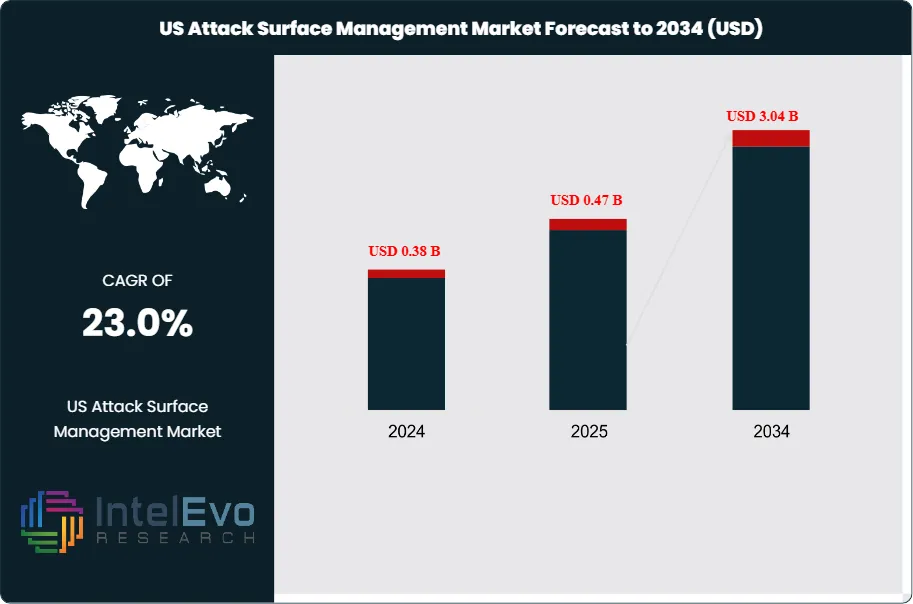
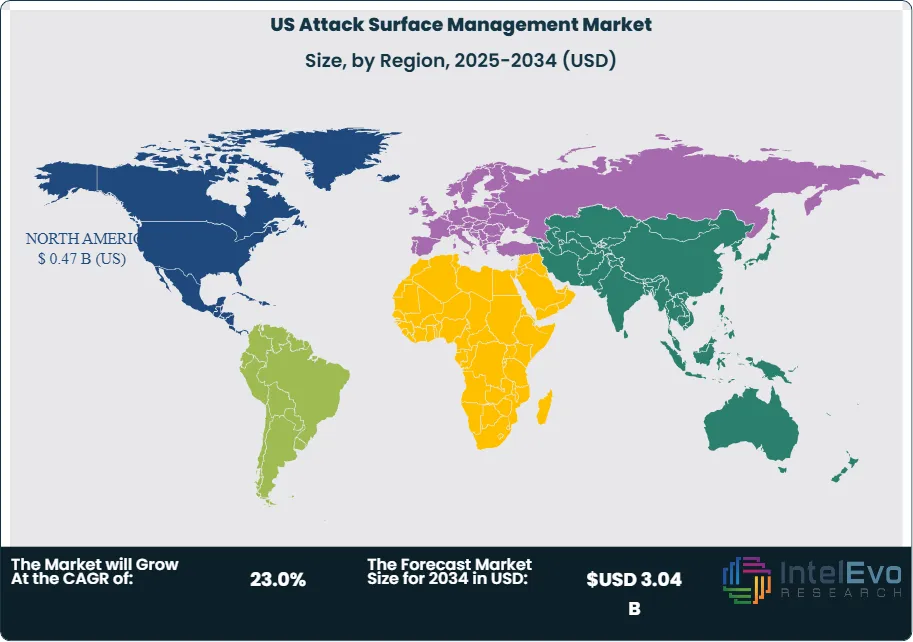
The U.S. Attack Surface Management Market was valued at USD 0.38 Billion in 2024 and reached USD 0.47 Billion in 2025. The market is projected to reach USD 3.04 Billion by 2034, expanding at a CAGR of 23.0% during the forecast period from 2026 to 2034. The market is experiencing robust growth driven by the rising frequency of sophisticated cyberattacks, rapid cloud adoption, expanding remote and hybrid work environments, and increasing digital transformation across enterprises. Organizations are increasingly investing in attack surface management solutions to continuously discover internet-facing assets, identify security gaps, and reduce cyber risk across complex IT ecosystems.
The growing adoption of Zero Trust security architectures, AI-powered threat intelligence, and automated exposure management platforms is further strengthening market demand across the United States. In addition, stringent cybersecurity regulations, increasing investments in critical infrastructure protection, and rising demand for proactive cyber risk management across BFSI, healthcare, government, defense, manufacturing, and technology sectors are expected to support sustained market growth throughout the forecast period from 2026 to 2034.
Get More Information about this report -
Request Free Sample ReportKey Market Segment
By Offering
- Solutions
- Services
By Deployment
- Cloud-Based
- On-Premises
By Application
- Threat Intelligence
- Vulnerability Management
- Risk Assessment
- Compliance Management
- Asset Discovery & Monitoring
- Others
By End-User
- BFSI
- Government & Defense
- Healthcare
- IT & Telecommunications
- Retail & E-commerce
- Manufacturing
- Others
By Regional Coverage
- US
| Report Attribute | Details |
| Market size (2025) | USD 0.47 B |
| Forecast Revenue (2034) | USD 3.04 B |
| CAGR (2025-2034) | 23.0% |
| Historical data | 2021-2025 |
| Base Year For Estimation | 2025 |
| Forecast Period | 2026-2034 |
| Report coverage | Revenue Forecast, Competitive Landscape, Market Dynamics, Growth Factors, Trends and Recent Developments |
| Segments covered | By Offering, (Solutions, Services), By Deployment, (Cloud-Based, On-Premises), By Application, (Threat Intelligence, Vulnerability Management, Risk Assessment, Compliance Management, Asset Discovery & Monitoring, Others), By End-User, (BFSI, Government & Defense, Healthcare, IT & Telecommunications, Retail & E-commerce, Manufacturing, Others), |
| Research Methodology |
|
| Regional scope |
|
| Competitive Landscape | PALO ALTO NETWORKS, INC., MICROSOFT CORPORATION, CROWDSTRIKE HOLDINGS, INC., TENABLE HOLDINGS, INC., QUALYS, INC., RAPID7, INC., SERVICENOW, INC. / ARMIS, INTERNATIONAL BUSINESS MACHINES CORPORATION, GOOGLE CLOUD / MANDIANT, CISCO SYSTEMS, INC., SENTINELONE, INC., BITSIGHT TECHNOLOGIES, INC., CYCOGNITO LTD., IONIX LTD., AXONIUS, INC., RUNZERO, INC., ARCTIC WOLF NETWORKS, INC., BALBIX, INC., NETSPI LLC, OTHERS |
| Customization Scope | Customization for segments, region/country-level will be provided. Moreover, additional customization can be done based on the requirements. |
| Pricing and Purchase Options | Avail customized purchase options to meet your exact research needs. We have three licenses to opt for: Single User License, Multi-User License (Up to 5 Users), Corporate Use License (Unlimited User and Printable PDF). |


Frequently Asked Questions
How big is the US Attack Surface Management Market?
The U.S. Attack Surface Management Market was valued at USD 0.38 Billion in 2024 and is projected to reach USD 3.04 Billion by 2034, growing at a CAGR of 23.0% during the forecast period 2026–2034.
Who are the major players in the US Attack Surface Management Market?
PALO ALTO NETWORKS, INC., MICROSOFT CORPORATION, CROWDSTRIKE HOLDINGS, INC., TENABLE HOLDINGS, INC., QUALYS, INC., RAPID7, INC., SERVICENOW, INC. / ARMIS, INTERNATIONAL BUSINESS MACHINES CORPORATION, GOOGLE CLOUD / MANDIANT, CISCO SYSTEMS, INC., SENTINELONE, INC., BITSIGHT TECHNOLOGIES, INC., CYCOGNITO LTD., IONIX LTD., AXONIUS, INC., RUNZERO, INC., ARCTIC WOLF NETWORKS, INC., BALBIX, INC., NETSPI LLC, OTHERS
Which segments covered the US Attack Surface Management Market?
By Offering, (Solutions, Services), By Deployment, (Cloud-Based, On-Premises), By Application, (Threat Intelligence, Vulnerability Management, Risk Assessment, Compliance Management, Asset Discovery & Monitoring, Others), By End-User, (BFSI, Government & Defense, Healthcare, IT & Telecommunications, Retail & E-commerce, Manufacturing, Others),
How can this market research report help my business make strategic decisions?
Our market research reports provide actionable intelligence, including verified market size data, CAGR projections, competitive benchmarking, and segment-level opportunity analysis. These insights support strategic planning, investment decisions, product development, and market entry strategies for enterprises and startups alike.
How frequently is the data updated?
We continuously monitor industry developments and update our reports to reflect regulatory changes, technological advancements, and macroeconomic shifts. Updated editions ensure you receive the latest market intelligence.

Select Licence Type
Connect with our sales team

US Attack Surface Management Market
Published Date : 23 Jul 2026 | Formats :Why IntelEvoResearch
100%
Customer
Satisfaction
24x7+
Availability - we are always
there when you need us
200+
Fortune 50 Companies trust
IntelEvoResearch
80%
of our reports are exclusive
and first in the industry
100%
more data
and analysis
1000+
reports published
till date