

- Home
- Industries
 Aerospace And Defence
 Agriculture
 Automotive And Transportation
 Banking And Finance
 Business
 Chemicals And Materials
 Consumer And Retail
 Electronics And Semiconductors
 Food And Beverages
 Machinery & Equipments
 Manufacturing And Construction
 Medical Devices
 Others
 Pharmaceuticals And Healthcare
 Power And Energy
 Sports
 Technology
- Services
- News Room
- About us
- Contact Us
-
U.S. Check Cashing Market Size & CAGR 2025–2034
US Check Cashing Market Size, Share & Alternative Financial Services Analysis By Service Type (Payroll, Government, Personal Checks), By Consumer Segment (Unbanked, Underbanked), Digital Integration Trends, Regulatory Landscape, Key Operators & Forecast 2025–2034

Report Overview
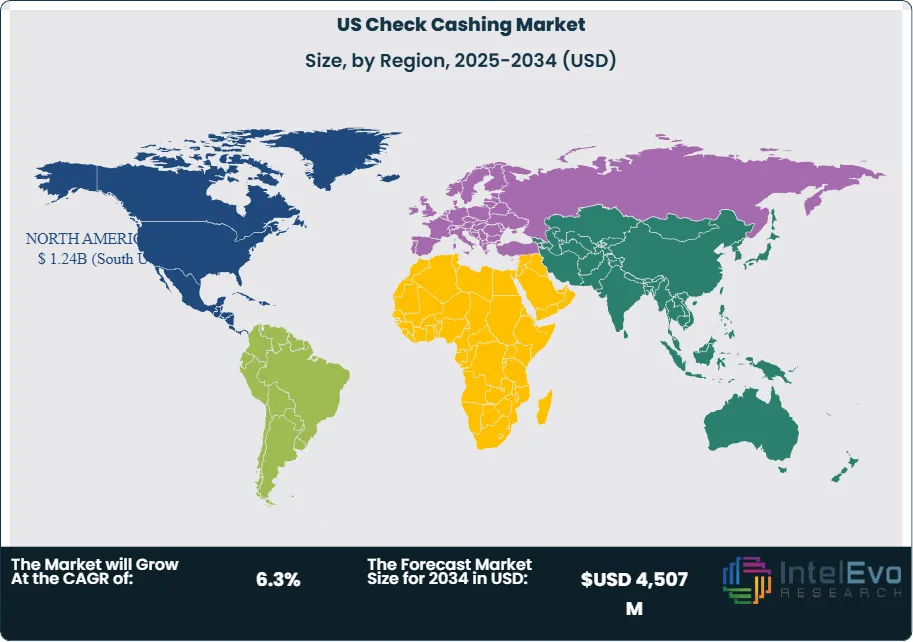
The U.S. check cashing market is estimated at USD 3,075 million in 2024 and is projected to reach approximately USD 4,507 million by 2034, registering a CAGR of about 6.3% during 2025–2034. This sustained expansion is driven by continued reliance on alternative financial services among unbanked and underbanked households, steady volumes of payroll and government benefit checks, and the concentration of demand in urban and low-income communities. Additionally, the gradual integration of digital check cashing platforms, mobile verification tools, and fintech partnerships is improving service reach and operational efficiency, reinforcing long-term market relevance across the United States.
_Size_by_Region.png.png)
The market has expanded steadily over the past decade, supported by a persistent segment of the population that remains outside the traditional banking system. Approximately 13,000 outlets across the country process more than USD 58 billion in checks annually, underscoring the scale and resilience of this financial service. Growth is expected to continue as demand for immediate liquidity and accessible financial solutions remains strong.
The primary driver is the high proportion of unbanked and underbanked households, which together account for nearly 5.9% of US households according to recent Federal Deposit Insurance Corporation surveys. For these consumers, check cashing provides a direct and reliable means of accessing wages and government benefits without the delays or requirements of conventional banking. Payroll checks remain the dominant transaction type, reflecting the essential role of these services in bridging income distribution gaps. Small businesses also contribute to demand, using check cashing to manage working capital and maintain cash flow flexibility.
The market faces challenges from regulatory scrutiny, particularly regarding fee structures and consumer protection standards. Compliance costs and potential restrictions on service charges could pressure margins for operators. At the same time, competition from digital payment platforms and prepaid debit cards is reshaping consumer preferences. However, the convenience and immediacy of physical outlets continue to sustain a loyal customer base, especially in lower-income communities where digital adoption is slower.
Technology is beginning to reshape the sector. Providers are introducing mobile applications, remote deposit capture, and digital wallets to attract younger users and extend services beyond physical locations. Integration of artificial intelligence for fraud detection and transaction monitoring is also gaining traction, improving security and operational efficiency. These advancements are expected to create new revenue streams while maintaining relevance in a changing financial landscape.
Regionally, demand is concentrated in urban centers with higher proportions of unbanked populations, including parts of California, Texas, and New York. Emerging opportunities are visible in secondary cities where banking penetration remains limited. For investors, the market offers steady cash flows, repeat customer engagement, and potential upside from digital expansion. The combination of entrenched demand and gradual modernization positions the US check cashing market for sustained growth through 2034.

Key Takeaways
- Market Growth: The US check cashing market is projected to expand from USD 3,075 million in 2024 to USD 4,507 million by 2034, reflecting a CAGR of 6.3%. Growth is supported by persistent demand from unbanked and underbanked households, which account for nearly 6% of US households.
- Product Type: Payroll checks represented 36.7% of total transactions in 2024, making them the largest product category. The segment remains critical as many workers without bank accounts rely on immediate access to wages.
- End Use: The personal use segment accounted for 68.6% of market share in 2024. This reflects strong demand for cashing government-issued checks, tax refunds, and insurance settlements, which remain essential for households managing daily liquidity needs.
- Distribution Channel: Retail and convenience stores processed 48.6% of check cashing transactions in 2024. Their dominance is driven by widespread geographic presence, extended operating hours, and integration of check cashing into broader financial service offerings.
- Driver: The market is fueled by the 13,000 check cashing outlets across the US that collectively process over USD 58 billion annually. Convenience and immediacy remain decisive factors for repeat usage.
- Restraint: Regulatory scrutiny on fee structures and compliance requirements poses a challenge. Potential caps on service charges could compress margins for operators, particularly smaller outlets.
- Opportunity: Digital platforms, including mobile check deposit and prepaid debit card integration, represent a high-growth area. Providers adopting digital channels are positioned to capture younger demographics and expand beyond traditional walk-in customers.
- Trend: Technology adoption is accelerating, with operators deploying AI-driven fraud detection and mobile applications. Early movers in digital check cashing are reporting higher transaction volumes and improved customer retention.
- Regional Analysis: Demand is concentrated in urban centers such as California, Texas, and New York, where unbanked populations are higher. Secondary cities with limited banking penetration present emerging growth opportunities, with projected above-average CAGR through 2034.
Type Analysis
As of 2025, payroll checks continue to represent the largest share of the US check cashing market, accounting for more than 36% of total transactions. This dominance reflects the ongoing reliance on paper-based wage distribution in industries where direct deposit adoption remains limited. Despite the steady expansion of digital payroll systems, a significant portion of workers—particularly in small businesses, construction, and service sectors—still receive physical checks, sustaining demand for immediate cashing services.
Government-issued checks, including tax refunds and social security payments, remain another important category, generating over USD 315 million in revenue in 2024 and expected to expand steadily through 2030. Personal checks, while declining in use, continue to account for nearly USD 185 million annually, supported by older demographics and small-scale transactions. Cashier’s checks and insurance checks together contribute a smaller but stable share, reflecting their role in settlement payments and claims processing.
The resilience of payroll and government checks is reinforced by their security features and regulatory oversight, which enhance consumer trust. At the same time, technology integration—such as mobile check imaging and automated kiosks—has streamlined processing, reducing wait times and expanding accessibility. These developments ensure that check cashing remains a critical financial service for unbanked and underbanked populations, even as digital alternatives expand.
Service Providers Analysis
Retail and convenience stores remain the dominant service providers, capturing nearly 49% of the market in 2024 and expected to maintain leadership through 2030. Their strength lies in accessibility, with thousands of outlets across both urban and rural areas, extended operating hours, and minimal entry requirements for customers. In 2024, these outlets generated more than USD 1 billion in revenue, underscoring their role as the primary access point for check cashing services.
Dedicated check-cashing stores accounted for approximately USD 651 million in 2024, serving as specialized providers for repeat customers who rely on consistent, fast transactions. Banks and credit unions, while representing a smaller share at under USD 200 million, continue to attract customers seeking regulated environments, though their stricter requirements and longer processing times limit broader adoption.
The competitive edge of retail and convenience stores is further strengthened by the integration of additional financial services such as bill payments, prepaid cards, and money transfers. The adoption of automated verification systems and point-of-sale integration has also improved transaction security, reducing fraud risks and enhancing consumer confidence. This multi-service model positions retail outlets as the most resilient and adaptable providers in the market.
End-Use Analysis
The personal segment dominates the US check cashing market, representing nearly 69% of total transactions in 2024 and projected to remain the largest category through 2030. Individuals use these services primarily to access wages, government benefits, and refunds quickly, bypassing delays associated with traditional banks. For many households, especially those without bank accounts, check cashing provides essential liquidity for rent, utilities, and daily expenses.
Commercial users, including small businesses and contractors, accounted for approximately USD 649 million in 2024. These businesses often rely on check cashing to manage working capital, pay suppliers, and maintain cash flow flexibility. While smaller in scale compared to personal use, the commercial segment is expected to grow steadily as small enterprises continue to seek faster alternatives to bank processing.
The dominance of the personal segment is reinforced by the trust and familiarity consumers have with local providers, particularly retail outlets and dedicated check-cashing stores. For many users, the immediacy and simplicity of these services outweigh the potential cost savings of traditional banking, ensuring sustained demand across both urban and rural communities.
Regional Analysis
The US check cashing market is concentrated in states with higher proportions of unbanked and underbanked populations. California, Texas, and New York remain the largest markets, collectively accounting for more than one-third of national revenue in 2024. These states benefit from large urban populations, diverse labor markets, and significant demand for payroll and government check cashing.
Emerging growth opportunities are visible in secondary cities across the Midwest and Southeast, where banking penetration remains limited and reliance on alternative financial services is higher. Regions such as Florida and Illinois are expected to record above-average growth rates through 2030, supported by demographic shifts and steady inflows of migrant workers who often depend on check cashing for wage access.
Looking ahead, regional growth will be shaped by regulatory environments and the pace of digital adoption. States with supportive frameworks for alternative financial services are likely to see sustained expansion, while stricter fee regulations may slow growth in others. For investors, urban centers with high transaction volumes remain the most attractive markets, while underserved rural areas present long-term opportunities for expansion through mobile and hybrid service models.
Get More Information about this report -
Request Free Sample ReportMarket Key Segments
By Types
- Government Checks
- Payroll Checks
- Cashier’s Checks
- Insurance Checks
- Retirement Checks
- Personal Checks
- Others (Business Checks, etc.)
By Service Providers
- Retail & Convenience Stores
- Check-Cashing Stores
- Banks and Credit Unions
- Others (online services, mobile apps, etc.)
By End User
- Personal
- Commercial
Regions
- U.S.A.
| Report Attribute | Details |
| Market size (2024) | USD 3,075 M |
| Forecast Revenue (2034) | USD 4,507 M |
| CAGR (2024-2034) | 6.3% |
| Historical data | 2020-2023 |
| Base Year For Estimation | 2024 |
| Forecast Period | 2025-2034 |
| Report coverage | Revenue Forecast, Competitive Landscape, Market Dynamics, Growth Factors, Trends and Recent Developments |
| Segments covered | By Types (Government Checks, Payroll Checks, Cashier’s Checks, Insurance Checks, Retirement Checks, Personal Checks, Others (Business Checks, etc.)), By Service Providers (Retail & Convenience Stores, Check-Cashing Stores, Banks and Credit Unions, Others (online services, mobile apps, etc.)), By End User (Personal, Commercial) |
| Research Methodology |
|
| Regional scope |
|
| Competitive Landscape | Moneytree, Inc., PayPal, CFSC (Community Financial Service Centers), ACE Cash Express, United Check Cashing, The Check Cashing Store, Friendly Check Cashing, Inc., Western Union, Walmart, MoneyGram International, Inc., PLS Financial Services, Inc., Pay-O-Matic, Speedy Cash |
| Customization Scope | Customization for segments, region/country-level will be provided. Moreover, additional customization can be done based on the requirements. |
| Pricing and Purchase Options | Avail customized purchase options to meet your exact research needs. We have three licenses to opt for: Single User License, Multi-User License (Up to 5 Users), Corporate Use License (Unlimited User and Printable PDF). |


Frequently Asked Questions
How big is the US Check Cashing Market?
The U.S. check cashing market was valued at USD 3.07B in 2024 and is forecast to reach USD 4.51B by 2034, growing at a 6.3% CAGR, driven by unbanked households and fintech integration.
Who are the major players in the US Check Cashing Market?
Moneytree, Inc., PayPal, CFSC (Community Financial Service Centers), ACE Cash Express, United Check Cashing, The Check Cashing Store, Friendly Check Cashing, Inc., Western Union, Walmart, MoneyGram International, Inc., PLS Financial Services, Inc., Pay-O-Matic, Speedy Cash
Which segments covered the US Check Cashing Market?
By Types (Government Checks, Payroll Checks, Cashier’s Checks, Insurance Checks, Retirement Checks, Personal Checks, Others (Business Checks, etc.)), By Service Providers (Retail & Convenience Stores, Check-Cashing Stores, Banks and Credit Unions, Others (online services, mobile apps, etc.)), By End User (Personal, Commercial)
How can this market research report help my business make strategic decisions?
Our market research reports provide actionable intelligence, including verified market size data, CAGR projections, competitive benchmarking, and segment-level opportunity analysis. These insights support strategic planning, investment decisions, product development, and market entry strategies for enterprises and startups alike.
How frequently is the data updated?
We continuously monitor industry developments and update our reports to reflect regulatory changes, technological advancements, and macroeconomic shifts. Updated editions ensure you receive the latest market intelligence.

Select Licence Type
Connect with our sales team

Why IntelEvoResearch
100%
Customer
Satisfaction
24x7+
Availability - we are always
there when you need us
200+
Fortune 50 Companies trust
IntelEvoResearch
80%
of our reports are exclusive
and first in the industry
100%
more data
and analysis
1000+
reports published
till date
