

- Home
- Industries
 Aerospace And Defence
 Agriculture
 Automotive And Transportation
 Banking And Finance
 Business
 Chemicals And Materials
 Consumer And Retail
 Electronics And Semiconductors
 Food And Beverages
 Machinery & Equipments
 Manufacturing And Construction
 Medical Devices
 Others
 Pharmaceuticals And Healthcare
 Power And Energy
 Sports
 Technology
- Services
- News Room
- About us
- Contact Us
-
US Decellularized Tissue Market Size & Forecast | CAGR of 9.6%
US Decellularized Tissue Market Size, Share, Analysis By Source (Human, Animal, Synthetic/Bioengineered), By Application (Cardiovascular, Orthopedic, Wound Healing & Skin Regeneration), By End User (Hospitals, Clinics, Research Institutes) Region, Key Players – Dynamics, Extracellular Matrix (dECM) Scaffolds & Tissue Engineering Trends & Forecast 2026-2034

Report Overview
| Market Size (2025) | Forecast Value (2034) | CAGR (2026-2034) | Largest Region (2025) |
|---|---|---|---|
| USD 3.95 Billion | USD 8.83 Billion | 9.4% | North America, 44.8% |
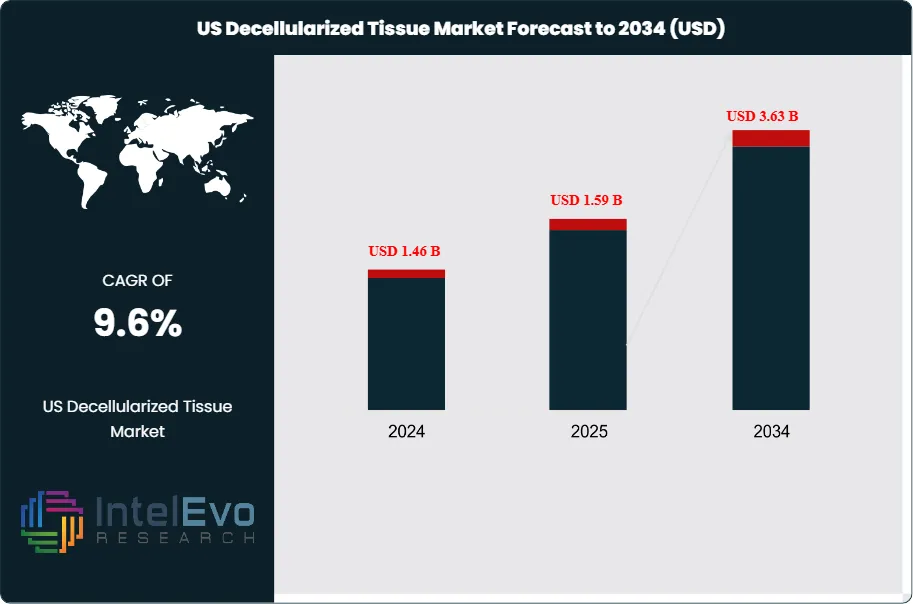
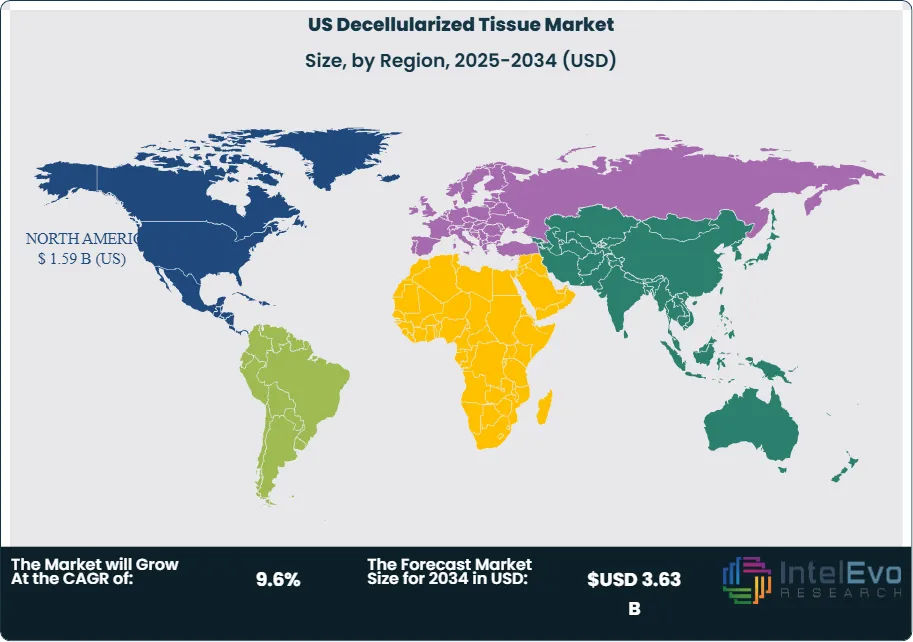
The U.S. Decellularized Tissue Market was valued at USD 1.46 Billion in 2024 and reached USD 1.59 Billion in 2025. The market is projected to grow to USD 3.63 Billion by 2034, expanding at a CAGR of 9.6% during the forecast period from 2026 to 2034. While The Global Decellularized Tissue Market was valued at USD 3.63 Billion in 2024 and reached USD 3.95 Billion in 2025. The market is projected to grow to USD 8.83 Billion by 2034, expanding at a CAGR of 9.4% during the forecast period from 2026 to 2034. This represents an absolute dollar opportunity of USD 4.88 Billion over the analysis period.
Get More Information about this report -
Request Free Sample ReportDemand for the decellularized tissue market is anchored in three converging clinical priorities: cell-free scaffolds that resist immunogenic rejection, off-the-shelf availability for trauma and reconstructive procedures, and host-cell remodeling capacity that conventional synthetic meshes cannot deliver. Across orthopedic, cardiovascular, dermal, and peripheral nerve indications, surgeon preference has migrated toward acellular biologic matrices because clinical evidence now spans more than two decades for first-generation products such as AlloDerm and SurgiMend. Hospital procurement teams have responded by adding decellularized SKUs to standing formularies for breast reconstruction, hernia repair, and diabetic foot ulcer programs.
Regulatory architecture has tightened around the decellularized tissue market in ways that favor incumbents with deep dossiers. Most acellular dermal matrices in the United States fall under the FDA's Section 361 Human Cells, Tissues, and Cellular and Tissue-Based Products framework, while decellularized cardiac and vascular constructs typically pursue 510(k) clearance or Premarket Approval. On December 19, 2024, the FDA granted full approval to Humacyte's Symvess (acellular tissue engineered vessel-tyod) for extremity arterial trauma, which set a new regulatory benchmark for off-the-shelf bioengineered conduits. Additional weight came on December 5, 2025, when the FDA approved Axogen's Biologics License Application for Avance Nerve Graft, a processed human nerve allograft, granting 12 years of market exclusivity. Together, these clearances expanded the addressable label space for decellularized tissue products by roughly USD 600 Million in immediate trauma and peripheral nerve indications.
Innovation pressure runs along two technical vectors within the decellularized tissue market. The first is decellularization protocol refinement, where MATRACELL processing at LifeNet Health, SynerGraft processing at Artivion, and patent-protected enzymatic methods at Integra LifeSciences have each demonstrated residual donor DNA reductions exceeding 97% while preserving collagen and elastin architecture. The second vector is alternative tissue sourcing, where ovine forestomach matrix from Aroa Biosurgery and intact Atlantic cod skin from Kerecis (a Coloplast subsidiary since 2023) avoid mammalian zoonotic risk profiles. North America accounted for an estimated 44.8% of 2025 revenue, supported by mature tissue banking infrastructure and the highest installed base of biologic graft procedures globally. Asia Pacific is forecast to expand at a 12.6% CAGR through 2034 because of China's National Medical Products Administration scaffold guidance and Japan's PMDA conditional approval pathway for regenerative medicine constructs.
Market Definition and Scope
The decellularized tissue market is defined as the global commercial supply of biologic scaffolds derived from human or animal tissues that have undergone validated decellularization processes to remove cellular and nuclear material while preserving extracellular matrix architecture, collagen composition, and bioactive growth factor content. The market encompasses acellular dermal matrices, decellularized small intestinal submucosa, decellularized pericardium and heart valves, processed nerve allografts, decellularized adipose and bone matrices, and ovine, porcine, bovine, and piscine xenograft products supplied as sheets, particulates, powders, or pre-shaped implants.
Included in this analysis are commercial finished products distributed under FDA Section 361 HCT/P regulation, 510(k) clearance, Premarket Approval, BLA approval, and equivalent CE-marked Class III medical device pathways in Europe. Excluded from scope are fully synthetic polymer scaffolds without extracellular matrix content, recombinant collagen products manufactured without donor tissue input, cellularized tissue-engineered constructs containing live cells at the point of implantation, and demineralized bone matrix products processed primarily for osteoinductive rather than scaffolding purposes. The decellularized tissue market sits inside the broader tissue engineering parent market, representing approximately 18% of total tissue engineering revenue in 2025.

Key Takeaways
- Market Growth: The decellularized tissue market reached USD 3.95 Billion in 2025 and is forecast to climb to USD 8.83 Billion by 2034 at a 9.4% CAGR.
- Segment Dominance: By tissue source, acellular dermal matrix held 38.4% of the decellularized tissue market in 2025, anchored by breast reconstruction and hernia repair volumes.
- Segment Dominance: By application, soft tissue reconstruction accounted for 32.7% of 2025 revenue, with wound and burn management as the fastest-expanding indication.
- Driver: Decellularized scaffolds within the soft tissue allograft category are forecast to grow at an 8.1% CAGR, outpacing fresh-frozen alternatives, on the basis of reduced rejection and improved host integration.
- Restraint: Donor tissue procurement constraints and cGMP processing costs keep average selling prices 30-50% above conventional grafts, throttling adoption in low-reimbursement geographies.
- Opportunity: Asia Pacific represents the largest expansion runway, with regional revenue projected to climb from USD 720 Million in 2025 to roughly USD 2.2 Billion by 2034.
- Trend: Off-the-shelf bioengineered acellular vessels reached commercial reality in 2025, with Symvess shipping into 21 hospital VAC processes within two months of launch.
- Regional: North America held the leading regional position at 44.8% revenue share, equating to USD 1.77 Billion in 2025.
Key Insights Summary
- Per Axogen's Q4 2025 earnings disclosure, the December 2025 FDA approval of Avance Nerve Graft delivered the first biologic therapeutic clearance for peripheral nerve discontinuities, paired with 12 years of market exclusivity.
- Artivion's SynerGraft-processed CryoValve SGPV registered 83% freedom from conduit dysfunction at 10 years against a 50% benchmark for standard cryopreserved allografts, per the company's 2024 annual report filed February 28, 2025.
- Effective January 1, 2026, the Centers for Medicare & Medicaid Services created a Level 3 Nerve Procedure Code that lifted facility reimbursement for Avance to USD 8,965 in hospital outpatient settings, a 40% increase year over year.
- Humacyte's Symvess, cleared by the FDA on December 19, 2024, entered commercial circulation in February 2025 and was added to the U.S. Defense Logistics Agency Electronic Catalog in July 2025 for Department of Defense and VA hospital procurement.
- LifeNet Health's MATRACELL technology removes greater than 97% of donor genetic material from human dermal allografts while sustaining a sterility assurance level of 10⁻⁶ on terminally sterilized Dermacell Porous, which became available across the United States in April 2025.
- A Bioengineering peer-reviewed analysis published December 26, 2025 codified residual DNA thresholds for clinical-grade decellularized extracellular matrix at less than 50 ng per mg of dry tissue, establishing a quantitative manufacturing benchmark.
Competitive Landscape Overview
The decellularized tissue market is moderately consolidated, with the top four companies controlling an estimated 41% of 2025 global revenue. Competitive dynamics turn on three pivots: proprietary decellularization technology, regulatory pathway depth (PMA and BLA dossiers carry the most strategic weight), and surgeon-level clinical evidence accumulation. Pricing rivalry has intensified within acellular dermal matrices, where bovine, porcine, and human-derived alternatives now compete on outcome data rather than discount tiers. M&A activity over the trailing 18 months has tilted toward vertical integration, with Coloplast's Kerecis subsidiary expanding manufacturing capacity and RTI Surgical adding xenograft collagen capability via its November 2024 Collagen Solutions transaction.
Competitive Landscape Matrix
| Company | Headquarters | Market Position | Key Product | Geographic Strength | Recent Strategic Move |
|---|---|---|---|---|---|
| Integra LifeSciences | Princeton, NJ, USA | Leader | SurgiMend Collagen Matrix | North America, EMEA | PMA approvable notification received for SurgiMend; Braintree manufacturing transition slated for first-half 2026 |
| AbbVie (Allergan Aesthetics) | North Chicago, IL, USA | Leader | AlloDerm RTM, Strattice RTM | North America | Continued AlloDerm and Strattice promotion in implant-based breast reconstruction post-FDA 2021 safety communication |
| Coloplast (Kerecis) | Humlebæk, Denmark | Leader | Kerecis Omega3 Wound | North America, Europe | Closed Kerecis acquisition for upfront USD 1.2 Billion; revenue tracking 30% three-year CAGR through FY2025/26 |
| Stryker (LifeNet Health partnership) | Kalamazoo, MI, USA | Leader | DermACELL | North America | Distribution of Dermacell Porous expanded across the United States in April 2025 |
| Artivion | Kennesaw, GA, USA | Challenger | CryoValve SG, CryoPatch SG | North America | PMA approval for CryoValve SGPV anticipated in 2026 for full commercial distribution |
| Axogen | Alachua, FL, USA | Challenger | Avance Nerve Graft | North America | FDA BLA approval received on December 5, 2025; closed USD 133.3 Million upsized public offering in January 2026 |
| Humacyte | Durham, NC, USA | Niche Player | Symvess ATEV | North America | Commercial launch of Symvess in February 2025; ECAT listing secured in July 2025 |
| Aroa Biosurgery | Auckland, New Zealand | Niche Player | Endoform, Myriad Matrix | Asia Pacific, North America | Published clinical evidence on Myriad in trauma and acute care surgery on January 23, 2026 |
| Cook Biotech | West Lafayette, IN, USA | Challenger | Surgisis (porcine SIS) | North America, Global | Continued OEM supply of decellularized SIS to multiple wound care licensees |
| Organogenesis | Canton, MA, USA | Challenger | PuraPly AM, Affinity | North America | Posted USD 564.2 Million 2025 net revenue; rolling BLA submission for ReNu initiated late 2025 |
By Tissue Source
Acellular dermal matrix dominated the decellularized tissue market with 38.4% revenue share in 2025, equivalent to USD 1.52 Billion. Human-derived ADM products such as AlloDerm and DermACELL retain leadership in breast reconstruction because longitudinal datasets exceeding 25 years support reimbursement claims, while bovine fetal matrix products like SurgiMend hold ground in hernia repair where Type III collagen content delivers higher initial tensile loading. Porcine ADM, including Strattice and DSM's pericardium-based ECM sheets, has captured share in ventral hernia repair because non-crosslinked porcine matrices enable cellular infiltration and neovascularization without compromising scaffold strength.
Decellularized small intestinal submucosa and pericardium accounted for 21.6% of 2025 revenue, supported by Cook Biotech's porcine SIS supply chain feeding licensees including Sanara MedTech for FORTIFY ECM and TRG products. Cardiac applications in this segment center on Artivion's SynerGraft-processed CryoValve SG pulmonary heart valve, which received the first FDA 510(k) clearance for a decellularized human heart valve. Multi-center evidence at the 10-year mark indicates 83% freedom from conduit dysfunction with SGPV against 50% with standard allografts, reinforcing payer willingness to fund higher unit prices in pediatric congenital heart programs.
Processed nerve allografts and acellular vessels combined for 14.3% of 2025 revenue. The Axogen Avance Nerve Graft posted USD 225.2 Million in full-year 2025 revenue and grew 20.2% over 2024, with the December 2025 BLA approval enabling reclassification as a biologic and unlocking the new CMS Level 3 reimbursement code. Humacyte's Symvess opened a fresh sub-segment in extremity vascular trauma after its December 19, 2024 FDA full approval, with 21 hospitals initiating Value Analysis Committee processes within two months of the February 2025 launch.
Decellularized adipose, bone, fascia, and other connective matrices made up the remaining 25.7% of revenue, including ovine forestomach matrix products from Aroa Biosurgery (Endoform, Myriad Matrix, Ovitex) and decellularized bone scaffolds processed for orthopedic and dental indications. Comparatively, dermal matrix volumes grew at 8.4% in 2025 while processed nerve allograft revenue grew at 20.2%, reflecting the much earlier adoption curve in peripheral nerve repair.
By Application
Soft tissue reconstruction held 32.7% of the decellularized tissue market in 2025, driven by breast reconstruction and abdominal wall reconstruction procedure volumes. Hernia repair represented 18.9% of revenue, where xenograft acellular matrices have replaced human ADM as the surgeon-preferred option for ventral and incisional cases requiring high tensile strength. Wound and burn management captured 22.4% of revenue and is forecast to grow at an 8.95% CAGR through 2034 on the strength of diabetic foot ulcer protocols incorporating Kerecis fish skin, LifeNet Health Dermacell, and Organogenesis PuraPly AM.
Cardiovascular and vascular reconstruction accounted for 11.6% of 2025 revenue. Pediatric right heart reconstruction has emerged as the highest-value pocket because somatic growth evidence in over 70% of decellularized allograft recipients at five-year follow-up has been published in the Journal of the American College of Cardiology and Annals of Thoracic Surgery. Peripheral nerve repair and dental and oral surgery segments collectively represented 14.4% of revenue, with the latter underpinned by AlloDerm and Puros Dermis use in ridge augmentation and root coverage procedures.
By End User
Hospitals captured 56.7% of the decellularized tissue market in 2025, reflecting the concentration of complex cardiovascular, breast reconstruction, and trauma procedures in tertiary care settings. Ambulatory surgical centers accounted for 24.3% and are projected to grow at a 9.18% CAGR through 2031, helped by hernia repair migration to outpatient facilities and Medicare site-of-service neutrality adjustments. Specialty wound care clinics held 12.1% of revenue, while research institutions and CDMOs accounted for the remaining 6.9%, including OEM purchases of porcine SIS and bovine collagen feedstock from Cook Biotech and Collagen Solutions (now part of RTI Surgical).
U.S. Decellularized Tissue Market Regional Overview
The United States represents the largest and most mature market for decellularized tissue products, supported by its advanced healthcare infrastructure, strong regenerative medicine ecosystem, and high volume of reconstructive, cardiovascular, orthopedic, and wound care procedures. The country has witnessed significant adoption of decellularized extracellular matrix (ECM) biomaterials across multiple clinical applications due to their superior biocompatibility, reduced immunogenicity, and ability to promote natural tissue regeneration. Continuous investments in biomedical research, increasing organ transplantation requirements, and expanding utilization of biologic scaffolds in surgical procedures continue to strengthen market growth across the nation.
Regionally, the market is concentrated across major healthcare and life sciences hubs, including the Northeast, Midwest, South, and West, where leading academic medical centers, transplant institutes, biotechnology companies, and medical device manufacturers actively drive innovation in tissue engineering and regenerative therapies. The presence of established industry participants, favorable reimbursement for advanced surgical procedures, increasing clinical adoption of acellular dermal matrices, heart valve replacements, and soft tissue repair products, along with growing collaborations between research institutions and biotechnology companies, is expected to accelerate the commercialization of next-generation decellularized tissue technologies. As demand for regenerative biomaterials continues to expand, the U.S. Decellularized Tissue Market is anticipated to maintain steady growth throughout the forecast period from 2026 to 2034.
Get More Information about this report -
Request Free Sample ReportKey Market Segment
By Tissue Source
- Human Tissue
- Animal Tissue
- Synthetic/Bioengineered Tissue
By Application
- Cardiovascular Repair
- Orthopedic & Musculoskeletal Repair
- Wound Healing & Skin Regeneration
- Others
By End User
- Hospitals
- Specialty Clinics
- Research & Academic Institutes
- Others
By Regional Coverage
- US
| Report Attribute | Details |
| Market size (2025) | USD 1.59 B |
| Forecast Revenue (2034) | USD 3.63 B |
| CAGR (2025-2034) | 9.6% |
| Historical data | 2021-2025 |
| Base Year For Estimation | 2025 |
| Forecast Period | 2026-2034 |
| Report coverage | Revenue Forecast, Competitive Landscape, Market Dynamics, Growth Factors, Trends and Recent Developments |
| Segments covered | By Tissue Source, (Human Tissue, Animal Tissue, Synthetic/Bioengineered Tissue), By Application, (Cardiovascular Repair, Orthopedic & Musculoskeletal Repair, Wound Healing & Skin Regeneration, Others), By End User, (Hospitals, Specialty Clinics, Research & Academic Institutes, Others), |
| Research Methodology |
|
| Regional scope |
|
| Competitive Landscape | INTEGRA LIFESCIENCES HOLDINGS CORPORATION, ABBVIE INC. (ALLERGAN AESTHETICS), COLOPLAST A/S (KERECIS), AXOGEN, INC., ARTIVION, INC., HUMACYTE, INC., STRYKER CORPORATION, LIFENET HEALTH, MTF BIOLOGICS, AROA BIOSURGERY LIMITED, COOK BIOTECH INC., ORGANOGENESIS HOLDINGS INC., BAXTER INTERNATIONAL INC., MEDTRONIC PLC, BOSTON SCIENTIFIC CORPORATION, B. BRAUN MELSUNGEN AG, SMITH & NEPHEW PLC, DSM-FIRMENICH AG, RTI SURGICAL, INC., ELUTIA INC., Others |
| Customization Scope | Customization for segments, region/country-level will be provided. Moreover, additional customization can be done based on the requirements. |
| Pricing and Purchase Options | Avail customized purchase options to meet your exact research needs. We have three licenses to opt for: Single User License, Multi-User License (Up to 5 Users), Corporate Use License (Unlimited User and Printable PDF). |


Frequently Asked Questions
How big is the US Decellularized Tissue Market?
The U.S. Decellularized Tissue Market was valued at USD 1.46 Billion in 2024 and is projected to reach USD 3.63 Billion by 2034, growing at a CAGR of 9.6% during the forecast period 2026–2034.
Who are the major players in the US Decellularized Tissue Market?
INTEGRA LIFESCIENCES HOLDINGS CORPORATION, ABBVIE INC. (ALLERGAN AESTHETICS), COLOPLAST A/S (KERECIS), AXOGEN, INC., ARTIVION, INC., HUMACYTE, INC., STRYKER CORPORATION, LIFENET HEALTH, MTF BIOLOGICS, AROA BIOSURGERY LIMITED, COOK BIOTECH INC., ORGANOGENESIS HOLDINGS INC., BAXTER INTERNATIONAL INC., MEDTRONIC PLC, BOSTON SCIENTIFIC CORPORATION, B. BRAUN MELSUNGEN AG, SMITH & NEPHEW PLC, DSM-FIRMENICH AG, RTI SURGICAL, INC., ELUTIA INC., Others
Which segments covered the US Decellularized Tissue Market?
By Tissue Source, (Human Tissue, Animal Tissue, Synthetic/Bioengineered Tissue), By Application, (Cardiovascular Repair, Orthopedic & Musculoskeletal Repair, Wound Healing & Skin Regeneration, Others), By End User, (Hospitals, Specialty Clinics, Research & Academic Institutes, Others),
How can this market research report help my business make strategic decisions?
Our market research reports provide actionable intelligence, including verified market size data, CAGR projections, competitive benchmarking, and segment-level opportunity analysis. These insights support strategic planning, investment decisions, product development, and market entry strategies for enterprises and startups alike.
How frequently is the data updated?
We continuously monitor industry developments and update our reports to reflect regulatory changes, technological advancements, and macroeconomic shifts. Updated editions ensure you receive the latest market intelligence.

Select Licence Type
Connect with our sales team

US Decellularized Tissue Market
Published Date : 20 Jul 2026 | Formats :Why IntelEvoResearch
100%
Customer
Satisfaction
24x7+
Availability - we are always
there when you need us
200+
Fortune 50 Companies trust
IntelEvoResearch
80%
of our reports are exclusive
and first in the industry
100%
more data
and analysis
1000+
reports published
till date