

- Home
- Industries
 Aerospace And Defence
 Agriculture
 Automotive And Transportation
 Banking And Finance
 Business
 Chemicals And Materials
 Consumer And Retail
 Electronics And Semiconductors
 Food And Beverages
 Machinery & Equipments
 Manufacturing And Construction
 Medical Devices
 Others
 Pharmaceuticals And Healthcare
 Power And Energy
 Sports
 Technology
- Services
- News Room
- About us
- Contact Us
-
U.S. Drug-Target Interaction Platform Market Size, Share | CAGR of 13.8%
US Drug-Target Interaction Platform Market Size, Share & Analysis Report By Offering (Software Platforms, Services, Databases), By Technology (AI & Machine Learning, Molecular Docking, Network Analysis), By Application (Drug Discovery, Drug Repurposing, Target Identification, Lead Optimization), By End-User (Pharma, Biotech, Academic Institutes, CROs): Regional Segment Overview, Market Dynamics, Competitive Strategies, Trends & Forecast 2026–2034

Report Overview
| Market Size (2025) | Forecast Value (2034) | CAGR (2026-2034) | Largest Region (2025) |
| USD 1.42 Billion | USD 4.78 Billion | 14.4% | North America, 43.6% |
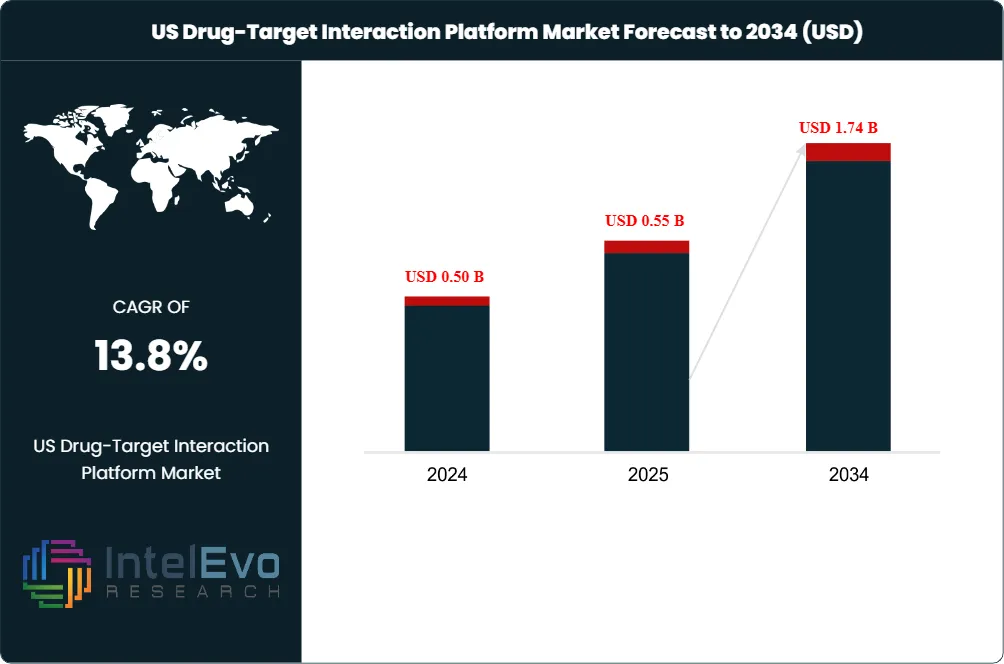
The U.S. Drug-Target Interaction Platform Market was valued at USD 0.50 Billion in 2024 and reached USD 0.55 Billion in 2025. The market is projected to reach USD 1.74 Billion by 2034, expanding at a CAGR of 13.8% during the forecast period from 2026 to 2034. While The Global Drug-Target Interaction Platform Market was valued at USD 1.31 Billion in 2024 and reached USD 1.42 Billion in 2025. The market is projected to reach USD 4.78 Billion by 2034, expanding at a CAGR of 14.4% during the forecast period from 2026 to 2034. This represents an absolute dollar opportunity of USD 3.36 Billion over the analysis period.
Get More Information about this report -
Request Free Sample ReportDemand for drug-target interaction platforms is being pulled by three forces. Biopharmaceutical R&D budgets above USD 250 Billion annually are shifting toward computation, with per-asset development costs cited at over USD 2 Billion in a Frontiers in Pharmacology analysis from October 2025. The May 2024 release of AlphaFold 3 by Google DeepMind and Isomorphic Labs raised the technical ceiling for protein-ligand structure prediction, allowing commercial DTI platforms to model previously intractable target classes including protein-protein interfaces, intrinsically disordered regions, and nucleic acid binding sites. More than 173 AI-discovered drug programs were in clinical development globally as of early 2026.
Regulatory anchoring is firming around AI-derived computational evidence. On January 6, 2025, the U.S. Food and Drug Administration issued draft guidance covering AI use in submissions for drugs and biologics, introducing a context-of-use credibility framework that platform vendors now reference in customer collateral. The European Medicines Agency followed with a first AI-methodology qualification opinion in March 2025. China's Ministry of Science and Technology earmarked roughly USD 1.4 Billion under its 14th Five-Year Plan to support AI in drug discovery.
Platform economics are bifurcating between physics-grounded incumbents and AI-native challengers. Schrödinger, Inc. reported full-year 2025 software revenue of USD 199.5 million (a 10.6% year-on-year increase) and drug discovery revenue of USD 56.4 million (more than double the prior year), while Isomorphic Labs closed a USD 600 million external financing in March 2025. Specialized DTI predictors such as Iambic Therapeutics' NeuralPLexer and the Tsinghua-developed DrugCLIP framework, published in Science in January 2026, demonstrated screening throughput up to ten million times faster than conventional docking on benchmark genome-scale runs.
North America held 43.6% of 2025 revenue, supported by FDA AI guidance and concentration of platform vendors in the Boston-San Francisco corridor. Asia Pacific is the fastest-growing region at a 17.2% expected CAGR through 2034, with China's investigational asset pipeline doubling to 4,391 between 2021 and 2024. Through 2034 the market is expected to consolidate around physics-plus-AI hybrid platforms, with foundation models for biomolecular structure becoming a baseline capability rather than a differentiator.
Market Definition & Scope
The drug-target interaction platform market is defined as the segment of drug discovery informatics that supplies software, services, and integrated computational systems used to predict, model, simulate, and quantify physical and functional interactions between candidate drug molecules and biological targets, including proteins, nucleic acids, and macromolecular complexes. The market encompasses molecular docking engines, free-energy perturbation tools, AI-based protein-ligand co-folding models, generative chemistry platforms with binding-affinity scoring, and interaction-focused biological knowledge graphs.
Included in this analysis are commercial software licenses, hosted SaaS subscriptions, paid API access to predictive models, and discovery-services revenue tied directly to platform-driven DTI workflows. Excluded are wet-lab assay services without an integrated computational platform, broad cheminformatics suites unrelated to interaction prediction, generic high-performance-computing infrastructure, and clinical trial informatics. The parent market is drug discovery informatics, sized at approximately USD 4.14 Billion in 2025; DTI platforms account for roughly 34% of that parent.

Key Takeaways
- Market Growth: The global drug-target interaction platform market was valued at USD 1.42 Billion in 2025 and is expected to reach USD 4.78 Billion by 2034 at a 14.4% CAGR.
- Segment Dominance (By Offering): The software sub-segment captured 71.4% revenue share in 2025, anchored by perpetual and hosted license deployments at major pharmaceutical companies.
- Segment Dominance (By Application): Target identification and validation held 38.7% share in 2025, the largest single application category.
- Driver: Per-drug development cost above USD 2 Billion has pushed 81% of large pharmaceutical companies to deploy AI-based DTI tools by 2025.
- Restraint: Public training data for protein-ligand binding affinity remains thin, with fewer than 600,000 high-quality structure-affinity pairs available, capping model accuracy in novel target classes.
- Opportunity: USD 3.36 Billion of absolute dollar opportunity exists between 2025 and 2034, with the molecular modeling sub-segment registering a 16.1% CAGR.
- Trend: Foundation models including AlphaFold 3, ESM-3, and NeuralPLexer are replacing rule-based docking as the default screening engine, with adoption above 60% among the top 20 pharmaceutical companies in 2025.
- Regional: North America held the largest share at 43.6%, equivalent to USD 619 million in 2025.
Key Insights Summary
- AI-derived clinical candidates posted Phase I success rates of 80-90% in peer-reviewed analyses cited during 2025, against a 40-65% historical average for conventionally discovered molecules.
- AlphaFold 3, released by Google DeepMind together with Isomorphic Labs in May 2024, outperformed dedicated docking software on protein-ligand benchmarks and models protein, nucleic acid, ligand, and ion structures within one diffusion-based framework.
- Insilico Medicine's TNIK inhibitor program, which used PandaOmics for target identification and Chemistry42 for compound generation, moved from novel target to first-in-human dosing in roughly 30 months.
- In a Science paper published January 2026, Tsinghua University researchers reported that the DrugCLIP framework matched a 10,000-protein human pocket library against billion-scale compound collections within hours.
- As of Q1 2026, more than 173 AI-discovered drug programs were in clinical development globally, with 15-20 entering Phase III trials during 2026.
- Chinese-origin platform deals reached 32% of global biotech licensing value in Q1 2025, up from 21% in 2023 and 2024.
Competitive Landscape Overview
The drug-target interaction platform market is moderately consolidated. The top four players combined held an estimated 26.8% revenue share in 2025, with the remainder split across roughly 35 specialized vendors and academic-origin platforms. Competition is anchored on technology depth (physics versus deep-learning architectures), pharmaceutical partnership quality, and clinical proof of concept on AI-designed assets. The Recursion-Exscientia merger closed November 2024 and produced the largest combined AI drug discovery entity by pipeline breadth, bringing together approximately 46 million biological images and more than 60 petabytes of proprietary data into one operating system. Foundation-model availability has compressed the cost structure: AlphaFold 3 access through Isomorphic Labs and the open AlphaFold Server has reduced the structure-prediction barrier that once defined incumbent moats.
Competitive evolution favors hybrid models. Schrödinger pairs physics-based simulation with machine learning for high-precision binding affinity, while Insilico Medicine and Iambic Therapeutics anchor on generative AI augmented by structure prediction. Pricing-tier disclosures from industry case studies indicate annual platform license costs of USD 500,000 to USD 2 million for mid-sized pharmaceutical buyers.
Competitive Landscape Matrix
| Company | HQ | Position | Key Product/Solution | Geographic Strength | Recent Strategic Move (trailing 18 months) |
| Schrödinger, Inc. | USA | Leader | Maestro, FEP+, LiveDesign | North America, Europe | Closed an expanded software and discovery deal with Novartis in November 2024: USD 150M upfront, up to USD 2.3B in milestones. |
| Isomorphic Labs Limited | UK | Leader | AlphaFold 3 drug design engine | North America, Europe | Banked USD 600M on March 31, 2025 in its first external round, led by Thrive Capital with GV and Alphabet. |
| Insilico Medicine, Inc. | Hong Kong/USA | Leader | Pharma.AI (PandaOmics, Chemistry42) | Asia Pacific, North America | Listed on the Hong Kong Stock Exchange on December 30, 2025, raising approximately USD 293M. |
| Recursion Pharmaceuticals, Inc. | USA | Leader | Recursion OS, Phenomaps | North America, Europe | Logged a fifth Sanofi discovery milestone in February 2026, totaling USD 134M to date. |
| Atomwise, Inc. | USA | Challenger | AtomNet | North America | Introduced a quantum-computing target discovery module in February 2025 for neurodegenerative indications. |
| Iambic Therapeutics, Inc. | USA | Challenger | NeuralPLexer, Enchant | North America | Inked a multi-year arrangement with Takeda in February 2026 worth more than USD 1.7B in potential value. |
| XtalPi Holdings Limited | China | Challenger | Quantum-AI drug design platform | Asia Pacific | Disclosed an up-to-USD 5.99B partnership with DoveTree in January 2025 covering oncology, immunology, and metabolic targets. |
| Certara, Inc. | USA | Challenger | D360, Chemaxon Design Hub | North America, Europe | Closed acquisition of Chemaxon in October 2024. |
| BenevolentAI | UK | Niche Player | Benevolent Platform knowledge graph | Europe | Continued execution of the AstraZeneca multi-target collaboration in chronic kidney disease and idiopathic pulmonary fibrosis. |
Segmentation Analysis
The drug-target interaction platform market is segmented across four dimensions: by offering, by technology approach, by application, and by end-user. Each dimension reveals different growth dynamics.
By Offering
The drug-target interaction platform market by offering is divided into software and services, with software dominant at 71.4% of 2025 revenue. Software covers perpetual and hosted licenses for docking engines, free-energy calculation tools, AI-based co-folding models, and platform suites. Schrödinger generated USD 199.5 million of software revenue in 2025 with a software gross margin of 74%, and reported a transition target of 75% hosted revenue by 2028. GPU-backed cloud APIs from NVIDIA BioNeMo, Schrödinger LiveDesign, and Isomorphic's drug design portal are pulling buyers away from on-premise installations.
The services sub-segment held 28.6% in 2025 and is registering a 17.3% CAGR, faster than software, as pharmaceutical buyers contract DTI specialists for project-specific virtual screens. Recursion Pharmaceuticals reported drug discovery revenue tied to partnerships with Roche, Genentech, Sanofi, and Bayer; cumulative milestone payments topped USD 500 million by year-end 2025. Iambic Therapeutics secured a Takeda collaboration in February 2026 valued at over USD 1.7 Billion in potential payments and continues to monetize NeuralPLexer under a Revolution Medicines arrangement worth up to USD 25 million.
By Technology
By technology, the market is divided into AI/ML-based platforms, physics-based platforms, and hybrid platforms. AI/ML-based platforms led with 47.3% revenue share in 2025, anchored by deep learning models such as AlphaFold 3, ESM-3, and NeuralPLexer. Insilico Medicine's Chemistry42 generated 78,000 virtual TNIK inhibitor candidates within a single program and produced a 16.7% experimental hit rate, against a typical 0.1% rate for conventional high-throughput screening.
Physics-based platforms held 28.4% share, with Schrödinger's free-energy perturbation engine producing zasocitinib (TAK-279), now in Phase III for psoriasis through Takeda. Hybrid platforms accounted for 24.3% and grow at 16.8% CAGR, the fastest sub-segment. XtalPi co-developed a quantum-physics-plus-AI platform with Pfizer that was expanded in June 2025, and Atomwise unveiled a quantum-computing module for neurodegenerative target discovery in February 2025.
By Application
By application, the market segments into target identification and validation, virtual screening and lead optimization, ADMET prediction, drug repurposing, and de novo design. Target identification and validation captured 38.7% of 2025 revenue. Tools such as Insilico's PandaOmics, BenevolentAI's knowledge graph, and Recursion's Phenomaps anchor this category. Recursion delivered a second neuroscience Phenomap to Genentech in 2025 for a USD 30 million milestone. The category benefits directly from FDA willingness, signaled in the January 2025 draft guidance, to consider in silico evidence in regulatory submissions.
Virtual screening and lead optimization held 27.5% share. The DrugCLIP framework reported in Science in January 2026 demonstrated genome-wide screening across 10,000 human proteins within hours, compared with weeks for conventional docking pipelines. ADMET prediction represented 14.2%, drug repurposing covered 11.0%, and de novo design covered 8.6%. De novo design is the fastest-growing application at 18.4% CAGR through 2034.
By End-User
Pharmaceutical and biotechnology companies represented 58.2% of 2025 revenue, the dominant end-user segment. All ten of the world's largest pharmaceutical companies have a partnership with at least one AI-driven discovery vendor, and 81% of pharmaceutical buyers now deploy AI tools across some portion of their R&D function. Schrödinger reported 15% growth in annual contract value from its top 20 pharmaceutical customers in 2025, while Isomorphic Labs operates active multi-target programs with Eli Lilly and Novartis worth nearly USD 3 Billion in upfront and milestone value.
Contract research organizations held 22.4% share. Charles River Laboratories expanded its Apollo platform in January 2025 to broaden client access. Academic and research institutes accounted for 14.6% and grow at 14.9% CAGR, the fastest end-user segment, as open AlphaFold Server access and falling cloud GPU prices put structure prediction within reach of small academic labs. Other end-users including government laboratories and non-profit consortia held 4.8% share.
Regional Analysis
United States
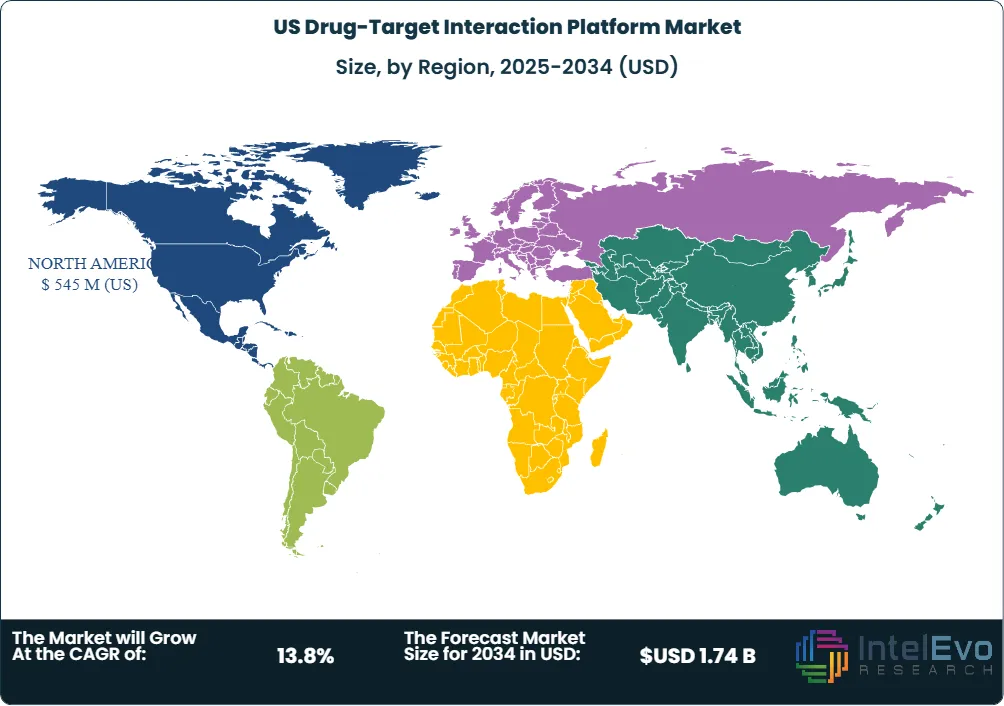
The United States drug-target interaction platform market was valued at USD 545 million in 2025 and is projected to grow at a country-specific CAGR of 13.8% through 2034. The country leads on three measures: vendor concentration, partnership volume, and regulatory clarity. The FDA's January 6, 2025 draft guidance on AI in regulatory decision-making created a credibility framework that platform vendors now reference in customer collateral, and 8 of the 13 largest pharmaceutical companies have urgent generative-AI replenishment programs against a USD 236 Billion patent cliff projected through 2030. NVIDIA and Eli Lilly opened a co-innovation AI lab in 2026, and venture capital deployed into AI drug startups topped USD 2.7 Billion through Q3 2025.
Get More Information about this report -
Request Free Sample ReportKey Market Segment
By Offering
- Software Platforms
- Services
- Databases
By Technology
- Artificial Intelligence (AI) & Machine Learning
- Molecular Docking
- Network-Based Analysis
- Others
By Application
- Drug Discovery
- Drug Repurposing
- Target Identification & Validation
- Lead Optimization
- Others
By End-User
- Pharmaceutical Companies
- Biotechnology Companies
- Academic & Research Institutes
- Contract Research Organizations (CROs)
By Regional Coverage
- US
| Report Attribute | Details |
| Market size (2025) | USD 0.55 B |
| Forecast Revenue (2034) | USD 1.74 B |
| CAGR (2025-2034) | 13.8% |
| Historical data | 2021-2025 |
| Base Year For Estimation | 2025 |
| Forecast Period | 2026-2034 |
| Report coverage | Revenue Forecast, Competitive Landscape, Market Dynamics, Growth Factors, Trends and Recent Developments |
| Segments covered | By Offering, (Software Platforms, Services, Databases), By Technology, (Artificial Intelligence (AI) & Machine Learning, Molecular Docking, Network-Based Analysis, Others), By Application, (Drug Discovery, Drug Repurposing, Target Identification & Validation, Lead Optimization, Others), By End-User, (Pharmaceutical Companies, Biotechnology Companies, Academic & Research Institutes, Contract Research Organizations (CROs)) |
| Research Methodology |
|
| Regional scope |
|
| Competitive Landscape | SCHRÖDINGER, INC., ISOMORPHIC LABS LIMITED, INSILICO MEDICINE, INC., RECURSION PHARMACEUTICALS, INC., ATOMWISE, INC., IAMBIC THERAPEUTICS, INC., XTALPI HOLDINGS LIMITED, CERTARA, INC., BENEVOLENTAI, DASSAULT SYSTÈMES SE (BIOVIA), CHARLES RIVER LABORATORIES INTERNATIONAL, INC., REVVITY, INC., THERMO FISHER SCIENTIFIC INC., NVIDIA CORPORATION (BIONEMO), GENESIS THERAPEUTICS, INC., RELAY THERAPEUTICS, INC., GENERATE:BIOMEDICINES, INC., INSITRO, INC., Others |
| Customization Scope | Customization for segments, region/country-level will be provided. Moreover, additional customization can be done based on the requirements. |
| Pricing and Purchase Options | Avail customized purchase options to meet your exact research needs. We have three licenses to opt for: Single User License, Multi-User License (Up to 5 Users), Corporate Use License (Unlimited User and Printable PDF). |


Frequently Asked Questions
How big is the US Drug-Target Interaction Platform Market?
The U.S. Drug-Target Interaction Platform Market was valued at USD 0.50 Billion in 2024 and is projected to reach USD 1.74 Billion by 2034, growing at a CAGR of 13.8% during the forecast period 2026–2034.
Who are the major players in the US Drug-Target Interaction Platform Market?
SCHRÖDINGER, INC., ISOMORPHIC LABS LIMITED, INSILICO MEDICINE, INC., RECURSION PHARMACEUTICALS, INC., ATOMWISE, INC., IAMBIC THERAPEUTICS, INC., XTALPI HOLDINGS LIMITED, CERTARA, INC., BENEVOLENTAI, DASSAULT SYSTÈMES SE (BIOVIA), CHARLES RIVER LABORATORIES INTERNATIONAL, INC., REVVITY, INC., THERMO FISHER SCIENTIFIC INC., NVIDIA CORPORATION (BIONEMO), GENESIS THERAPEUTICS, INC., RELAY THERAPEUTICS, INC., GENERATE:BIOMEDICINES, INC., INSITRO, INC., Others
Which segments covered the US Drug-Target Interaction Platform Market?
By Offering, (Software Platforms, Services, Databases), By Technology, (Artificial Intelligence (AI) & Machine Learning, Molecular Docking, Network-Based Analysis, Others), By Application, (Drug Discovery, Drug Repurposing, Target Identification & Validation, Lead Optimization, Others), By End-User, (Pharmaceutical Companies, Biotechnology Companies, Academic & Research Institutes, Contract Research Organizations (CROs))
How can this market research report help my business make strategic decisions?
Our market research reports provide actionable intelligence, including verified market size data, CAGR projections, competitive benchmarking, and segment-level opportunity analysis. These insights support strategic planning, investment decisions, product development, and market entry strategies for enterprises and startups alike.
How frequently is the data updated?
We continuously monitor industry developments and update our reports to reflect regulatory changes, technological advancements, and macroeconomic shifts. Updated editions ensure you receive the latest market intelligence.

Select Licence Type
Connect with our sales team

US Drug-Target Interaction Platform Market
Published Date : 25 Jul 2026 | Formats :Why IntelEvoResearch
100%
Customer
Satisfaction
24x7+
Availability - we are always
there when you need us
200+
Fortune 50 Companies trust
IntelEvoResearch
80%
of our reports are exclusive
and first in the industry
100%
more data
and analysis
1000+
reports published
till date