

- Home
- Industries
 Aerospace And Defence
 Agriculture
 Automotive And Transportation
 Banking And Finance
 Business
 Chemicals And Materials
 Consumer And Retail
 Electronics And Semiconductors
 Food And Beverages
 Machinery & Equipments
 Manufacturing And Construction
 Medical Devices
 Others
 Pharmaceuticals And Healthcare
 Power And Energy
 Sports
 Technology
- Services
- News Room
- About us
- Contact Us
-
U.S. Electrochromic Material Market Size, Share & Forecast 2034 | CAGR of 8.4%
US Electrochromic Material Market Size, Share & Analysis Report By Material Type (Transition Metal Oxides, Conducting Polymers, Viologens, Nanomaterials), By Technology (Solution-Based, Solid-State), By Application (Smart Windows, Displays, Mirrors), By End-Use Industry (Building & Construction, Automotive, Aerospace, Consumer Electronics): Regional Segment Overview, Market Dynamics, Competitive Landscape, Trends & Forecast 2026–2034

Report Overview
| Market Size (2025) | Forecast Value (2034) | CAGR (2026-2034) | Largest Region (2025) |
| USD 2.10 Billion | USD 4.45 Billion | 8.7% | Asia Pacific, 36.4% |
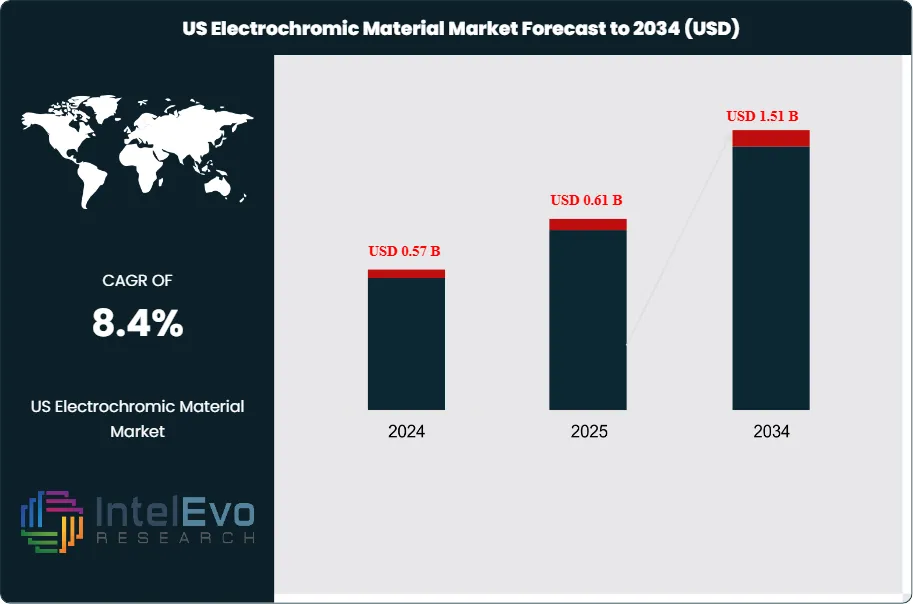
U.S. Electrochromic Material Market was valued at USD 0.57 Billion in 2024 and reached USD 0.61 Billion in 2025. The market is projected to reach USD 1.51 Billion by 2034, expanding at a CAGR of 8.4% during the forecast period from 2026 to 2034. While The Global Electrochromic Material Market was valued at USD 1.95 Billion in 2024 and reached USD 2.10 Billion in 2025. The market is projected to reach USD 4.45 Billion by 2034, expanding at a CAGR of 8.7% during the forecast period from 2026 to 2034. This represents an absolute dollar opportunity of USD 2.35 Billion over the analysis period. Demand is anchored in three structural shifts: tightening building energy codes, premium automotive content growth, and the emergence of compound-curved electrochromic glazing for electric vehicles. The electrochromic material market now sits at the intersection of advanced materials chemistry and the broader smart glass category, which itself crossed USD 11 Billion in 2025.
Get More Information about this report -
Request Free Sample ReportTungsten oxide remains the workhorse chemistry, accounting for the bulk of inorganic deposition volume in commercial smart-window installations. Material innovations through 2025 have shifted the cost-performance frontier. Solution-processed films from Ambilight Inc. and Miru Smart Technologies are reducing the dependence on physical vapor deposition equipment that previously kept square-foot pricing above USD 50. Nickel oxide and titanium dioxide complement the tungsten oxide layer in five-layer stacks supplied by SAGE Electrochromics and EControl-Glas, while viologens dominate Gentex Corporation's automotive mirror chemistry and Boeing 787 cabin windows.
Regulation is the strongest demand pull. The U.S. Department of Energy attributes more than 70% of national energy consumption to homes, buildings, and industries, anchoring federal incentives for dynamic glazing under the Inflation Reduction Act's commercial buildings tax credit. California's 2025 Building Energy Efficiency Standards now treat electrochromic facades as a compliance pathway for stricter U-factor and Solar Heat Gain Coefficient thresholds. The European Union's revised Energy Performance of Buildings Directive (EPBD), in force since 2024, mandates zero-emission building targets that pull electrochromic glazing into both new construction and renovation tenders across Germany, France, and the Nordics.
Asia Pacific holds the largest 2025 share at 36.4%, driven by Chinese electric-vehicle sunroof adoption, Japanese aerospace deliveries, and South Korean smart-city construction pipelines. North America's 32.1% share is concentrated in U.S. commercial real estate retrofits, where SageGlass and View Inc. installations cleared 25 million cumulative square feet by Q4 2025. Europe's 24.3% share reflects EPBD-driven retrofit cycles in Germany and France, supplemented by ChromoGenics AB's Nordic curved-glass shipments. Through 2034, the fastest growth will originate in compound-curved automotive sunroofs, where Miru's 1.5 m x 1.6 m prototype and Ambilight's mass-produced black smart film for over 20 vehicle programs signal the transition from premium novelty to mainstream OEM line item.
Market Definition & Scope
The electrochromic material market is defined as the global commercial supply of compounds that reversibly modulate optical transmission, reflectance, or color when subjected to a low-voltage current via redox reactions. The market encompasses inorganic chemistries (tungsten oxide WO3, nickel oxide NiO, titanium dioxide TiO2, vanadium pentoxide V2O5, molybdenum oxide MoO3, Prussian blue analogs), organic chemistries (viologens, polyaniline PANI, polypyrrole PPy, PEDOT), hybrid composites, and the conductive transparent electrodes (typically indium tin oxide) and electrolyte layers required to assemble a working electrochromic device.
Included in scope: material sales to glass laminators, automotive Tier-1 suppliers, aerospace OEMs, and consumer device manufacturers; thin-film and roll-to-roll deposition output sold as device-ready stacks; and finished electrochromic glazing where the material content is the value-add. Excluded: thermochromic and photochromic glass (passive activation), polymer-dispersed liquid crystal (PDLC) and suspended particle device (SPD) products that rely on different switching mechanisms, and pure low-emissivity coatings. The electrochromic material category accounts for approximately 19% of the broader USD 11.16 Billion smart glass parent market in 2025.

Key Takeaways
- Market Growth: The electrochromic material market expanded from USD 2.10 Billion in 2025 toward a projected USD 4.45 Billion by 2034, registering a CAGR of 8.7%.
- Segment Dominance (Material): Metal oxides led with approximately 49% revenue share in 2025, anchored by tungsten oxide's stability across more than 50,000 switching cycles.
- Segment Dominance (Application): Smart windows and glazing accounted for an estimated 52% of 2025 revenue, with smart mirrors holding the second position at roughly 23%.
- Driver: Energy-code tightening across California Title 24, the EU EPBD, and China's national green building plan is converting electrochromic glazing from optional spec to compliance pathway, lifting commercial real estate adoption by an estimated 27% in cumulative square footage during 2024-2025.
- Restraint: Installed cost above USD 50 per square foot for premium architectural systems, compared with USD 12-18 for low-emissivity glass, continues to restrict residential penetration.
- Opportunity: Compound-curved automotive electrochromic sunroofs address an absolute dollar opportunity of approximately USD 1.1 Billion across the forecast period as Chinese and German OEMs standardize panoramic glazing in EV trims.
- Trend: Roll-to-roll solution-processed flexible films are displacing sputtered tungsten oxide in automotive applications, with Ambilight's black smart film already shipping into more than 20 vehicle programs by mid-2025.
- Regional: Asia Pacific captured the leading 36.4% share in 2025, equivalent to roughly USD 765 Million, with China alone contributing more than half of regional volume.
Key Insights Summary
- Tungsten oxide volumes underpinned roughly 64% of global electrochromic material consumption through 2024, with more than 65 million square feet of finished electrochromic glass produced in that year and integration into more than 8,400 buildings worldwide.
- Within Gentex Corporation's installed base, dimmable device shipments cleared 50 million units annually by 2025, anchoring an estimated 86% global share of automatic-dimming automotive mirrors and a 78% share of the broader electrochromic mirror category.
- On March 18, 2025, Miru Smart Technologies and Argotec demonstrated a 1.5 m x 1.6 m compound-curved electrochromic sunroof, the largest such device disclosed for the automotive industry, with EV-range gains of up to 10% reported by the partners.
- U.S. Department of Energy modeling cited by Lawrence Berkeley National Laboratory indicates that SageGlass installations can shrink HVAC equipment sizing by up to 25% and lower peak summer demand by 25% or more in retrofitted commercial buildings.
- In June 2025, Xiaomi launched AI smart glasses incorporating an electrochromic lens, marking the first mass-market consumer-electronics deployment of dynamic tinting controlled by a two-finger swipe gesture.
- As of January 2026, Mativ Holdings expanded its 2024 development agreement with Miru into a direct equity investment, with the partners targeting deployment of 10 million square feet of dynamic eWindows by 2028 against the backdrop of automotive OEM demand.
Competitive Landscape Overview
The electrochromic material market is moderately consolidated. The top four suppliers—Gentex Corporation, Saint-Gobain (through SAGE Electrochromics), AGC Inc. (through the Halio joint venture with Kinestral Technologies), and View Inc.—collectively held an estimated 62-66% of 2025 device-level revenue. Competition is bifurcated. The architectural glazing segment competes on cost-per-square-foot, panel size, switching uniformity, and integration with building management systems, while the automotive segment competes on cycle life, optical clarity, and curvature compatibility. The competitive frontier is shifting toward solution-processed films from Asian entrants such as Ambilight Inc. and North American challengers Miru Smart Technologies and Tynt Technologies, whose reversible metal electrodeposition platform targets a price floor near traditional window-treatment costs.
Competitive Landscape Matrix
| Company | HQ | Position | Key Product | Geographic Strength | Recent Strategic Move |
| Gentex Corporation | USA | Leader | Auto-dimming mirrors, dimmable sunroof film, EDWs | Global automotive OEMs | Closed VOXX International acquisition in April 2025; debuted film-based EC sunroof at CES 2025 |
| Saint-Gobain (SAGE) | France / USA | Leader | SageGlass Classic, Harmony, RealTone | North America, Europe | Brought RealTone neutral-tone electrochromic glazing to market in February 2025 |
| AGC Inc. / Halio | Japan / USA | Leader | Halio smart-tinting glass | Asia Pacific, Europe | Continued scaling of Halio China JV with G-Tech Optoelectronics for EV-grade glazing |
| View Inc. | USA | Leader | View Smart Windows, Dynamic Glass | North America | Banked USD 30 Million in equity early 2026 after restructuring; cumulative deployment crossed 25 million sq ft |
| ChromoGenics AB | Sweden | Challenger | ConverLight Dynamic film | Nordics, Europe | Introduced ConverLight AW solar-powered autonomous window in 2024-2025 for retrofit projects |
| Miru Smart Technologies | Canada | Challenger | eWindow electrochromic glazing | North America, Europe | Inked equity investment from Mativ Holdings in January 2026 to scale automotive eWindow output |
| Ambilight Inc. | China | Challenger | Black EC smart film, EC sunroof | China, Asia Pacific | Mass-produced black EC film deployed across more than 20 vehicle programs by mid-2025 |
| Research Frontiers Inc. | USA | Niche Player | SPD-licensed material (adjacent), EC research | Global licensees | Continued licensee royalty growth from automotive panoramic roof launches in 2025 |
| Tynt Technologies | USA | Niche Player | Reversible metal electrodeposition windows | North America | Banked cumulative funding of approximately USD 16 Million through 2024 to commercialize residential blackout glazing |
Segmentation Analysis
The electrochromic material market is segmented across material type, technology, application, and end-use industry. Metal oxides retain the dominant share by chemistry, smart windows lead by application, and the construction and architecture sector leads by end-use. Each segmentation cut shows a different competitive shape.
By Material Type
Metal oxides accounted for approximately 49% of 2025 revenue, valued at roughly USD 1.03 Billion. Tungsten oxide (WO3) anchors this share, supplying around 70% of metal-oxide volume due to operating voltages of 1-3 V, durability past 50,000 switching cycles, and visible-light transmission swings from 65% to 5%. Nickel oxide (NiO) and titanium dioxide (TiO2) supply complementary counter-electrode and ion-storage layers in five-layer thin-film stacks shipped by SAGE Electrochromics and EControl-Glas. Within the segment, segment growth is led by molybdenum oxide and vanadium pentoxide at the research-pilot stage, where Brilliant Matters and Polyceed Inc. (dba Glass Dyenamics) are working with the National Renewable Energy Laboratory on cycle-life improvements.
Conducting polymers held an estimated 17% share in 2025, equivalent to USD 357 Million. PEDOT, polyaniline, and polypyrrole offer faster switching speeds (under 8 seconds for viologen-based polymer hybrids per Brilliant Matters' January 2024 disclosure) and lower deposition temperatures, making them dominant in flexible and wearable applications. Viologens captured around 18% of 2025 share, anchored by Gentex Corporation's automotive mirrors and Boeing 787 windows, where viologens combined with phenylenediamine deliver the gel-based active layer. Prussian blue analogs and hybrid composites together held the remaining 16%, with hybrid materials growing fastest at an estimated 12% year-on-year as researchers in Uppsala and Berkeley pursue broader color palettes.
By Technology
Solution processing led the technology cut at approximately 47.6% of 2025 revenue, displacing sputtering for film-based applications. Roll-to-roll solution-processed lines from Ambilight and Miru Smart Technologies cut capital expenditure per unit area by an estimated 35-45% versus sputtered glass lines, expanding the addressable market beyond premium architecture. Vapor deposition (chemical vapor deposition and sputtering) retained roughly 38% share through SAGE Electrochromics' Faribault, Minnesota plant, which produces panes up to 1.5 m x 3.5 m at the largest commercial scale. Printing technologies and other methods together accounted for approximately 14%, with the segment's CAGR of 11.4% outpacing the market average due to flexible-substrate adoption in eyewear and consumer electronics.
By Application
Smart windows and glazing led applications at an estimated 52% of 2025 revenue, supported by SageGlass installations across 1,500 airport projects and View Inc.'s 25-million-square-foot cumulative deployment. Smart mirrors held approximately 23% share, dominated by Gentex's 50-million-unit annual shipment volume into automotive OEM programs spanning 124 vehicle models. Displays and indicator panels captured around 9%, with Ricoh Company and Hitachi Chemical supplying electrochromic e-paper and digital signage substrates. Aerospace cabin windows made up roughly 5% of 2025 application revenue, with Boeing 787 and Airbus A350 deliveries anchoring demand and EDW retrofit cycles of 5-7 years setting the replacement rhythm.
Wearable devices and eyewear represent the smallest but fastest-growing application slice, expanding at an estimated 14.6% CAGR through 2034. Xiaomi's June 2025 AI smart glasses launch with electrochromic lenses signals the consumer-electronics inflection point, while Tynt Technologies and Brilliant Matters are positioning their flexible electrochromic platforms for ski goggles and AR/VR optics. Energy storage devices using electrochromic active materials remain a research frontier with negligible commercial revenue in 2025.
By End-Use Industry
Construction and architecture led end-use at approximately 46% of 2025 revenue. The segment is propelled by EU EPBD compliance, California Title 24 thresholds, and LEED certification economics, with SageGlass and View Inc. leading commercial real estate installations. Automotive and transportation captured around 32% share, with electrochromic mirrors, sunroofs, and side windows shipped by Gentex, Ambilight, and Magna Mirrors into BMW, Tesla, NIO, Xpeng, and Ferrari programs. Aerospace and defense held roughly 8%, dominated by Gentex EDWs on Boeing 787 and 777X aircraft and PPG Aerospace cabin windows. Consumer electronics captured about 7%, marine 3%, and healthcare and other end-uses the remaining 4%, with healthcare growing fastest at 17.5% CAGR as intensive-care wards specify instant-opaque privacy panels.
Regional Analysis
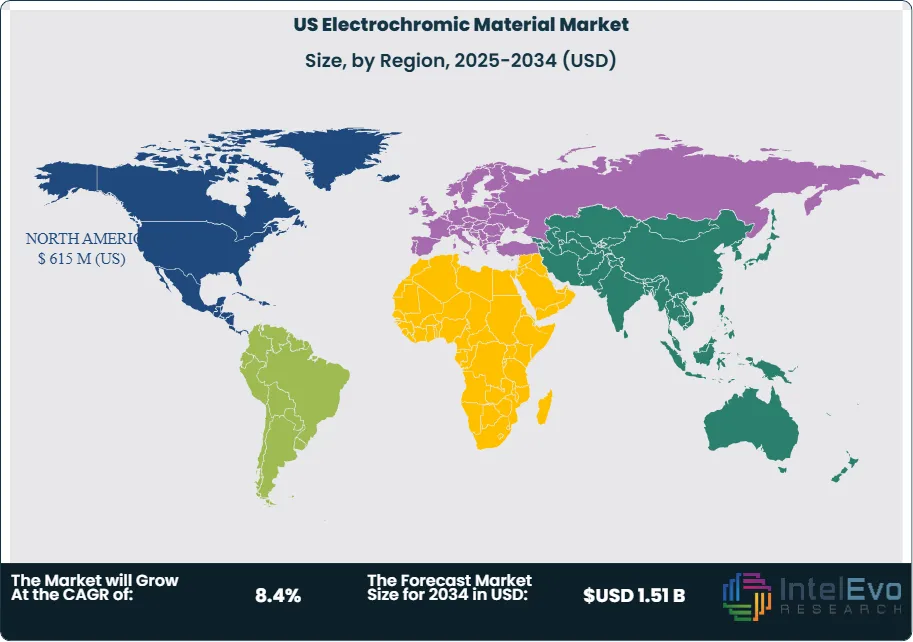
United States: The U.S. electrochromic material market was valued at approximately USD 615 Million in 2025, growing at a country-level CAGR of 8.4% through 2034. Federal levers include the Inflation Reduction Act's commercial buildings tax credit (up to 30% for qualifying smart-glass retrofits) and U.S. Department of Energy programs, alongside state-level mandates such as California's 2025 Building Energy Efficiency Standards. Lawrence Berkeley National Laboratory continues to anchor R&D collaboration with industry, including ARPA-E projects on next-generation chemistries. Gentex Corporation's Zeeland headquarters and Saint-Gobain SAGE's Faribault plant supply the bulk of domestic device output, while Tynt Technologies in Boulder, Colorado, and Polyceed Inc. partner with NREL on cost-reduction programs.
Get More Information about this report -
Request Free Sample ReportKey Market Segment
By Material Type
- Transition Metal Oxides
- Conducting Polymers
- Viologens
- Nanomaterials
- Others
By Technology
- Solution-Based Electrochromic
- Solid-State Electrochromic
By Application
- Smart Windows
- Displays
- Rear-View Mirrors
- Electronic Devices
- Others
By End-Use Industry
- Building & Construction
- Automotive
- Aerospace
- Consumer Electronics
- Healthcare
- Others
By Regional Coverage
- US
| Report Attribute | Details |
| Market size (2025) | USD 0.61 B |
| Forecast Revenue (2034) | USD 1.51 B |
| CAGR (2025-2034) | 8.4% |
| Historical data | 2021-2025 |
| Base Year For Estimation | 2025 |
| Forecast Period | 2026-2034 |
| Report coverage | Revenue Forecast, Competitive Landscape, Market Dynamics, Growth Factors, Trends and Recent Developments |
| Segments covered | By Material Type, (Transition Metal Oxides, Conducting Polymers, Viologens, Nanomaterials, Others), By Technology, (Solution-Based Electrochromic, Solid-State Electrochromic), By Application, (Smart Windows, Displays, Rear-View Mirrors, Electronic Devices, Others), By End-Use Industry, (Building & Construction, Automotive, Aerospace, Consumer Electronics, Healthcare, Others), |
| Research Methodology |
|
| Regional scope |
|
| Competitive Landscape | GENTEX CORPORATION, SAINT-GOBAIN / SAGE ELECTROCHROMICS, AGC INC. / HALIO, VIEW INC., CHROMOGENICS AB, RESEARCH FRONTIERS INC., PPG INDUSTRIES, INC., CORNING INCORPORATED, GAUZY LTD., MIRU SMART TECHNOLOGIES, AMBILIGHT INC., KINESTRAL TECHNOLOGIES, INC., ECONTROL-GLAS GMBH & CO. KG, HITACHI CHEMICAL CO., LTD., NIPPON SHEET GLASS CO., LTD., MERCK KGAA, TYNT TECHNOLOGIES, POLYTRONIX, INC., Others |
| Customization Scope | Customization for segments, region/country-level will be provided. Moreover, additional customization can be done based on the requirements. |
| Pricing and Purchase Options | Avail customized purchase options to meet your exact research needs. We have three licenses to opt for: Single User License, Multi-User License (Up to 5 Users), Corporate Use License (Unlimited User and Printable PDF). |


Frequently Asked Questions
How big is the US Electrochromic Material Market?
The U.S. Electrochromic Material Market was valued at USD 0.57 Billion in 2024 and is projected to reach USD 1.51 Billion by 2034, growing at a CAGR of 8.4% during the forecast period 2026–2034.
Who are the major players in the US Electrochromic Material Market?
GENTEX CORPORATION, SAINT-GOBAIN / SAGE ELECTROCHROMICS, AGC INC. / HALIO, VIEW INC., CHROMOGENICS AB, RESEARCH FRONTIERS INC., PPG INDUSTRIES, INC., CORNING INCORPORATED, GAUZY LTD., MIRU SMART TECHNOLOGIES, AMBILIGHT INC., KINESTRAL TECHNOLOGIES, INC., ECONTROL-GLAS GMBH & CO. KG, HITACHI CHEMICAL CO., LTD., NIPPON SHEET GLASS CO., LTD., MERCK KGAA, TYNT TECHNOLOGIES, POLYTRONIX, INC., Others
Which segments covered the US Electrochromic Material Market?
By Material Type, (Transition Metal Oxides, Conducting Polymers, Viologens, Nanomaterials, Others), By Technology, (Solution-Based Electrochromic, Solid-State Electrochromic), By Application, (Smart Windows, Displays, Rear-View Mirrors, Electronic Devices, Others), By End-Use Industry, (Building & Construction, Automotive, Aerospace, Consumer Electronics, Healthcare, Others),
How can this market research report help my business make strategic decisions?
Our market research reports provide actionable intelligence, including verified market size data, CAGR projections, competitive benchmarking, and segment-level opportunity analysis. These insights support strategic planning, investment decisions, product development, and market entry strategies for enterprises and startups alike.
How frequently is the data updated?
We continuously monitor industry developments and update our reports to reflect regulatory changes, technological advancements, and macroeconomic shifts. Updated editions ensure you receive the latest market intelligence.

Select Licence Type
Connect with our sales team

US Electrochromic Material Market
Published Date : 22 Jul 2026 | Formats :Why IntelEvoResearch
100%
Customer
Satisfaction
24x7+
Availability - we are always
there when you need us
200+
Fortune 50 Companies trust
IntelEvoResearch
80%
of our reports are exclusive
and first in the industry
100%
more data
and analysis
1000+
reports published
till date