

- Home
- Industries
 Aerospace And Defence
 Agriculture
 Automotive And Transportation
 Banking And Finance
 Business
 Chemicals And Materials
 Consumer And Retail
 Electronics And Semiconductors
 Food And Beverages
 Machinery & Equipments
 Manufacturing And Construction
 Medical Devices
 Others
 Pharmaceuticals And Healthcare
 Power And Energy
 Sports
 Technology
- Services
- News Room
- About us
- Contact Us
-
U.S. Epigenomics Market Size, Share & Forecast 2034 | CAGR of 13.5%
US Epigenomics Market Size, Share & Analysis Report By Offering (Kits & Reagents, Instruments, Software & Services), By Technology (DNA Methylation, Histone Modification, Chromatin Accessibility, Non-Coding RNA), By Application (Oncology, Drug Discovery, Diagnostics, Personalized Medicine), By End-User (Pharma & Biotech, Academic Institutes, Hospitals, CROs): Regional Segment Overview, Market Dynamics, Competitive Strategies, Trends & Forecast 2026–2034

Report Overview
| Market Size (2025) | Forecast Value (2034) | CAGR (2026-2034) | Largest Region (2025) |
|---|---|---|---|
| USD 2.62 Billion | USD 9.10 Billion | 14.8% | North America, 42.5% |
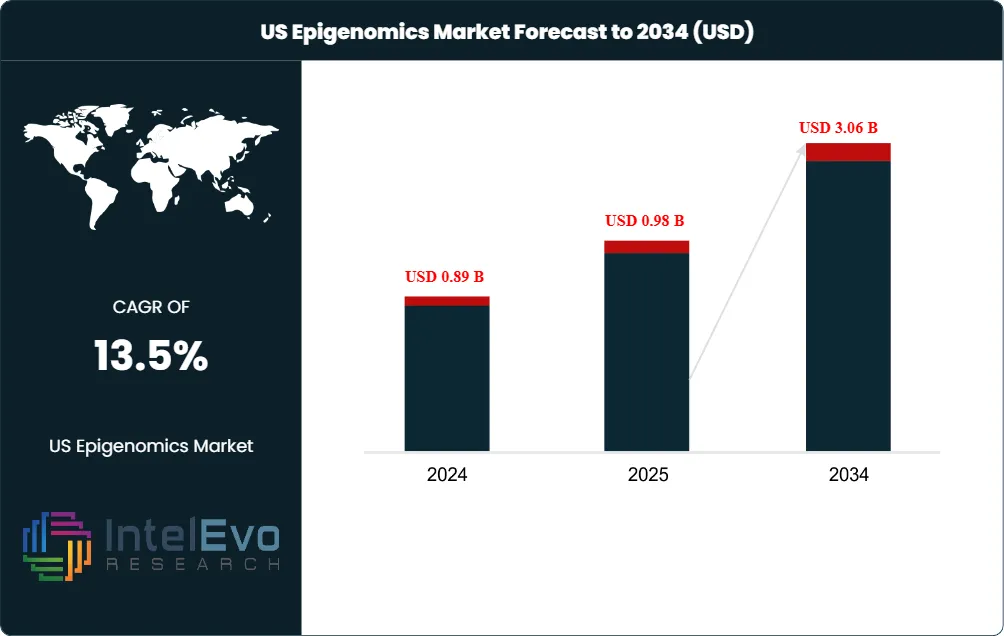
The U.S. Epigenomics Market was valued at USD 0.89 Billion in 2024 and reached USD 0.98 Billion in 2025. The market is projected to reach USD 3.06 Billion by 2034, expanding at a CAGR of 13.5% during the forecast period from 2026 to 2034. While The Global Epigenomics Market was valued at USD 2.42 Billion in 2024 and reached USD 2.62 Billion in 2025. The market is projected to reach USD 9.10 Billion by 2034, expanding at a CAGR of 14.8% during the forecast period from 2026 to 2034. This represents an absolute dollar opportunity of USD 6.48 Billion over the analysis period. The epigenomics market reflects sustained scientific demand for tools that map DNA methylation, histone modification, and chromatin accessibility across research, diagnostic, and therapeutic settings.
Get More Information about this report -
Request Free Sample ReportThree forces anchor demand for epigenomics tools and services. Cancer prevalence drives ongoing biomarker discovery, with the World Health Organization projecting 35 million new cancer cases globally by 2050 against 20 million in 2022. Pharmaceutical pipelines now include over 552 active clinical trials referencing epigenetic interventions on ClinicalTrials.gov as of mid-2025. Technology cost curves continue to compress: enzymatic methyl conversion assays from New England Biolabs, Watchmaker Genomics, and Biomodal released between January and October 2025 reduced minimum input requirements for whole-genome methylation work to under 100 ng, with several variants requiring single-digit nanogram inputs.
Regulatory tailwinds reinforce the growth profile of the epigenomics market. The U.S. NIH Roadmap Epigenomics Program produced 111 reference epigenomes that remain widely used by the global research community, and follow-on agency funding continues through Common Fund-linked initiatives at NHGRI and NCI. The FDA granted Breakthrough Device Designation to Guardant Health's Shield methylation-based multi-cancer detection assay in June 2025, signaling regulatory readiness for population-screening epigenetic tests. The European Medicines Agency continues to support epigenomic biomarker submissions under its companion-diagnostic frameworks.
North America held the largest regional share of the epigenomics market at 42.5% in 2025, anchored by U.S. NIH funding and a dense biotech base across Boston, San Francisco, and Durham. Asia Pacific is the fastest-growing region with a forecast CAGR above 17.0%, driven by population-scale sequencing programs in China and Japan and biotech expansion across South Korea, Singapore, and Australia. Europe holds the second-largest regional share, supported by IHEC-aligned consortia and the German Cancer Research Center's epigenome mapping work.
The forward outlook for the epigenomics market through 2034 is shaped by clinical translation. Epigenetic editing therapies entered human dosing in early 2026 with nChroma Bio's CRMA-1001 study for chronic hepatitis B, joining Tune Therapeutics' RHYTHM trial of TUNE-401. Multi-omic platforms from Illumina, Roche, and PacBio are converging genomic and methylation readouts into single workflows, suggesting that by 2030 the typical pharmaceutical sequencing run will read methylation signals as a default output rather than a separate assay.
Market Definition & Scope
The epigenomics market is defined as the commercial supply of products, instruments, reagents, kits, software, and services used to detect, quantify, map, or modulate heritable changes in gene expression that occur without alterations to the underlying DNA sequence. The market encompasses DNA methylation profiling, histone modification analysis, chromatin accessibility assays, non-coding RNA characterization, and programmable epigenetic editing platforms across research, clinical diagnostic, and therapeutic discovery applications.
Included within scope: bisulfite and enzymatic methyl conversion kits, methylation arrays such as the Infinium MethylationEPIC v2.0, ChIP-seq and CUT&RUN reagents, single-cell ATAC-seq workflows, methylation-aware bioinformatics pipelines such as Illumina DRAGEN, and contract methylation services. Excluded from scope: general-purpose DNA sequencing instruments not configured for methylation calling, broad-spectrum chemotherapy with incidental epigenetic activity, and germline genetic testing without an epigenomic readout. The epigenomics market sits within the broader life-sciences research-tools market and accounts for approximately 4-5% of the global genomics tools market by 2025 revenue.

Key Takeaways
- Market Growth: The epigenomics market expanded from USD 2.62 Billion in 2025 to a projected USD 9.10 Billion by 2034, registering a 14.8% CAGR.
- Segment Dominance: Reagents and kits captured 58.4% of epigenomics market revenue in 2025, anchored by repeat consumables demand from academic, biopharma, and CRO laboratories.
- Segment Dominance: DNA methylation analysis accounted for 46.7% of technology-segment revenue in 2025, the dominant epigenomic mark by clinical and research adoption.
- Driver: Oncology applications generated 51% of total epigenomics market revenue in 2025, propelled by biomarker discovery work in solid tumors and methylation-based liquid biopsy assays.
- Restraint: Regulatory and reimbursement uncertainty around laboratory-developed tests slows clinical adoption, with FDA review timelines for methylation-based diagnostics averaging 14-18 months from submission.
- Opportunity: Epigenetic editing therapeutics represent a USD 1.5 Billion-plus addressable opportunity by 2034, anchored by venture-backed pipelines at Tune Therapeutics, nChroma Bio, and Epic Bio.
- Trend: Multi-omic integration platforms grew over 30% year-over-year in 2025 as Illumina, Roche, and PacBio rolled out combined genomic-methylation workflows.
- Regional: North America led at 42.5% market share with USD 1.11 Billion in 2025 revenue, underwritten by NIH funding and U.S. biotech venture capital.
Key Insights Summary
- An NIH-cited count of ClinicalTrials.gov registrations identified roughly 552 active studies citing epigenetic interventions as of May 9, 2025, against fewer than 200 such trials in 2018.
- Per its January 30, 2026 closing announcement, Illumina paid USD 350 Million in cash for SomaLogic with up to USD 75 Million in milestone payments tied to performance triggers.
- On January 28, 2026, nChroma Bio administered the first patient dose for its Phase 1/2 evaluation of CRMA-1001, a CRISPR-Cas-based epigenetic silencer designed against chronic hepatitis B virus infection.
- According to peer-reviewed work in Genome Biology and Briefings in Bioinformatics, single-cell ATAC-seq and CUT&Tag now resolve chromatin features at roughly 10,000 cells per sample at sub-USD 0.10 per profiled site.
- At the October 2025 ASHG annual meeting, Roche reported that its SBX-Duplex Methylation chemistry, paired with the Watchmaker TAPS platform, profiles methylation alongside DNA variants from a single library preparation.
- A January 2025 venture round of USD 175 Million carried Tune Therapeutics into clinical evaluation of TUNE-401, with first-cohort biomarker data expected before the end of 2026.
Competitive Landscape Overview
The epigenomics market is moderately consolidated. The top four suppliers, Illumina, Thermo Fisher Scientific, F. Hoffmann-La Roche, and QIAGEN, accounted for an estimated 51% of combined epigenomics market revenue in 2025, with the next tier including Merck KGaA, Agilent Technologies, Bio-Rad Laboratories, PacBio, and Oxford Nanopore Technologies.
Competition has shifted from single-assay differentiation toward platform breadth, where vendors compete on the strength of integrated genomic-methylation-proteomic readouts rather than individual kit performance. Emerging therapeutic firms such as Tune Therapeutics, nChroma Bio, and Epic Bio represent a parallel competitive vector focused on programmable epigenetic editing rather than measurement, expanding the addressable market beyond research tools.
Competitive Landscape Matrix
| Company | HQ | Position | Key Product | Geographic Strength | Recent Strategic Move |
|---|---|---|---|---|---|
| Illumina, Inc. | United States | Leader | 5-base sequencing, MethylationEPIC v2.0 | Global | On Jan 30, 2026 closed the SomaLogic purchase for USD 350M |
| Thermo Fisher Scientific | United States | Leader | Ion Torrent Genexus Dx, MethylEdge | Global | In Jul 2025 cleared Oncomine Dx Express via FDA |
| F. Hoffmann-La Roche | Switzerland | Leader | SBX-Duplex Methylation, KAPA EvoPrep | Global | Set GUINNESS WORLD RECORD at ASHG Oct 2025 with sub-4-hour WGS |
| QIAGEN N.V. | Germany | Leader | QIAseq Targeted Methyl Panel | Europe, Americas | Expanded UMI-tagged bisulfite kit lines during 2025 |
| Merck KGaA | Germany | Challenger | Validated chromatin antibodies | EU, APAC | Picked up a US single-cell epigenetic mapping startup in Jan 2025 |
| Agilent Technologies | United States | Challenger | SureSelect Methyl-Seq | Global | In Nov 2025 paired with Tagomics on Interlace integration |
| PacBio | United States | Niche Player | HiFi 5-base, Fiber-seq | Americas, APAC | Co-marketing accord with EpiCypher signed in 2025 |
| Oxford Nanopore Technologies | United Kingdom | Niche Player | PromethION direct methylation | Europe, APAC | Direct targeted methylation assay rolled out via Wasatch Biolabs in 2025 |
| Bio-Rad Laboratories | United States | Niche Player | ChIP-grade reagents | Global | Broadened ddPCR methylation portfolio across 2025 |
| Tune Therapeutics | United States | Niche Player | TUNE-401 epigenetic silencer | Americas | Brought in USD 175M during Jan 2025 Series B |
Segmentation Analysis
The epigenomics market segments across offering, technology, application, and end-user dimensions, with reagents and kits, DNA methylation analysis, oncology applications, and pharmaceutical end-users dominating their respective categories in 2025.
By Offering
The reagents and kits segment dominated the epigenomics market with 58.4% of revenue in 2025, generating approximately USD 1.53 Billion. Kits and reagents anchor every methylation, histone, and chromatin workflow regardless of sequencing platform, producing a high recurring-revenue base for Thermo Fisher Scientific, Merck KGaA, New England Biolabs, and QIAGEN. The Infinium MethylationEPIC v2.0 BeadChip from Illumina alone supports a six-figure annual run rate of population-scale epigenome-wide association studies, and CUTANA meCUT&RUN from EpiCypher captures more than 80% of methyl-CpGs measured by whole-genome bisulfite sequencing while consuming roughly 20 times less sequencing depth.
Services and software combined held 28% of 2025 epigenomics market revenue, with services growing fastest at a forecast 17.6% CAGR through 2034. Service providers such as Novogene, CD Genomics, EpigenDx, and CeGaT operate at population scale across China, the United Kingdom, the United States, and Singapore, supplying methylation analysis to pharmaceutical clients running large cohort studies. Bioinformatics tools from Illumina DRAGEN, Sentieon, and open-source projects including methylKit and Bismark complete the analytical stack. Instruments accounted for the remaining 13.6% in 2025, dominated by Illumina NovaSeq, Roche SBX, PacBio Revio, and Oxford Nanopore PromethION platforms.
By Technology
DNA methylation analysis captured 46.7% of technology-segment revenue in 2025, equivalent to approximately USD 1.22 Billion. Cost reductions in enzymatic methyl conversion (EM-seq from New England Biolabs, TAPS from Watchmaker Genomics, duet+ from Biomodal) drove a roughly 30% year-over-year increase in methylation library preparation volume during 2025. The technology category includes whole-genome bisulfite sequencing, reduced representation bisulfite sequencing, methylation array profiling, and multimodal long-read approaches from PacBio HiFi and Oxford Nanopore Technologies that detect 5mC and 6mA without conversion chemistry.
Histone modification analysis represented 28.0% of technology revenue in 2025 and is the fastest-growing technology subsegment with a forecast 16.2% CAGR. CUT&Tag and CUT&RUN have largely supplanted ChIP-seq for low-input applications, with EpiCypher's Multiomic CUT&RUN co-profiling histone marks alongside DNA methylation in a single assay. The remaining 25.3% of technology revenue covers chromatin accessibility (scATAC-seq), non-coding RNA profiling, and chromatin conformation methods such as Hi-C and Micro-C from Cantata Bio.
By Application
Oncology dominated application revenue with 51% share of the epigenomics market in 2025, equivalent to USD 1.34 Billion. Oncology applications include early cancer detection (Galleri from GRAIL, Shield from Guardant Health, Cancerguard from Exact Sciences), minimal residual disease monitoring, methylation-based tumor classification, and pharmacodynamic monitoring of epigenetic drugs such as decitabine and azacitidine. Non-oncology applications hold the remaining 49% and include neurology (Alzheimer's biomarker work), immunology (autoimmune disease epigenetics), aging research (Horvath and PhenoAge methylation clocks, TruDiagnostic SYMPHONYAge), and cardiovascular disease diagnostics.
The non-oncology category outpaces oncology in growth rate, with a forecast 16.4% CAGR against 14.0% for oncology, narrowing the application mix toward more balanced clinical use cases by 2034. Epigenetic clocks alone serve a USD 200 Million-plus direct-to-consumer health analytics segment with TruDiagnostic, Elysium Health, and Horvath-licensed laboratories competing on biomarker breadth and clinical validation.
By End-User
Pharmaceutical and biotechnology companies held 47% of end-user revenue in the epigenomics market in 2025, applying epigenomics for target validation, biomarker development, and companion diagnostic strategy. Academic and research institutions captured 36% share, while contract research organizations and hospitals together held the remaining 17%. Clinical research is the fastest-growing end-user category at a forecast 14.97% CAGR, supported by rising integration of methylation endpoints into Phase 2 and Phase 3 oncology trials, with 38% of new oncology trials initiated in 2025 incorporating at least one epigenetic biomarker.
Regional Analysis
United States
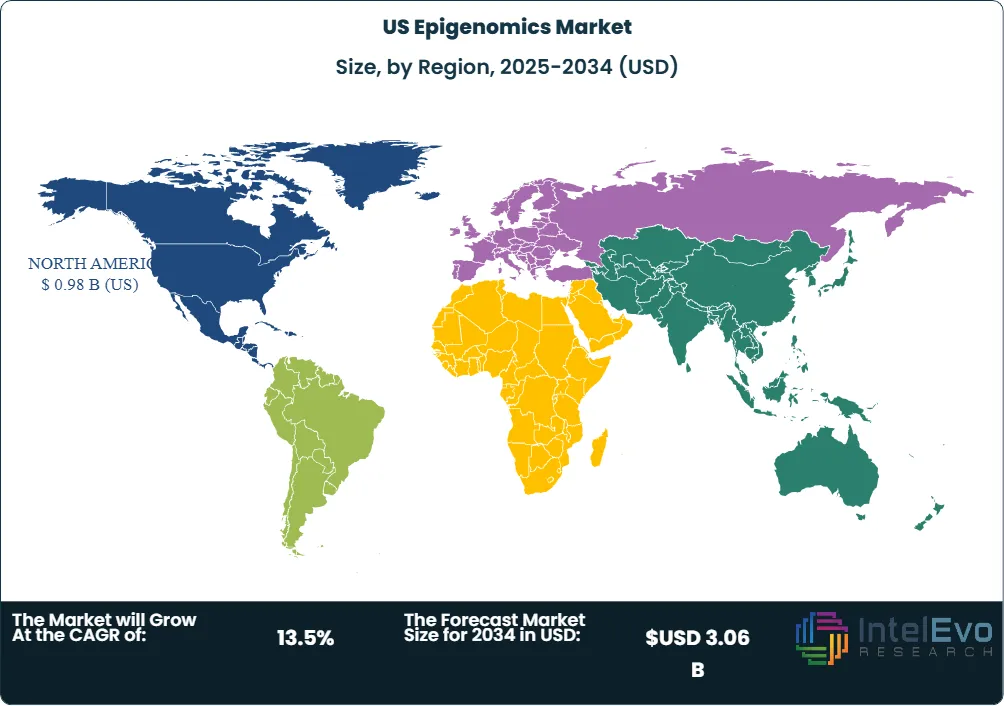
The United States epigenomics market reached USD 980 Million in 2025 and is forecast to grow at a 13.5% country-level CAGR through 2034. NIH funding through the Common Fund-linked Roadmap Epigenomics legacy and ongoing NHGRI programs allocated approximately USD 250 Million to advance methylation profiling and histone modification mapping during 2024-2025, per agency disclosures. The FDA's Breakthrough Device pathway for methylation-based multi-cancer detection (Guardant Shield MCD, Cancerguard from Exact Sciences) accelerated commercial validation, while state programs such as the California Institute for Regenerative Medicine Cure for Huntington's program funded epigenetic editing research at the Innovative Genomics Institute. Private capital flows reinforced public funding: Tune Therapeutics' USD 175 Million Series B closed in January 2025 was led by NEA, Yosemite, Regeneron Ventures, and Hevolution Foundation.
Get More Information about this report -
Request Free Sample ReportKey Market Segment
By Offering
- Kits & Reagents
- Instruments
- Software & Services
By Technology
- DNA Methylation
- Histone Modification
- Chromatin Accessibility
- Non-Coding RNA Analysis
By Application
- Oncology
- Drug Discovery & Development
- Diagnostics
- Personalized Medicine
By End-User
- Pharmaceutical & Biotechnology Companies
- Academic & Research Institutes
- Hospitals & Diagnostic Laboratories
- Contract Research Organizations (CROs)
By Regional Coverage
- US
| Report Attribute | Details |
| Market size (2025) | USD 0.98 B |
| Forecast Revenue (2034) | USD 3.06 B |
| CAGR (2025-2034) | 13.5% |
| Historical data | 2021-2025 |
| Base Year For Estimation | 2025 |
| Forecast Period | 2026-2034 |
| Report coverage | Revenue Forecast, Competitive Landscape, Market Dynamics, Growth Factors, Trends and Recent Developments |
| Segments covered | By Offering, (Kits & Reagents, Instruments, Software & Services), By Technology, (DNA Methylation, Histone Modification, Chromatin Accessibility, Non-Coding RNA Analysis), By Application, (Oncology, Drug Discovery & Development, Diagnostics, Personalized Medicine), By End-User, (Pharmaceutical & Biotechnology Companies, Academic & Research Institutes, Hospitals & Diagnostic Laboratories, Contract Research Organizations (CROs)), |
| Research Methodology |
|
| Regional scope |
|
| Competitive Landscape | ILLUMINA, INC., THERMO FISHER SCIENTIFIC INC., F. HOFFMANN-LA ROCHE LTD, QIAGEN N.V., MERCK KGAA, AGILENT TECHNOLOGIES, INC., BIO-RAD LABORATORIES, INC., PACIFIC BIOSCIENCES OF CALIFORNIA, INC., OXFORD NANOPORE TECHNOLOGIES PLC, ACTIVE MOTIF, INC., ZYMO RESEARCH CORPORATION, DIAGENODE (HOLOGIC, INC.), EPICYPHER, INC., NEW ENGLAND BIOLABS, WATCHMAKER GENOMICS, BIOMODAL LIMITED, TUNE THERAPEUTICS, INC., NCHROMA BIO, EPIGENOMICS AG, DANAHER CORPORATION, Others |
| Customization Scope | Customization for segments, region/country-level will be provided. Moreover, additional customization can be done based on the requirements. |
| Pricing and Purchase Options | Avail customized purchase options to meet your exact research needs. We have three licenses to opt for: Single User License, Multi-User License (Up to 5 Users), Corporate Use License (Unlimited User and Printable PDF). |


Frequently Asked Questions
How big is the US Epigenomics Market?
The U.S. Epigenomics Market was valued at USD 0.89 Billion in 2024 and is projected to reach USD 3.06 Billion by 2034, growing at a CAGR of 13.5% during the forecast period 2026–2034.
Who are the major players in the US Epigenomics Market?
ILLUMINA, INC., THERMO FISHER SCIENTIFIC INC., F. HOFFMANN-LA ROCHE LTD, QIAGEN N.V., MERCK KGAA, AGILENT TECHNOLOGIES, INC., BIO-RAD LABORATORIES, INC., PACIFIC BIOSCIENCES OF CALIFORNIA, INC., OXFORD NANOPORE TECHNOLOGIES PLC, ACTIVE MOTIF, INC., ZYMO RESEARCH CORPORATION, DIAGENODE (HOLOGIC, INC.), EPICYPHER, INC., NEW ENGLAND BIOLABS, WATCHMAKER GENOMICS, BIOMODAL LIMITED, TUNE THERAPEUTICS, INC., NCHROMA BIO, EPIGENOMICS AG, DANAHER CORPORATION, Others
Which segments covered the US Epigenomics Market?
By Offering, (Kits & Reagents, Instruments, Software & Services), By Technology, (DNA Methylation, Histone Modification, Chromatin Accessibility, Non-Coding RNA Analysis), By Application, (Oncology, Drug Discovery & Development, Diagnostics, Personalized Medicine), By End-User, (Pharmaceutical & Biotechnology Companies, Academic & Research Institutes, Hospitals & Diagnostic Laboratories, Contract Research Organizations (CROs)),
How can this market research report help my business make strategic decisions?
Our market research reports provide actionable intelligence, including verified market size data, CAGR projections, competitive benchmarking, and segment-level opportunity analysis. These insights support strategic planning, investment decisions, product development, and market entry strategies for enterprises and startups alike.
How frequently is the data updated?
We continuously monitor industry developments and update our reports to reflect regulatory changes, technological advancements, and macroeconomic shifts. Updated editions ensure you receive the latest market intelligence.

Select Licence Type
Connect with our sales team

Why IntelEvoResearch
100%
Customer
Satisfaction
24x7+
Availability - we are always
there when you need us
200+
Fortune 50 Companies trust
IntelEvoResearch
80%
of our reports are exclusive
and first in the industry
100%
more data
and analysis
1000+
reports published
till date