

- Home
- Industries
 Aerospace And Defence
 Agriculture
 Automotive And Transportation
 Banking And Finance
 Business
 Chemicals And Materials
 Consumer And Retail
 Electronics And Semiconductors
 Food And Beverages
 Machinery & Equipments
 Manufacturing And Construction
 Medical Devices
 Others
 Pharmaceuticals And Healthcare
 Power And Energy
 Sports
 Technology
- Services
- News Room
- About us
- Contact Us
-
U.S. Gene Editing Therapeutics Market Size, Share | CAGR of 13.9%
US Gene Editing Therapeutics Market Size, Share & Analysis Report By Editing Modality (CRISPR-Cas, TALEN, ZFNs), By Therapy Type (In Vivo, Ex Vivo), By Therapeutic Area (Oncology, Genetic Disorders, Infectious Diseases), By End-User (Hospitals, Pharma & Biotech, Academic Institutes, CROs): Regional Segment Overview, Market Dynamics, Competitive Strategies, Key Players, Emerging Technologies, Growth Trends & Forecast 2026–2034

Report Overview
| Market Size (2025) | Forecast Value (2034) | CAGR (2026-2034) | Largest Region (2025) |
| USD 5.20 Billion | USD 17.80 Billion | 14.7% | North America, 47.6% |
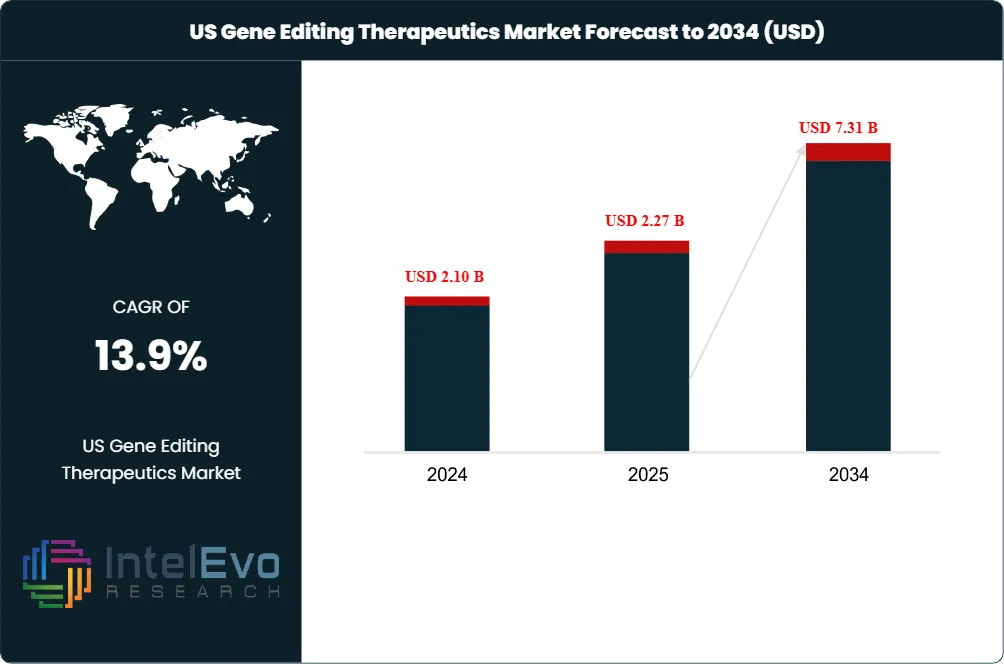
The U.S. Gene Editing Therapeutics Market was valued at USD 2.10 Billion in 2024 and reached USD 2.27 Billion in 2025. The market is projected to reach USD 7.31 Billion by 2034, expanding at a CAGR of 13.9% during the forecast period from 2026 to 2034. While The Global Gene Editing Therapeutics Market was valued at USD 4.80 Billion in 2024 and reached USD 5.20 Billion in 2025. The market is projected to reach USD 17.80 Billion by 2034, expanding at a CAGR of 14.7% during the forecast period from 2026 to 2034. This represents an absolute dollar opportunity of USD 12.60 Billion across the analysis horizon.
Get More Information about this report -
Request Free Sample ReportThree forces propel demand. The category passed its commercial proof of concept during 2025: Casgevy (exagamglogene autotemcel), the first approved CRISPR gene-editing therapy, generated USD 116 million in full-year revenue (USD 54 million in Q4 alone) under the Vertex-CRISPR Therapeutics 40/60 profit-sharing structure. Patient initiations roughly tripled year over year, with Vertex disclosing that 301 patients began the Casgevy treatment process in 2025 versus 109 in 2024. Base editing produced clinically meaningful Phase 1/2 efficacy in sickle cell disease (Beam Therapeutics's BEAM-101, now risto-cel), and prime editing began registrational programs through Prime Medicine.
Regulatory momentum kept pace. The FDA awarded Vertex a Commissioner's National Priority Review Voucher in November 2025 for the Casgevy label expansion in children aged 5 to 11, allowing a roughly two-month review timeline. Verve Therapeutics' VERVE-102 holds Fast Track designation for in vivo PCSK9 base editing in heterozygous familial hypercholesterolemia. Intellia Therapeutics enrolled more than 550 patients into the MAGNITUDE Phase 3 study of nexiguran ziclumeran (nex-z) for ATTR cardiomyopathy by year-end 2025, ahead of internal targets, and the Phase 3 HAELO study of lonvoguran ziclumeran (lonvo-z) for hereditary angioedema completed enrollment in Q3 2025. Intellia plans to file a Biologics License Application for lonvo-z in the second half of 2026.
Capital deployment validated the modality. Eli Lilly closed its USD 1.3 Billion acquisition of Verve Therapeutics in Q3 2025 (USD 10.50 per share upfront plus a USD 3.00 contingent value right per share), securing one of the largest cardiovascular base-editing pipelines. Patient population economics are wide: Casgevy targets more than 60,000 eligible SCD and TDT patients across approved geographies, with roughly 37,000 of those in the U.S. and Europe combined and a further 23,000-plus across Middle Eastern markets.
Geographic distribution is heavily concentrated. North America accounted for 47.6% of 2025 revenue, anchored by Casgevy launches in the U.S. and Canada and a vendor cluster in Cambridge, Massachusetts and the Bay Area. Asia Pacific, expanding at 16.1% expected CAGR through 2034, captured 21.8% of 2025 revenue. By 2034, the market is expected to broaden from rare-disease anchor indications into in vivo cardiovascular and metabolic editing.
Market Definition & Scope
The gene editing therapeutics market is defined as the segment of pharmaceutical and clinical-stage development covering medicines that intentionally modify, repair, replace, or disrupt specific DNA sequences in patient cells using programmable nuclease or template-based technologies. The market encompasses CRISPR/Cas9 and Cas12 systems, base editors, prime editors, zinc-finger nucleases (ZFNs), TALENs, ARCUS meganucleases, and related delivery platforms. Both ex vivo edited cell therapies (autologous or allogeneic) and in vivo editing (LNP, AAV, and non-viral delivery) fall within scope.
In scope are net product revenues for approved gene editing therapeutics, milestone payments tied to gene editing assets, and partnered licensing economics where a gene editing platform is the underlying deliverable. Out of scope are research-grade CRISPR reagents and kits, gene replacement therapies that do not edit endogenous DNA (such as Zolgensma), RNA interference and antisense oligonucleotide therapies that suppress translation without modifying DNA, and CRISPR-based diagnostics. The parent market is the broader gene therapy industry; gene editing therapeutics represent the fastest-growing segment within that parent through 2034.

Key Takeaways
- Market Growth: Sized at USD 5.20 Billion in 2025 and projected to reach USD 17.80 Billion by 2034 at a 14.7% CAGR.
- Segment Dominance (By Editing Modality): CRISPR/Cas systems captured 52.4% of 2025 revenue, anchored by Casgevy commercial revenue and a deep CRISPR-based clinical pipeline.
- Segment Dominance (By Therapy Type): Ex vivo edited cell therapies held 56.1% share in 2025, dominated by autologous hematopoietic stem cell editing for sickle cell disease and beta thalassemia.
- Driver: Per-patient pricing of approximately USD 2.2 million for Casgevy supports premium revenue capture, with payer access secured for approximately 90% of U.S. patients by year-end 2025.
- Restraint: Myeloablative conditioning required for ex vivo cell therapies limits eligible patient populations and extends the patient journey to roughly 12 months from cell collection to infusion.
- Opportunity: USD 12.60 Billion of absolute dollar opportunity exists between 2025 and 2034, with cardiovascular in vivo editing positioned as the next leg of growth following Eli Lilly's USD 1.3 Billion Verve Therapeutics buyout.
- Trend: Base editing and prime editing combined captured 14.2% of 2025 revenue and grow at a 18.4% CAGR through 2034, the fastest sub-segment by editing modality.
- Regional: North America held the largest share at 47.6%, equivalent to USD 2.48 Billion in 2025.
Key Insights Summary
- Vertex Pharmaceuticals reported Casgevy full-year 2025 revenue of USD 116 million, with 301 patients beginning treatment versus 109 in 2024 and 64 patients receiving cell reinfusions across the year.
- On December 6, 2025, Vertex disclosed Phase 3 pediatric data showing all four sickle cell patients aged 5 to 11 with at least one year of follow-up remained free of vaso-occlusive crises after Casgevy.
- In long-term Casgevy follow-up data presented at ASH 2025, 100% of sickle cell patients (45/45) maintained vaso-occlusive crisis freedom for at least 12 consecutive months, with mean VOC-free duration of 35.3 months.
- On June 17, 2025, Eli Lilly entered an agreement to acquire Verve Therapeutics for up to USD 1.3 Billion (USD 10.50 per share upfront, plus a USD 3.00 contingent value right), at a 113% premium.
- Intellia Therapeutics's Phase 2 study of NTLA-2002 in hereditary angioedema, published in the New England Journal of Medicine in October 2024, supported selection of the 50 mg dose for the Phase 3 HAELO study.
- Beam Therapeutics's BEACON Phase 1/2 trial of risto-cel (BEAM-101) demonstrated durable fetal hemoglobin induction with reductions in sickle hemoglobin in 17 patients reported at the European Hematology Association 2025 Congress in June.
- In May 2024, an infant patient with CPS1 deficiency received a personalized base-editing therapy designed and manufactured within seven months, reported in the New England Journal of Medicine in May 2025 as the first bespoke CRISPR base editing therapeutic.
Competitive Landscape Overview
The gene editing therapeutics market is moderately concentrated. Combined revenue share of the top four players (Vertex Pharmaceuticals, CRISPR Therapeutics, Intellia Therapeutics, and Beam Therapeutics) reached approximately 41.6% of 2025 revenue when measured by combined commercial revenue plus pipeline-weighted enterprise value. Vertex captured 60% of Casgevy economics under its profit-sharing structure with CRISPR Therapeutics, leaving CRISPR with the remaining 40%. Recursion Pharmaceuticals, Editas Medicine, Prime Medicine, Sangamo Therapeutics, Caribou Biosciences, and Tessera Therapeutics make up the next tier.
Three competitive dynamics defined 2025. First, big pharma moved decisively into in vivo editing through M&A: Eli Lilly closed the Verve Therapeutics acquisition in Q3 2025, anchoring a cardiovascular base-editing pipeline (VERVE-102 for PCSK9, VERVE-201 for ANGPTL3, VERVE-301 for Lp(a)). Second, base editing reached commercial-stage readiness as Beam advanced risto-cel toward BLA filing for sickle cell disease. Third, Intellia rationalized its pipeline in January 2025, cutting workforce by 27% and discontinuing NTLA-3001 to focus capital on the two Phase 3 programs.
Competitive Landscape Matrix
| Company | HQ | Position | Lead Product/Pipeline | Geographic Strength | Recent Strategic Move (trailing 18 months) |
| Vertex Pharmaceuticals, Inc. | USA | Leader | Casgevy (exa-cel) | North America, Europe, MEA | Banked USD 116M in 2025 Casgevy revenue with Q4 of USD 54M; received an FDA Commissioner's National Priority Voucher in November 2025 for the pediatric label expansion. |
| CRISPR Therapeutics AG | Switzerland | Leader | Casgevy (40% share), CTX112, CTX320 | North America, Europe | Recognized USD 116M in 2025 Casgevy revenue under the Vertex profit-sharing pact; on track to commence the Phase 3 ex vivo SCD trial cleared by FDA in May 2025. |
| Intellia Therapeutics, Inc. | USA | Leader | lonvo-z (NTLA-2002), nex-z (NTLA-2001) | North America, Europe | Wrapped enrollment of the Phase 3 HAELO study in Q3 2025; intends to submit a BLA for lonvo-z in 2H 2026. |
| Beam Therapeutics, Inc. | USA | Leader | risto-cel (BEAM-101), BEAM-302, BEAM-301 | North America | Reported updated BEACON Phase 1/2 SCD data at ASH on December 6, 2025 with 17+ patients dosed; advancing risto-cel toward a BLA submission. |
| Eli Lilly and Company | USA | Challenger | VERVE-102, VERVE-201, VERVE-301 | Global | Closed the USD 1.3B Verve Therapeutics buyout in Q3 2025 (announced June 17, 2025) at USD 10.50 per share plus a USD 3.00 CVR. |
| Prime Medicine, Inc. | USA | Challenger | PM359 (CGD), PM577 (cystic fibrosis) | North America | On July 23, 2025, the Cystic Fibrosis Foundation pledged up to USD 24M to support development of PM577 for CFTR-mutation cystic fibrosis. |
| Editas Medicine, Inc. | USA | Challenger | reni-cel (EDIT-301) | North America | Restructured during 2024-2025 to refocus on in vivo editing; out-licensed reni-cel rights and announced workforce reductions. |
| Caribou Biosciences, Inc. | USA | Niche Player | CB-010 (LBCL), CB-011 (multiple myeloma) | North America | Continued advancing CRISPR-Cas12a allogeneic CAR-T programs through Phase 1 cohorts during 2025. |
| Sangamo Therapeutics, Inc. | USA | Niche Player | Zinc finger nuclease platform, ST-920 (Fabry) | North America, Europe | Restructured commercial focus to neurology gene editing partnerships through 2025. |
Segmentation Analysis
The gene editing therapeutics market segments across four dimensions: by editing modality, by therapy type, by therapeutic area, and by end-user. Each axis carries distinct growth dynamics and reimbursement economics.
By Editing Modality
By editing modality, CRISPR/Cas systems dominated 2025 with 52.4% of revenue, anchored by Casgevy commercial sales (USD 116 million) and a CRISPR-Cas9 clinical pipeline running across more than 60 active programs. Within the CRISPR family, Cas9 retained majority share at approximately 38% of 2025 revenue while Cas12 captured roughly 9%. Base editing took 9.6% of 2025 revenue, anchored by Beam Therapeutics's BEACON Phase 1/2 risto-cel data and Verve Therapeutics's VERVE-102 cardiovascular program. Prime editing captured 4.6%, led by Prime Medicine's CFTR and CGD programs.
Other modalities including ZFNs, TALENs, ARCUS meganucleases, and epigenetic editing accounted for the remaining 33.4%. Sangamo Therapeutics anchors the ZFN segment with allogeneic CAR-T and CNS partnerships. Precision BioSciences advances ARCUS meganucleases. The base-and-prime-editing combined sub-segment grows at 18.4% expected CAGR through 2034, the fastest modality slice.
By Therapy Type
By therapy type, ex vivo edited cell therapies captured 56.1% of 2025 revenue, dominated by Casgevy and the broader autologous hematopoietic stem cell editing category for sickle cell disease and beta thalassemia. Approximately eight million people worldwide live with sickle cell disease. Allogeneic CAR-T and edited T-cell therapies for oncology held a smaller share, anchored by Caribou Biosciences's CB-010 program.
In vivo gene editing therapies held 36.2% of 2025 revenue and grow at 16.8% expected CAGR through 2034, the fastest therapy-type sub-segment. Intellia Therapeutics's lonvo-z and nex-z programs and Verve Therapeutics's PCSK9, ANGPTL3, and Lp(a) programs anchor cardiovascular and rare-disease in vivo applications. Other formats including engineered T-cell receptor therapies represented 7.7% of 2025 revenue.
By Therapeutic Area
By therapeutic area, genetic and rare diseases captured 51.4% of 2025 revenue, the largest sub-segment, anchored by Casgevy in sickle cell disease and beta thalassemia. The hemoglobinopathy category alone represents an addressable population of more than 60,000 patients across approved Casgevy geographies. Cardiovascular indications held 14.7% of 2025 revenue and grow at 19.2% expected CAGR through 2034, the fastest by therapeutic area, driven by VERVE-102 and Intellia's nex-z.
Oncology held 18.6% of 2025 revenue, anchored by allogeneic CRISPR-edited CAR-T programs. CRISPR Therapeutics's CTX112 (anti-CD19) and Caribou Biosciences's CB-010 represent the lead programs. Neurology and CNS held 8.4% of 2025 revenue. Other therapeutic areas including infectious disease, ophthalmology, and metabolic conditions accounted for 6.9% of 2025 revenue.
By End-User
Authorized treatment centers (ATCs) and hospitals represented 73.4% of 2025 revenue, reflecting the centralized cell-collection-and-infusion infrastructure required for ex vivo cell therapies. Vertex activated more than 75 ATCs globally for Casgevy by mid-2025, with 25 ATCs initiating five or more patients by Q3 2025. Specialty clinics and infusion centers accounted for 14.2%, supporting in vivo gene editing infusions for NTLA-2002 and similar lipid-nanoparticle-delivered programs.
Academic medical centers and research institutes held 8.6% of 2025 revenue, supporting clinical trial sites and rare-disease management. Other end-users including government and military medical facilities held 3.8% of 2025 revenue. Reimbursement breadth has expanded materially: Vertex disclosed that approximately 90% of U.S. patients had reimbursed insurance access to Casgevy by year-end 2025, with coverage in 10 ex-U.S. countries.
Regional Analysis
United States
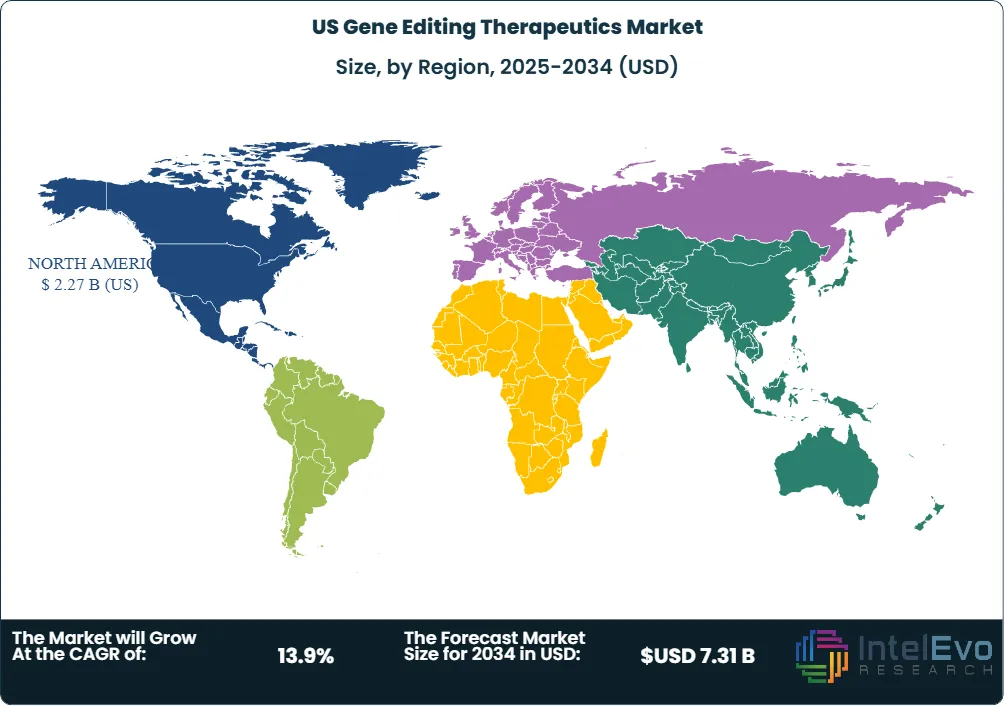
The U.S. gene editing therapeutics market reached approximately USD 2.27 Billion in 2025 and is projected to grow at a country-specific CAGR of 13.9% through 2034. The country leads on three measures: vendor concentration, reimbursement access, and clinical trial activity. Approximately 90% of U.S. Casgevy patients had reimbursed insurance access by year-end 2025. The FDA's Commissioner's National Priority Review Voucher granted to Vertex in November 2025 enables a roughly two-month review timeline for the Casgevy pediatric label expansion, with anticipated submission in 1H 2026.
Get More Information about this report -
Request Free Sample ReportKey Market Segment
By Editing Modality
- CRISPR-Cas Systems
- TALEN
- Zinc Finger Nucleases (ZFNs)
- Other Gene Editing Technologies
By Therapy Type
- In Vivo Gene Editing
- Ex Vivo Gene Editing
By Therapeutic Area
- Oncology
- Genetic Disorders
- Infectious Diseases
- Other Therapeutic Areas
By End-User
- Hospitals & Specialty Clinics
- Pharmaceutical & Biotechnology Companies
- Academic & Research Institutes
- Contract Research Organizations (CROs)
By Regional Coverage
- US
| Report Attribute | Details |
| Market size (2025) | USD 2.27 B |
| Forecast Revenue (2034) | USD 7.31 B |
| CAGR (2025-2034) | 13.9% |
| Historical data | 2021-2025 |
| Base Year For Estimation | 2025 |
| Forecast Period | 2026-2034 |
| Report coverage | Revenue Forecast, Competitive Landscape, Market Dynamics, Growth Factors, Trends and Recent Developments |
| Segments covered | By Editing Modality, (CRISPR-Cas Systems, TALEN, Zinc Finger Nucleases (ZFNs), Other Gene Editing Technologies), By Therapy Type, (In Vivo Gene Editing, Ex Vivo Gene Editing), By Therapeutic Area, (Oncology, Genetic Disorders, Infectious Diseases, Other Therapeutic Areas), By End-User, (Hospitals & Specialty Clinics, Pharmaceutical & Biotechnology Companies, Academic & Research Institutes, Contract Research Organizations (CROs)), |
| Research Methodology |
|
| Regional scope |
|
| Competitive Landscape | VERTEX PHARMACEUTICALS, INC., CRISPR THERAPEUTICS AG, INTELLIA THERAPEUTICS, INC., BEAM THERAPEUTICS, INC., ELI LILLY AND COMPANY (VERVE THERAPEUTICS), PRIME MEDICINE, INC., EDITAS MEDICINE, INC., CARIBOU BIOSCIENCES, INC., SANGAMO THERAPEUTICS, INC., PRECISION BIOSCIENCES, INC., TESSERA THERAPEUTICS, INC., GRAPHITE BIO (LENTIGEN), ALLOGENE THERAPEUTICS, INC., POSEIDA THERAPEUTICS, INC., VOR BIOPHARMA INC., EXCISION BIOTHERAPEUTICS, SIRIUS THERAPEUTICS, MAMMOTH BIOSCIENCES, INC., VERVE THERAPEUTICS (LILLY SUBSIDIARY), Others |
| Customization Scope | Customization for segments, region/country-level will be provided. Moreover, additional customization can be done based on the requirements. |
| Pricing and Purchase Options | Avail customized purchase options to meet your exact research needs. We have three licenses to opt for: Single User License, Multi-User License (Up to 5 Users), Corporate Use License (Unlimited User and Printable PDF). |


Frequently Asked Questions
How big is the US Gene Editing Therapeutics Market?
The U.S. Gene Editing Therapeutics Market was valued at USD 2.10 Billion in 2024 and is projected to reach USD 7.31 Billion by 2034, growing at a CAGR of 13.9% during the forecast period 2026–2034.
Who are the major players in the US Gene Editing Therapeutics Market?
VERTEX PHARMACEUTICALS, INC., CRISPR THERAPEUTICS AG, INTELLIA THERAPEUTICS, INC., BEAM THERAPEUTICS, INC., ELI LILLY AND COMPANY (VERVE THERAPEUTICS), PRIME MEDICINE, INC., EDITAS MEDICINE, INC., CARIBOU BIOSCIENCES, INC., SANGAMO THERAPEUTICS, INC., PRECISION BIOSCIENCES, INC., TESSERA THERAPEUTICS, INC., GRAPHITE BIO (LENTIGEN), ALLOGENE THERAPEUTICS, INC., POSEIDA THERAPEUTICS, INC., VOR BIOPHARMA INC., EXCISION BIOTHERAPEUTICS, SIRIUS THERAPEUTICS, MAMMOTH BIOSCIENCES, INC., VERVE THERAPEUTICS (LILLY SUBSIDIARY), Others
Which segments covered the US Gene Editing Therapeutics Market?
By Editing Modality, (CRISPR-Cas Systems, TALEN, Zinc Finger Nucleases (ZFNs), Other Gene Editing Technologies), By Therapy Type, (In Vivo Gene Editing, Ex Vivo Gene Editing), By Therapeutic Area, (Oncology, Genetic Disorders, Infectious Diseases, Other Therapeutic Areas), By End-User, (Hospitals & Specialty Clinics, Pharmaceutical & Biotechnology Companies, Academic & Research Institutes, Contract Research Organizations (CROs)),
How can this market research report help my business make strategic decisions?
Our market research reports provide actionable intelligence, including verified market size data, CAGR projections, competitive benchmarking, and segment-level opportunity analysis. These insights support strategic planning, investment decisions, product development, and market entry strategies for enterprises and startups alike.
How frequently is the data updated?
We continuously monitor industry developments and update our reports to reflect regulatory changes, technological advancements, and macroeconomic shifts. Updated editions ensure you receive the latest market intelligence.

Select Licence Type
Connect with our sales team

US Gene Editing Therapeutics Market
Published Date : 25 Jul 2026 | Formats :Why IntelEvoResearch
100%
Customer
Satisfaction
24x7+
Availability - we are always
there when you need us
200+
Fortune 50 Companies trust
IntelEvoResearch
80%
of our reports are exclusive
and first in the industry
100%
more data
and analysis
1000+
reports published
till date