

- Home
- Industries
 Aerospace And Defence
 Agriculture
 Automotive And Transportation
 Banking And Finance
 Business
 Chemicals And Materials
 Consumer And Retail
 Electronics And Semiconductors
 Food And Beverages
 Machinery & Equipments
 Manufacturing And Construction
 Medical Devices
 Others
 Pharmaceuticals And Healthcare
 Power And Energy
 Sports
 Technology
- Services
- News Room
- About us
- Contact Us
-
U.S. Hydrogel for Drug Delivery Market Size, Share | CAGR of 8.5%
US Hydrogel for Drug Delivery Market Size, Share, Growth, Industry Analysis By Polymer Origin (Natural, Synthetic, Hybrid), By Delivery Route (Injectable, Oral, Topical & Transdermal, Ocular), By Application (Cancer Therapy, Wound Healing, Tissue Engineering & Regenerative Medicine), By End User (Hospitals & Clinics, Pharma & Biotech Companies, Research Institutes), Regional Analysis & Key Players - Market Dynamics, Competitive Strategies & Forecast 2026-2034

Report Overview
| Market Size (2025) | Forecast Value (2034) | CAGR (2026-2034) | Largest Region (2025) |
|---|---|---|---|
| USD 8.85 Billion | USD 18.40 Billion | 8.5% | North America, 43.0% |
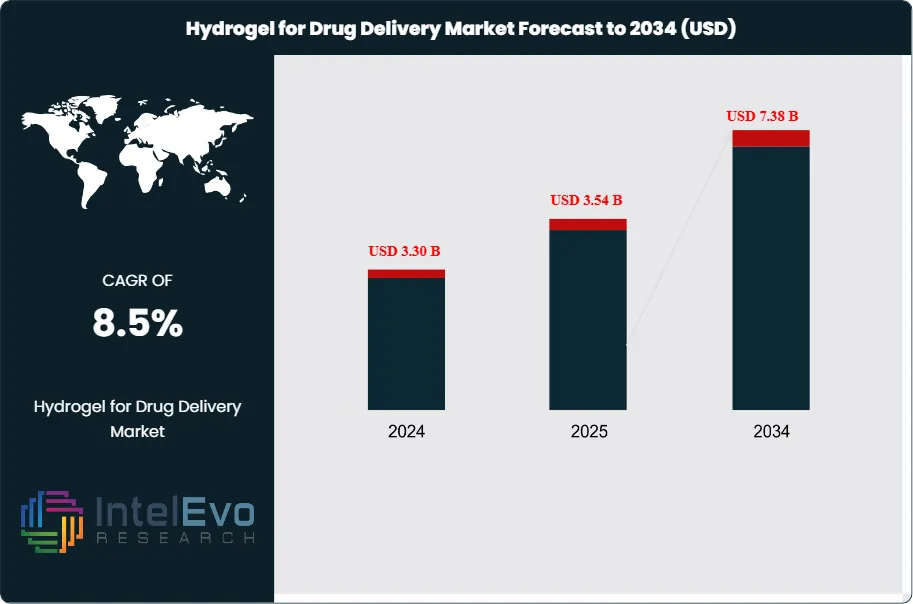
The U.S. Hydrogel for Drug Delivery Market was valued at USD 3.30 Billion in 2024 and reached USD 3.54 Billion in 2025. The market is projected to reach USD 7.38 Billion by 2034, expanding at a CAGR of 8.5% during the forecast period from 2026 to 2034. While The Hydrogel for Drug Delivery Market was valued at USD 8.24 Billion in 2024 and reached USD 8.85 Billion in 2025. The market is projected to reach USD 18.40 Billion by 2034, expanding at a CAGR of 8.5% during the forecast period from 2026 to 2034. This represents an absolute dollar opportunity of USD 9.55 Billion over the analysis period.
Get More Information about this report -
Request Free Sample ReportDemand for the hydrogel for drug delivery market is anchored by ophthalmology, oncology, wound care, and pain management applications where controlled release kinetics, site-specific targeting, and biocompatibility outperform conventional formulation technologies. Three FDA approvals reshaped the commercial landscape across 2025. On February 4, 2025, the FDA approved Genentech's Susvimo (ranibizumab injection) for diabetic macular edema, marking the second indication for the Port Delivery Platform after wet AMD. On May 22, 2025, the FDA cleared Susvimo for diabetic retinopathy, with refills required only every nine months in the Pavilion Phase 3 protocol. On June 12, 2025, UroGen Pharma secured FDA approval for ZUSDURI (UGN-102), an intravesical mitomycin formulation built on the proprietary RTGel reverse-thermal hydrogel platform, for adults with recurrent low-grade intermediate-risk non-muscle invasive bladder cancer. The Phase 3 ENVISION trial reported a 79.6% complete response rate at three months, with 79% of responders remaining event-free at one year.
Regulatory and reimbursement frameworks shape commercial adoption across the hydrogel for drug delivery market. The U.S. Food and Drug Administration regulates hydrogel-based drug delivery products through the Center for Drug Evaluation and Research for drug-device combination products, while the European Medicines Agency operates the centralized procedure for parallel review. Medicare reimbursement under HCPCS Level II J-codes covers approved ophthalmic implants such as Susvimo, while UroGen secured permanent J-code J9281 for Jelmyto and provisional pricing for ZUSDURI. The Centers for Medicare & Medicaid Services issued a National Coverage Determination supporting payer adoption of sustained-release ocular implants, while reimbursement under MS-DRGs in inpatient settings supports oncology hydrogel deployment. Per WHO data cited in industry analyses, the global burden of chronic disease is forecast to expand 57% by 2030, expanding the addressable population for hydrogel sustained-release platforms in oncology, ophthalmology, and pain management.
Innovation across the hydrogel for drug delivery market follows three vectors. First, stimuli-responsive smart hydrogels that respond to pH, temperature, enzymatic activity, redox potential, and light enable on-demand release profiles tailored to disease microenvironments. Second, theranostic platforms integrate hydrogel scaffolds with imaging agents such as magnetic nanoparticles, fluorescent dyes, and radiolabeled isotopes for real-time therapeutic monitoring during cancer treatment. Third, particulate hydrogel formats such as microgels and nanogels address syringeability constraints for posterior eye, intra-articular, and tumor margin applications. North America captured 43.0% of 2025 revenue, while Asia Pacific is forecast to register the fastest 10.2% CAGR through 2034, supported by aging demographics, expanded healthcare infrastructure, and rising chronic disease prevalence in China, Japan, and South Korea.
Market Definition and Scope
The hydrogel for drug delivery market is defined as the global commercial supply of three-dimensional, cross-linked, hydrophilic polymer networks formulated with active pharmaceutical ingredients (APIs) for sustained, controlled, targeted, or stimuli-responsive therapeutic release across pharmaceutical and combination drug-device products. The market includes natural-polymer hydrogels (collagen, gelatin, alginate, chitosan, hyaluronic acid, dextran, pectin, xanthan gum), synthetic-polymer hydrogels (polyethylene glycol, polyvinyl alcohol, polyacrylic acid, poly(2-hydroxyethyl methacrylate), polylactic-co-glycolic acid), hybrid hydrogels combining natural and synthetic polymers, and stimuli-responsive (smart) hydrogels engineered to respond to pH, temperature, enzymatic activity, redox potential, or light triggers.
Included in this analysis are injectable hydrogels, in-situ-forming hydrogels, intravesical hydrogels, intravitreal hydrogels, ocular implants, transdermal hydrogel patches, oral hydrogels, buccal and vaginal hydrogels, hydrogel-coated medical devices for drug elution, and hydrogel-based microneedle patches. Excluded from scope are wound-care hydrogels intended primarily for moisture donation rather than API delivery, hydrogel scaffolds for tissue engineering without therapeutic payload, contact lenses, hygiene products incorporating superabsorbent polymers, agricultural hydrogels, and hydrogel-based medical adhesives without active drug release. The hydrogel for drug delivery market sits inside the broader pharmaceutical drug delivery technology market and accounts for approximately 4.7% of total global drug delivery revenue in 2025.

Key Takeaways
- Market Growth: The hydrogel for drug delivery market reached USD 8.85 Billion in 2025 and is projected to reach USD 18.40 Billion by 2034 at an 8.5% CAGR.
- Segment Dominance: By polymer origin, synthetic-polymer hydrogels captured 48.6% of 2025 revenue equivalent to USD 4.30 Billion, anchored by FDA-approved Susvimo, ZUSDURI, and Zilretta formulations.
- Segment Dominance: By delivery route, ophthalmic hydrogels accounted for 27.4% of 2025 revenue, while topical hydrogels are forecast to register the fastest 10.0% CAGR through 2034.
- Driver: Three FDA approvals in 2025, including Susvimo for diabetic macular edema (February 4), Susvimo for diabetic retinopathy (May 22), and ZUSDURI for low-grade intermediate-risk NMIBC (June 12), validated commercial scale-up of sustained-release hydrogel platforms.
- Restraint: Manufacturing scale-up costs for medical-grade hydrogel APIs run 6 to 10 times conventional formulations, with sterility validation, biocompatibility testing, and multi-phase clinical trials extending commercialization timelines beyond eight years for novel hydrogel chemistries.
- Opportunity: Injectable oncology hydrogels are forecast to expand at an 11.2% CAGR through 2034, with chemo-immunotherapy combination depots and stimuli-responsive tumor-microenvironment platforms anchoring the pipeline.
- Trend: Theranostic hydrogel platforms integrating MRI contrast agents, fluorescent probes, and radiolabeled tracers are advancing through preclinical and Phase 1 studies for real-time therapeutic monitoring in oncology and ophthalmology.
- Regional: North America held the leading regional position at 43.0% revenue share equivalent to USD 3.81 Billion in 2025, anchored by Genentech, UroGen Pharma, Pacira BioSciences, and Ocular Therapeutix commercial product lines.
Key Insights Summary
- On June 12, 2025, the FDA approved UroGen Pharma's ZUSDURI (UGN-102) for adults with recurrent low-grade intermediate-risk non-muscle invasive bladder cancer, with the Phase 3 ENVISION trial reporting a 79.6% complete response rate at three months and 79% durability at one year using the proprietary RTGel reverse-thermal hydrogel.
- On February 4, 2025, Genentech secured FDA approval for Susvimo (ranibizumab injection) for diabetic macular edema based on the Pagoda Phase 3 study, where 6-month refills delivered non-inferior visual acuity gains of 9.6 ETDRS letters versus 9.4 letters for monthly intravitreal injections in 634 randomized patients.
- On May 22, 2025, the FDA expanded Susvimo's label to include diabetic retinopathy, the first continuous delivery treatment for the condition, with the Pavilion Phase 3 study demonstrating diabetic retinopathy severity scale improvements of two or more steps at 52 weeks with refill intervals of nine months.
- On December 11, 2025, NEXGEL Inc. spun off its prescription drug delivery program into NexGelRx with initial outside investor funding, retaining a 19.99% non-dilutive equity stake and a 5% perpetuity royalty on global Rx applications of NEXGEL's electron-beam-cross-linked hydrogel platform.
- An October 2025 MDPI peer-reviewed analysis sized injectable hydrogel applications across ocular, intra-articular, subcutaneous, intramuscular, tumoral, central nervous system, and mucosal delivery, with stimuli-responsive variants including thermosensitive, enzyme-cleavable, and pH-sensitive moieties matching pathological features such as inflammation and acidic tumor microenvironments.
- Pacira BioSciences' Zilretta (triamcinolone acetonide), an FDA-approved intra-articular injectable formulation comprising approximately 50-micron PLGA microspheres with sustained release over several weeks, anchors the commercial intra-articular sub-segment for osteoarthritis pain management.
Competitive Landscape Overview
The hydrogel for drug delivery market is moderately fragmented. Specialty pharmaceutical companies including Genentech (Roche), UroGen Pharma, Pacira BioSciences, and Ocular Therapeutix anchor the commercial drug-product segment with FDA-approved hydrogel formulations across ophthalmology, oncology, and pain management. Polymer and excipient suppliers including Ashland Global Holdings, Lubrizol Life Sciences, BASF, and Royal DSM serve formulation R&D programs across pharma and medtech accounts. Wound care and medical device firms including Cardinal Health, Johnson & Johnson, Smith & Nephew, ConvaTec, Coloplast, B. Braun Melsungen, and Paul Hartmann support hydrogel platforms across hospital and clinic settings. Strategic levers run along three lines: FDA approval velocity for new hydrogel-API combinations, polymer formulation IP including stimuli-responsive chemistries, and commercial reimbursement coverage including J-code assignments. Strategic activity over the trailing 12 months centered on FDA approvals, label expansions, corporate spin-offs, and bolt-on acquisitions of polymer suppliers rather than mega-deals.
Competitive Landscape Matrix
| Company | Headquarters | Market Position | Key Product | Geographic Strength | Recent Strategic Move |
|---|---|---|---|---|---|
| Genentech (Roche) | South San Francisco, CA, USA | Leader | Susvimo (ranibizumab) Port Delivery Platform | Global | Earned FDA approval for Susvimo for diabetic retinopathy on May 22, 2025 |
| UroGen Pharma Ltd. | Princeton, NJ, USA / Israel | Leader | ZUSDURI (UGN-102), Jelmyto, RTGel platform | North America | Secured FDA approval for ZUSDURI for LG-IR-NMIBC on June 12, 2025 |
| Pacira BioSciences | Tampa, FL, USA | Challenger | Zilretta (triamcinolone acetonide) PLGA microspheres | North America, Europe | Continued commercial scale-up of Zilretta for intra-articular osteoarthritis pain |
| Ocular Therapeutix | Bedford, MA, USA | Challenger | OTX-TIC, OTX-IVT bioresorbable hydrogel implants | North America | Advanced OTX-TIC bioresorbable intracameral travoprost implant in Phase 1/2 glaucoma trials |
| Cardinal Health Inc. | Dublin, OH, USA | Leader | Hydrogel-based drug delivery and wound care products | Global | Maintained leading position in hospital and clinic distribution channels |
| Johnson & Johnson | New Brunswick, NJ, USA | Leader | Hydrogel-based drug delivery formulations | Global | Continued portfolio expansion across ophthalmic and surgical hydrogel applications |
| Merck KGaA | Darmstadt, Germany | Leader | Hydrogel-based drug delivery and biopharma supply | Global | Closed USD 3.4 Billion acquisition of SpringWorks Therapeutics in 2025 |
| Ashland Global Holdings | Wilmington, DE, USA | Challenger | Pharmaceutical hydrogel polymers and excipients | Global | Continued expansion of Klucel and Aquasolve hydrogel polymer lines |
| Lubrizol Life Science | Wickliffe, OH, USA | Challenger | Carbopol hydrogel polymers, formulation services | Global | Maintained drug delivery polymer leadership across topical and ophthalmic categories |
| ConvaTec Group PLC | Reading, UK | Niche Player | Hydrogel-based wound care and ostomy products | Europe, North America | Continued geographic expansion across emerging markets in 2025 |
| NEXGEL Inc. | Langhorne, PA, USA | Niche Player | Electron-beam cross-linked hydrogel platform | North America | Spun off Rx drug delivery program into NexGelRx on December 11, 2025 |
| Smith & Nephew plc | London, UK | Challenger | Hydrogel wound care and surgical drug delivery | Global | Continued commercial expansion across advanced wound care portfolio |
By Polymer Origin
Synthetic-polymer hydrogels dominated the hydrogel for drug delivery market with 48.6% of 2025 revenue equivalent to USD 4.30 Billion. Polyethylene glycol, polyvinyl alcohol, polyacrylic acid, poly(2-hydroxyethyl methacrylate), and PLGA chemistries anchor commercial product lines including Genentech's Susvimo Port Delivery Platform, UroGen's RTGel reverse-thermal platform underpinning Jelmyto and ZUSDURI, and Pacira BioSciences' Zilretta PLGA microsphere formulation. Synthetic chemistries deliver tunable mechanical strength, controlled degradation rates, and reproducible manufacturing scale-up advantages that natural polymers cannot match, supporting their continued lead.
Natural-polymer hydrogels captured 36.7% of 2025 revenue and are forecast to grow at a 9.4% CAGR through 2034, the fastest among polymer-origin classes. Collagen, gelatin, alginate, chitosan, hyaluronic acid, dextran, pectin, xanthan gum, and fibrin anchor the natural sub-segment, with biocompatibility, biodegradability, and extracellular matrix mimicry driving demand across oncology depot, wound healing, and tissue-engineering-adjacent applications. Hybrid hydrogels combining natural and synthetic polymers held the remaining 14.7% of revenue, with crosslinker chemistries including dibenzocyclooctyne-functionalized poly(L-glutamic acid) and copper-free strain-promoted azide-alkyne cycloaddition supporting in-situ-forming depot platforms in oncology trials.
By Delivery Route
Ophthalmic hydrogels captured 27.4% of the hydrogel for drug delivery market in 2025, equivalent to USD 2.42 Billion. Genentech's Susvimo Port Delivery Platform, FDA-approved across wet AMD, diabetic macular edema, and diabetic retinopathy, anchors the commercial ophthalmic segment alongside Ocular Therapeutix's OTX-TIC bioresorbable intracameral travoprost implant. Sustained intraocular release of anti-VEGF therapeutics (ranibizumab, aflibercept) addresses patient adherence challenges and reduces injection frequency from monthly to every six or nine months, supporting the segment's commercial leadership.
Injectable hydrogels accounted for 24.6% of 2025 revenue and are forecast to grow at an 11.0% CAGR through 2034, the fastest among delivery routes, supported by oncology depot platforms and intra-articular pain management applications. Pacira BioSciences' Zilretta and emerging chemo-immunotherapy hydrogel depots based on matrix metalloproteinase-responsive polypeptide chemistries anchor the injectable segment. Topical hydrogels captured 19.8% of revenue, with the segment expected to grow at 10.0% CAGR through 2034 supported by Beiersdorf's January 2025 Hansaplast hydrogel format launches and Biomiq's PureGel nanotechnology-based wound care launch in February 2025. Intravesical hydrogels held 11.6% of revenue, anchored by UroGen's Jelmyto and ZUSDURI commercial portfolio. Other delivery routes including transdermal patches, oral, buccal, and vaginal hydrogels collectively accounted for 16.6% of 2025 revenue.
By Application
Oncology applications captured 28.3% of the hydrogel for drug delivery market in 2025, equivalent to USD 2.50 Billion. Bladder cancer led oncology revenue through UroGen's Jelmyto and June 12, 2025-approved ZUSDURI commercial product lines. Solid-tumor injectable hydrogel depots including OncoGel (paclitaxel) and chemo-immunotherapy combination platforms based on dibenzocyclooctyne-functionalized polypeptide chemistries advanced through Phase 1 and Phase 2 trials. The application is forecast to grow at a 10.4% CAGR through 2034, supported by tumor-microenvironment-responsive smart hydrogel pipelines.
Ophthalmology accounted for 26.7% of 2025 revenue, anchored by wet AMD, diabetic macular edema, and diabetic retinopathy applications across Susvimo, Ozurdex, Iluvien, Yutiq, and Retisert FDA-approved sustained-release platforms. Pain management captured 17.4% of revenue, anchored by intra-articular triamcinolone acetonide formulations such as Pacira BioSciences' Zilretta and emerging hyaluronic-acid-based osteoarthritis depots. Wound care held 14.5% of revenue, while cardiovascular, immunology, dermatology, and other applications collectively accounted for 13.1% of 2025 revenue.
By End User
Hospitals captured 47.8% of 2025 hydrogel for drug delivery market revenue, anchored by inpatient ophthalmic surgery, oncology infusion, and pain management procedure volumes. Specialty clinics including ophthalmology centers, urology clinics, and oncology infusion centers represented 28.2% of revenue, with retina specialist offices and academic medical centers anchoring outpatient Susvimo refill procedures and ZUSDURI intravesical instillations. Ambulatory surgery centers held 13.6% of revenue, while research institutes, contract research organizations, and pharma/biotech R&D end users collectively accounted for 10.4% of 2025 revenue.
Regional Analysis
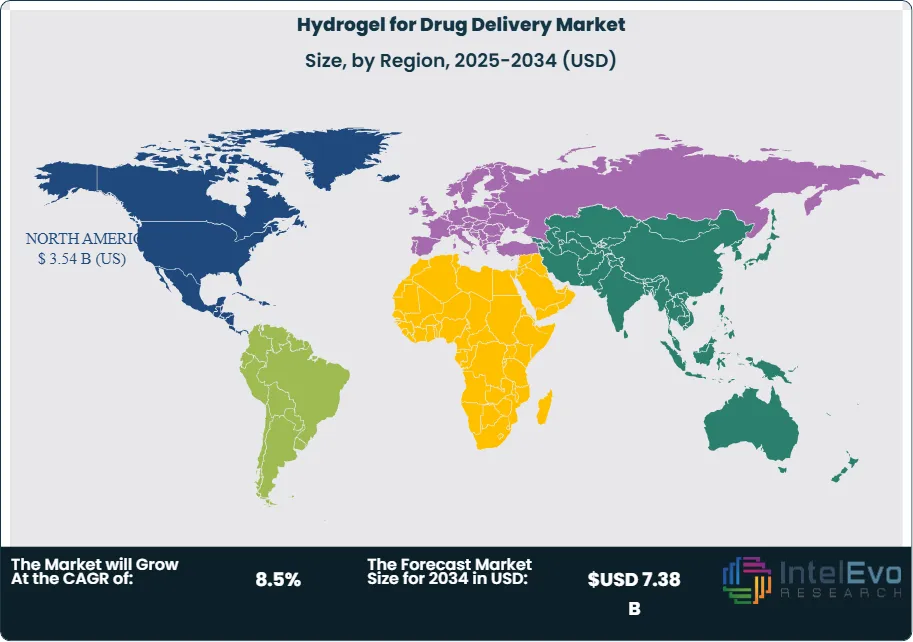
The U.S. Hydrogel for Drug Delivery Market represents one of the largest and most technologically advanced regional markets worldwide, supported by a robust pharmaceutical and biotechnology industry, extensive research infrastructure, and strong adoption of innovative drug delivery technologies. The growing prevalence of chronic diseases, increasing demand for biologics and biosimilars, and rising use of targeted therapeutics have significantly accelerated the adoption of hydrogel-based drug delivery systems across oncology, ophthalmology, wound care, regenerative medicine, and chronic disease management. Furthermore, substantial investments in biomedical research, favorable reimbursement frameworks, and the presence of leading pharmaceutical manufacturers continue to strengthen the country's position in the global market.
The market is further driven by continuous advancements in smart hydrogels, biodegradable polymer technologies, injectable formulations, and sustained-release drug delivery platforms designed to improve therapeutic efficacy and patient compliance. Increasing collaborations between pharmaceutical companies, biotechnology firms, academic institutions, and research organizations are fostering innovation in precision medicine, tissue engineering, and cell-based therapies. With strong FDA support for novel therapeutic products, expanding clinical trials, and growing commercialization of advanced biomaterials, the U.S. Hydrogel for Drug Delivery Market is expected to witness steady growth throughout the forecast period from 2026 to 2034.
Get More Information about this report -
Request Free Sample ReportKey Market Segment
By Polymer Origin
- Natural Hydrogels
- Synthetic Hydrogels
- Hybrid Hydrogels
By Delivery Route
- Injectable
- Oral
- Topical & Transdermal
- Ocular
- Others
By Application
- Cancer Therapy
- Wound Healing
- Ophthalmic Drug Delivery
- Tissue Engineering & Regenerative Medicine
- Others
By End User
- Hospitals & Clinics
- Pharmaceutical & Biotechnology Companies
- Research & Academic Institutes
- Ambulatory Surgical Centers (ASCs)
By Regional Coverage
- US
| Report Attribute | Details |
| Market size (2025) | USD 3.54 B |
| Forecast Revenue (2034) | USD 7.38 B |
| CAGR (2025-2034) | 8.5% |
| Historical data | 2021-2025 |
| Base Year For Estimation | 2025 |
| Forecast Period | 2026-2034 |
| Report coverage | Revenue Forecast, Competitive Landscape, Market Dynamics, Growth Factors, Trends and Recent Developments |
| Segments covered | By Polymer Origin, (Natural Hydrogels, Synthetic Hydrogels, Hybrid Hydrogels), By Delivery Route, (Injectable, Oral, Topical & Transdermal, Ocular, Others), By Application, (Cancer Therapy, Wound Healing, Ophthalmic Drug Delivery, Tissue Engineering & Regenerative Medicine, Others), By End User, (Hospitals & Clinics, Pharmaceutical & Biotechnology Companies, Research & Academic Institutes, Ambulatory Surgical Centers (ASCs)), |
| Research Methodology |
|
| Regional scope |
|
| Competitive Landscape | GENENTECH INC. (ROCHE), UROGEN PHARMA LTD., PACIRA BIOSCIENCES INC., OCULAR THERAPEUTIX INC., JOHNSON & JOHNSON, CARDINAL HEALTH INC., INTEGRA LIFESCIENCES HOLDINGS CORPORATION, MERCK KGAA, ASHLAND GLOBAL HOLDINGS INC., THE LUBRIZOL CORPORATION, UPM BIOMEDICALS OY, PAUL HARTMANN AG, CONVATEC GROUP PLC, SMITH & NEPHEW PLC, 3M COMPANY, COLOPLAST A/S, B. BRAUN MELSUNGEN AG, ROYAL DSM N.V., BASF SE, NEXGEL INC., BIOMIQ INC., BEIERSDORF AG, ROQUETTE FRÈRES, AXELGAARD MANUFACTURING CO. LTD., GALDERMA SA, SANYO CHEMICAL INDUSTRIES LTD., LG CHEM LTD., SUMITOMO SEIKA CHEMICALS CO. LTD., NIPPON SHOKUBAI CO. LTD., THE COOPER COMPANIES INC., Others |
| Customization Scope | Customization for segments, region/country-level will be provided. Moreover, additional customization can be done based on the requirements. |
| Pricing and Purchase Options | Avail customized purchase options to meet your exact research needs. We have three licenses to opt for: Single User License, Multi-User License (Up to 5 Users), Corporate Use License (Unlimited User and Printable PDF). |


Frequently Asked Questions
How big is the Hydrogel for Drug Delivery Market?
The U.S. Hydrogel for Drug Delivery Market was valued at USD 3.30 Billion in 2024 and is projected to reach USD 7.38 Billion by 2034, growing at a CAGR of 8.5% during the forecast period 2026–2034.
Who are the major players in the Hydrogel for Drug Delivery Market?
GENENTECH INC. (ROCHE), UROGEN PHARMA LTD., PACIRA BIOSCIENCES INC., OCULAR THERAPEUTIX INC., JOHNSON & JOHNSON, CARDINAL HEALTH INC., INTEGRA LIFESCIENCES HOLDINGS CORPORATION, MERCK KGAA, ASHLAND GLOBAL HOLDINGS INC., THE LUBRIZOL CORPORATION, UPM BIOMEDICALS OY, PAUL HARTMANN AG, CONVATEC GROUP PLC, SMITH & NEPHEW PLC, 3M COMPANY, COLOPLAST A/S, B. BRAUN MELSUNGEN AG, ROYAL DSM N.V., BASF SE, NEXGEL INC., BIOMIQ INC., BEIERSDORF AG, ROQUETTE FRÈRES, AXELGAARD MANUFACTURING CO. LTD., GALDERMA SA, SANYO CHEMICAL INDUSTRIES LTD., LG CHEM LTD., SUMITOMO SEIKA CHEMICALS CO. LTD., NIPPON SHOKUBAI CO. LTD., THE COOPER COMPANIES INC., Others
Which segments covered the Hydrogel for Drug Delivery Market?
By Polymer Origin, (Natural Hydrogels, Synthetic Hydrogels, Hybrid Hydrogels), By Delivery Route, (Injectable, Oral, Topical & Transdermal, Ocular, Others), By Application, (Cancer Therapy, Wound Healing, Ophthalmic Drug Delivery, Tissue Engineering & Regenerative Medicine, Others), By End User, (Hospitals & Clinics, Pharmaceutical & Biotechnology Companies, Research & Academic Institutes, Ambulatory Surgical Centers (ASCs)),
How can this market research report help my business make strategic decisions?
Our market research reports provide actionable intelligence, including verified market size data, CAGR projections, competitive benchmarking, and segment-level opportunity analysis. These insights support strategic planning, investment decisions, product development, and market entry strategies for enterprises and startups alike.
How frequently is the data updated?
We continuously monitor industry developments and update our reports to reflect regulatory changes, technological advancements, and macroeconomic shifts. Updated editions ensure you receive the latest market intelligence.

Select Licence Type
Connect with our sales team

US Hydrogel for Drug Delivery Market
Published Date : 21 Jul 2026 | Formats :Why IntelEvoResearch
100%
Customer
Satisfaction
24x7+
Availability - we are always
there when you need us
200+
Fortune 50 Companies trust
IntelEvoResearch
80%
of our reports are exclusive
and first in the industry
100%
more data
and analysis
1000+
reports published
till date