

- Home
- Industries
 Aerospace And Defence
 Agriculture
 Automotive And Transportation
 Banking And Finance
 Business
 Chemicals And Materials
 Consumer And Retail
 Electronics And Semiconductors
 Food And Beverages
 Machinery & Equipments
 Manufacturing And Construction
 Medical Devices
 Others
 Pharmaceuticals And Healthcare
 Power And Energy
 Sports
 Technology
- Services
- News Room
- About us
- Contact Us
-
U.S. Metal-Organic Framework Market Size, Share | CAGR of 17.8%
US Metal-Organic Framework Market Size, Share & Analysis Report By Product Type (Copper, Zinc, Iron, Aluminum MOFs), By Synthesis Method (Solvothermal, Microwave, Electrochemical, Mechanochemical), By Form (Powder, Pellets, Membranes), By Application (Gas Storage, Gas Separation, Catalysis, Drug Delivery, Sensors), By End-Use Industry (Chemical, Healthcare, Oil & Gas, Environmental): Regional Overview, Market Dynamics, Trends & Forecast 2026–2034

Report Overview
| Market Size (2025) | Forecast Value (2034) | CAGR (2026-2034) | Largest Region (2025) |
| USD 0.78 Billion | USD 3.10 Billion | 16.6% | Asia Pacific, 38.4% |
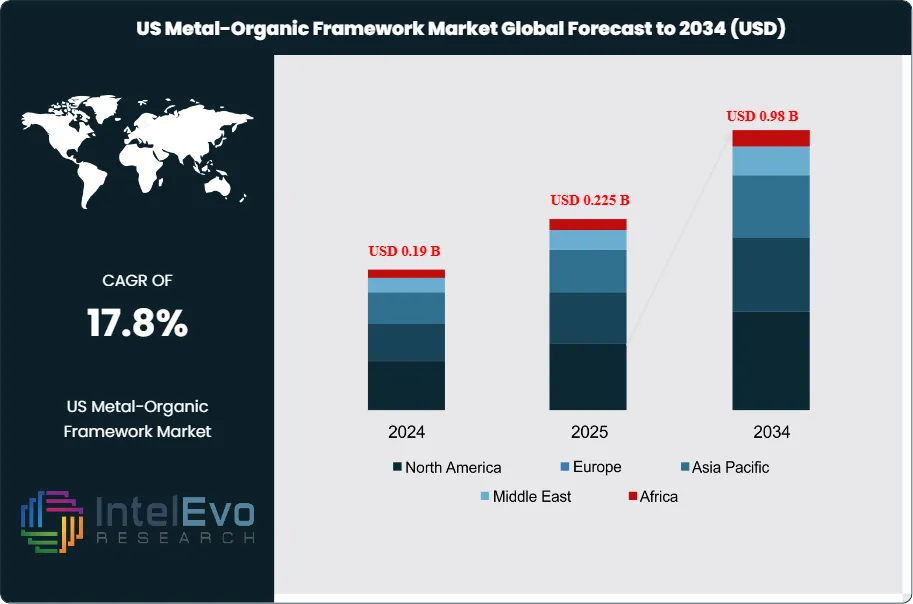
The U.S. Metal-Organic Framework Market was valued at USD 0.19 Billion in 2024 and reached USD 0.225 Billion in 2025. The market is projected to reach USD 0.98 Billion by 2034, expanding at a CAGR of 17.8% during the forecast period from 2026 to 2034. While The Global Metal-Organic Framework Market was valued at USD 0.67 Billion in 2024 and reached USD 0.78 Billion in 2025. The market is projected to reach USD 3.10 Billion by 2034, expanding at a CAGR of 16.6% during the forecast period from 2026 to 2034. This represents an absolute dollar opportunity of USD 2.32 Billion over the analysis period. The metal-organic framework market reached a defining inflection point in October 2025 when the Royal Swedish Academy of Sciences awarded the Nobel Prize in Chemistry to Susumu Kitagawa, Richard Robson, and Omar Yaghi for their development of MOFs, transitioning the technology from academic novelty to mainstream industrial materials category.
Get More Information about this report -
Request Free Sample ReportCarbon capture is the single largest demand pull. Svante Technologies' implementation of CALF-20—a zinc-based MOF manufactured at multi-hundred-ton scale by BASF SE since October 2023—has captured approximately one tonne of CO2 daily from cement-plant flue gas in commissioned trials. Industrial scale-up by NuMat Technologies, with U.S. capacity approaching 300 tonnes per year, and tonne-scale manufacturing by UK-based MOF Technologies Ltd. signal that supply has caught up with the most ambitious flagship deployments. The U.S. Inflation Reduction Act's Section 45Q tax credit at USD 85 per tonne of captured CO2 underwrites project economics, while the EU Carbon Border Adjustment Mechanism (CBAM) and the EU Emissions Trading System extension to maritime and waste-to-energy create downstream demand.
Beyond carbon capture, demand pulls in three additional verticals. Direct air capture (DAC) deployments at AspiraDAC, AirJoule, and Avnos use MOFs to lower the regeneration energy versus amine sorbents. Atmospheric water harvesting—anchored by MOF-303 testing in Death Valley demonstrating 0.7 liters per kilogram of MOF daily—targets arid regions and disaster-relief applications. Hydrogen and methane storage applications anchor NuMat's ION-X cylinder business serving the semiconductor industry, where MOF-based gas adsorption replaces high-pressure cylinders for toxic specialty gases.
Asia Pacific holds the leading 38.4% share in 2025, valued at approximately USD 300 Million, anchored by Chinese government action plans on energy conservation under the 14th Five-Year Plan, Japanese commercial activity at Atomis Inc. and Mitsui Kinzoku, and Australian DAC pilots at AspiraDAC. North America's 32.7% share is driven by U.S. Department of Energy carbon-capture funding and the Inflation Reduction Act's tax credits, with Mosaic Materials—acquired by Baker Hughes in 2022—anchoring oil and gas decarbonization. Europe's 22.5% share reflects Horizon Europe materials funding, BASF's German manufacturing base, and a deep Swiss-Norwegian innovator network. Through 2034, the market will be defined by the transition from kilogram-scale chemical-supplier shipments to multi-thousand-tonne industrial sorbent volumes.
Market Definition & Scope
The metal-organic framework market is defined as the global commercial supply of crystalline porous coordination polymers consisting of metal ions or metal-oxide clusters bridged by organic ligands, forming three-dimensional networks with surface areas ranging from 1,000 to over 7,000 square meters per gram. The market encompasses MOF synthesis intermediates and finished sorbent powders, films, monoliths, pellets, and structured filter formats, sold either by the kilogram for research and small-volume specialty uses or by the tonne for industrial gas-separation, carbon-capture, and water-harvesting applications.
Included in scope: zinc-based MOFs (CALF-20, ZIF-8, MOF-5), copper-based MOFs (HKUST-1), aluminum-based MOFs (MIL-53, MOF-303), iron-based MOFs (MIL-101, MIL-100), zirconium-based MOFs (UiO-66, UiO-67), magnesium-based MOFs (Mg-MOF-74), and emerging multi-metallic and hybrid frameworks; downstream-formed MOF films, membranes, and monoliths; and MOF-based finished products such as Svante's structured adsorbent filters and NuMat's ION-X cylinders. Excluded: covalent organic frameworks (COFs), zeolites, activated carbons, and silica gels, which compete in adjacent sorbent markets but are not coordination polymers. The MOF category accounts for approximately 8% of the broader USD 9.6 Billion industrial sorbent and adsorbent parent market in 2025.

Key Takeaways
- Market Growth: The metal-organic framework market expanded from USD 0.78 Billion in 2025 toward a projected USD 3.10 Billion by 2034, registering a CAGR of 16.6%.
- Segment Dominance (Material): Zinc-based MOFs accounted for approximately 35% of 2025 revenue, equivalent to USD 273 Million, anchored by CALF-20 production for Svante's carbon capture filters and ZIF-8 supply for research customers.
- Segment Dominance (Application): Gas storage and separation captured approximately 39% of 2025 revenue, equivalent to USD 304 Million, with carbon capture sub-applications driving the bulk of new demand.
- Driver: The U.S. Inflation Reduction Act's Section 45Q tax credit pays USD 85 per tonne of CO2 captured at point sources and USD 180 per tonne for direct air capture, transforming MOF-based capture project economics and underwriting Svante, AirJoule, and Mosaic Materials commercial deployments.
- Restraint: Bulk MOF production cost above USD 50-200 per kilogram in 2025—versus USD 2-5 per kilogram for activated carbon—keeps payback periods longer than competing sorbents in non-incentivized markets.
- Opportunity: Atmospheric water harvesting using MOF-303 and aluminum-based frameworks addresses an absolute dollar opportunity of approximately USD 380 Million across the forecast period as arid-region pilots scale.
- Trend: Mechanochemical and aqueous solvothermal synthesis are displacing organic-solvent solvothermal routes, with mechanochemical synthesis projected to grow at the fastest 26.2% CAGR through 2034 due to lower solvent use and energy efficiency.
- Regional: Asia Pacific captured the leading 38.4% share in 2025, equivalent to roughly USD 300 Million, supported by Chinese carbon-emission reduction action plans and Japanese specialty MOF commercialization at Atomis and Mitsui Kinzoku.
Key Insights Summary
- On October 8, 2025, the Royal Swedish Academy of Sciences awarded the Nobel Prize in Chemistry to Susumu Kitagawa, Richard Robson, and Omar Yaghi for their development of metal-organic frameworks, citing the materials' enormous potential for capturing and storing specific substances including carbon dioxide.
- Svante Technologies' commercial deployment of CALF-20—a zinc-based MOF manufactured by BASF SE—has captured approximately one tonne of CO2 daily from cement-plant flue gas trials, validating the commercial viability of MOF-based carbon capture.
- BASF SE has established multi-hundred-tonne annual MOF production capacity using batch synthesis methods at sites in Germany and the United States, with the company's July 2025 commercial-scale CALF-20 facility designed for several hundred tonnes per year.
- NuMat Technologies operates U.S. MOF manufacturing capacity approaching 300 tonnes annually, with its ION-X gas storage cylinders supplying the semiconductor industry as a safer alternative to high-pressure toxic-gas containers.
- MOF-303, an aluminum-based framework, has been validated in Death Valley field tests generating up to 0.7 liters of potable water per kilogram of MOF daily under arid conditions, demonstrating practical atmospheric water harvesting.
- On July 21, 2025, Nitto Denko Corporation entered a strategic partnership and made an equity investment in NuMat Technologies to co-develop next-generation decarbonization technologies using MOF-based separation systems.
Competitive Landscape Overview
The metal-organic framework market is fragmented at the company level but moderately consolidated at the manufacturing-capacity level. The top four suppliers by tonnage—BASF SE, NuMat Technologies Inc., MOF Technologies Ltd., and Mosaic Materials Inc. (Baker Hughes)—collectively held approximately 58% of 2025 industrial-scale revenue, while a long tail of specialty research suppliers (Strem Chemicals, novoMOF, ProfMOF, GS Alliance, Promethean Particles) addresses kilogram-scale academic and pilot-line demand. Competition runs along three axes: chemistry depth (proprietary framework versus commodity ZIF-8/HKUST-1 supply), production scale (tonne versus kilogram), and downstream integration (sorbent powder seller versus filter and module integrator).
Competitive Landscape Matrix
| Company | HQ | Position | Key Product | Geographic Strength | Recent Strategic Move |
| BASF SE | Germany | Leader | Basolite MOFs, CALF-20 | Global | Brought commercial-scale CALF-20 facility online July 2025; debuted hydrogen-storage MOF line September 2025 |
| NuMat Technologies Inc. | USA | Leader | ION-X cylinders, decarbonization MOFs | North America, Asia Pacific | Banked equity investment from Nitto Denko in July 2025; secured additional VC funding October 2025 |
| MOF Technologies Ltd. | UK | Leader | Mechanochemical MOF production, NUADA filters | Europe, North America | Inked multi-year supply agreement with Air Liquide for MOF-based gas purification in Q1 2025 |
| Mosaic Materials Inc. (Baker Hughes) | USA | Leader | Diamine-functionalized MOFs | North America | Posted over 90% CO2 capture efficiency at U.S. natural gas processing plant deployment in August 2025 |
| Svante Technologies Inc. | Canada | Challenger | Structured CALF-20 adsorbent filters, OEM&D | North America, Europe | Commissioned world's first commercial sorbent-based capture filter manufacturing facility in 2025 |
| Promethean Particles Ltd. | UK | Challenger | Continuous-flow MOF synthesis | Europe | Continued tonne-scale production scale-up through 2024-2025 for environmental and energy applications |
| Framergy Inc. | USA | Challenger | AYRSORB F250, AYRSORB MOF series | North America | Concluded April 2025 field pilot of AYRSORB F250 achieving 100% pure methane stream in natural gas purification trials |
| Atomis Inc. | Japan | Niche Player | CubiTan MOF gas storage | Asia Pacific | Continued commercialization of MOF-loaded gas tanks for industrial customers in Japan and Korea |
| Decarbontek Inc. | USA | Niche Player | DCF-1 MOF for carbon capture | North America | Brought DCF-1 to commercial launch at kilogram scale in July 2025 targeting industrial carbon management |
Segmentation Analysis
The metal-organic framework market is segmented across product type, synthesis method, form, application, and end-use industry. Zinc-based MOFs lead by product type, solvothermal synthesis dominates by method, powder dominates by form, and gas storage and separation leads by application.
By Product Type
Zinc-based MOFs accounted for approximately 35% of 2025 revenue, equivalent to USD 273 Million. CALF-20—the zinc 1,2,4-triazolate-oxalate framework developed by Dr. George Shimizu at the University of Calgary and licensed to Svante Technologies—anchors the segment through BASF's multi-hundred-tonne production. ZIF-8 (zeolitic imidazolate framework-8) supplies research and pilot-scale customers globally, with thermal stability above 400 degrees Celsius and a Brunauer-Emmett-Teller surface area of approximately 1,800 square meters per gram. Within zinc chemistries, CALF-20 captured roughly 60% of segment revenue, ZIF-8 about 30%, and other zinc frameworks (MOF-5, IRMOF-3) the remaining 10%.
Copper-based MOFs held approximately 22% share in 2025, valued at USD 172 Million. HKUST-1 (also known as Cu-BTC and Basolite C300 in BASF's catalog) dominates due to its high CO2 adsorption capacity at moderate pressures and well-understood synthesis pathways. Aluminum-based MOFs captured around 17%, growing fastest at an estimated 19% year-on-year as MIL-53 and MOF-303 gain traction in atmospheric water harvesting and CO2 capture. Iron-based MOFs (MIL-101, MIL-100) held approximately 11% share, with biomedical and catalysis applications anchoring demand. Zirconium-based UiOs captured 10%, magnesium-based Mg-MOF-74 held 3%, and other product types collectively the remaining 2%.
By Synthesis Method
Solvothermal synthesis led at approximately 50% of 2025 revenue, anchored by its proven reliability, high crystallinity output, and widespread research adoption. The hydro(solvo)thermal route remains the workhorse for zinc-based and copper-based MOF production. Microwave-assisted synthesis captured around 18% share, offering shorter reaction times (minutes versus hours) and lower energy consumption per kilogram. Mechanochemical synthesis held approximately 15% in 2025 but is projected to grow fastest at a 26.2% CAGR through 2034 due to its near-zero solvent use, energy efficiency, and scalability validated by MOF Technologies Ltd. at tonne scale. Electrochemical and continuous-flow methods together held the remaining 17%, with continuous-flow Promethean Particles synthesis providing a route to MOF production at industrial cost points.
By Form
Powder formats dominated at approximately 49% of 2025 revenue, owing to ease of handling, high surface exposure, and suitability for bulk adsorption, catalysis, and separation processes. Pellet and granular forms captured around 23% share, with shaped MOFs feeding fixed-bed industrial reactors. Films and membranes held approximately 17%, projected to grow fastest at a 25.7% CAGR through 2034 as semiconductor sensors and gas separation membranes scale. Monoliths captured around 7%, with Svante's structured adsorbent filters representing the largest commercial monolith application. Other forms (composites, aerogels, fibers) held the remaining 4%.
By Application
Gas storage and separation led applications at approximately 39% of 2025 revenue, valued at USD 304 Million. Carbon capture sub-applications dominate, with cement, steel, hydrogen, and pulp-and-paper sector deployments anchoring demand. Catalysis captured approximately 18% share, with MOFs serving as platforms for chemical synthesis and pollutant degradation. Drug delivery and biomedical applications held around 14%, projected to grow fastest at a 27.9% CAGR through 2034 as MOFs' controlled-release capabilities and tunable biocompatibility scale into commercial pharmaceutical products.
Water harvesting and HVAC applications captured approximately 13% of 2025 application revenue, with WaHa, AirJoule, and Transaera leveraging MOFs' superior water adsorption properties. Sensing and electronics held around 9%, with Lantha Sensors and Matrix Sensors Inc. integrating MOFs into volatile organic compound and gas detection products. Energy storage (hydrogen, methane), water purification, and other applications collectively held the remaining 7%, with hydrogen storage growing alongside the global hydrogen economy expansion.
By End-Use Industry
The chemicals industry led end-use at approximately 28% of 2025 revenue, anchored by gas separation, catalyst, and process-intensification applications. Oil and gas captured around 22% share, propelled by Mosaic Materials' (Baker Hughes) deployments at U.S. natural gas processing plants and Framergy's AYRSORB methane purification systems. Healthcare and pharmaceuticals held approximately 15%, environmental protection 13%, semiconductor and electronics 9%, food and beverage 6%, and energy and other end-uses the remaining 7%. Healthcare's 27.9% CAGR within drug-delivery sub-applications outpaces all end-use categories due to FDA-cleared MOF-based controlled-release research advancing toward commercial filings.
Regional Analysis
U.S. Metal-Organic Framework Market Overview
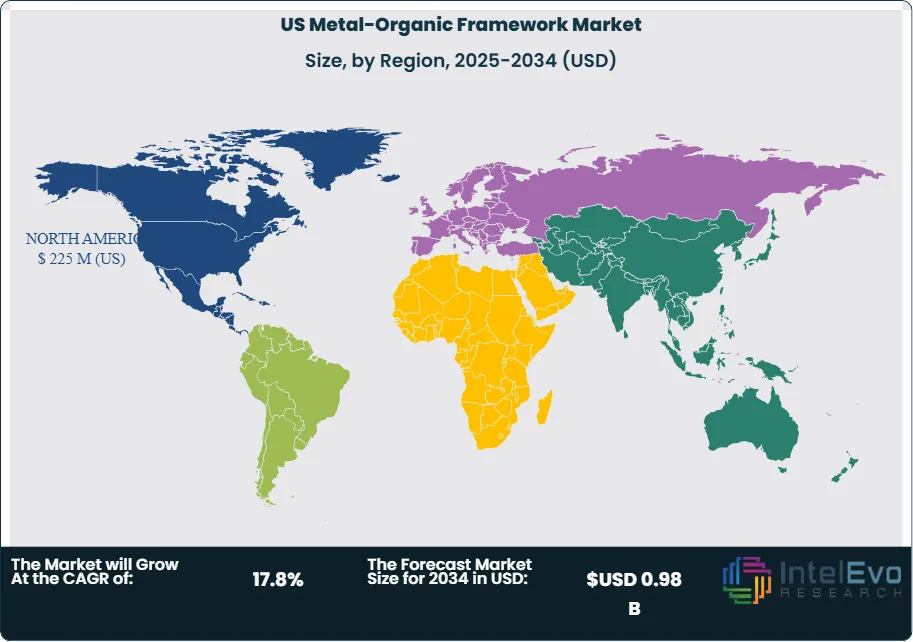
The U.S. Metal-Organic Framework Market was valued at USD 0.19 Billion in 2024 and reached USD 0.225 Billion in 2025. The market is projected to reach USD 0.98 Billion by 2034, expanding at a CAGR of 17.8% during the forecast period from 2026 to 2034. The market is experiencing rapid growth driven by increasing investments in advanced materials research, carbon capture technologies, hydrogen storage, and high-performance gas separation solutions. Growing adoption of metal-organic frameworks across chemical processing, healthcare, environmental remediation, and energy storage applications is further supporting market expansion throughout the country.
Strong federal funding for clean energy initiatives, expanding research collaborations between national laboratories, universities, and private companies, and increasing commercialization of MOF-based technologies are strengthening the U.S. market outlook. In addition, rising demand for sustainable industrial processes, next-generation catalysis, water purification systems, and advanced porous materials is expected to create significant long-term opportunities for manufacturers and technology developers throughout the forecast period from 2026 to 2034.
Get More Information about this report -
Request Free Sample ReportKey Market Segment
By Product Type
- Copper-Based MOFs
- Zinc-Based MOFs
- Iron-Based MOFs
- Aluminum-Based MOFs
- Others
By Synthesis Method
- Solvothermal
- Microwave-Assisted
- Electrochemical
- Mechanochemical
- Others
By Form
- Powder
- Pellets
- Membranes
- Monoliths
By Application
- Gas Storage
- Gas Separation
- Catalysis
- Drug Delivery
- Sensors
- Others
By End-Use Industry
- Chemical
- Healthcare & Pharmaceuticals
- Oil & Gas
- Environmental
- Electronics
- Others
By Regional Coverage
- US
| Report Attribute | Details |
| Market size (2025) | USD 0.225 B |
| Forecast Revenue (2034) | USD 0.98 B |
| CAGR (2025-2034) | 17.8% |
| Historical data | 2021-2025 |
| Base Year For Estimation | 2025 |
| Forecast Period | 2026-2034 |
| Report coverage | Revenue Forecast, Competitive Landscape, Market Dynamics, Growth Factors, Trends and Recent Developments |
| Segments covered | By Product Type, (Copper-Based MOFs, Zinc-Based MOFs, Iron-Based MOFs, Aluminum-Based MOFs, Others), By Synthesis Method, (Solvothermal, Microwave-Assisted, Electrochemical, Mechanochemical, Others), By Form, (Powder, Pellets, Membranes, Monoliths), By Application, (Gas Storage, Gas Separation, Catalysis, Drug Delivery, Sensors, Others), By End-Use Industry, (Chemical, Healthcare & Pharmaceuticals, Oil & Gas, Environmental, Electronics, Others), |
| Research Methodology |
|
| Regional scope | United States |
| Competitive Landscape | BASF SE, NUMAT TECHNOLOGIES INC., MOF TECHNOLOGIES LTD., MOSAIC MATERIALS INC. (BAKER HUGHES), SVANTE TECHNOLOGIES INC., PROMETHEAN PARTICLES LTD., FRAMERGY INC., STREM CHEMICALS, INC. (ASCENSUS SPECIALTIES), MERCK KGAA / SIGMA-ALDRICH, ATOMIS INC., NUADA LTD., NOVOMOF AG, DECARBONTEK INC., ACSYNAM INC., IMMATERIAL LTD., KURARAY CO., LTD., GS ALLIANCE CO., LTD., MOFAPPS AS, PROFMOF AS, Others |
| Customization Scope | Customization for segments, region/country-level will be provided. Moreover, additional customization can be done based on the requirements. |
| Pricing and Purchase Options | Avail customized purchase options to meet your exact research needs. We have three licenses to opt for: Single User License, Multi-User License (Up to 5 Users), Corporate Use License (Unlimited User and Printable PDF). |


Frequently Asked Questions
How big is the US Metal-Organic Framework Market?
The U.S. Metal-Organic Framework Market was valued at USD 0.19 Billion in 2024 and is projected to reach USD 0.98 Billion by 2034, growing at a CAGR of 17.8% during the forecast period 2026–2034.
Who are the major players in the US Metal-Organic Framework Market?
BASF SE, NUMAT TECHNOLOGIES INC., MOF TECHNOLOGIES LTD., MOSAIC MATERIALS INC. (BAKER HUGHES), SVANTE TECHNOLOGIES INC., PROMETHEAN PARTICLES LTD., FRAMERGY INC., STREM CHEMICALS, INC. (ASCENSUS SPECIALTIES), MERCK KGAA / SIGMA-ALDRICH, ATOMIS INC., NUADA LTD., NOVOMOF AG, DECARBONTEK INC., ACSYNAM INC., IMMATERIAL LTD., KURARAY CO., LTD., GS ALLIANCE CO., LTD., MOFAPPS AS, PROFMOF AS, Others
Which segments covered the US Metal-Organic Framework Market?
By Product Type, (Copper-Based MOFs, Zinc-Based MOFs, Iron-Based MOFs, Aluminum-Based MOFs, Others), By Synthesis Method, (Solvothermal, Microwave-Assisted, Electrochemical, Mechanochemical, Others), By Form, (Powder, Pellets, Membranes, Monoliths), By Application, (Gas Storage, Gas Separation, Catalysis, Drug Delivery, Sensors, Others), By End-Use Industry, (Chemical, Healthcare & Pharmaceuticals, Oil & Gas, Environmental, Electronics, Others),
How can this market research report help my business make strategic decisions?
Our market research reports provide actionable intelligence, including verified market size data, CAGR projections, competitive benchmarking, and segment-level opportunity analysis. These insights support strategic planning, investment decisions, product development, and market entry strategies for enterprises and startups alike.
How frequently is the data updated?
We continuously monitor industry developments and update our reports to reflect regulatory changes, technological advancements, and macroeconomic shifts. Updated editions ensure you receive the latest market intelligence.

Select Licence Type
Connect with our sales team

US Metal-Organic Framework Market
Published Date : 23 Jul 2026 | Formats :Why IntelEvoResearch
100%
Customer
Satisfaction
24x7+
Availability - we are always
there when you need us
200+
Fortune 50 Companies trust
IntelEvoResearch
80%
of our reports are exclusive
and first in the industry
100%
more data
and analysis
1000+
reports published
till date