

- Home
- Industries
 Aerospace And Defence
 Agriculture
 Automotive And Transportation
 Banking And Finance
 Business
 Chemicals And Materials
 Consumer And Retail
 Electronics And Semiconductors
 Food And Beverages
 Machinery & Equipments
 Manufacturing And Construction
 Medical Devices
 Others
 Pharmaceuticals And Healthcare
 Power And Energy
 Sports
 Technology
- Services
- News Room
- About us
- Contact Us
-
U.S. Shape Memory Polymer Market Size, Share & Forecast | CAGR of 10.8%
US Shape Memory Polymer Market Size, Share, Growth Analysis By Material Type (Polyurethane SMP, Polyurethane-Urea SMP, Epoxy-Based SMP, Polyethylene SMP, Styrene-Based SMP), By Form (Films & Sheets, Foams, Fibers & Textiles, Molded Parts), By Application (Biomedical, Aerospace, Automotive, Smart Textiles, Robotics, Consumer Electronics), By End-Use Industry, Manufacturing Process & Forecast 2026-2034

Report Overview
| Market Size (2025) | Forecast Value (2034) | CAGR (2026-2034) | Largest Region (2025) |
| USD 1.30 Billion | USD 3.20 Billion | 10.5% | North America, 38.0% |
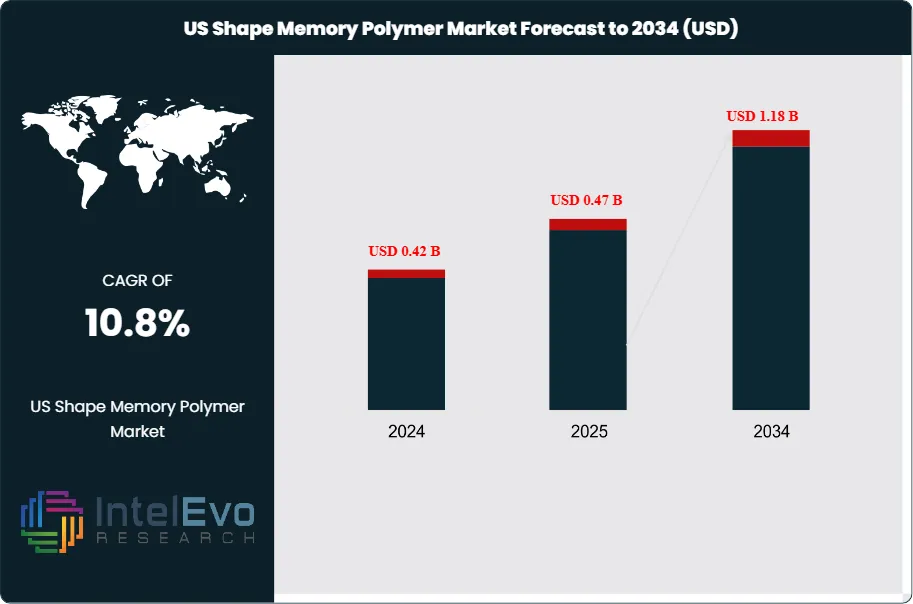
The U.S. Shape Memory Polymer Market was valued at USD 0.42 Billion in 2024 and reached USD 0.47 Billion in 2025. The market is projected to reach USD 1.18 Billion by 2034, expanding at a CAGR of 10.8% during the forecast period from 2026 to 2034. While The Global Shape Memory Polymer Market was valued at USD 1.18 Billion in 2024 and reached USD 1.30 Billion in 2025. The market is projected to reach USD 3.20 Billion by 2034, expanding at a CAGR of 10.5% during the forecast period from 2026 to 2034. This represents an absolute dollar opportunity of USD 1.90 Billion over the analysis period. Shape memory polymer demand is being pulled by three converging forces: the medical device industry's pivot toward minimally invasive embolization and self-expanding implants, aerospace deployable structures for small satellites and morphing wings, and the maturation of 4D printing as a serial-production technique rather than a laboratory curiosity.
Get More Information about this report -
Request Free Sample ReportPolyurethane shape memory chemistries dominate commercial output, anchored by Covestro AG, BASF SE, and SMP Technologies Inc. Epoxy-based formulations from Composite Technology Development Inc. and Cornerstone Research Group have moved from laboratory benches to space-qualified hardware, with NASA's 2024 disclosure of a 3-meter-scale shape memory polymer composite test article setting performance targets at less than 3 mm RMS shape accuracy. Biocompatible polyurethane platforms developed at Lawrence Livermore National Laboratory and Texas A&M University underpin Shape Memory Medical Inc.'s IMPEDE embolization plug family, which secured EU MDR Class III certification on December 22, 2025, becoming one of the first SMP devices cleared under the more stringent 2017/745 framework.
Regulatory tailwinds extend beyond medical devices. The EU's Packaging and Packaging Waste Regulation (PPWR) entered into force in February 2025, creating compliance pressure for active and intelligent packaging where SMPs add temperature-triggered tamper indicators and shelf-life signaling. Horizon Europe's 2026-2027 Work Programme allocated EUR 4.9 Billion to climate-action research, with advanced polymers identified as a priority technology. In the United States, the FDA's 510(k) and IDE pathways anchor medical-device SMP commercialization, while the U.S. Department of Energy continues to fund SMP composite work at Lawrence Berkeley National Laboratory and university consortia.
North America held the leading 38.0% share in 2025, supported by deep medical-device innovation pipelines, a concentrated aerospace prime base (Boeing, Lockheed Martin, Northrop Grumman), and university-industry partnerships at Texas A&M, MIT, and Harvard. Asia Pacific captured 33.0% share, propelled by Japanese material science leadership at Asahi Kasei, Nissan Chemical, and Mitsubishi Chemical, alongside Chinese capacity additions from Guangzhou Manborui Materials Technology. Europe held 22.0% share, with Germany's BASF, Covestro, and Evonik Industries anchoring polyurethane supply and Fraunhofer IAP coordinating research consortia. The forecast period through 2034 will be defined by transitions: from thermoset to thermoplastic SMPs, from temperature-only activation to multi-stimulus chemistries, and from prototype 4D printing to certified flight hardware.
Market Definition & Scope
The shape memory polymer market is defined as the global commercial supply of polymeric smart materials capable of holding a programmed temporary shape and recovering a permanent shape upon exposure to an external stimulus such as heat, light, electrical current, magnetic field, pH change, or moisture. The market encompasses thermoset and thermoplastic chemistries—polyurethane (PU), epoxy, polyvinyl chloride (PVC), acrylic, polylactic acid (PLA), polycaprolactone (PCL), and polyether ether ketone (PEEK)—sold either as resin pellets and films to converters or as finished SMP composites and devices.
Included in scope: bulk SMP resin and pellet sales to medical-device, aerospace, automotive, and consumer-goods OEMs; SMP composites incorporating reinforcing fibers (carbon, glass) or fillers (graphene, MWCNTs, ceramic platelets); 4D-printed SMP feedstock and finished structures; and SMP films, foams, and fibers used in active packaging and textiles. Excluded: shape memory alloys (SMA) such as nickel-titanium nitinol and copper-based SMAs, shape memory ceramics, ferromagnetic shape memory alloys, and conventional thermoplastic elastomers without programmable shape recovery. The SMP segment represents approximately 14% of the broader USD 9 Billion shape memory materials parent market in 2025.

Key Takeaways
- Market Growth: The shape memory polymer market expanded from USD 1.30 Billion in 2025 toward a projected USD 3.20 Billion by 2034, registering a CAGR of 10.5%.
- Segment Dominance (Material): Polyurethane SMPs accounted for approximately 46% of 2025 revenue, equivalent to USD 598 Million, anchored by Covestro and BASF supply into automotive and biomedical end-markets.
- Segment Dominance (Application): Medical devices led at approximately 30% of 2025 revenue, equivalent to USD 390 Million, with self-expanding stents, embolization plugs, and tissue scaffolds driving volume growth.
- Driver: Aging populations across OECD countries are pushing minimally invasive cardiovascular and neurovascular procedure volumes higher; the 510(k)-cleared IMPEDE embolization plug family is now approved across more than 25 countries, demonstrating commercial-scale SMP medical traction.
- Restraint: Material cost above USD 80-150 per kilogram for medical-grade polyurethane SMPs versus USD 4-8 per kilogram for commodity polyurethanes constrains penetration into price-sensitive automotive and consumer applications.
- Opportunity: Aerospace deployable structures—solar arrays, antenna booms, drag sails—represent an absolute dollar opportunity of approximately USD 380 Million across the forecast period as small-satellite launches accelerate.
- Trend: 4D printing of SMPs is moving from research prototypes to qualified production, with continuous-fiber 4D printing techniques achieving roughly 86% shape recovery in carbon-nanotube-loaded deployable booms tested for spacecraft applications.
- Regional: North America captured the leading 38.0% share in 2025, equivalent to roughly USD 494 Million, supported by USD 38 Million in disclosed Series C funding into Shape Memory Medical Inc. through the trailing 24 months.
Key Insights Summary
- On December 22, 2025, Shape Memory Medical Inc. received EU MDR Class III certification for its IMPEDE embolization plug product family under Regulation 2017/745, expanding commercial reach across the European Economic Area.
- CRG (Cornerstone Research Group) launched its shape memory polymer composite samples to the International Space Station via SpaceX Dragon on March 21, 2024 as part of MISSE-19, with follow-on cyclic-attachment trials on MISSE-21 conducted across a six-month exposure window beginning early 2025.
- NASA's 2024 technical report documented a 3-meter-scale SMP composite deployable structure designed to maintain shape accuracy below 3 mm RMS error, defining the performance target for future flight-qualified deployables.
- The U.S. Department of Energy estimates that buildings and industries account for more than 70% of national energy consumption, providing the policy underpinning for SMP-based active-insulation and self-deploying retrofit components specified under federal efficiency programs.
- Shape Memory Medical Inc. closed USD 38 Million in Series C financing on March 5, 2024, led by Earlybird Venture Capital with HBM Healthcare Investments, WexMed II, and Emergent Medical Partners II participating, anchoring the AAA-SHAPE pivotal trial.
- PEEK-based shape memory polymers with glass transition temperatures near 143 degrees Celsius enable radiation-resistant aerospace deployable hardware, with prototype drag sails and metallic-ball transport mechanisms validated in published 2024-2025 actuation studies.
Competitive Landscape Overview
The shape memory polymer market is moderately consolidated. The top four suppliers—SMP Technologies Inc., BASF SE, Covestro AG, and DuPont de Nemours Inc.—collectively held approximately 54% of 2025 device-level revenue, with Shape Memory Medical Inc. providing the dominant medical-device franchise on top of these material suppliers. Competition runs along three vectors: chemistry (polyurethane versus epoxy versus emerging vitrimers), application depth (medical regulatory expertise versus aerospace qualification versus textile and packaging cost), and downstream integration (resin-only sellers versus device-makers). Specialized players such as Cornerstone Research Group and Composite Technology Development command niche aerospace contracts that larger chemical companies cannot easily replicate, while Shape Memory Medical and EndoShape have built medical-device businesses on top of resin platforms originally licensed from national laboratories.
Competitive Landscape Matrix
| Company | HQ | Position | Key Product | Geographic Strength | Recent Strategic Move |
| SMP Technologies Inc. | Japan | Leader | Diaplex polyurethane SMPs | Asia Pacific, Europe | Continued expansion of Diaplex grade portfolio for textile and consumer-goods applications through 2025 |
| BASF SE | Germany | Leader | Polyurethane SMP grades | Global | Engineering SMP-based actuators and adaptive components for vehicle interiors and aerospace structures |
| Covestro AG | Germany | Leader | Thermoplastic polyurethane SMPs | Europe, North America, Asia | Brought thermo-responsive polyurethane films to market in late 2023 with extended shape-recovery cycle counts; Changhua Taiwan TPU line scaled in 2024-2025 |
| Shape Memory Medical Inc. | USA | Leader | IMPEDE, IMPEDE-FX, IMPEDE-FX RapidFill, TrelliX coil | North America, Europe | Earned EU MDR Class III certification for IMPEDE family on December 22, 2025; closed USD 38 Million Series C in March 2024 |
| Evonik Industries AG | Germany | Challenger | VESTAMID, specialty polyamide SMPs | Europe, Asia Pacific | Continued specialty resin development for biomedical and aerospace customers through 2024-2025 |
| DuPont de Nemours, Inc. | USA | Challenger | Polymer SMP grades for industrial uses | North America, Asia | Maintained portfolio integration following 2019 corporate restructuring; ongoing automotive interior applications |
| Cornerstone Research Group | USA | Niche Player | Veriflex SMP composites, deployable structures | North America (defense/space) | Sent SMP composite samples to ISS aboard MISSE-19 (March 2024) and follow-on MISSE-21 cyclic test in 2025 |
| Composite Technology Development Inc. | USA | Niche Player | TEMBO elastic memory composites | North America (aerospace) | Ongoing supply of deployable boom and antenna structures for small-satellite primes through 2025 |
| Spintech Holdings Inc. | USA | Niche Player | Smart tooling SMP composites | North America | Continued aerospace tooling deployments with Tier-1 suppliers across 2024-2025 |
Segmentation Analysis
The shape memory polymer market is segmented across material type, stimulus type, application, and end-use industry. Polyurethane chemistries dominate the material cut, temperature-induced activation leads stimulus, medical devices anchor application, and healthcare leads end-use.
By Material Type
Polyurethane SMPs accounted for approximately 46% of 2025 revenue, equivalent to USD 598 Million. Polyurethane platforms benefit from a wide tunable glass-transition temperature window (-30 to 170 degrees Celsius), inherent biocompatibility for certain grades, and processability through extrusion and injection molding. Covestro AG's thermoplastic polyurethane films and BASF SE's automotive-grade resins anchor large-volume supply, while SMP Technologies Inc.'s Diaplex line dominates Japanese and Asian textile applications. Within the polyurethane segment, biodegradable polyurethane variants are growing fastest at an estimated 14% year-on-year as Shape Memory Medical and EndoShape scale clinical adoption.
Epoxy-based SMPs captured approximately 22% share in 2025, valued at USD 286 Million. The segment's high glass-transition temperatures (typically 90-160 degrees Celsius) and superior shape-fixing performance make epoxies the dominant choice in aerospace deployable hardware, where Cornerstone Research Group and Composite Technology Development supply NASA, the U.S. Air Force, and commercial small-satellite primes. A 2026 study from the Korea Institute of Industrial Technology validated bisphenol-A epoxy SMP composites with amine curing-agent blends for elevated-temperature applications. PVC-based SMPs held approximately 11% share, acrylic SMPs held 9%, and other chemistries (PEEK, PLA, PCL, vitrimers) collectively captured 12%, with vitrimers and PEEK-based variants growing fastest.
By Stimulus Type
Temperature-induced SMPs led stimulus at approximately 70% of 2025 revenue, equivalent to USD 910 Million. Thermal activation through ambient heat, body temperature (37 degrees Celsius for medical grades), or external heat sources remains the most commercialized actuation mechanism due to its simplicity and predictability. Light-induced SMPs captured around 11% share, with photothermal activation gaining traction in optoelectronic and reconfigurable consumer applications. Electricity-induced (Joule-heating) SMPs held approximately 10%, often using embedded carbon nanotubes or graphene foam to enable resistive heating. Magnetic-field-induced and pH-responsive variants together accounted for the remaining 9%, with the multi-stimulus segment growing fastest as research consortia at Fraunhofer IAP and U.S. universities target programmable composites.
By Application
Medical devices led applications at approximately 30% of 2025 revenue, valued at USD 390 Million. Self-expanding stents, embolization plugs, vascular grafts, sutures, drug-delivery systems, and tissue scaffolds anchor demand. Shape Memory Medical Inc.'s IMPEDE embolization plug family is now approved across more than 25 countries, while the AAA-SHAPE pivotal trial enrolling 180 patients across 40 sites tests sac-management in abdominal aortic aneurysm repair. Aerospace and defense captured approximately 23% share, equivalent to USD 299 Million, with deployable booms, solar arrays, antennas, and morphing wing components driving demand. Automotive applications held around 21% share, anchored by SMP-based actuators in vehicle interiors, adaptive seat assemblies, and reconfigurable storage.
Construction and infrastructure captured approximately 13% of 2025 application revenue, including self-deploying expansion seals, smart concrete reinforcements, and adaptive insulation. Textiles held approximately 8%, with self-fitting garments, wrinkle-resistant fabrics, and active sportswear from Adidas and other brands integrating SMP yarns and films. Consumer electronics, toys, packaging, and other applications collectively held the remaining 5%. Within applications, medical devices recorded the steepest growth trajectory at an 11.1% CAGR, supported by an aging global population and the EU PPWR's February 2025 entry into force, which indirectly boosts active-packaging adoption.
By End-Use Industry
Healthcare led end-use at approximately 33% of 2025 revenue, with cardiovascular devices, orthopedic implants, dental aligners, and minimally invasive surgical tools anchoring demand. Aerospace held around 24%, propelled by small-satellite deployable hardware, Boeing and Airbus interior actuators, and U.S. Department of Defense morphing-structure programs. Automotive captured approximately 22%, with Stellantis, BMW, and Toyota integrating SMP-based active components. Construction held around 11%, textile 6%, and consumer electronics and other end-uses 4%. Healthcare's 11.1% segment CAGR outpaces the market average due to Shape Memory Medical's commercial expansion and Enovis-owned MedShape's orthopedic franchise scaling across U.S. and EU markets.
Regional Analysis
U.S. Shape Memory Polymer Market Overview
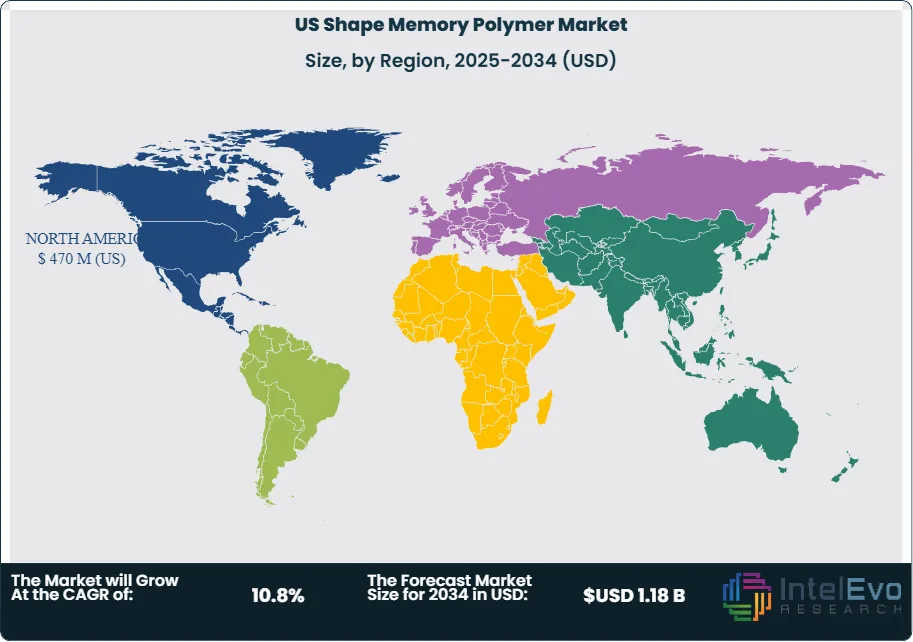
The U.S. Shape Memory Polymer Market was valued at USD 0.42 Billion in 2024 and reached USD 0.47 Billion in 2025. The market is projected to reach USD 1.18 Billion by 2034, expanding at a CAGR of 10.8% during the forecast period from 2026 to 2034. The market is experiencing robust growth driven by increasing demand for advanced smart materials across healthcare, aerospace, defense, automotive, and electronics industries. Rising adoption of minimally invasive medical devices, soft robotics, wearable technologies, and lightweight aerospace components is further accelerating market expansion across the United States.
Strong investments in polymer research, additive manufacturing, biomedical engineering, and next-generation functional materials continue to strengthen the country's leadership in shape memory polymer innovation. In addition, growing government support for advanced manufacturing, expanding defense modernization programs, and increasing commercialization of intelligent materials are expected to create significant growth opportunities for manufacturers and technology developers throughout the forecast period from 2026 to 2034.
Get More Information about this report -
Request Free Sample ReportKey Market Segment
By Material Type
- Polyurethane (PU)
- Polyethylene (PE)
- Polystyrene (PS)
- Epoxy-Based SMP
- Others
By Stimulus Type
- Heat-Activated
- Light-Activated
- Electrical-Activated
- Chemical & Moisture-Activated
- Others
By Application
- Biomedical Devices
- Aerospace & Defense
- Textiles
- Electronics
- Automotive
- Others
By End-Use Industry
- Healthcare
- Aerospace
- Automotive
- Consumer Electronics
- Industrial & Manufacturing
- Others
By Regional Coverage
- US
| Report Attribute | Details |
| Market size (2025) | USD 0.47 B |
| Forecast Revenue (2034) | USD 1.18 B |
| CAGR (2025-2034) | 10.8% |
| Historical data | 2021-2025 |
| Base Year For Estimation | 2025 |
| Forecast Period | 2026-2034 |
| Report coverage | Revenue Forecast, Competitive Landscape, Market Dynamics, Growth Factors, Trends and Recent Developments |
| Segments covered | By Material Type, (Polyurethane (PU), Polyethylene (PE), Polystyrene (PS), Epoxy-Based SMP, Others), By Stimulus Type, (Heat-Activated, Light-Activated, Electrical-Activated, Chemical & Moisture-Activated, Others), By Application, (Biomedical Devices, Aerospace & Defense, Textiles, Electronics, Automotive, Others), By End-Use Industry, (Healthcare, Aerospace, Automotive, Consumer Electronics, Industrial & Manufacturing, Others), |
| Research Methodology |
|
| Regional scope |
|
| Competitive Landscape | SMP TECHNOLOGIES INC., BASF SE, COVESTRO AG, SHAPE MEMORY MEDICAL INC., EVONIK INDUSTRIES AG, DUPONT DE NEMOURS, INC., THE LUBRIZOL CORPORATION, ASAHI KASEI CORPORATION, CORNERSTONE RESEARCH GROUP, INC., COMPOSITE TECHNOLOGY DEVELOPMENT, INC., MEDSHAPE, INC. (ENOVIS), ENDOSHAPE, INC., SPINTECH HOLDINGS INC., MITSUBISHI CHEMICAL GROUP, NISSAN CHEMICAL CORPORATION, HUNTSMAN INTERNATIONAL LLC, NANOSHEL LLC, GUANGZHOU MANBORUI MATERIALS TECHNOLOGY CO., LTD., Others |
| Customization Scope | Customization for segments, region/country-level will be provided. Moreover, additional customization can be done based on the requirements. |
| Pricing and Purchase Options | Avail customized purchase options to meet your exact research needs. We have three licenses to opt for: Single User License, Multi-User License (Up to 5 Users), Corporate Use License (Unlimited User and Printable PDF). |


Frequently Asked Questions
How big is the US Shape Memory Polymer Market?
The U.S. Shape Memory Polymer Market was valued at USD 0.42 Billion in 2024 and is projected to reach USD 1.18 Billion by 2034, growing at a CAGR of 10.8% during the forecast period 2026–2034.
Who are the major players in the US Shape Memory Polymer Market?
SMP TECHNOLOGIES INC., BASF SE, COVESTRO AG, SHAPE MEMORY MEDICAL INC., EVONIK INDUSTRIES AG, DUPONT DE NEMOURS, INC., THE LUBRIZOL CORPORATION, ASAHI KASEI CORPORATION, CORNERSTONE RESEARCH GROUP, INC., COMPOSITE TECHNOLOGY DEVELOPMENT, INC., MEDSHAPE, INC. (ENOVIS), ENDOSHAPE, INC., SPINTECH HOLDINGS INC., MITSUBISHI CHEMICAL GROUP, NISSAN CHEMICAL CORPORATION, HUNTSMAN INTERNATIONAL LLC, NANOSHEL LLC, GUANGZHOU MANBORUI MATERIALS TECHNOLOGY CO., LTD., Others
Which segments covered the US Shape Memory Polymer Market?
By Material Type, (Polyurethane (PU), Polyethylene (PE), Polystyrene (PS), Epoxy-Based SMP, Others), By Stimulus Type, (Heat-Activated, Light-Activated, Electrical-Activated, Chemical & Moisture-Activated, Others), By Application, (Biomedical Devices, Aerospace & Defense, Textiles, Electronics, Automotive, Others), By End-Use Industry, (Healthcare, Aerospace, Automotive, Consumer Electronics, Industrial & Manufacturing, Others),
How can this market research report help my business make strategic decisions?
Our market research reports provide actionable intelligence, including verified market size data, CAGR projections, competitive benchmarking, and segment-level opportunity analysis. These insights support strategic planning, investment decisions, product development, and market entry strategies for enterprises and startups alike.
How frequently is the data updated?
We continuously monitor industry developments and update our reports to reflect regulatory changes, technological advancements, and macroeconomic shifts. Updated editions ensure you receive the latest market intelligence.

Select Licence Type
Connect with our sales team

US Shape Memory Polymer Market
Published Date : 23 Jul 2026 | Formats :Why IntelEvoResearch
100%
Customer
Satisfaction
24x7+
Availability - we are always
there when you need us
200+
Fortune 50 Companies trust
IntelEvoResearch
80%
of our reports are exclusive
and first in the industry
100%
more data
and analysis
1000+
reports published
till date