
Global Women’s Health Market Size, Share & Analysis By Health Conditions (Gynecological Conditions, Mental Health, Cardiovascular Health, Maternal Health, Other Health Conditions), By Age Group (Adolescents, Adult Women, Elderly Women) Industry Regions & Key Players – Healthcare Access Trends & Forecast 2025–2034
The Women’s Health Market is projected to rise from USD 44.1 Billion in 2024 to approximately USD 74.5 Billion by 2034, growing at a CAGR of around 5.6% during 2025–2034. Rising focus on preventive care and early diagnostics is significantly boosting investment in women-focused healthcare solutions. Digital health platforms, generative AI in diagnostics, and telehealth services are expanding access to personalized care worldwide. Growing awareness, supportive government policies, and innovation in reproductive and hormonal wellness products are accelerating global market adoption.
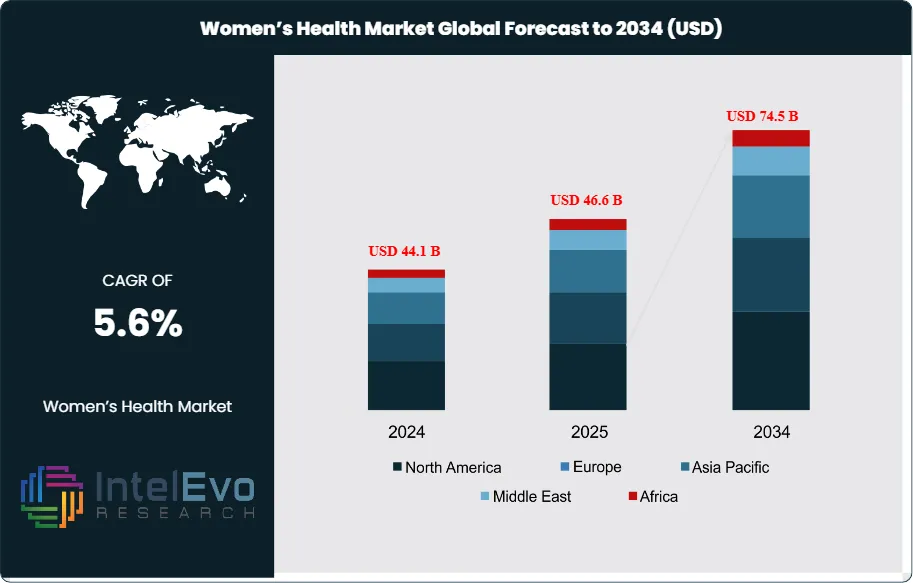
The market has evolved significantly as women’s healthcare needs take center stage in global health priorities. Government initiatives, regulatory oversight, and heightened awareness of gender-specific conditions are accelerating demand for advanced solutions targeting reproductive health, maternal care, and chronic disease management among women. Organizations such as the World Health Organization (WHO) and the U.S. Food and Drug Administration (FDA) continue to shape policy frameworks, ensuring access to safe, effective, and equitable healthcare. Early detection measures for breast cancer, supported by WHO studies, highlight the sector’s life-saving potential, with screening programs improving survival rates by up to 30% in certain regions.
Market momentum is further reinforced by robust capital flows from venture capital and private equity firms. More than USD 2 billion in investments over the past year have been directed toward fertility services, telemedicine, and personalized care platforms, confirming investor confidence in the sector’s innovation capacity. The intersection of women’s health with pharmaceuticals, medical devices, wellness solutions, and mental health care has broadened the ecosystem, driving new revenue streams and positioning the industry at the crossroads of healthcare and consumer well-being. Notably, targeted interventions in cardiovascular health have contributed to a 30% decline in heart disease among women over the past decade, underscoring tangible progress.
Technological innovation is playing a transformative role. The widespread adoption of telehealth, artificial intelligence, and wearable health devices is enabling more personalized, data-driven care. Nearly three-quarters of healthcare organizations now deploy AI to enhance diagnostics, predict health risks, and support remote monitoring. These advances are reshaping how women engage with healthcare, making solutions more inclusive and accessible.
Regionally, North America and Europe remain leading markets due to strong healthcare infrastructure and regulatory support, while Asia-Pacific is emerging as a high-growth destination, fueled by expanding healthcare access, urbanization, and greater awareness of women’s health needs. Despite progress, challenges persist including limited healthcare availability for 1.6 billion women worldwide and persistent gender bias in clinical research. Addressing these gaps represents both a societal imperative and a commercial opportunity for stakeholders across the global healthcare value chain.
Key Takeaways
Market Growth: The Women’s Health Market is projected to expand from USD 41.3 billion in 2023 to USD 66 billion by 2033, representing a robust CAGR of 4.8%, propelled by increased investment in preventive care and personalized healthcare solutions.
Condition Type: Gynecological conditions hold the leading market position, accounting for over 37% of revenue, fueled by rising incidence rates and improvements in early diagnostic solutions.
Age Group: Adult women represent the primary consumer segment, commanding more than 46% market share due to broad health needs spanning fertility, chronic disease management, and menopausal care.
Driver: Proactive government and private sector initiatives, including breast cancer screening and maternal health programs, have elevated global awareness and accelerated the adoption of women’s health services.
Restraint: Limited healthcare access for an estimated 1.6 billion women globally, coupled with persistent gender bias in clinical research, remains a significant barrier to market growth and equitable outcomes.
Opportunity: The emergence of telehealth, wearable devices, and AI-powered diagnostics is unlocking new possibilities for remote, personalized healthcare delivery, particularly in underserved regions.
Trend: There is a pronounced shift toward mental health integration in women’s healthcare, as holistic models increasingly acknowledge the interplay of physical and psychological well-being.
Regional Analysis: North America leads with a 38.7% market share valued at USD 15.9 billion in 2023, backed by advanced healthcare systems and high consumer awareness, while Asia-Pacific is rapidly becoming a key investment hotspot due to expanding infrastructure and rising demand.
Health Conditions Analysis
The Women’s Health Market in 2025 demonstrates substantial segmentation according to distinct health conditions, with gynecological disorders such as ovarian cysts and uterine fibroids remaining the prevailing area of focus and accounting for over 37% of total market revenues . This leadership is primarily due to rising incidence rates and the widespread adoption of minimally invasive diagnostic and therapeutic approaches. Companies including Hologic, Bayer, and Boston Scientific are investing in advanced technologies, such as integrated imaging systems and hormonal therapies, to further improve patient outcomes.
Mental health continues to ascend as a priority within women’s healthcare, bolstered by increased societal acceptance and growing integration of mental health solutions into general wellness platforms . Mobile applications and telemedicine are now more frequently used for conditions such as depression and anxiety, reflecting a systemic shift toward accessible, stigma-free treatment. Simultaneously, cardiovascular health is rising in prominence as research increasingly highlights sex-specific risk factors and treatment complexities, prompting new initiatives around personalized care.
The maternal health segment further strengthens the market, with sustained attention to maternal morbidity, safe pregnancy outcomes, and innovative prenatal care models. Beyond these, areas such as osteoporosis and autoimmune conditions are gaining traction, powered by advances in prevention and early detection. Collectively, these segments underscore the need for strategic investment in female-specific health programs and policy reform, as the market acknowledges the diversity of women’s health needs
Age Group Analysis
The adult women demographic is projected to remain the leading segment in 2025, representing over 46% of market share owing to its broad spectrum of healthcare considerations, ranging from reproductive concerns to chronic and mental health management. Heightened awareness, enhanced healthcare delivery systems, and the rising incidence of non-communicable diseases underpin continued growth in this category. Corporate wellness initiatives and government awareness campaigns contribute to greater engagement with healthcare services.
Both adolescent and elderly women are experiencing marked growth in demand for tailored healthcare services. Targeted outreach and governmental policies focused on menstrual health and preventative care are positively impacting adolescents. In contrast, the growing elderly population is driving increased adoption of geriatric care, particularly for post-menopausal health challenges and chronic condition management. Companies are pivoting towards developing personalized solutions that address the evolving requirements of women throughout their life stages, reinforcing the market’s shift toward holistic care.
Regional Analysis
North America remains the most influential region in the global Women’s Health Market for 2025, maintaining a leadership position with more than 38.7% market share and a value surpassing USD 15.9 billion. The landscape is characterized by robust healthcare infrastructure, progressive regulatory environments, and persistent investment in biomedical research and innovation from leading organizations like Johnson & Johnson and Abbott Laboratories. Enhanced consumer trust and physician confidence result from strict evaluation standards and ongoing professional education.
The region’s market strength is further supported by focused initiatives from government bodies and non-profit organizations, which prioritize awareness, preventive care, and early intervention programs for women’s health concerns. As North America continues to advance in medical technology, increase household incomes, and experience demographic aging, the outlook for sustained market growth is positive. Still, emerging markets in Europe and Asia-Pacific, with expanding healthcare investments and changing population dynamics, are positioning themselves as increasingly competitive regions, providing new avenues for industry development and strategic expansion.
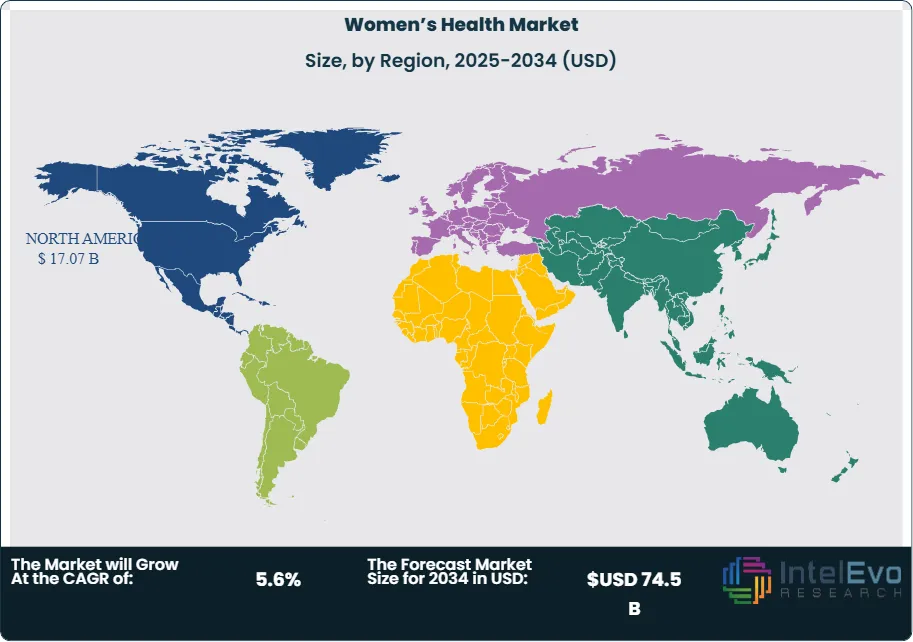
By Health Conditions (Gynecological Conditions, Mental Health, Cardiovascular Health, Maternal Health, Other Health Conditions), By Age Group (Adolescents, Adult Women, Elderly Women)
Research Methodology
Primary Research- 100 Interviews of Stakeholders
Secondary Research
Desk Research
Regional scope
North America (United States, Canada, Mexico)
Latin America (Brazil, Argentina, Columbia)
East Asia And Pacific (China, Japan, South Korea, Australia, Cambodia, Fiji, Indonesia)
Sea And South Asia (India, Singapore, Thailand, Taiwan, Malaysia)
Eastern Europe (Poland, Russia, Czech Republic, Romania)
Western Europe (Germany, U.K., France, Spain, Itlay)
Middle East & Africa (GCC Countries, Egypt, Nigeria, South Africa, Israel)
Customization for segments, region/country-level will be provided. Moreover, additional customization can be done based on the requirements.
Pricing and Purchase Options
Avail customized purchase options to meet your exact research needs. We have three licenses to opt for: Single User License, Multi-User License (Up to 5 Users), Corporate Use License (Unlimited User and Printable PDF).
TABLE OF CONTENTS
1. EXECUTIVE SUMMARY
1.1. MARKET SNAPSHOT
1.2. KEY FINDINGS & INSIGHTS
1.3. ANALYST RECOMMENDATIONS
1.4. FUTURE OUTLOOK
2. RESEARCH METHODOLOGY
2.1. MARKET DEFINITION & SCOPE
2.2. RESEARCH OBJECTIVES: PRIMARY & SECONDARY DATA SOURCES
2.3. DATA COLLECTION SOURCES
2.3.1. COVERAGE OF 100+ PRIMARY RESEARCH/CONSULTATION CALLS WITH INDUSTRY STAKEHOLDERS
FIGURE 17 NORTH AMERICA WOMEN’S HEALTH CURRENT AND FUTURE TYPE ANALYSIS, 2025–2034, (USD MILLION)
FIGURE 18 NORTH AMERICA WOMEN’S HEALTH CURRENT AND FUTURE END USER ANALYSIS, 2025–2034, (USD MILLION)
FIGURE 19 MARKET SHARE BY COUNTRY
FIGURE 20 LATIN AMERICA WOMEN’S HEALTH CURRENT AND FUTURE TYPE ANALYSIS, 2025–2034, (USD MILLION)
FIGURE 21 LATIN AMERICA WOMEN’S HEALTH CURRENT AND FUTURE END USER ANALYSIS, 2025–2034, (USD MILLION)
FIGURE 22 MARKET SHARE BY COUNTRY
FIGURE 23 EASTERN EUROPE WOMEN’S HEALTH CURRENT AND FUTURE TYPE ANALYSIS, 2025–2034, (USD MILLION)
FIGURE 24 EASTERN EUROPE WOMEN’S HEALTH CURRENT AND FUTURE END USER ANALYSIS, 2025–2034, (USD MILLION)
FIGURE 25 MARKET SHARE BY COUNTRY
FIGURE 26 WESTERN EUROPE WOMEN’S HEALTH CURRENT AND FUTURE TYPE ANALYSIS, 2025–2034, (USD MILLION)
FIGURE 27 WESTERN EUROPE WOMEN’S HEALTH CURRENT AND FUTURE END USER ANALYSIS, 2025–2034, (USD MILLION)
FIGURE 28 MARKET SHARE BY COUNTRY
FIGURE 29 EAST ASIA AND PACIFIC WOMEN’S HEALTH CURRENT AND FUTURE TYPE ANALYSIS, 2025–2034, (USD MILLION)
FIGURE 30 EAST ASIA AND PACIFIC WOMEN’S HEALTH CURRENT AND FUTURE END USER ANALYSIS, 2025–2034, (USD MILLION)
FIGURE 31 MARKET SHARE BY COUNTRY
FIGURE 32 SEA AND SOUTH ASIA WOMEN’S HEALTH CURRENT AND FUTURE TYPE ANALYSIS, 2025–2034, (USD MILLION)
FIGURE 33 SEA AND SOUTH ASIA WOMEN’S HEALTH CURRENT AND FUTURE END USER ANALYSIS, 2025–2034, (USD MILLION)
FIGURE 34 MARKET SHARE BY COUNTRY
FIGURE 35 MIDDLE EAST AND AFRICA WOMEN’S HEALTH CURRENT AND FUTURE TYPE ANALYSIS, 2025–2034, (USD MILLION)
FIGURE 36 MIDDLE EAST AND AFRICA WOMEN’S HEALTH CURRENT AND FUTURE END USER ANALYSIS, 2025–2034, (USD MILLION)
FIGURE 37 NORTH AMERICA WOMEN’S HEALTH CURRENT AND FUTURE MARKET VOLUME SHARE REGIONAL ANALYSIS, 2025–2034, (USD MILLION)
FIGURE 38 U.S. WOMEN’S HEALTH CURRENT AND FUTURE TYPE ANALYSIS, 2025–2034, (USD MILLION)
FIGURE 39 U.S. WOMEN’S HEALTH CURRENT AND FUTURE END USER ANALYSIS, 2025–2034, (USD MILLION)
FIGURE 40 CANADA WOMEN’S HEALTH CURRENT AND FUTURE TYPE ANALYSIS, 2025–2034, (USD MILLION)
FIGURE 41 CANADA WOMEN’S HEALTH CURRENT AND FUTURE END USER ANALYSIS, 2025–2034, (USD MILLION)
FIGURE 42 LATIN AMERICA WOMEN’S HEALTH CURRENT AND FUTURE MARKET VOLUME SHARE REGIONAL ANALYSIS, 2025–2034, (USD MILLION)
FIGURE 43 MEXICO WOMEN’S HEALTH CURRENT AND FUTURE TYPE ANALYSIS, 2025–2034, (USD MILLION)
FIGURE 44 MEXICO WOMEN’S HEALTH CURRENT AND FUTURE END USER ANALYSIS, 2025–2034, (USD MILLION)
FIGURE 45 BRAZIL WOMEN’S HEALTH CURRENT AND FUTURE TYPE ANALYSIS, 2025–2034, (USD MILLION)
FIGURE 46 BRAZIL WOMEN’S HEALTH CURRENT AND FUTURE END USER ANALYSIS, 2025–2034, (USD MILLION)
FIGURE 47 ARGENTINA WOMEN’S HEALTH CURRENT AND FUTURE TYPE ANALYSIS, 2025–2034, (USD MILLION)
FIGURE 48 ARGENTINA WOMEN’S HEALTH CURRENT AND FUTURE END USER ANALYSIS, 2025–2034, (USD MILLION)
FIGURE 49 COLUMBIA WOMEN’S HEALTH CURRENT AND FUTURE TYPE ANALYSIS, 2025–2034, (USD MILLION)
FIGURE 50 COLUMBIA WOMEN’S HEALTH CURRENT AND FUTURE END USER ANALYSIS, 2025–2034, (USD MILLION)
FIGURE 51 REST OF LATIN AMERICA WOMEN’S HEALTH CURRENT AND FUTURE TYPE ANALYSIS, 2025–2034, (USD MILLION)
FIGURE 52 REST OF LATIN AMERICA WOMEN’S HEALTH CURRENT AND FUTURE END USER ANALYSIS, 2025–2034, (USD MILLION)
FIGURE 53 EASTERN EUROPE WOMEN’S HEALTH CURRENT AND FUTURE MARKET VOLUME SHARE REGIONAL ANALYSIS, 2025–2034, (USD MILLION)
FIGURE 54 POLAND WOMEN’S HEALTH CURRENT AND FUTURE TYPE ANALYSIS, 2025–2034, (USD MILLION)
FIGURE 55 POLAND WOMEN’S HEALTH CURRENT AND FUTURE END USER ANALYSIS, 2025–2034, (USD MILLION)
FIGURE 56 RUSSIA WOMEN’S HEALTH CURRENT AND FUTURE TYPE ANALYSIS, 2025–2034, (USD MILLION)
FIGURE 57 RUSSIA WOMEN’S HEALTH CURRENT AND FUTURE END USER ANALYSIS, 2025–2034, (USD MILLION)
FIGURE 58 CZECH REPUBLIC WOMEN’S HEALTH CURRENT AND FUTURE TYPE ANALYSIS, 2025–2034, (USD MILLION)
FIGURE 59 CZECH REPUBLIC WOMEN’S HEALTH CURRENT AND FUTURE END USER ANALYSIS, 2025–2034, (USD MILLION)
FIGURE 60 ROMANIA WOMEN’S HEALTH CURRENT AND FUTURE TYPE ANALYSIS, 2025–2034, (USD MILLION)
FIGURE 61 ROMANIA WOMEN’S HEALTH CURRENT AND FUTURE END USER ANALYSIS, 2025–2034, (USD MILLION)
FIGURE 62 REST OF EASTERN EUROPE WOMEN’S HEALTH CURRENT AND FUTURE TYPE ANALYSIS, 2025–2034, (USD MILLION)
FIGURE 63 REST OF EASTERN EUROPE WOMEN’S HEALTH CURRENT AND FUTURE END USER ANALYSIS, 2025–2034, (USD MILLION)
FIGURE 64 WESTERN EUROPE WOMEN’S HEALTH CURRENT AND FUTURE MARKET VOLUME SHARE REGIONAL ANALYSIS, 2025–2034, (USD MILLION)
FIGURE 65 GERMANY WOMEN’S HEALTH CURRENT AND FUTURE TYPE ANALYSIS, 2025–2034, (USD MILLION)
FIGURE 66 GERMANY WOMEN’S HEALTH CURRENT AND FUTURE END USER ANALYSIS, 2025–2034, (USD MILLION)
FIGURE 67 FRANCE WOMEN’S HEALTH CURRENT AND FUTURE TYPE ANALYSIS, 2025–2034, (USD MILLION)
FIGURE 68 FRANCE WOMEN’S HEALTH CURRENT AND FUTURE END USER ANALYSIS, 2025–2034, (USD MILLION)
FIGURE 69 UK WOMEN’S HEALTH CURRENT AND FUTURE TYPE ANALYSIS, 2025–2034, (USD MILLION)
FIGURE 70 UK WOMEN’S HEALTH CURRENT AND FUTURE END USER ANALYSIS, 2025–2034, (USD MILLION)
FIGURE 71 SPAIN WOMEN’S HEALTH CURRENT AND FUTURE TYPE ANALYSIS, 2025–2034, (USD MILLION)
FIGURE 72 SPAIN WOMEN’S HEALTH CURRENT AND FUTURE END USER ANALYSIS, 2025–2034, (USD MILLION)
FIGURE 73 ITALY WOMEN’S HEALTH CURRENT AND FUTURE TYPE ANALYSIS, 2025–2034, (USD MILLION)
FIGURE 74 ITALY WOMEN’S HEALTH CURRENT AND FUTURE END USER ANALYSIS, 2025–2034, (USD MILLION)
FIGURE 75 REST OF WESTERN EUROPE WOMEN’S HEALTH CURRENT AND FUTURE TYPE ANALYSIS, 2025–2034, (USD MILLION)
FIGURE 76 REST OF WESTERN EUROPE WOMEN’S HEALTH CURRENT AND FUTURE END USER ANALYSIS, 2025–2034, (USD MILLION)
FIGURE 77 EAST ASIA AND PACIFIC WOMEN’S HEALTH CURRENT AND FUTURE MARKET VOLUME SHARE REGIONAL ANALYSIS, 2025–2034, (USD MILLION)
FIGURE 78 CHINA WOMEN’S HEALTH CURRENT AND FUTURE TYPE ANALYSIS, 2025–2034, (USD MILLION)
FIGURE 79 CHINA WOMEN’S HEALTH CURRENT AND FUTURE END USER ANALYSIS, 2025–2034, (USD MILLION)
FIGURE 80 JAPAN WOMEN’S HEALTH CURRENT AND FUTURE TYPE ANALYSIS, 2025–2034, (USD MILLION)
FIGURE 81 JAPAN WOMEN’S HEALTH CURRENT AND FUTURE END USER ANALYSIS, 2025–2034, (USD MILLION)
FIGURE 82 AUSTRALIA WOMEN’S HEALTH CURRENT AND FUTURE TYPE ANALYSIS, 2025–2034, (USD MILLION)
FIGURE 83 AUSTRALIA WOMEN’S HEALTH CURRENT AND FUTURE END USER ANALYSIS, 2025–2034, (USD MILLION)
FIGURE 84 CAMBODIA WOMEN’S HEALTH CURRENT AND FUTURE TYPE ANALYSIS, 2025–2034, (USD MILLION)
FIGURE 85 CAMBODIA WOMEN’S HEALTH CURRENT AND FUTURE END USER ANALYSIS, 2025–2034, (USD MILLION)
FIGURE 86 FIJI WOMEN’S HEALTH CURRENT AND FUTURE TYPE ANALYSIS, 2025–2034, (USD MILLION)
FIGURE 87 FIJI WOMEN’S HEALTH CURRENT AND FUTURE END USER ANALYSIS, 2025–2034, (USD MILLION)
FIGURE 88 INDONESIA WOMEN’S HEALTH CURRENT AND FUTURE TYPE ANALYSIS, 2025–2034, (USD MILLION)
FIGURE 89 INDONESIA WOMEN’S HEALTH CURRENT AND FUTURE END USER ANALYSIS, 2025–2034, (USD MILLION)
FIGURE 90 SOUTH KOREA WOMEN’S HEALTH CURRENT AND FUTURE TYPE ANALYSIS, 2025–2034, (USD MILLION)
FIGURE 91 SOUTH KOREA WOMEN’S HEALTH CURRENT AND FUTURE END USER ANALYSIS, 2025–2034, (USD MILLION)
FIGURE 92 REST OF EAST ASIA AND PACIFIC WOMEN’S HEALTH CURRENT AND FUTURE TYPE ANALYSIS, 2025–2034, (USD MILLION)
FIGURE 93 REST OF EAST ASIA AND PACIFIC WOMEN’S HEALTH CURRENT AND FUTURE END USER ANALYSIS, 2025–2034, (USD MILLION)
FIGURE 94 SEA AND SOUTH ASIA WOMEN’S HEALTH CURRENT AND FUTURE MARKET VOLUME SHARE REGIONAL ANALYSIS, 2025–2034, (USD MILLION)
FIGURE 95 BANGLADESH WOMEN’S HEALTH CURRENT AND FUTURE TYPE ANALYSIS, 2025–2034, (USD MILLION)
FIGURE 96 BANGLADESH WOMEN’S HEALTH CURRENT AND FUTURE END USER ANALYSIS, 2025–2034, (USD MILLION)
FIGURE 97 NEW ZEALAND WOMEN’S HEALTH CURRENT AND FUTURE TYPE ANALYSIS, 2025–2034, (USD MILLION)
FIGURE 98 NEW ZEALAND WOMEN’S HEALTH CURRENT AND FUTURE END USER ANALYSIS, 2025–2034, (USD MILLION)
FIGURE 99 INDIA WOMEN’S HEALTH CURRENT AND FUTURE TYPE ANALYSIS, 2025–2034, (USD MILLION)
FIGURE 100 INDIA WOMEN’S HEALTH CURRENT AND FUTURE END USER ANALYSIS, 2025–2034, (USD MILLION)
FIGURE 101 SINGAPORE WOMEN’S HEALTH CURRENT AND FUTURE TYPE ANALYSIS, 2025–2034, (USD MILLION)
FIGURE 102 SINGAPORE WOMEN’S HEALTH CURRENT AND FUTURE END USER ANALYSIS, 2025–2034, (USD MILLION)
FIGURE 103 THAILAND WOMEN’S HEALTH CURRENT AND FUTURE TYPE ANALYSIS, 2025–2034, (USD MILLION)
FIGURE 104 THAILAND WOMEN’S HEALTH CURRENT AND FUTURE END USER ANALYSIS, 2025–2034, (USD MILLION)
FIGURE 105 TAIWAN WOMEN’S HEALTH CURRENT AND FUTURE TYPE ANALYSIS, 2025–2034, (USD MILLION)
FIGURE 106 TAIWAN WOMEN’S HEALTH CURRENT AND FUTURE END USER ANALYSIS, 2025–2034, (USD MILLION)
FIGURE 107 MALAYSIA WOMEN’S HEALTH CURRENT AND FUTURE TYPE ANALYSIS, 2025–2034, (USD MILLION)
FIGURE 108 MALAYSIA WOMEN’S HEALTH CURRENT AND FUTURE END USER ANALYSIS, 2025–2034, (USD MILLION)
FIGURE 109 REST OF SEA AND SOUTH ASIA WOMEN’S HEALTH CURRENT AND FUTURE TYPE ANALYSIS, 2025–2034, (USD MILLION)
FIGURE 110 REST OF SEA AND SOUTH ASIA WOMEN’S HEALTH CURRENT AND FUTURE END USER ANALYSIS, 2025–2034, (USD MILLION)
FIGURE 111 MIDDLE EAST AND AFRICA WOMEN’S HEALTH CURRENT AND FUTURE MARKET VOLUME SHARE REGIONAL ANALYSIS, 2025–2034, (USD MILLION)
FIGURE 112 GCC COUNTRIES WOMEN’S HEALTH CURRENT AND FUTURE TYPE ANALYSIS, 2025–2034, (USD MILLION)
FIGURE 113 GCC COUNTRIES WOMEN’S HEALTH CURRENT AND FUTURE END USER ANALYSIS, 2025–2034, (USD MILLION)
FIGURE 114 SAUDI ARABIA WOMEN’S HEALTH CURRENT AND FUTURE TYPE ANALYSIS, 2025–2034, (USD MILLION)
FIGURE 115 SAUDI ARABIA WOMEN’S HEALTH CURRENT AND FUTURE END USER ANALYSIS, 2025–2034, (USD MILLION)
FIGURE 116 UAE WOMEN’S HEALTH CURRENT AND FUTURE TYPE ANALYSIS, 2025–2034, (USD MILLION)
FIGURE 117 UAE WOMEN’S HEALTH CURRENT AND FUTURE END USER ANALYSIS, 2025–2034, (USD MILLION)
FIGURE 118 BAHRAIN WOMEN’S HEALTH CURRENT AND FUTURE TYPE ANALYSIS, 2025–2034, (USD MILLION)
FIGURE 119 BAHRAIN WOMEN’S HEALTH CURRENT AND FUTURE END USER ANALYSIS, 2025–2034, (USD MILLION)
FIGURE 120 KUWAIT WOMEN’S HEALTH CURRENT AND FUTURE TYPE ANALYSIS, 2025–2034, (USD MILLION)
FIGURE 121 KUWAIT WOMEN’S HEALTH CURRENT AND FUTURE END USER ANALYSIS, 2025–2034, (USD MILLION)
FIGURE 122 OMAN WOMEN’S HEALTH CURRENT AND FUTURE TYPE ANALYSIS, 2025–2034, (USD MILLION)
FIGURE 123 OMAN WOMEN’S HEALTH CURRENT AND FUTURE END USER ANALYSIS, 2025–2034, (USD MILLION)
FIGURE 124 QATAR WOMEN’S HEALTH CURRENT AND FUTURE TYPE ANALYSIS, 2025–2034, (USD MILLION)
FIGURE 125 QATAR WOMEN’S HEALTH CURRENT AND FUTURE END USER ANALYSIS, 2025–2034, (USD MILLION)
FIGURE 126 EGYPT WOMEN’S HEALTH CURRENT AND FUTURE TYPE ANALYSIS, 2025–2034, (USD MILLION)
FIGURE 127 EGYPT WOMEN’S HEALTH CURRENT AND FUTURE END USER ANALYSIS, 2025–2034, (USD MILLION)
FIGURE 128 NIGERIA WOMEN’S HEALTH CURRENT AND FUTURE TYPE ANALYSIS, 2025–2034, (USD MILLION)
FIGURE 129 NIGERIA WOMEN’S HEALTH CURRENT AND FUTURE END USER ANALYSIS, 2025–2034, (USD MILLION)
FIGURE 130 SOUTH AFRICA WOMEN’S HEALTH CURRENT AND FUTURE TYPE ANALYSIS, 2025–2034, (USD MILLION)
FIGURE 131 SOUTH AFRICA WOMEN’S HEALTH CURRENT AND FUTURE END USER ANALYSIS, 2025–2034, (USD MILLION)
FIGURE 132 ISRAEL WOMEN’S HEALTH CURRENT AND FUTURE TYPE ANALYSIS, 2025–2034, (USD MILLION)
FIGURE 133 ISRAEL WOMEN’S HEALTH CURRENT AND FUTURE END USER ANALYSIS, 2025–2034, (USD MILLION)
FIGURE 134 REST OF MEA WOMEN’S HEALTH CURRENT AND FUTURE TYPE ANALYSIS, 2025–2034, (USD MILLION)
FIGURE 135 REST OF MEA WOMEN’S HEALTH CURRENT AND FUTURE END USER ANALYSIS, 2025–2034, (USD MILLION)
FIGURE 136 U. S. MARKET SHARE ANALYSIS BY TYPE (2024)
FIGURE 137 U. S. MARKET SHARE ANALYSIS BY END USER (2024)
FIGURE 138 CANADA MARKET SHARE ANALYSIS BY TYPE (2024)
FIGURE 139 CANADA MARKET SHARE ANALYSIS BY END USER (2024)
FIGURE 140 MEXICO MARKET SHARE ANALYSIS BY TYPE (2024)
FIGURE 141 MEXICO MARKET SHARE ANALYSIS BY END USER (2024)
FIGURE 142 CHINA MARKET SHARE ANALYSIS BY TYPE (2024)
FIGURE 143 CHINA MARKET SHARE ANALYSIS BY END USER (2024)
FIGURE 144 JAPAN MARKET SHARE ANALYSIS BY TYPE (2024)
FIGURE 145 JAPAN MARKET SHARE ANALYSIS BY END USER (2024)
FIGURE 146 INDIA MARKET SHARE ANALYSIS BY TYPE (2024)
FIGURE 147 INDIA MARKET SHARE ANALYSIS BY END USER (2024)
FIGURE 148 SOUTH KOREA MARKET SHARE ANALYSIS BY TYPE (2024)
FIGURE 149 SOUTH KOREA MARKET SHARE ANALYSIS BY END USER (2024)
FIGURE 150 SAUDI ARABIA MARKET SHARE ANALYSIS BY TYPE (2024)
FIGURE 151 SAUDI ARABIA MARKET SHARE ANALYSIS BY END USER (2024)
FIGURE 152 UAE MARKET SHARE ANALYSIS BY TYPE (2024)
FIGURE 153 UAE MARKET SHARE ANALYSIS BY END USER (2024)
FIGURE 154 EGYPT MARKET SHARE ANALYSIS BY TYPE (2024)
FIGURE 155 EGYPT MARKET SHARE ANALYSIS BY END USER (2024)
FIGURE 156 NIGERIA MARKET SHARE ANALYSIS BY TYPE (2024)
FIGURE 157 NIGERIA MARKET SHARE ANALYSIS BY END USER (2024)
FIGURE 158 SOUTH AFRICA MARKET SHARE ANALYSIS BY TYPE (2024)
FIGURE 159 SOUTH AFRICA MARKET SHARE ANALYSIS BY END USER (2024)
FIGURE 160 GERMANY MARKET SHARE ANALYSIS BY TYPE (2024)
FIGURE 161 GERMANY MARKET SHARE ANALYSIS BY END USER (2024)
FIGURE 162 FRANCE MARKET SHARE ANALYSIS BY TYPE (2024)
FIGURE 163 FRANCE MARKET SHARE ANALYSIS BY END USER (2024)
FIGURE 164 UK MARKET SHARE ANALYSIS BY TYPE (2024)
FIGURE 165 UK MARKET SHARE ANALYSIS BY END USER (2024)
FIGURE 166 SPAIN MARKET SHARE ANALYSIS BY TYPE (2024)
FIGURE 167 SPAIN MARKET SHARE ANALYSIS BY END USER (2024)
FIGURE 168 ITALY MARKET SHARE ANALYSIS BY TYPE (2024)
FIGURE 169 ITALY MARKET SHARE ANALYSIS BY END USER (2024)
FIGURE 170 BRAZIL MARKET SHARE ANALYSIS BY TYPE (2024)
FIGURE 171 BRAZIL MARKET SHARE ANALYSIS BY END USER (2024)
FIGURE 172 ARGENTINA MARKET SHARE ANALYSIS BY TYPE (2024)
FIGURE 173 ARGENTINA MARKET SHARE ANALYSIS BY END USER (2024)
FIGURE 174 COLUMBIA MARKET SHARE ANALYSIS BY TYPE (2024)
FIGURE 175 COLUMBIA MARKET SHARE ANALYSIS BY END USER (2024)
FIGURE 176 GLOBAL WOMEN’S HEALTH CURRENT AND FUTURE MARKET KEY COUNTRY LEVEL ANALYSIS, 2024–2034, (USD MILLION)
FIGURE 177 FINANCIAL OVERVIEW:
Key Player Analysis
Pfizer Inc.: Pfizer Inc. has strengthened its leadership position in the Women’s Health Market for 2025 through strategic investments in generative AI-powered analytics and data-driven clinical research platforms . The company’s approach integrates advanced automation across its drug discovery pipelines, facilitating rapid prototyping and testing for women-specific therapeutics. In the context of construction-sector relevance, Pfizer deploys cloud-based collaboration tools to optimize its pharmaceutical manufacturing assets, leveraging digital twins and predictive maintenance to enhance operational sustainability. Collaborative efforts with major AI firms have enabled Pfizer to streamline facility design, accelerate regulatory compliance, and lead industry-wide adoption of intelligent automation.
Teva Pharmaceutical Industries Ltd.: Teva Pharmaceutical Industries Ltd. has emerged as a key innovator, deploying AI solutions to optimize the production, packaging, and distribution of women’s health pharmaceuticals . Teva’s core platform utilizes AI-based forecasting and dynamic resource management for construction projects involving new regional manufacturing hubs. Partnerships with cloud service providers facilitate real-time monitoring of construction timelines and cost variables, increasing efficiency. Teva’s competitive edge lies in its early adoption of modular construction and integration of BIM (Building Information Modeling), driving scalable expansion and improving responsiveness to market demands for personalized medicines.
Agile Therapeutics: Agile Therapeutics positions itself as a disruptor, with a strong focus on leveraging algorithmic analytics and remote optimization for specialized women’s health solutions . The company invests in digital platforms that support decentralization and flexible site selection for commercial expansion, accelerated by generative AI workflows in facility planning. Agile’s modular design capabilities, supported by cloud-based construction management tools, allow agile adaptation to regulatory requirements and evolving market needs. These technological differentiators facilitate rapid deployment of innovative therapeutics, securing Agile’s market relevance amid shifting demands.
Amgen Inc.: Amgen Inc. stands out as a frontrunner in integrating generative AI into both its core R&D operations and infrastructure management strategies . By harnessing digital twin platforms and advanced analytics, Amgen achieves real-time oversight of construction and equipment expansion needed to support new biologic and women’s health product launches. Strategic alliances with digital engineering firms and sustained investment in smart manufacturing have positioned Amgen to maximize construction sector productivity while advancing the sustainability and efficacy of its healthcare offerings. This forward-thinking orientation ensures the company’s enduring influence in shaping industry standards and technological adoption for optimized women’s health services.
Market Key Players:
Amgen Inc.
Ferring B.V.
Teva Pharmaceutical Industries Ltd.
AbbVie Inc.
Agile Therapeutics
Merck & Co. Inc.
Blairex Laboratories Inc.
Bayer AG
Pfizer Inc.
Apothecus Pharmaceutical Corp.
Other Key Player
Driver
Generative AI Adoption Accelerates Efficiency and Personalized Women's Healthcare
As of 2025, the expansion of the Women’s Health Market is directly linked to the rapid implementation of generative AI technologies that automate clinical workflows, drive real-time diagnostics, and reduce operational expenses across healthcare facilities. By leveraging advanced AI platforms for patient triage, imaging analysis, and predictive risk modeling, healthcare providers are optimizing resource allocation while accelerating the design and deployment of personalized care plans. Early adopters, including multinational networks like Mayo Clinic and UnitedHealth Group, are reporting substantial improvements in project efficiency and budget management, with average reductions in administrative costs exceeding 20%. This evolution marks a shift toward data-driven operations that support both scalability and improved health outcomes.
Restraint
High Digital Integration Costs and Legacy Systems Slow Market Adoption
Despite technological progress, high upfront investment in digital and AI-powered solutions remains a major obstacle in 2025, particularly for organizations reliant on legacy infrastructure and constrained budgets. Many healthcare providers face integration challenges with older electronic health record systems and an ongoing need for employee retraining, leading to resistance in adopting new technologies at scale. Industry surveys reveal that modernization costs and disruption fears have slowed the pace of innovation, most notably among smaller practices and safety-net clinics. The persistence of these financial and operational barriers underscores the uneven adoption landscape and its limiting effect on market growth.
Opportunity
AI-Enabled Remote Care and Sustainable Healthcare Models Unlock New Growth
One of the most significant opportunities in the Women’s Health Market for 2025 arises from the convergence of AI-driven remote diagnostics and sustainability-focused care models. Advances in machine learning and material science are enabling precise health screening and treatment using eco-friendly devices and telehealth platforms, reducing the carbon footprint of clinical operations. Regulatory momentum toward greener healthcare, as seen in expanded guidelines by the EU and U.S. Food and Drug Administration, is prompting investment in compliant products and renewable energy solutions for clinics. Innovators that combine digital health with sustainable practices stand to capture both regulatory support and rising demand from environmentally conscious consumers.
Trend
Rise of Autonomous, Data-Driven Care Platforms and Smart Wearables in Women’s Health
A defining trend in 2025 is the integration of generative AI with remote monitoring and autonomous care platforms within women’s healthcare. Major providers now routinely use AI tools to power digital twins of patient profiles, enabling simulation-based diagnosis, early detection of adverse events, and continuous improvement of treatment algorithms. Companies like Philips and Teladoc Health are advancing smart wearable devices that connect seamlessly with virtual care portals, empowering women to proactively manage physical and mental health from home. This autonomous, data-centric model is reshaping patient engagement and represents a new frontier in holistic, technologically-enabled women’s health management.
Recent Developments:
December 2024 – Microsoft: Microsoft expanded its healthcare AI portfolio by partnering with leading women’s health startups to integrate Azure cloud services with AI-powered diagnostic tools. This collaboration enhances data interoperability and accelerates adoption of AI-enabled care solutions in women’s health.
January 2025 – Pfizer Inc.: Pfizer announced the launch of an AI-driven telehealth platform specifically designed to enhance remote monitoring and personalized care for women’s health conditions. This advancement positions Pfizer at the forefront of digital health innovation, expanding its reach in preventive and chronic care management.
February 2025 – Amgen Inc.: Amgen completed the acquisition of a specialized biotech firm focused on AI-enhanced diagnostics for female reproductive health disorders. This strategic move bolsters Amgen’s pipeline in women’s health therapeutics and accelerates its entry into precision medicine applications.
March 2025 – Teva Pharmaceutical Industries Ltd.: Teva unveiled a cloud-integrated manufacturing facility using generative AI to optimize production workflows for women’s health products. The facility automation reduces operational costs and increases scalability, strengthening Teva’s competitive manufacturing capabilities.
March 2025 – Google Cloud: Google Cloud launched a dedicated women’s health research cloud platform leveraging machine learning to analyze large-scale health datasets, aiming to support global research and innovation. The platform’s introduction significantly advances data-driven insights and fosters collaborative innovation within the sector.
April 2025 – Agile Therapeutics: Agile Therapeutics introduced a modular construction initiative for rapid deployment of treatment centers equipped with AI-enabled patient management systems. This initiative enables faster geographical market penetration and improves accessibility to specialized women’s health services.
